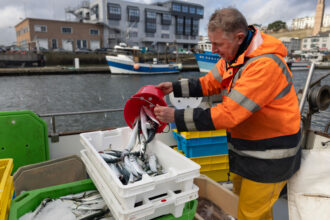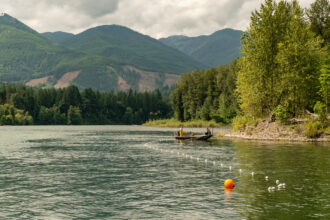


When he stares out from the docks on the Feather River, James Stone—a 46-year-old lifelong fisherman—feels a pang of concern.
Fishing for chinook salmon, also called king salmon, had been called off completely for California’s commercial fishermen since 2023 and nearly as long for recreational anglers. While the fishery is open again this year, and the federal government recently announced emergency funding for those hit hardest by the closure, the consequences of multiple canceled fishing seasons continues to have ripple effects that are hard to fully account for.
“We’re losing marinas. We’re losing tackle stores. We’re losing bait shops. We’re also losing infrastructure out on the ocean at the ports for gas pumps … everything’s going away because salmon is the driver,” Stone, who is based in Yuba City and serves as the board president of the NorCal Guides and Sportsmen’s Association, told Inside Climate News.
Without plentiful chinook salmon to support local fisheries, “people won’t always spend the money for other species or for other recreational activities,” Stone said. “Salmon is what drives the fishing industry.”
Fishing guides and anglers with the association, which has 4,000 members and represents more than 500 businesses, are among many who have been hurting for years as the fish dwindles in California.
Cameron Smith, a commercial fisherman for over 20 years, said people who make their living fishing in California have tried to turn to other species—like Dungeness crab and cod—to make ends meet. But it hasn’t been enough amid skyrocketing fuel costs and high inflation, said the 70-year-old captain based in Benicia.
“They can’t pivot. There’s nothing to pivot to,” Smith said.
Fishers with commercial licenses to catch other species are managing better than others, he said, but just barely.
California’s salmon industry spurs $1.4 billion in economic activity and provides 23,000 jobs in a normal season, according to the Golden State Salmon Association, a nonprofit. The industry also contributes about $700 million to the Oregon economy and supports more than 10,000 jobs there.
On June 17, the National Oceanic and Atmospheric Administration (NOAA) announced $123.6 million in disaster funding for several fishing industries in need of resources. That includes $21.3 million for Sacramento River fall chinook and Klamath River fall chinook ocean and inland salmon fisheries, Michael Milstein, a spokesman for NOAA Fisheries’ West Coast Region, said in an email.
Salmon fisheries in California were allocated close to the same amount, roughly $20 million, in 2024 as part of previous disaster funding.
Most importantly, salmon is once again central to California’s fishing economy after federal managers voted in April to allow the commercial and recreational salmon fishery to resume this year. In 2025, they granted a limited return for recreational fishermen, but Stone said about 95 percent of the recreational inland fishery remained closed in 2025 based on the areas where it was allowed. The first-ever salmon fishing pause in California took place in 2008, with a limited fishing season opening again two years later.
Still, people who rely on California’s salmon for their living continue to face economic stress.
While this year’s revived salmon fishing season in the state has already begun, commercial and recreational fishers are subject to strict limits on the size and number of fish they can catch.
The California Department of Fish and Wildlife (CDFW) warned in this year’s regulatory advisory that it may further reduce the number of fish allowed to be caught or close the fishery on days when it’s currently scheduled to be open if the summer harvest limit is close to being reached.
Decades of Decline
Three years ago, marine biologists and the Pacific Fishery Management Council, which oversees fisheries off the West Coast, cited plummeting fish stocks as the reason to pause salmon fishing.
Some fishermen, however, have warned of declining populations as far back as the 1990s.
A long drought, recently eased by wetter winters, is a principal cause of the most recent decline, the experts report.
But they also have pointed to climate change, river diversions, dams and development as driving down salmon spawning runs over the years. Populations of chinooks, which along with coho are the predominant coldwater salmon species in California, have nose-dived after years of drought that diminish stream levels and impede the fish’s journey upstream to lay eggs.
Additionally, there’s been criticism from some in the fishing industry that during the first Trump administration, more water diversions from the Sacramento River Basin for agricultural uses led to higher river temperatures and lower water levels in waterways that juvenile salmon migrate through to reach the ocean.
Fishermen, including Stone and Smith, said there is ample evidence of fewer landings of salmon over the decades.
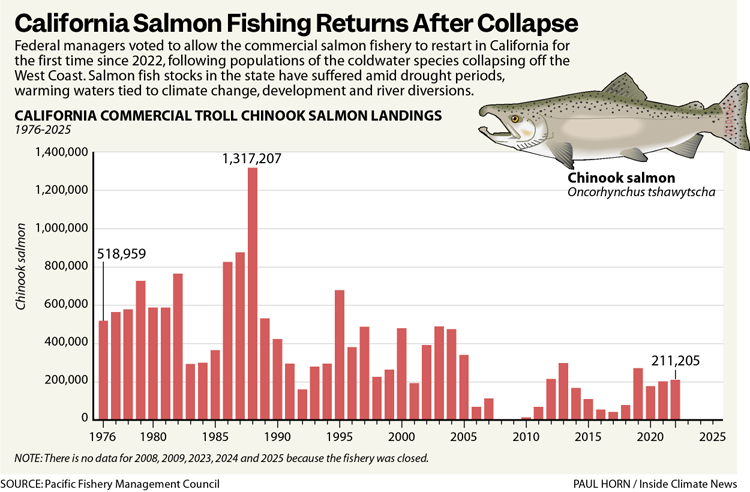
California landings data from the Pacific Fishery Management Council show seasonal commercial trolling catches ranging from 518,000 fish in the mid-1970s to over 765,000 in the early 1980s.
In 2019, the chinook salmon catch was about half the lower end of that range at 271,489 statewide, but the prior three years were much lower—between about 42,000 and 78,000 fish. Experts and fisheries workers also cited low escapement figures—the number of adult salmon that survive despite ocean-based fishing operations to return to the freshwater streams where they spawn.
Much more help is needed to bring the populations back, Stone and Smith argue, including creating additional habitats where chinook salmon can thrive, changing how California and federal leaders manage water resources and increasing funding for fisheries in dire need.
Higher than average temperatures on the West Coast since 2000, and multi-year droughts that drained reservoirs and groundwater supplies have also increased the temperatures of salmon streams, said Nate Mantua, who leads the Southwest Fisheries Science Center’s Landscape and Seascape Ecology Team at NOAA Fisheries.
“The other piece of the climate puzzle is the Pacific Ocean has been warming. We had a period from 2014 to 2016 that is now referred to as the warm ‘Blob’ period, where ocean temperatures along California were at record highs,” Mantua said.
That marked the warmest three-year period in California’s historical record.
Globally averaged ocean surface temperatures in central and southern California also hit record highs earlier in 2026.
“This year we’re in another very warm run of ocean temperatures off California, where our salmon spend most of their life,” Mantua said. “So the warming ocean is putting the squeeze on the suitability of their ocean habitat at the same time that the warming terrestrial [and] watershed areas are putting the squeeze on their freshwater habitat.”
An Upstream Swim With Some Success
Gov. Gavin Newsom has mapped out a series of strategies to protect and restore salmon populations and his administration recently pointed to progress in helping the species recover, including infrastructure removal, salmon tagging and the reintroduction of chinook salmon to certain waterways.
“Historically, salmon populations returning to California rivers were estimated to be in the millions, annually. Current populations are a fraction of that and depend heavily upon hatcheries,” reads an excerpt from the state’s first “California Salmon Strategy For a Hotter, Drier Future” report in 2024.
This story is funded by readers like you.
Our nonprofit newsroom provides award-winning climate coverage free of charge and advertising. We rely on donations from readers like you to keep going. Please donate now to support our work.
Donate NowA notable example of recent steps: 42 adult spring-run chinook were produced at the Feather River Hatchery by fishery managers and partners, and reintroduced in the North Fork Yuba River.
Despite the impending threats the paltry populations face, there has been other good news for salmon.
After a large number of fall-run salmon moved up the Klamath River following four dam removals in 2024, the Oregon Department of Fish and Wildlife reported a spring-run chinook salmon going up the river in Oregon past the former dam sites. Those salmon migrate earlier in the year and typically face greater hardships, such as drier conditions, that lower their survival rates compared to salmon that run in the fall.
“It was a tough three years, but things are definitely looking up,” Jared Davis, of the Golden Gate Fishermen’s Association, said over the phone Wednesday from the “Salty Lady,” his recreational fishing boat, a few miles out from San Francisco’s Golden Gate Bridge.
The previous day, 17 people on the boat caught 34 chinook salmon—the current limit—and called it a day early, Davis said. A day before that, another group of 17 caught a collective five salmon for the whole trip.
“Every day is different. That’s why they call it fishing instead of catching,” said Davis.
The 56-year-old, who has seen the decline of chinook salmon, is trying to be optimistic regarding efforts by the state—including expanding hatchery programs—he hopes will prove successful.
“It’s a pretty cool new thing they’re doing, it’s called parental-based tagging,” he said.
Instead of using physical tags, scientists collect DNA samples from hatchery salmon during spawning, which allows researchers to build a database of parent fish and identify nearly all of their offspring that are caught by fishermen or return to spawn. They’d know the origin point of the fish, too.
“That allows them to raise more fish through the hatchery programs,” Davis said.
Salmon Resilience Requires More Diversity and Funding
Salmon aren’t just important for human harvests.
Other species such as bears and eagles rely on abundant salmon runs, and the fish have been documented to improve inland environments by pushing marine nutrients to the headwaters of rivers that would otherwise have low productivity.
In addition to highlighting the importance of salmon to fishery businesses, Meghan Hertel, director of the California Department of Fish and Wildlife, called salmon “the lifeblood of tribal cultural heritage and nutrition” and “the backbone of river ecosystems.”
For California’s salmon recovery to continue, Steve Lindley, an oceanographer and fish ecologist at the University of California, Santa Cruz, and a former director of NOAA’s Fisheries Ecology Division, said it will be important to think of how salmon are raised and where they live.
“I think a key to rebuilding the resilience of the fisheries so it’s not so subject to these booms and busts—especially the busts—is increasing the diversity within salmon themselves, “ Lindley said.
“Right now, most of them are coming from a hatchery,” he said. “They have a very particular life history with that. They tend to be released at the same time of year at a very similar size, and that can work well when the environment lines up for that. But when it doesn’t, the system fails.”
In announcing the new $21.3 million allocation for California salmon fisheries, Neil Jacobs, the NOAA administrator, said federal scientists will keep working with communities that are trying to recover from fishery collapses.
Jacobs pointed to the “devastating effects” that fishery disasters—including the loss of chinook salmon in California and the crumpling Bering Sea snow crab industry in Alaska—have on local communities and the economy.
Asked about additional future funds for California, Milstein, the NOAA spokesman, said it is always possible Congress could approve additional funding in the future. However, “that may be more likely to come in the form of allocations for additional disaster declarations,” he said in an email.
The latest funds for California fisheries will be distributed after spending plans are submitted and reviewed, according to NOAA and a spokesman for the Pacific States Marine Fisheries Commission.
James Stone doesn’t think the latest round of disaster money is enough.
The fisherman did the math over how the $20 million—the money allocated two years ago—ultimately benefited each of the 119 businesses under his purview at the NorCal Guides and Sportsmen’s Association that qualified for funds.
“Most of my businesses were losing $50,000 to $100,000 and they were only given anywhere from 2 to 10 grand each,” Stone said.
For the commercial processors, charter boats and inland guides that make up California’s salmon fisheries, he said, “that number should have been closer to $50 million.”
About This Story
Perhaps you noticed: This story, like all the news we publish, is free to read. That’s because Inside Climate News is a 501c3 nonprofit organization. We do not charge a subscription fee, lock our news behind a paywall, or clutter our website with ads. We make our news on climate and the environment freely available to you and anyone who wants it.
That’s not all. We also share our news for free with scores of other media organizations around the country. Many of them can’t afford to do environmental journalism of their own. We’ve built bureaus from coast to coast to report local stories, collaborate with local newsrooms and co-publish articles so that this vital work is shared as widely as possible.
Two of us launched ICN in 2007. Six years later we earned a Pulitzer Prize for National Reporting, and now we run the oldest and largest dedicated climate newsroom in the nation. We tell the story in all its complexity. We hold polluters accountable. We expose environmental injustice. We debunk misinformation. We scrutinize solutions and inspire action.
Donations from readers like you fund every aspect of what we do. If you don’t already, will you support our ongoing work, our reporting on the biggest crisis facing our planet, and help us reach even more readers in more places?
Please take a moment to make a tax-deductible donation. Every one of them makes a difference.
Thank you,

Steven Rodas
Reporter, California
Steven Rodas covers water, wildfires and agriculture throughout California for Inside Climate News. Based in Los Angeles, he previously reported on the environment in New Jersey, covering energy, pollution, wildlife and development. Steven’s work has appeared in the San Francisco Chronicle, NJ.com/The Star Ledger and Grist. He worked as a copywriter at Google. Steven has a master’s degree from Syracuse University’s S.I. Newhouse School Of Public Communications. He is fluent in English and Spanish (and welcomes your tips).