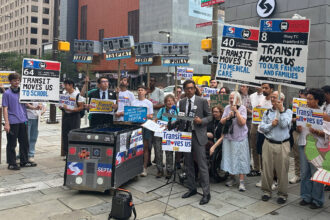
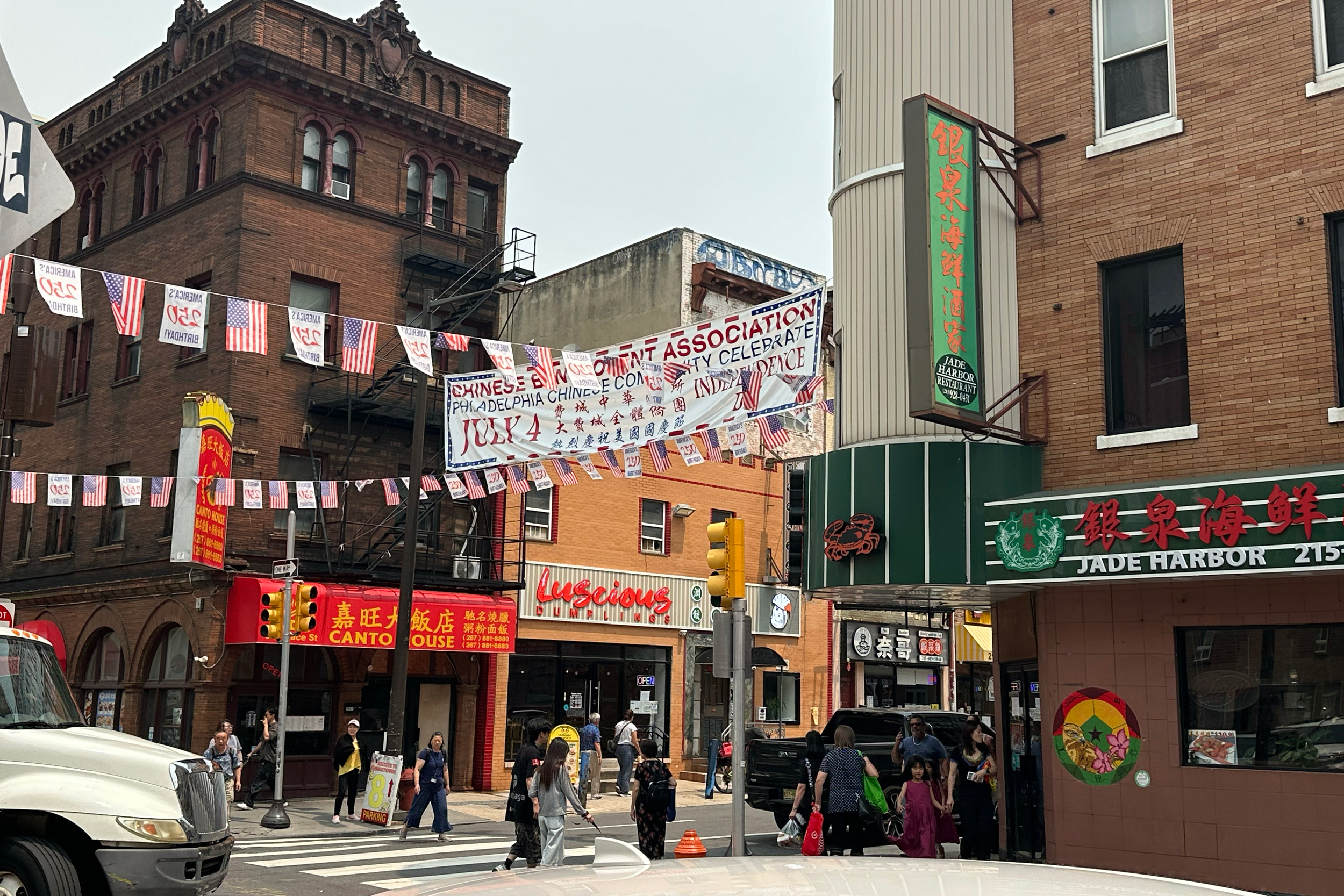


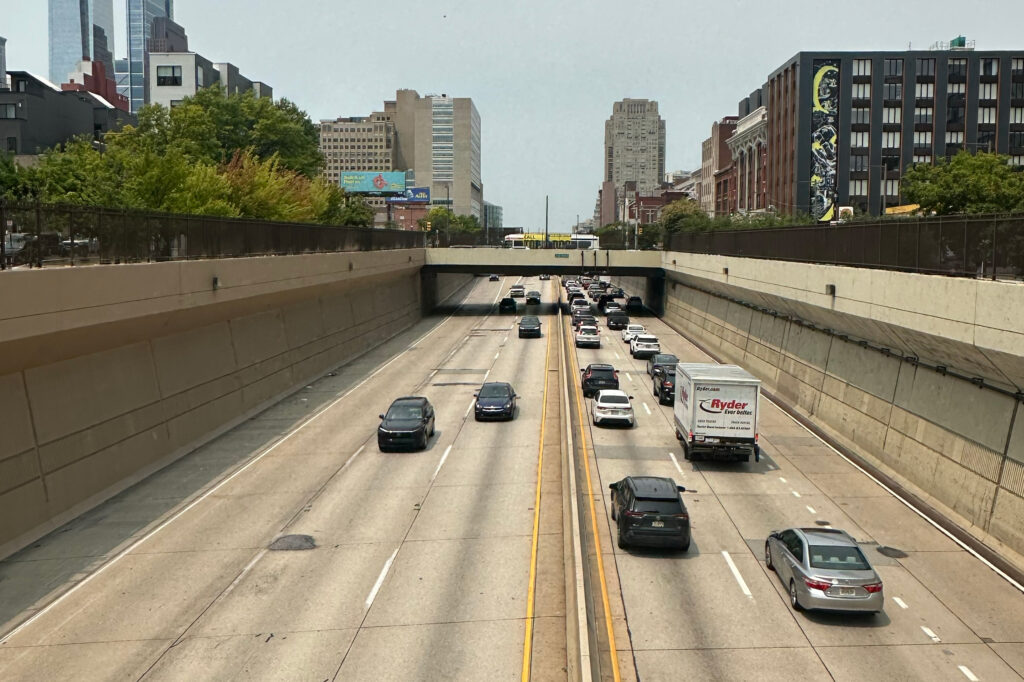
PHILADELPHIA—On a hot July day, workers in Philadelphia’s Chinatown unloaded boxes and ran errands on small sidewalks and tight streets crowded with small businesses and an almost constant flow of people. Cutting its northern blocks off from its commercial core, however, is the Vine Street Expressway, which created a six-lane, sunken trench through the neighborhood when it was extended to meet the Ben Franklin Bridge in 1991.
Community leaders long organized against the extension, citing the brutal implications for Chinatown’s future. Today, more than 100,000 vehicles use the expressway (I-676) every day, bringing pollution and noise with them, and the highway’s acres of cement intensify hot temperatures and limit mobility and public space in the neighborhood.
When the Bipartisan Infrastructure Law offered money to repair the harm of earlier built environment decisions in 2021, the Philadelphia Chinatown Development Corp. (PCDC)—a neighborhood advocacy group—saw a chance to tackle those issues with one project. The group collaborated with the city and state and received two grants together worth over $160 million in 2022 and 2024 to construct the Chinatown Stitch, a cap over two-and-a-half blocks of the expressway and a street-level park on top.
But in 2025, congressional Republicans rescinded all but $8 million of the project’s funding. Scrambling, local leaders made their case to the Delaware Valley Regional Planning Commission and the city of Philadelphia to keep it alive. They succeeded in securing some funding from those sources, but they’ll need the federal government’s support to move forward.
Advocates are now eyeing an upcoming legislative battle in Congress to bring back the full funds and construct the cap—a tall task in today’s political climate, but one that might garner bipartisan support.
“The Trump administration may have ripped away funding for the Chinatown Stitch, but this fight isn’t over yet,” Rep. Brendan Boyle, a Democrat who represents Chinatown in Congress, wrote in a statement.
If the project is never completed, the benefits it would bring to the community would also disappear.
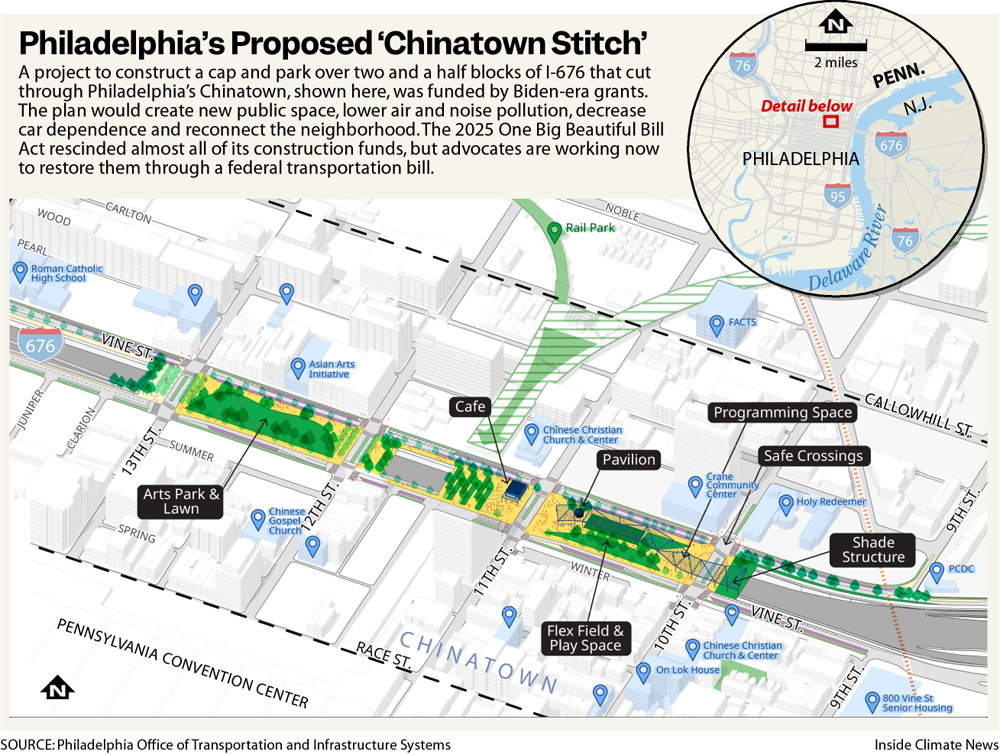
Landscape architecture firm OJB, hired for the planning process, said it would use specific plantings and design to absorb carbon emissions and reduce Chinatown’s urban heat island effect, an increasing problem in Philadelphia as climate change drives temperatures higher.
Russell Zerbo, an advocate with the Philadelphia-based Clean Air Council, emphasized the way that heat intensifies the effects of carbon pollution. Along with improving modes of transportation that get people out of their cars, the Stitch was “extremely necessary to try to add some much-needed green space to the area,” Zerbo said.
Sony Devabhaktuni, an architect and assistant professor of art at Swarthmore College, connected the Stitch to other infrastructure transitions around the country, saying it would do at a small scale what cities like Boston and Rochester have proven are “effective urban and environmental solutions” that rethink the role of highways in cities.
“What makes these projects ‘sustainable’ is the potential of using reclaimed highways to give residents more open space, and most importantly, to connect neighborhoods that were divided,” he wrote in an email.
The Vine Street Expressway is just one example of the kind of problematic 20th-century transportation infrastructure projects that the Biden grants sought to remedy: Decades ago, highways were built right through neighborhoods in cities from New Orleans to St. Paul, Minnesota, often devastating minority communities.
In February 2022, the Chinatown Stitch received $1.8 million from the Bipartisan Infrastructure Law’s Reconnecting Communities Pilot program, which it used to begin planning and community outreach. Two years later, $158.9 million from the Inflation Reduction Act promised to get the project over the finish line.
The very next year, however, the Trump-backed One Big Beautiful Bill Act undid many Biden-era environmental programs, including this one. The law rescinded all but $8 million of the project’s funding. In a statement at the time, Rep. Sam Graves of Missouri, the Republican chairman of the House Transportation and Infrastructure Committee, said the infrastructure equity grants were one of seven “unnecessary Green New Deal style programs” that were cut to pay for more border security and modernize air traffic control systems.
Christopher Puchalsky, director of policy and strategic initiatives at Philadelphia’s Office of Transportation and Infrastructure Systems, said in an interview that projects typically must reach certain stages of the timeline before they can obligate larger chunks of dollars.
“What is unusual is to have the money rescinded,” Puchalsky said, saying this was the first time he or his colleagues had seen it happen at this stage.
While such a setback could have pushed the Stitch’s leaders to pull the plug, they instead rallied to keep it on life support. Earlier this year, the Delaware Valley Regional Planning Commission awarded $10 million in tandem with $2.5 million from the city of Philadelphia to get the project “shovel-ready.”
Mark Squilla, who represents Chinatown on Philadelphia’s City Council while also serving as secretary of the regional planning commission, thanked his fellow board members for recognizing the importance of the project. “I’ve got to give credit to our surrounding counties, because they were willing to listen and then support this extra funding for a Philadelphia-specific project,” he said.
This story is funded by readers like you.
Our nonprofit newsroom provides award-winning climate coverage free of charge and advertising. We rely on donations from readers like you to keep going. Please donate now to support our work.
Donate NowThe emergency $12.5 million sets two processes in motion. One is to complete all the planning that needs to happen before construction. The other aims to get new construction funding from Washington—likely the only funding source available for a project this large.
Squilla, along with Boyle and state Sen. Nikil Saval, who represents Chinatown, struck an optimistic tone, emphasizing that lawmakers will be far more likely to fund a project that’s ready to begin construction.
In the budget for fiscal year 2026, Congress restored $30 million in funding for recipients of large Reconnecting Communities grants that had been rescinded. Puchalsky said the Stitch could access a portion of these dollars to fund the engineering process, but it won’t be nearly enough to construct the Stitch. Instead, advocates are hoping an ongoing legislative process to reauthorize the country’s five-year surface transportation bill could renew funding for the Stitch.
The BUILD America 250 Act, which passed out of the House Transportation and Infrastructure Committee in May, didn’t include funding for the Stitch or similar projects. Squeezing the funds into the law while Republicans hold a trifecta in Washington will be challenging.
Because the reauthorization process takes place only every five years, however, it’s a crucial opportunity to fund lawmakers’ individual infrastructure priorities, often forcing more compromises from both parties. Squilla said he’d heard positive feedback from both of Pennsylvania’s senators, who belong to different parties, and the project’s advocates think the economic benefits of improved infrastructure could convince even skeptical Republicans.
“I believe there are enough Republicans and Democrats who agree that our cities deserve infrastructure that heals communities torn apart by shortsighted decisions,” Boyle said.
While Puchalsky couldn’t reveal exactly how the team would lobby Congress for the money, he said the effort could include coalition building with other Reconnecting Communities projects and with national partner organizations. The nature of messy reauthorization fights means that the key is convincing members of the House’s infrastructure committee and the Senate’s Environment and Public Works Committee.
“Our goal is to set it up where it’s a no-brainer; to make it so that when somebody looks at this, to be able to say that if you’re going to support a project, this would be the highest priority project to support,” Squilla said.
The current surface transportation bill will expire Sept. 30, leaving very little in-session time to pass a new one before transportation agencies run out of dollars. While the BUILD America 250 Act was a potential preview of the final legislation, it has yet to pass either the full House or Senate. It’s likely that Congress will use a continuing resolution to buy more time, and with the midterm elections only five weeks after the expiration, it’s also likely the project would face different political circumstances in the new year.
Saval said the possibility of the project’s restoration was “a good reason for people to support changes to our Congress.”
All of the project’s supporters see in the Stitch an opportunity to correct past mistakes and improve Chinatown. “By greening and reimagining that space and making it … better connect, it would really bring that community something that was taken away from them years ago,” Squilla said.
About This Story
Perhaps you noticed: This story, like all the news we publish, is free to read. That’s because Inside Climate News is a 501c3 nonprofit organization. We do not charge a subscription fee, lock our news behind a paywall, or clutter our website with ads. We make our news on climate and the environment freely available to you and anyone who wants it.
That’s not all. We also share our news for free with scores of other media organizations around the country. Many of them can’t afford to do environmental journalism of their own. We’ve built bureaus from coast to coast to report local stories, collaborate with local newsrooms and co-publish articles so that this vital work is shared as widely as possible.
Two of us launched ICN in 2007. Six years later we earned a Pulitzer Prize for National Reporting, and now we run the oldest and largest dedicated climate newsroom in the nation. We tell the story in all its complexity. We hold polluters accountable. We expose environmental injustice. We debunk misinformation. We scrutinize solutions and inspire action.
Donations from readers like you fund every aspect of what we do. If you don’t already, will you support our ongoing work, our reporting on the biggest crisis facing our planet, and help us reach even more readers in more places?
Please take a moment to make a tax-deductible donation. Every one of them makes a difference.
Thank you,

Daniel Perrin
Fellow
Daniel Perrin is a Philadelphia-based fellow at Inside Climate News, covering urban environmental issues. He is a rising senior at Swarthmore College, where he studies economics, literature, and history. He just finished serving as Editor-in-Chief of The Swarthmore Phoenix, overseeing the campus paper and reporting on trends within higher education, economic policy, sustainability, transportation, and governance at all levels. Having grown up in Chapel Hill, NC, before moving to Baltimore, he is especially interested in how large political and economic developments ripple through the built environment of local communities.