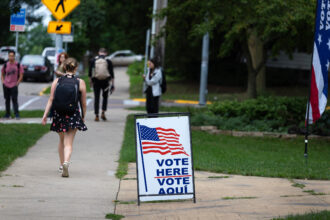


The so-called “lame duck” session of Congress after November’s midterm elections could be momentous for clean energy as lawmakers are set to consider a long-sought bipartisan deal to speed permitting of large energy and infrastructure projects.
Clean energy advocates and policy experts view the bill as a rare opportunity to deal with a major clean energy roadblock—long queues for interconnection to the grid. But division emerged immediately among environmental advocates, with some arguing the measure would weaken state and tribal government authority and allow pipelines and other fossil fuel projects to take advantage of a streamlined process.
This tension is not unusual. A version of it happened during debate over what would become the 2021 Infrastructure Investment and Jobs Act, also known as the Bipartisan Infrastructure Law, and the Inflation Reduction Act in 2022 under President Joe Biden.
“These policy bills have to get 60 Senate votes, so they have to be bipartisan, and so necessarily you’re going to be in a situation [in which there are] things that members like and things they don’t like,” said Rob Gramlich, president of Grid Strategies, a consulting firm that specializes in federal energy issues. The 60-vote threshold in the Senate is the number needed to overcome either party’s ability to block legislation with a filibuster.
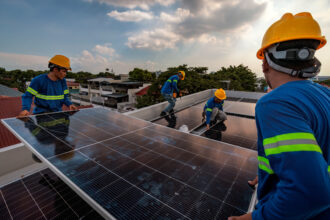
Gramlich considers the bill a big step forward for renewable energy because of technology-neutral provisions that would “enable many tens of gigawatts of clean energy to be connected that otherwise are unable to develop,” he said.
Also supporting the bill is Pete Wyckoff, vice president of policy for Evergreen Action, an environmental advocacy group. He also played a key role in developing the Inflation Reduction Act when he worked for Sen. Tina Smith, D-Minn.
“America can’t confront the climate crisis and meet growing energy demand unless we can build clean energy faster—and that means fixing how we permit it,” Wyckoff said in a statement.
Some of the Senate’s most vocal members on climate change co-wrote the measure.
“If we can pass this bill, we will flood the grid with clean, affordable energy and make data centers start paying their fair share,” Sen. Sheldon Whitehouse, D-R.I., ranking member of the Senate Environment and Public Works Committee, said in a statement. “Like all major pieces of bipartisan legislation, this bill is a compromise. We believe it is a compromise that will result in a brighter, cleaner, more affordable future.”
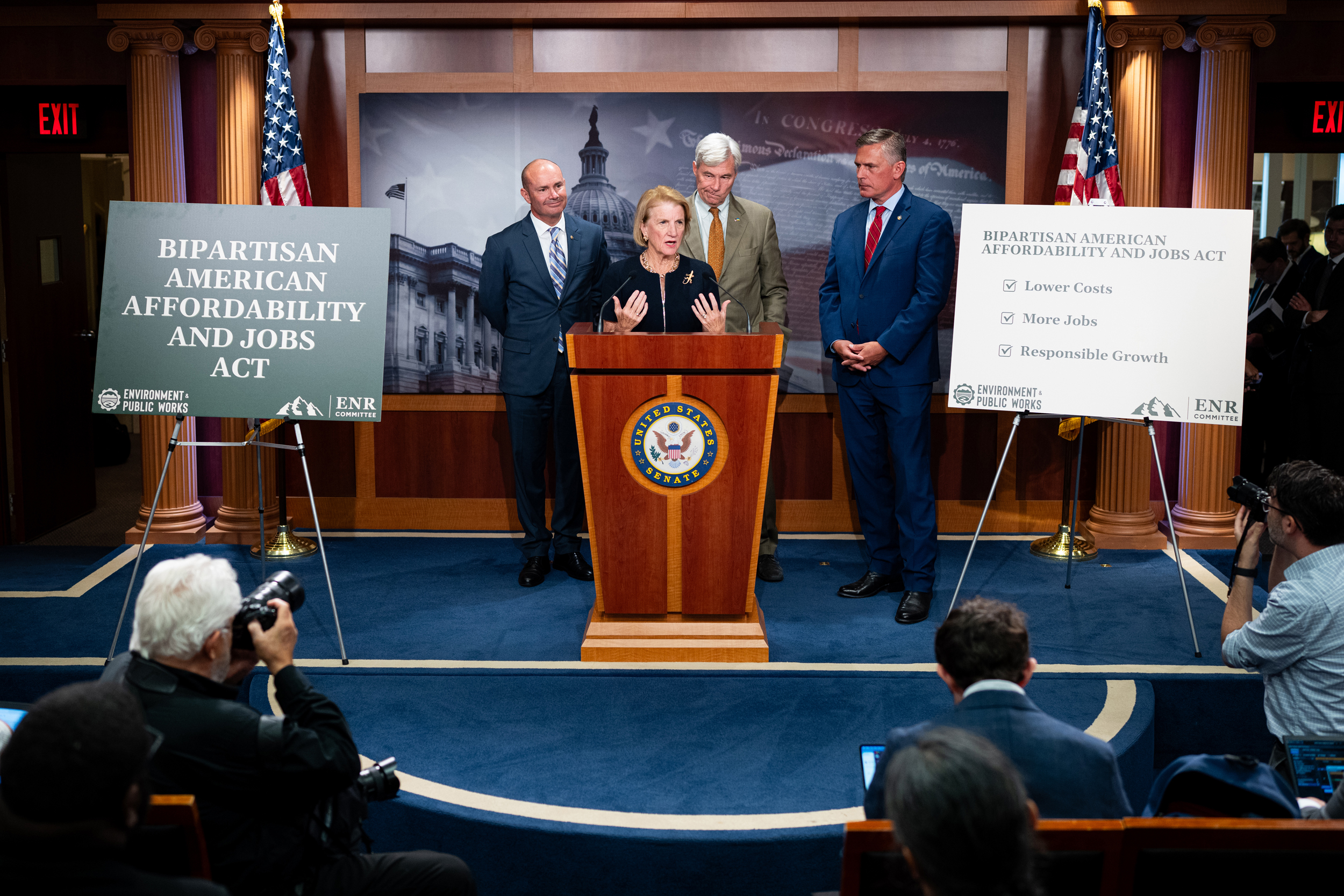
Whitehouse and the bill’s other co-authors are calling it the Bipartisan American Affordability and Jobs Act of 2026.
Committee Chair Shelley Moore Capito, R-W.Va., maintained that the bill would continue to protect land, water and wildlife while transforming the nation’s ability to fuel future growth. “For far too long, our broken and outdated federal environmental review and permitting processes have stood in the way of energy reliability, secure jobs, modern infrastructure, and economic growth,” Capito said in a statement.
A Post-Election Vote Plan
After months of working to hammer out their permitting compromise, Capito, Whitehouse and their partners on the deal—Senate Energy Committee leaders Sen. Mike Lee, R-Utah, and Sen. Martin Heinrich, D-N.M.—made clear they had run out of time to get the package to a vote before the midterm election.
That kicks the legislation to the final weeks of the 119th Congress, and possibly—depending on the November results—the last session of unified Republican control.
This creates some political peril for the package, clean energy lobbyist Chris Moyer, founder of Echo Communications Advisors, pointed out in a newsletter to his clients. “The question for the lame duck, especially with House Democrats, is whether we experience a repeat of the familiar cycle,” Moyer wrote. “The party on the verge of taking power holds out until the new Congress to get a ‘better’ bill.”
This story is funded by readers like you.
Our nonprofit newsroom provides award-winning climate coverage free of charge and advertising. We rely on donations from readers like you to keep going. Please donate now to support our work.
Donate NowMoyer noted that Rep. Jared Huffman, D-Calif., ranking Democrat on the House Natural Resources Committee, expressed exactly this sentiment in a post on X. “We can’t throw states, tribes, impacted communities, and threatened and endangered wildlife under the bus,” said Huffman, who pledged to work for a better bill in the next Congress.
But history has shown lame-duck sessions can forge compromises that wouldn’t be possible in regular sessions of Congress, in part because departing members will not face repercussions from voters. Among the historic environmental measures that passed Congress during lame-duck sessions were the Superfund toxic waste clean-up bill in 1980 and the establishment of the Occupational Safety and Health Administration in 1970.
The Challenge in the Senate
The most significant challenge the legislation faces may be securing enough Democratic votes in the Senate in the face of opposition from some environmentalists. Even before the text of the legislation was released, the Western Environmental Law Center released a statement labeling the deal a “five-alarm fire” that would allow artificial intelligence data centers and energy infrastructure to proliferate. Among the changes the legislation would make is limiting state and tribal officials from using their authority under the Clean Water Act to address issues unrelated to direct water pollution; the Trump administration proposed a similar regulatory change earlier this year.
“The permitting deal is a betrayal of public lands, water and wildlife, and environmental justice values that Westerners depend on for clean air and water, places to hike, hunt, and fish, and the inestimable sense of freedom the West provides us all,” said Erik Schlenker-Goodrich, executive director of the center.
At the unveiling of the legislation, Heinrich pointed to a provision in the bill that would require AI data centers to fully pay for grid upgrades made to serve them, even as they continue to bear their share of the costs of the rest of the power grid. If passed, it would be the first act of Congress to protect consumers from paying an unfair burden of the energy costs of data center proliferation.
By far, the most consequential provisions in the legislation for clean energy and climate change are those to speed up the process of siting transmission projects and getting clean energy on the grid. The 550-mile SunZia Wind and Transmission project, which came online this year between New Mexico and Arizona, took nearly 18 years to make its way through the permitting process. At that pace, clean energy advocates argue it will be nearly impossible for solar and wind power, as well as emerging low-carbon technologies like enhanced geothermal, to significantly reduce the nation’s dependence on fossil fuels.
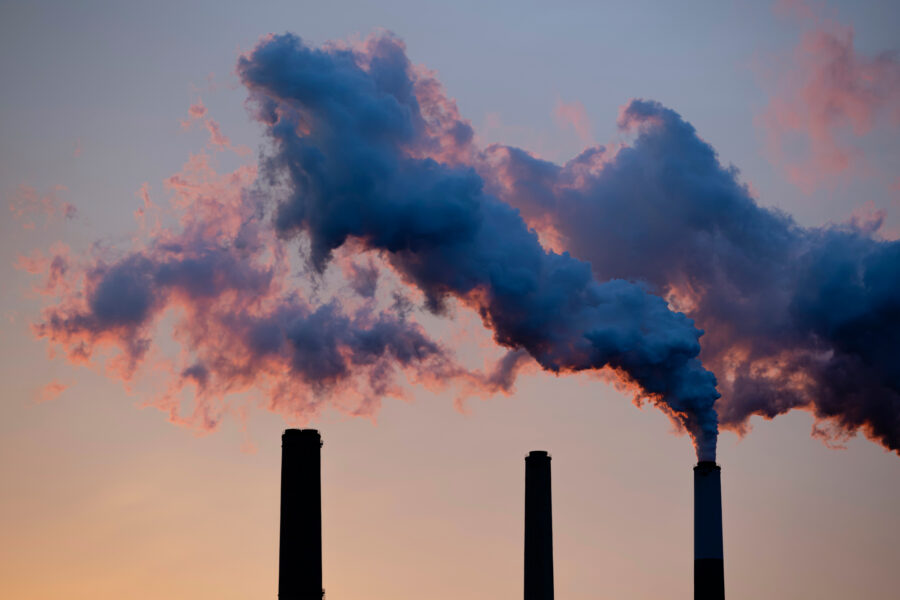
New modeling by the Center for Climate and Energy Solutions, or C2ES, and Greenline Insights indicated that the bill’s reforms would produce enough new clean energy to reduce carbon dioxide emissions by 9 percent in the four regional power grids they studied. The analysis showed that nationwide, the reforms could also reduce cumulative grid costs by $125 billion and residential electricity bills by $19 billion between 2026 and 2040.
“We think if you can reform that process, if you can provide a level playing field, the economics of clean energy will win out,” said Nat Keohane, president of C2ES. “We’re on the cusp of a moment I think that we and many others have been working toward for years.”
About This Story
Perhaps you noticed: This story, like all the news we publish, is free to read. That’s because Inside Climate News is a 501c3 nonprofit organization. We do not charge a subscription fee, lock our news behind a paywall, or clutter our website with ads. We make our news on climate and the environment freely available to you and anyone who wants it.
That’s not all. We also share our news for free with scores of other media organizations around the country. Many of them can’t afford to do environmental journalism of their own. We’ve built bureaus from coast to coast to report local stories, collaborate with local newsrooms and co-publish articles so that this vital work is shared as widely as possible.
Two of us launched ICN in 2007. Six years later we earned a Pulitzer Prize for National Reporting, and now we run the oldest and largest dedicated climate newsroom in the nation. We tell the story in all its complexity. We hold polluters accountable. We expose environmental injustice. We debunk misinformation. We scrutinize solutions and inspire action.
Donations from readers like you fund every aspect of what we do. If you don’t already, will you support our ongoing work, our reporting on the biggest crisis facing our planet, and help us reach even more readers in more places?
Please take a moment to make a tax-deductible donation. Every one of them makes a difference.
Thank you,

Marianne Lavelle
Bureau Chief, Washington, D.C.
Marianne Lavelle is the Washington, D.C. bureau chief for Inside Climate News. She has covered environment, science, law, and business in Washington, D.C. for more than two decades. She has won the Polk Award, the Investigative Editors and Reporters Award, and numerous other honors. Lavelle spent four years as online energy news editor and writer at National Geographic. She spearheaded a project on climate lobbying for the nonprofit journalism organization, the Center for Public Integrity. She also has worked at U.S. News and World Report magazine and The National Law Journal. While there, she led the award-winning 1992 investigation, “Unequal Protection,” on the disparity in environmental law enforcement against polluters in minority and white communities. Lavelle received her master’s degree from Columbia University Graduate School of Journalism, and is a graduate of Villanova University.

Dan Gearino
Reporter, Clean Energy
Dan Gearino covers the business and policy of renewable energy and utilities, often with an emphasis on the midwestern United States. He is the main author of ICN’s Inside Clean Energy newsletter. He came to ICN in 2018 after a nine-year tenure at The Columbus Dispatch, where he covered the business of energy. Before that, he covered politics and business in Iowa and in New Hampshire. He grew up in Warren County, Iowa, just south of Des Moines, and lives in Columbus, Ohio.