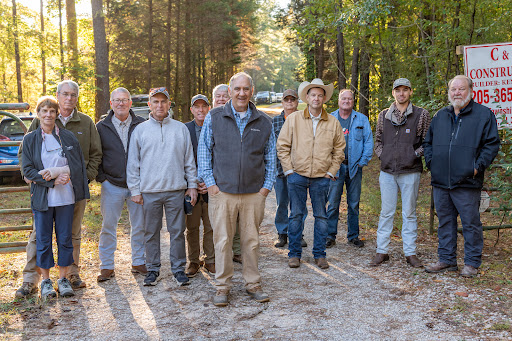


CALERA, Ala.—Fenn Church knew what he had to do.
“I’m going to stand in front of that gate and say, ‘This is my home, and I’m not letting you drive through that gate,’” Church said on Thursday morning. “And then if they want to arrest me, they can handcuff me and take me to jail or run me over. But this is where I take my stand.”
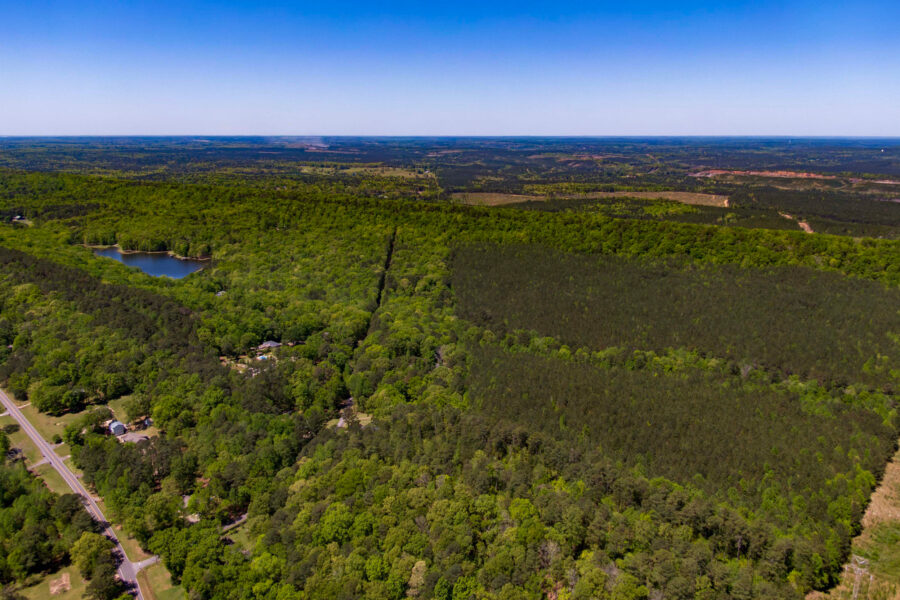
For months, Church had fought Alabama Power’s effort to use eminent domain to secure access to his property in Alabama’s lower courts, arguing that the utility could easily use alternative routes to build a transmission line that would not be as disruptive to homeowners like himself in rural Shelby County, about a 45-minute drive south of Birmingham.
In September, that legal battle resulted in a victory for Church when Circuit Court Judge Jonathan Spann issued a temporary injunction preventing Alabama Power from accessing Church’s property. In his ruling, Spann found that Alabama Power, one of the state’s most powerful companies, had failed to follow the necessary procedures for condemnation of Church’s land outlined in state law.
Church was likely to succeed on the merits of his case, and without a preliminary injunction, he would be irreparably harmed, the judge wrote.
Spann also noted that an Alabama Power employee had testified in court that the route for the planned transmission line crossing Church’s property had been finalized with “no consideration” to zoning plans or the “development potential or suitability” of properties it would cross.
That unrebutted testimony made it likely that Church would be able to prove that Alabama Power’s siting of the transmission line was illegally arbitrary and capricious, Spann ruled.
Church’s victory would be short-lived. On Wednesday, in a 5-1 ruling, the Alabama Supreme Court issued an order granting Alabama Power’s motion to stay Spann’s injunction against it. The state’s highest court did not provide reasons for its decision.
“Alabama Power understands that property is personal, and we remain committed to treating property owners fairly and respectfully,” the electric utility said in a statement after the state Supreme Court ruling. “The Alabama Supreme Court’s decision allows work on this section of the transmission line to move forward, supporting a project that is an important investment in the security and reliability of the electric grid for the customers and communities we serve.”
Desperate in the wake of the high court decision, Church called his federal lawmakers—Sens. Katie Britt and Tommy Tuberville and Rep. Barry Moore. He didn’t hear back.
John Rich, a country music star and a Trump-appointed, so-called Special Envoy for American Homeowners, had also pledged support for Church’s cause.
“We can build out our energy infrastructure and treat landowners with respect simultaneously, and that’s what I intend on doing in this case,” Rich had initially said publicly. “About 200 yards away, there’s a wide open, clear-cut path that doesn’t involve driving bulldozers and trucks and 18-wheelers for the rest of eternity through this man’s property, right through his front driveway.”
But it wasn’t long before Church said he felt that Rich was hitting a roadblock somewhere in the administration.
“Somebody must’ve got to Trump and told him to back down,” Church said.
Hours after the Supreme Court ruling against Church on Wednesday afternoon, representatives of Alabama Power notified Church’s lawyers that its crews would arrive at the property between 7 and 8 a.m. to begin the work to which he’d long objected.
With few options left, and on Rich’s advice, Church turned to social media, calling on supporters to show up the next day.
“Tree cutting crews are coming to my front gate in the morning,” he posted. “Appreciate any support that anyone can give me standing at my gate in the morning!”
Within hours, the post had been viewed more than 100,000 times on the social media platform, eliciting dozens of comments from across the country.
Rep. Phillip Ensler, a Democrat running to become the state’s lieutenant governor, showed up Thursday morning to stand alongside Church. It wasn’t the first time he’d visited Church’s property in solidarity—the only public official to do so, according to Church.
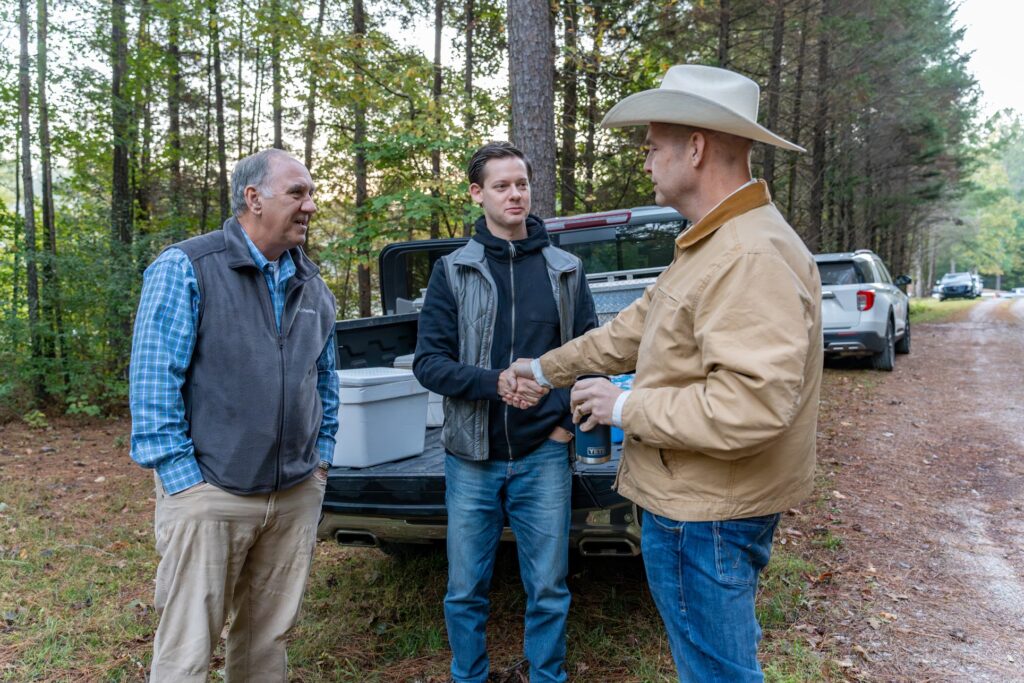
“Alabama Power thinks they can just walk over anyone and everyone,” Ensler said. “They’re just trying to flex their muscles and intimidate people, and if they can do that to him and do it here, they can do it anywhere.”
Ensler and Church talked more as the nippy morning began to slowly warm. One by one, cars and pickup trucks rolled up Church’s driveway. Whenever the hum of an engine could be heard coming down Township Road toward Church’s front gate, the group would crane their necks toward the gravel entrance.
Each time, one of the men, this time Church himself, would approach the vehicle stopped just outside the gate.
“Hey there,” Church said, a smile stretched across his face. The driver of the truck rolled down his window.
“You’re not here to cut down my trees are you?” Church asked.
The man in the truck laughed. “No. I’m here to help you stop them if I can,” the driver said.
Church waved the man through, instructing him to park wherever he’d like and make sure he grabbed himself a Hardee’s biscuit. Soon, Church and the newcomer would rejoin the growing group ready to resist Alabama Power, and the wait would continue.
The Alabama Power trucks never came.
Instead, close to 8 a.m., Church and others looked to the sky. A faint buzz overhead had drawn their attention. Just above the towering pines, a drone strafed into view, pausing briefly around a hundred feet above Church’s driveway before flying away.
“I wonder if they liked what they saw,” one man said. Church and the others laughed.
A couple hours later, cameras on the southern side of Church’s property showed crews surveying and marking trees, having accessed the property via another route.
“It was sneaky,” Church said of the move. “They knew we were here, so they snuck around back. It’s just a dirty way of doing business.”
Alabama Power did not respond to multiple requests for comment.
But now, Church said he knows the power company’s playbook. He’s got one, too.
Alabama Power’s crews are gone for now, but Church knows they’ll be back. And while he may not be able to keep them off his land forever, he’s certainly going to try.
“If I catch them trying to come onto my property, I’ll get on the phone and get everybody back up here,” Church said. “We’ve got no choice.”
About This Story
Perhaps you noticed: This story, like all the news we publish, is free to read. That’s because Inside Climate News is a 501c3 nonprofit organization. We do not charge a subscription fee, lock our news behind a paywall, or clutter our website with ads. We make our news on climate and the environment freely available to you and anyone who wants it.
That’s not all. We also share our news for free with scores of other media organizations around the country. Many of them can’t afford to do environmental journalism of their own. We’ve built bureaus from coast to coast to report local stories, collaborate with local newsrooms and co-publish articles so that this vital work is shared as widely as possible.
Two of us launched ICN in 2007. Six years later we earned a Pulitzer Prize for National Reporting, and now we run the oldest and largest dedicated climate newsroom in the nation. We tell the story in all its complexity. We hold polluters accountable. We expose environmental injustice. We debunk misinformation. We scrutinize solutions and inspire action.
Donations from readers like you fund every aspect of what we do. If you don’t already, will you support our ongoing work, our reporting on the biggest crisis facing our planet, and help us reach even more readers in more places?
Please take a moment to make a tax-deductible donation. Every one of them makes a difference.
Thank you,

Lee Hedgepeth
Reporter, Alabama
Lee Hedgepeth is Inside Climate News’ Alabama reporter. Raised in Grand Bay, Alabama, a small town on the Gulf Coast, Lee holds master’s degrees in community journalism and political development from the University of Alabama and Tulane University. Lee is the founder of Tread, a newsletter of Southern journalism, and has also worked for news outlets across Alabama, including CBS 42, Alabama Political Reporter and the Anniston Star. His reporting has focused on issues impacting members of marginalized groups, including homelessness, poverty, and the death penalty. His award-winning journalism has appeared in publications across the country and has been cited by the New York Times, the Wall Street Journal and the Washington Post, among others.