

Second of two stories about the effort to support Lahaina fire survivors’ health in the long, hard aftermath. Read the first story, about the Maui Wildfire Exposure Study, here.
LAHAINA, Hawaiʻi—As Mikey Burke walked into her acupuncture appointment on a Wednesday morning in May, she felt the energy shift, just as she always does.
Noelani Ahia, 51, an acupuncturist and Hawaiian healer, greeted Burke, 42, with a smile and a hug, and led her away from the sunlit, open-air courtyard of the Lahaina Comprehensive Health Center and into a dark room, walled in with dividers and empty except for a single bed, a chair and a few small tables. As they settled in, they spoke about Lahaina.
Burke, a mother of four, has been going to the local health center since her home burned down three years ago in the deadliest U.S. wildfires in more than a century. Sometimes, it feels like these appointments are the only time she can truly breathe.
“I don’t think people realize how hard a time people are still having,” said Ahia, who directs Maui Medic Healers Hui, a community organization that operates out of the state-run center. “Pretty much no one is fine.”
“And we’re almost worse off now than we were right after the fires,” Burke replied.
“Can you say a little bit more about that,” Ahia asked, softly.
Burke’s appointment was one day before a construction crew would pour the cement foundation of her family’s future home, and the same week that the Maui Wildfire Exposure Study might be shutting down for good.
As she started to speak, Burke fought back tears.
“The fire was a point in time,” she began, her voice breaking as she laid out a chronology that disaster survivors know all too well.
In the immediate aftermath, the first, most acute trauma was that everything was gone, she explained. But now there’s a slower, unrelenting ordeal of all that has fallen apart since.
It’s not just about the destruction of her family’s house, which she’d fought for years to find and secure. It’s her family’s mental health, the loss of friends and neighbors who were priced out and moved away, the fights to address water access, regain local control of land rights, advocate for her children’s Hawaiian immersion school and protect her people’s ability to be Hawaiian in this place that has been taken over by colonizers and corporate interests again and again. She and her neighbors have to be strong for every battle. Everything feels too important; nothing can fall through the cracks.
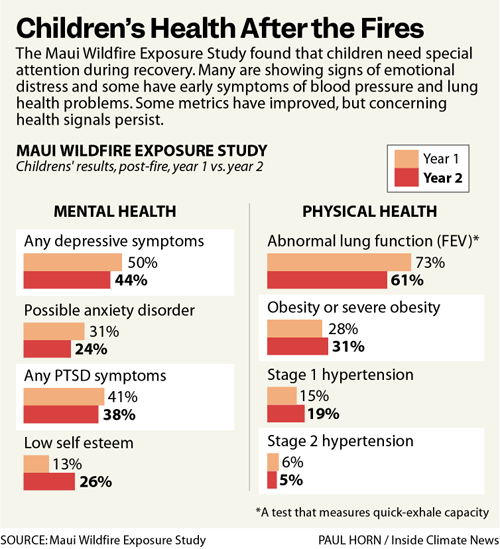
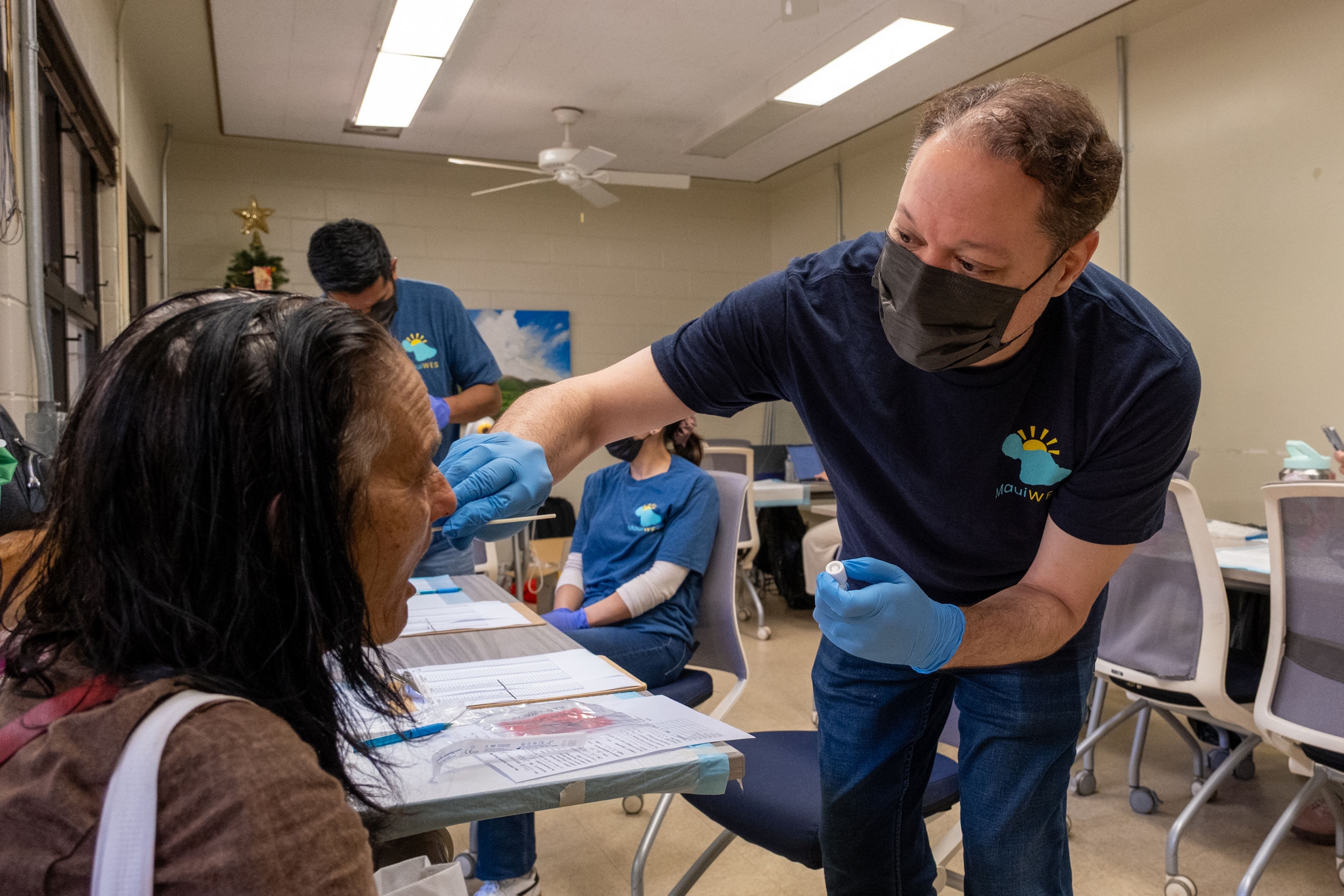
It was in this building that Burke found out about the Maui Wildfire Exposure Study, a University of Hawai‘i research project both quantifying the health impacts of the wildfires and helping survivors navigate them. Burke participated in MauiWES with her husband and four boys, and it was through the study that she learned that her twins, then just 10, were showing signs of post-traumatic stress disorder. It was also how she’d enrolled them in therapy.
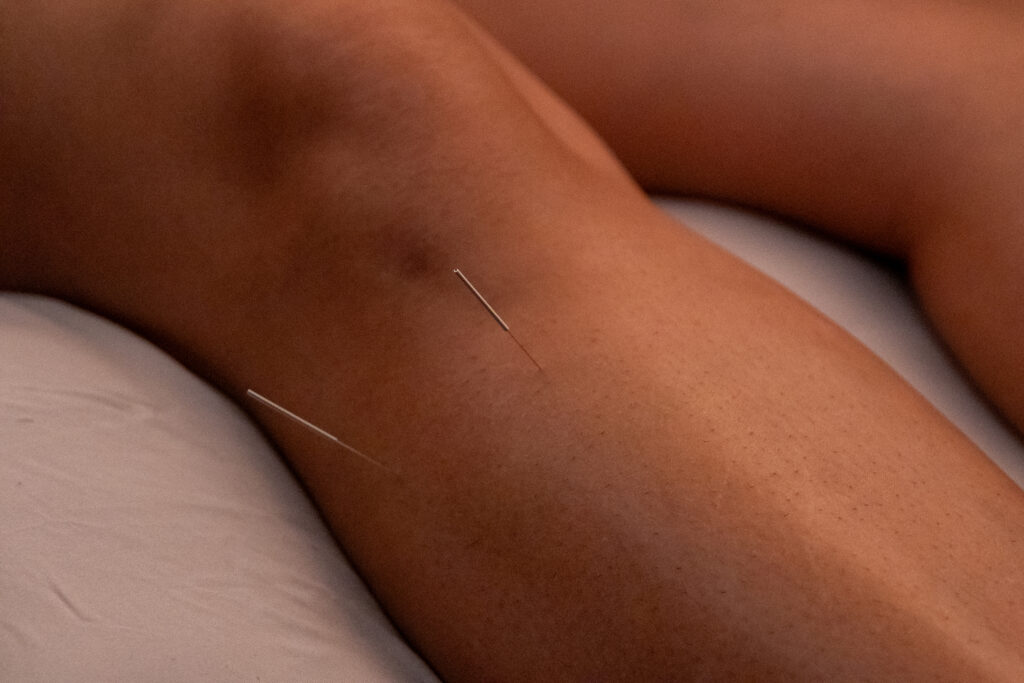
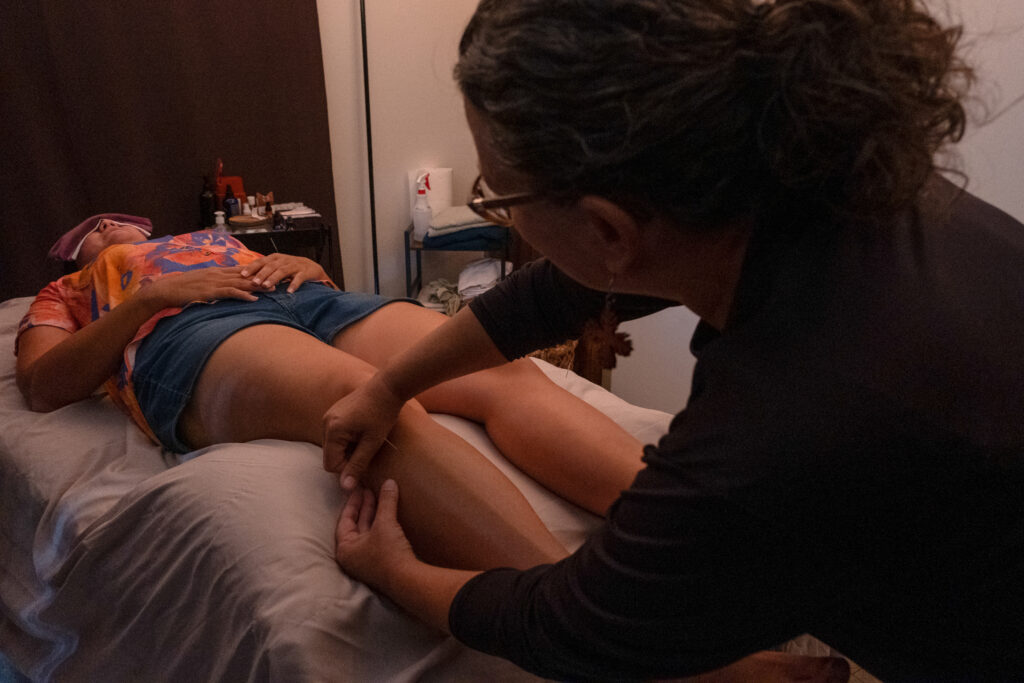
Noelani Ahia inserts acupuncture needles in Mikey Burke’s leg, part of her practice with Maui Medic Healers Hui.
But keeping the study funded had been an ongoing struggle, and a few days before Burke’s acupuncture appointment, organizers held a weekend-long event to collect survivors’ health information for what they feared could be the last time.
It made Burke angry. She’d seen what the study had done for her boys. She felt how deeply her community was still struggling. If no one tracked her community’s health, then how would they know, years from now, how the fires changed them? How would they know how to heal?
“There’s always something that we have to fight,” she continued, her tears now falling fast. “We can’t even just be in our own grief.”
The Maui wildfires on Aug. 8, 2023, destroyed more than 2,200 buildings and killed more than 100 people. The Burkes were among the nearly 13,000 displaced.
For months after the fires, Mikey, her husband, Rob, their four sons and four dogs were shuttled between family and friends’ homes, hotel rooms and finally to the two-bedroom, one-bathroom rental where they’re now living, another waystation in the long wait for a new home.
Three years out, she was still meeting people who hadn’t heard about the Lahaina Comprehensive Health Center or MauiWES, who had been so swept up in surviving, day-to-day, they hadn’t had time to seek support. It was clear to her there was a pressing need for these health resources.
In the dimly lit room at the health center, the magnitude of it all rose and took over. She fell into Ahia’s arms, shaking, and the older woman stroked her back with strong, fluid movements.
“I’ve got you,” Ahia said. “You’re carrying so much.”
Burke took a deep breath through her tears.
“Just for today, just for this little bit of time, we’re gonna set it down,” Ahia continued, her voice low and calm. “We’re going to take the pōhaku out, even though the pōhaku is your kuleana.”
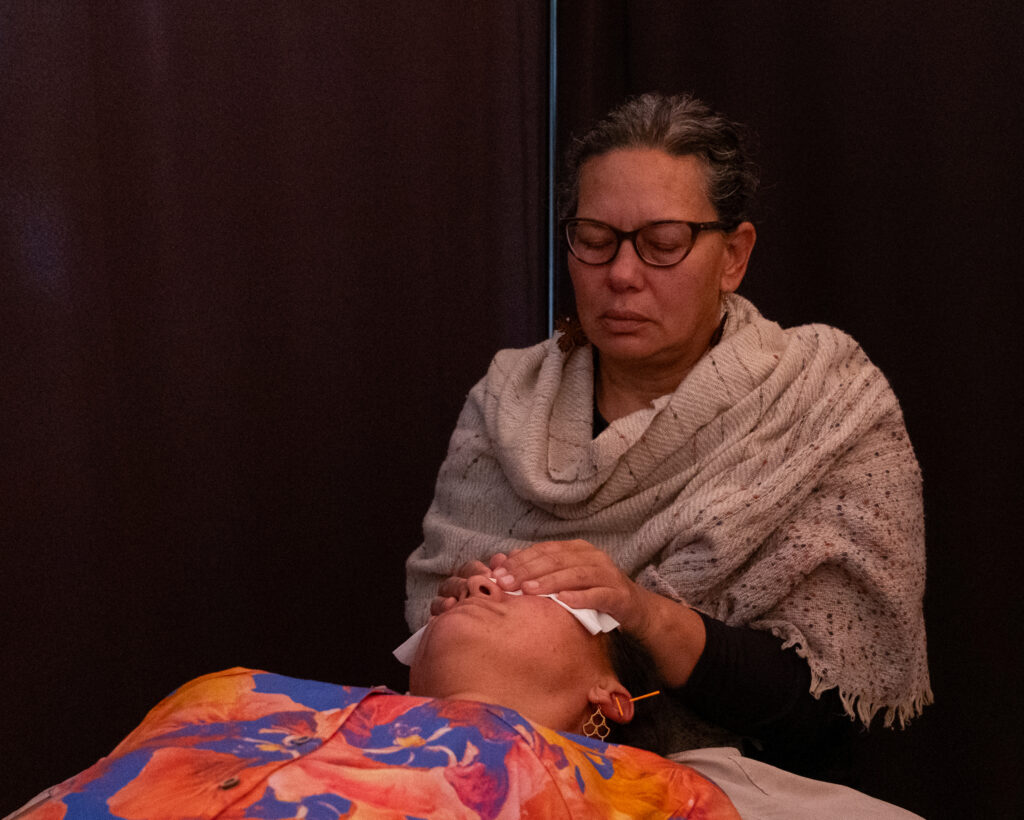
Her worldly responsibilities, her kuleana, are like pōhaku, stones, weighing her down every day, Ahia explained. But for now, she could set them aside.
Burke’s shoulders softened, the tension of the morning dissipating.
This is a central part of Ahia’s work. Her clients come in with a lifetime of wounds, small and large, their nervous systems shot by unending, compounding traumas. She refers to it as colonial inflammation, how years of layered injustices pile on and manifest in a physiological response to stress. A Native Hawaiian diaspora kid who grew up on the continent and returned to Hawai‘i as a young adult, Ahia blends teachings from Hawaiian healing and traditional Chinese medicine into her practice.
She co-founded what grew into Maui Medic Healers Hui in 2019 to care for protesters opposing an observatory on Mauna Kea, a volcano on Hawai‘i island considered sacred by many Native Hawaiians. After the 2023 fires, the organization mobilized to support survivors. Now, many of Ahia’s patients are still feeling the disaster’s aftershocks.
“Can I share a thought?” Ahia asked cautiously, and Burke nodded, her breathing slowing down.
“Before the fires, we all knew about the colonial bullshit that we all go through and how difficult it is, but we had our regular daily lives to keep us busy so we didn’t always have to see it and acknowledge it,” Ahia said.
Burke nodded again as Ahia continued.
“But one patient said to me that now that everything is literally, physically gone, there’s nowhere to hide. So all the pieces of the historical trauma and the current colonial structure that we’re still being oppressed by are screaming at us,” she said.
Lahaina was once the royal seat of the Hawaiian Kingdom and had a lush, green landscape with abundant waterways. But centuries of colonial extraction—first through sugar and pineapple plantations run by American and European companies and then through tourism—diverted water away from Lahaina and helped create today’s arid conditions.
The 2023 fires added fuel to West Maui’s longstanding water conflict. They also highlighted challenges to land ownership for Native Hawaiians and other long-time local families dealing with insurance shortfalls, foreclosure threats, complicated rebuilding requirements and long waitlists for housing.
“The wound is wide open and it’s constantly having dirt put in it,” Ahia continued. “We have to help each other take the dirt out of the wounds.”
Burke and many of her neighbors saw in the aftermath of the fires an opportunity to change course and rebuild with local priorities at the forefront. She helped found the Lahaina Community Land Trust, a nonprofit that works to help families rebuild and keep land in local hands.
For Burke, standing up for Lahaina doesn’t feel like a choice. It’s her kuleana, her responsibility. She can’t imagine another way of being than to be in the fight.
But even as she advocates for resources to help her neighbors, Burke hesitates to accept help for her own family, which faces the same challenges. The aid could go to someone else who needs it more, she tells herself.
“We shouldn’t have to be this strong and resilient,” Ahia said, and Burke laughed in agreement. “So for right now you don’t have to be strong or resilient, you can just be unmasked.”
Burke climbed onto the table, lay on her back and closed her eyes. Ahia swabbed each of her ears and began placing acupuncture needles in her hands and feet.
Her hands over Burke’s chest, Ahia began a pule ho‘ōla, a healing prayer. Her voice reverberated as she chanted, asking for the heavens to open, the rain to fall, the earth and its people to be nourished.
Burke was distracted when she arrived that morning, thinking about the lei she had to make for her twin boys’ fifth-grade graduation later that day. Flowering trees used to be abundant, found in every neighbor’s backyard. In recent years they’d dwindled as gentrification pushed local families away. Then the fires came, burning most homes and trees down. Now, she knows of just a handful of flowering trees remaining in Lahaina, their blossoms in high demand. Just one more thing the flames took.
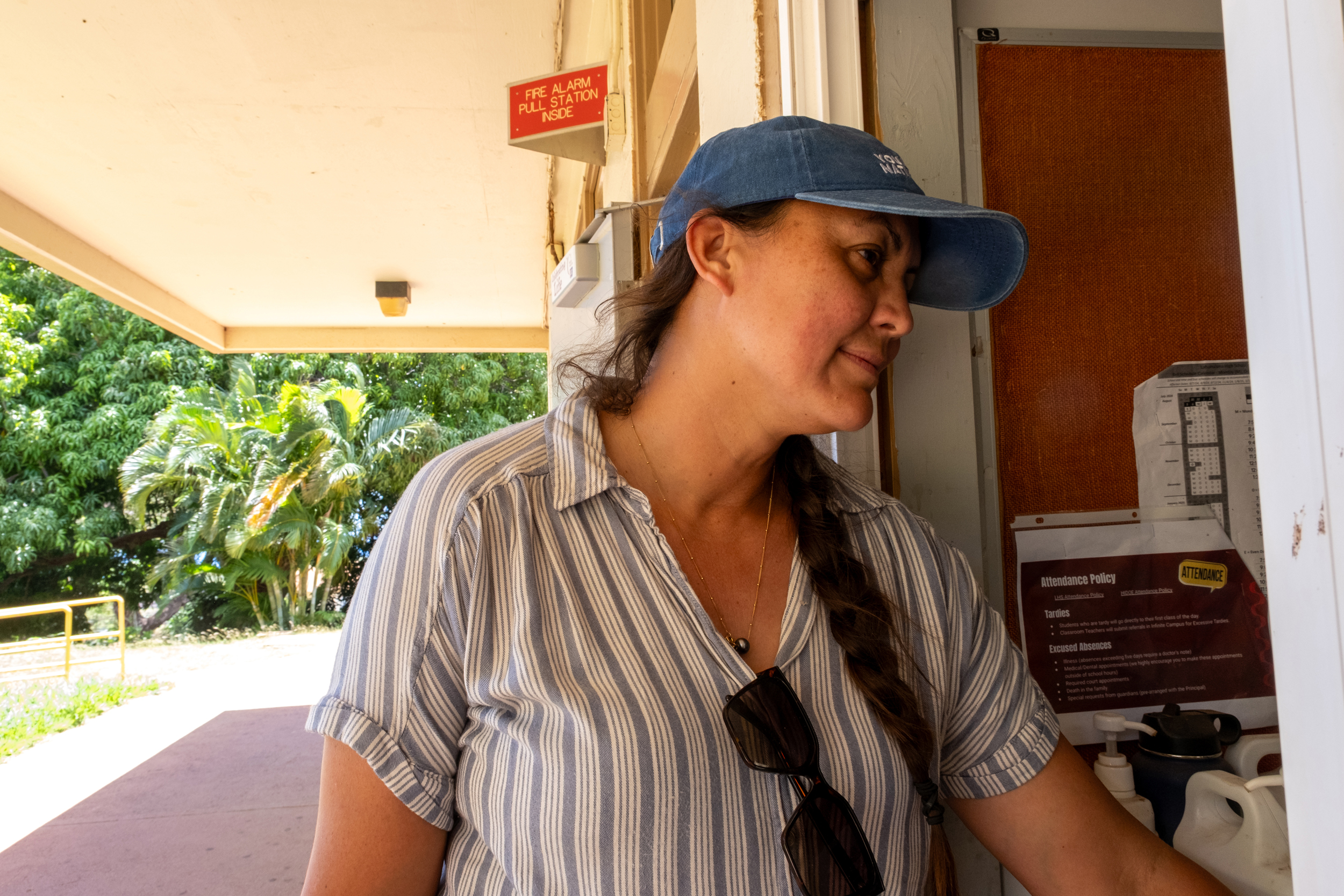
Burke comes to the center for talk therapy as well as her sessions with Ahia. Her twin boys attend therapy and a weekly video gaming group. Her husband, a transplant from California, doesn’t like talking about his feelings and isn’t drawn to talk therapy. But his body is showing the toll of the stress from the fires and a lifetime of manual labor.
Rob had an appointment scheduled for September, just before his 45th birthday, to remove a lesion on his nose, his latest bout with skin cancer. And when MauiWES ran tests on him, he learned that he—like many wildfire survivors here, including his wife—had elevated levels of heavy metals in his body and breathing problems. He listened to Mikey talk about her experience at the center and agreed to sign up for acupuncture and lomilomi massage there, too.
Super Smash Bros.
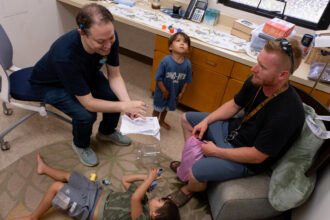
A few hours after Mikey Burke’s appointment, in the room next door, 11-year-old Makoa Burke was laser-focused on smashing Mario to a pulp.
He’d taken a couple of hits so far, but it was still early in the game. He was facing straight ahead, camo baseball hat turned to one side, eyes narrowed with concentration, feet fidgeting in and out of his Crocs.
Then, Makoa’s avatar ballooned on screen and his hammer came down hard on his opponent. A few feet away, Kaleohano Burke spun his chair around, eyes wide, watching his twin brother’s victory with glee. His lei were lying on the table, but he still wore the gray kīhei, knotted at his left shoulder, from their fifth-grade graduation ceremony that day. Raising a hand covered in bright orange powder, he scarfed down a Cheeto.
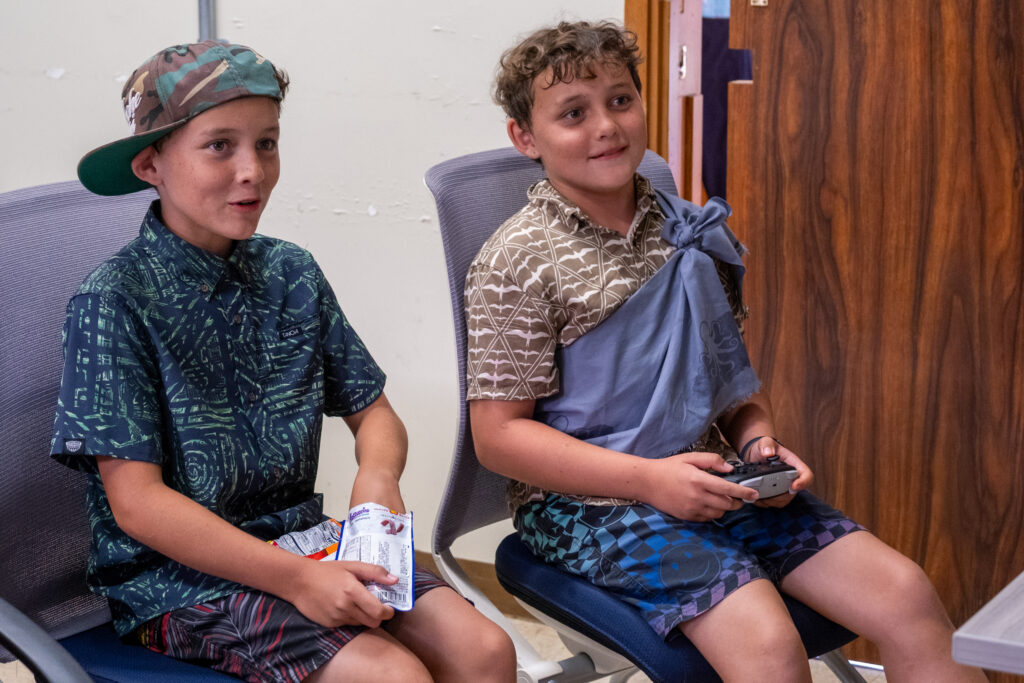
Makoa’s eyes remained trained on the screen.
“I’m surviving,” he said to the room, or maybe to himself. “No more dying.”
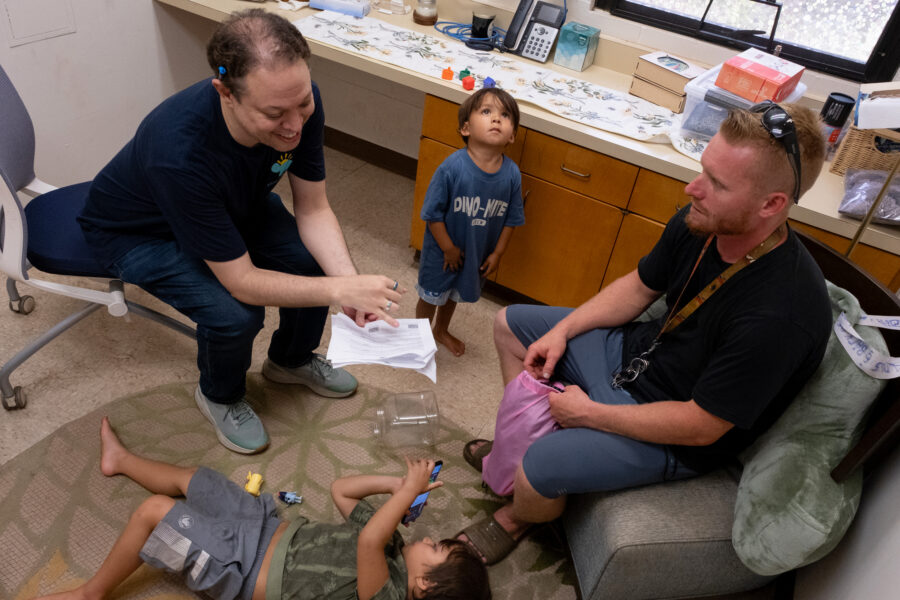
Christopher Knightsbridge, a therapist who works on the MauiWES study, sat quietly to the side of the room and watched the boys, leaning back in his chair with his hands behind his head.
As the hour went by, the table piled up with empty bags of Doritos, SunChips and the clear crowd favorite, Cheetos. About half an hour in, the Capri-Suns had run out, so Kaleohano cracked open a pack of organic apple juice boxes.
Since the fires, Mikey and Rob Burke had seen changes in their sons. Kaleohano began having nightmares and Makoa, who had always been a fiercely independent child, hovered around his parents, distraught at a hint of separation. They’d get triggered by smoke from a neighbor’s barbecue, unsettled until their parents took them to the source and proved, beyond a shred of doubt, that it was something distinct from the fire they’d fled as it burned their home, their street and nearly their entire town clear to the ground.
For months, the Burkes knew their kids were struggling. They were too. But the family was in survival mode, and addressing their mental health was one item on a long and impossible to-do list that included insurance paperwork, emergency housing, school, the logistics of rebuilding and continuing to support their community, where they counted their family lucky—sheltered and at least visibly uninjured. On top of everything, both parents had busy jobs: Rob as a construction worker and Mikey as the new West Maui community liaison for the state’s largest utility, Hawaiian Electric, which dealt with legal fallout after the fires.
Mikey remembers being in a state of shock when MauiWES staff said both boys were showing signs of PTSD. But Knightsbridge walked her over to the front desk of the center and helped her sign them up to see one of the mental health counselors there for free. In their second year of testing with MauiWES, after regular therapy and Knightsbridge’s gaming group sessions, their mental health scores had returned to a normal range.
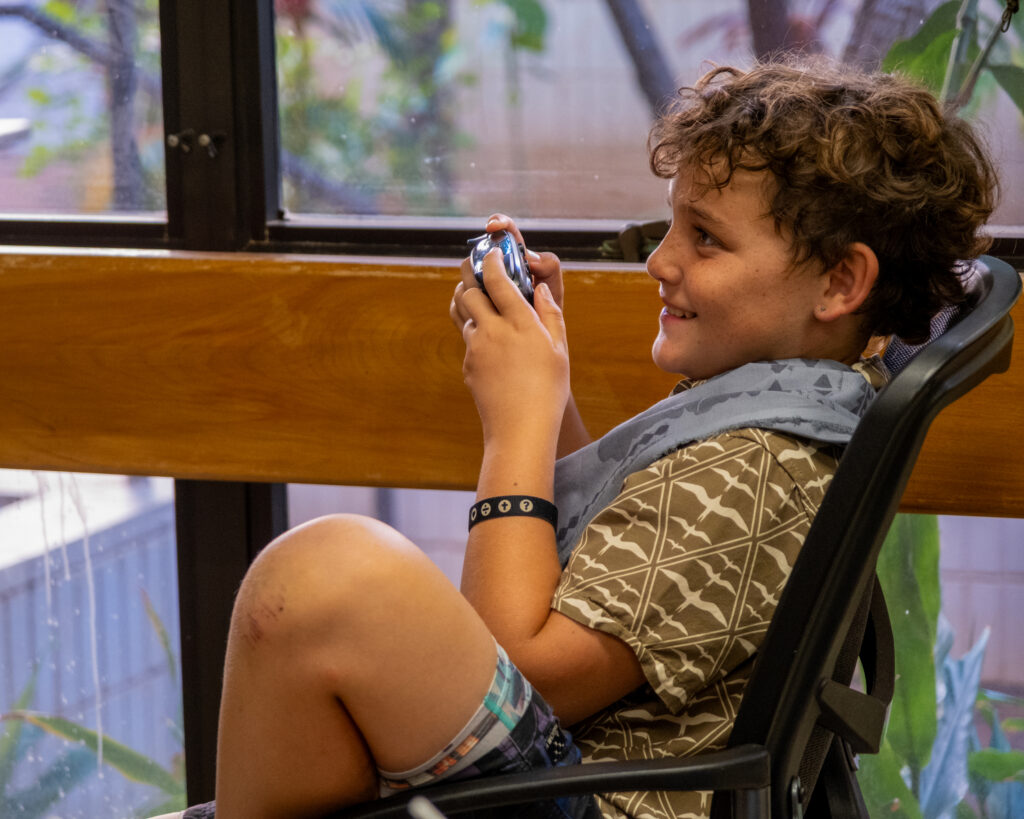
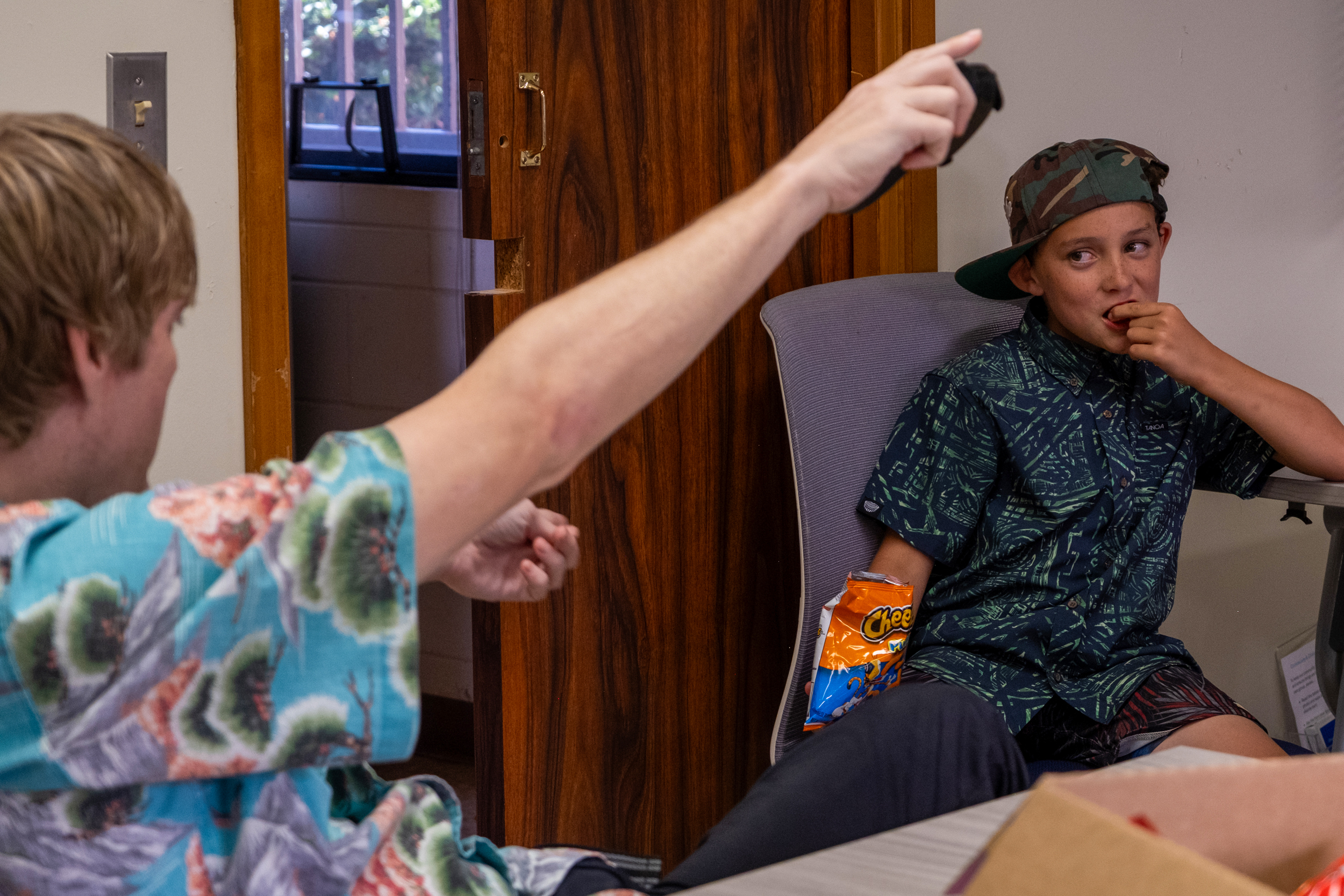
The gaming group is separate from formal therapy, but Knightsbridge sees it as a part of the center’s holistic approach to healing. Many of the children he sees are navigating instability at home and trauma from the fires. The gaming group gives them a reason to leave their homes and socialize. Sometimes, it’s a safe, low-stakes space to open up.
But everything feels precarious. That week, it looked like MauiWES would be shutting down. And after leaving the Department of Health in the spring, Knightsbridge was working at the center on a federal emergency response grant that was nearing an end. He lives on O‘ahu but was spending half of most weeks on Maui, and he couldn’t imagine leaving his patients.
Slab Pouring Day
The next morning, Rob Burke stood surveying a construction crew at the site of the family’s former and future home. The sun beat down hard from a cloudless sky, and the empty lot offered no shade for the workers.
This was therapy for Rob. Watching as their build began at last was the first time since the fires that he felt he could really breathe.
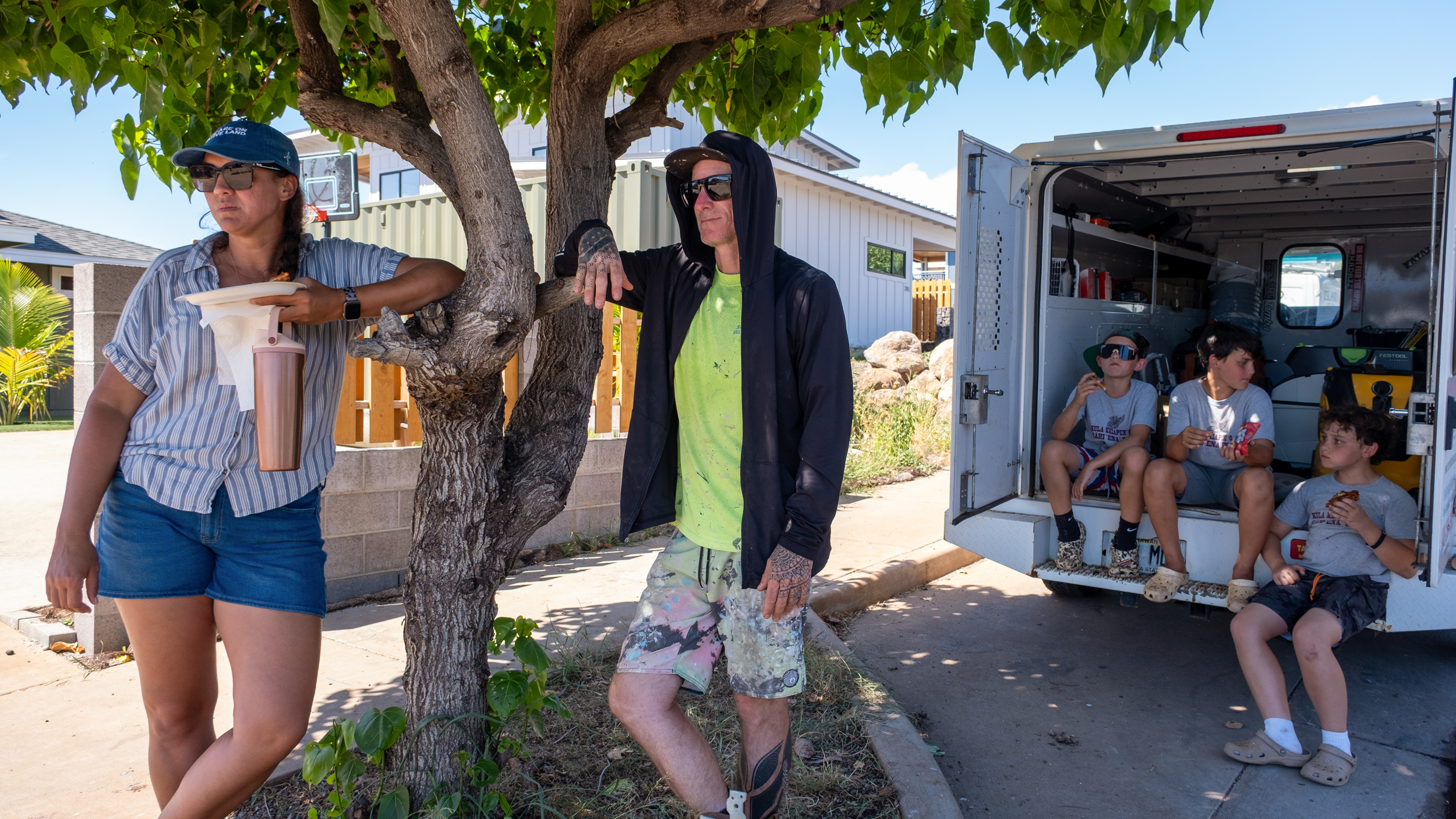
Rob was dressed to shield his skin from the sun: dark sunglasses and a black, long-sleeve zip-up with the hood pulled over his head. From under each sleeve and on one leg beneath knee-length shorts, thick, bold tattoos emerged. The only other skin left uncovered was his nose, already bright pink and sunburnt.
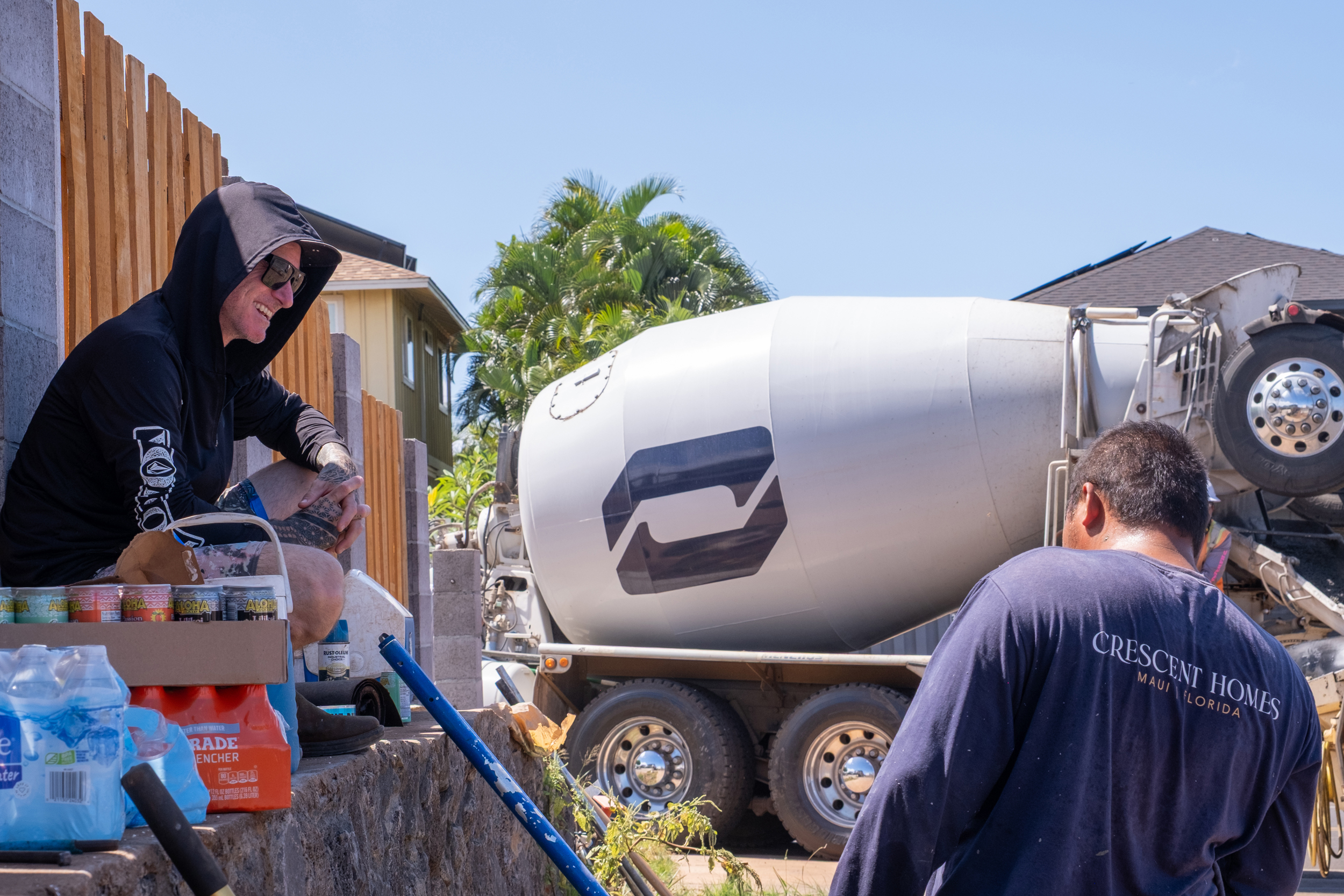
Rob does finishing work for Crescent Homes, a local company, and plans to take that on at his family’s home too. For now, the house was just a grid on the ground under the blazing sun. Pipes stuck out where the bathrooms and laundry room will take shape.
Rob jokes that his body, his pale skin and Irish blood, wasn’t made for Hawaiʻi. But his soul was. Even with his home burned to ash and skyrocketing prices for seemingly everything, he couldn’t imagine leaving Lahaina. The place is special. It’s the land, its spirit, its mana. As soon as he moved here, he could feel it. It’s the only place Mikey had ever wanted to bring up their kids. Now, he feels the same way.
Mikey had just parked her car and was walking up the road to their house. In contrast to Rob’s head-to-toe sun protection, she was dressed for summer in denim shorts, a short-sleeved button down and a baseball hat that read, “You Are On Native Land.”
As he spotted his wife, Rob brightened, then quickly sobered. As excited as he was, he knew this would be a difficult day for her.
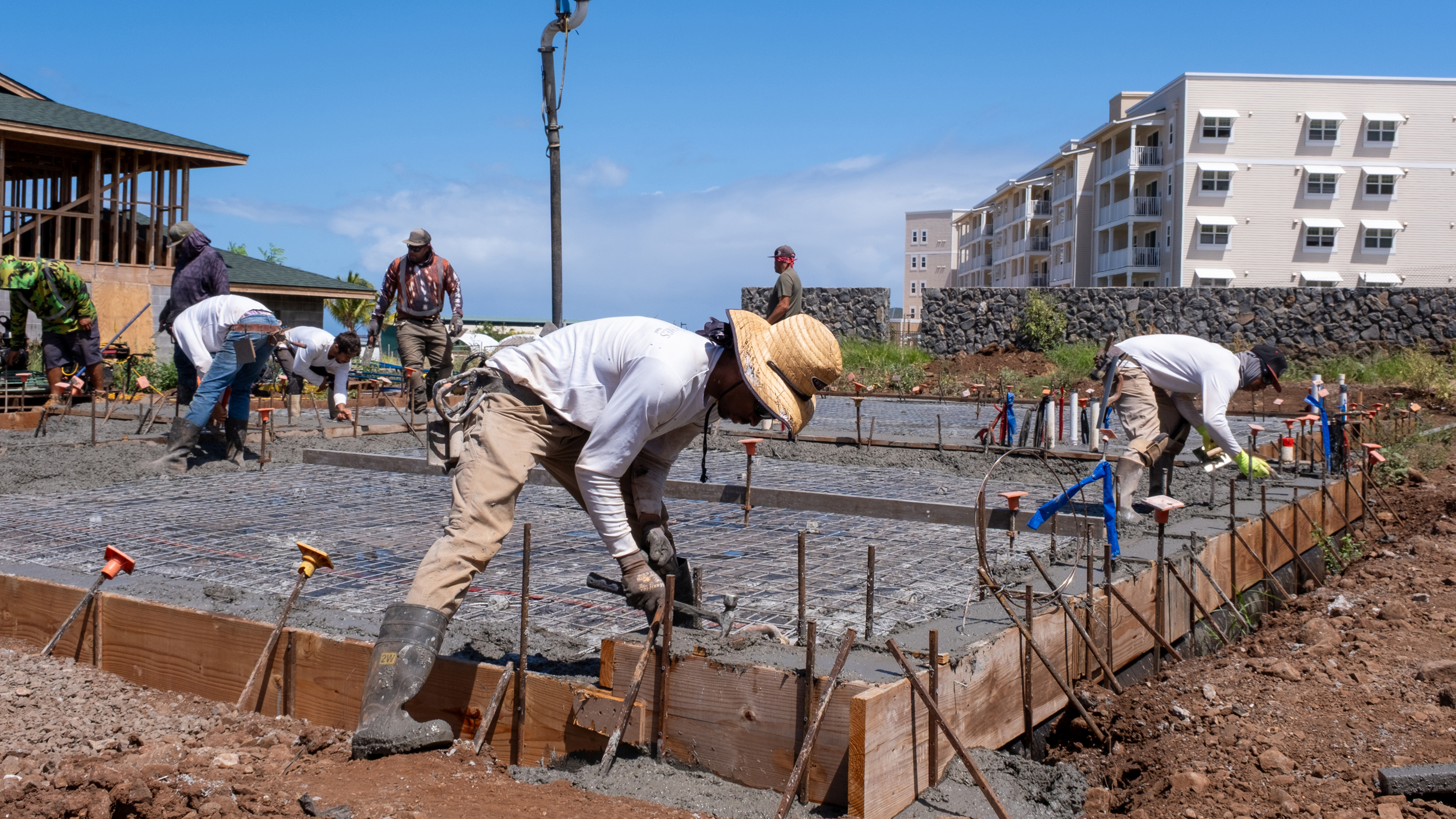
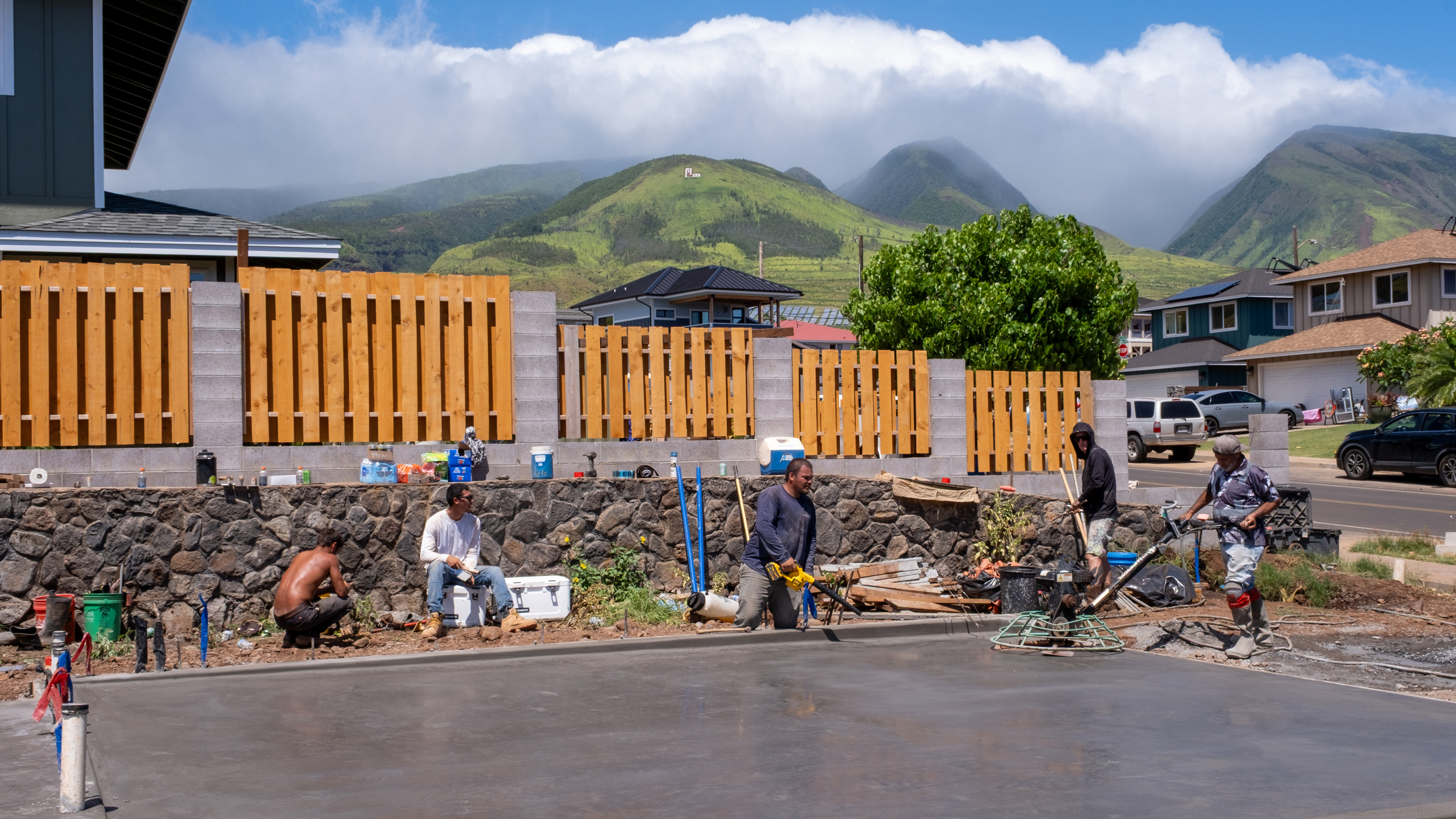
She approached Rob and they hugged, the weight of the morning left unsaid. Before long, a cement truck backed in from the street, and by a quarter to 10, the crew started pouring the foundation. Cement churned in the truck and was pushed through a crane before it gushed out of a vertical pipe and filled the grid on the ground.
Behind her sunglasses, Mikey began to cry. Rob pulled her into another hug as she shook with the sobs.
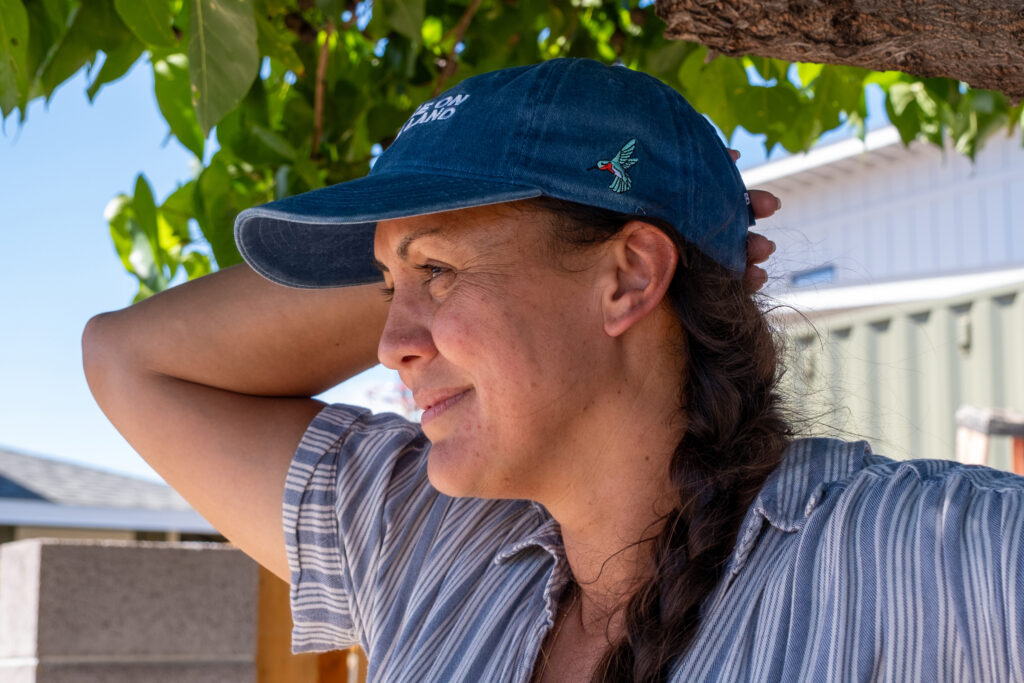
It was May, nearly three years since the fires, and they were only just starting to rebuild. She and Rob are taking on the job as owner-builders, without a general contractor. She doesn’t know when they’ll be able to get the materials to start building its frame. The length of the road ahead, full of unending unknowns, scares her. Her oldest son will be 18 by the time they’re ready to move back in, if they’re lucky. He might not even want to live here anymore.
The sun stayed high as the hours ticked by and the crew—most of whom Rob knew from work—labored steadily, pouring and smoothing the concrete. Rob passed around cool drinks and pizza.
As the day progressed, Mikey’s mood gradually lifted. The slab pouring felt like a metaphor. The foundation of the house, the start of their homecoming, the beginning of a new chapter in their family’s life. As the ground hardened, she and Rob could see it all beginning to take shape.
Around 1 p.m., Mikey left to pick up her kids a little early from school—she wanted them to be there to see this.
On the brief drive, she passed a neighbor’s home on the corner that was in the midst of construction. She remembered the beautiful house that had burned down, built in Lahaina’s plantation-era style and renovated by the current owner’s father, who has since passed away. That house was his legacy.
Throughout the burn zone, Lahaina was reemerging. The streets were bustling daily with construction crews in pickup trucks. A single block could house every stage of the construction process: a fully built home next to a wooden frame, beside two stories of scaffolding plastered with Tyvec paper flapping in the wind. Scattered throughout were empty lots, where homeowners moved away, sold their land or just haven’t been able to start building yet. Of the more than 2,200 structures destroyed by the fires, just over 300 have been rebuilt three years later.
Mikey picked up her son Maleko, then 16, at Lahainaluna High School and drove to Princess Nāhiʻenaʻena Elementary School just below it.
This story is funded by readers like you.
Our nonprofit newsroom provides award-winning climate coverage free of charge and advertising. We rely on donations from readers like you to keep going. Please donate now to support our work.
Donate Now“We’re pouring slab today,” she said with a smile to the women working the front desk as she signed out the younger boys, Makoa, Kaleohano and Kaimana, 9. The sun was high and the foundation already dry enough for the workers to walk on when she and the boys arrived.
As the afternoon dragged on, cars drove by, honking at the family and rolling down their windows to yell greetings and congratulations. The Burkes waved, shouted alohas and threw shakas at a cousin whose home was rebuilt by Habitat for Humanity down the block, a friend who lives in an apartment building that was burnt down and rebuilt a few streets over, a Hawaiian language teacher from the boys’ school, his grandchildren returning their waves from the back of his pickup.
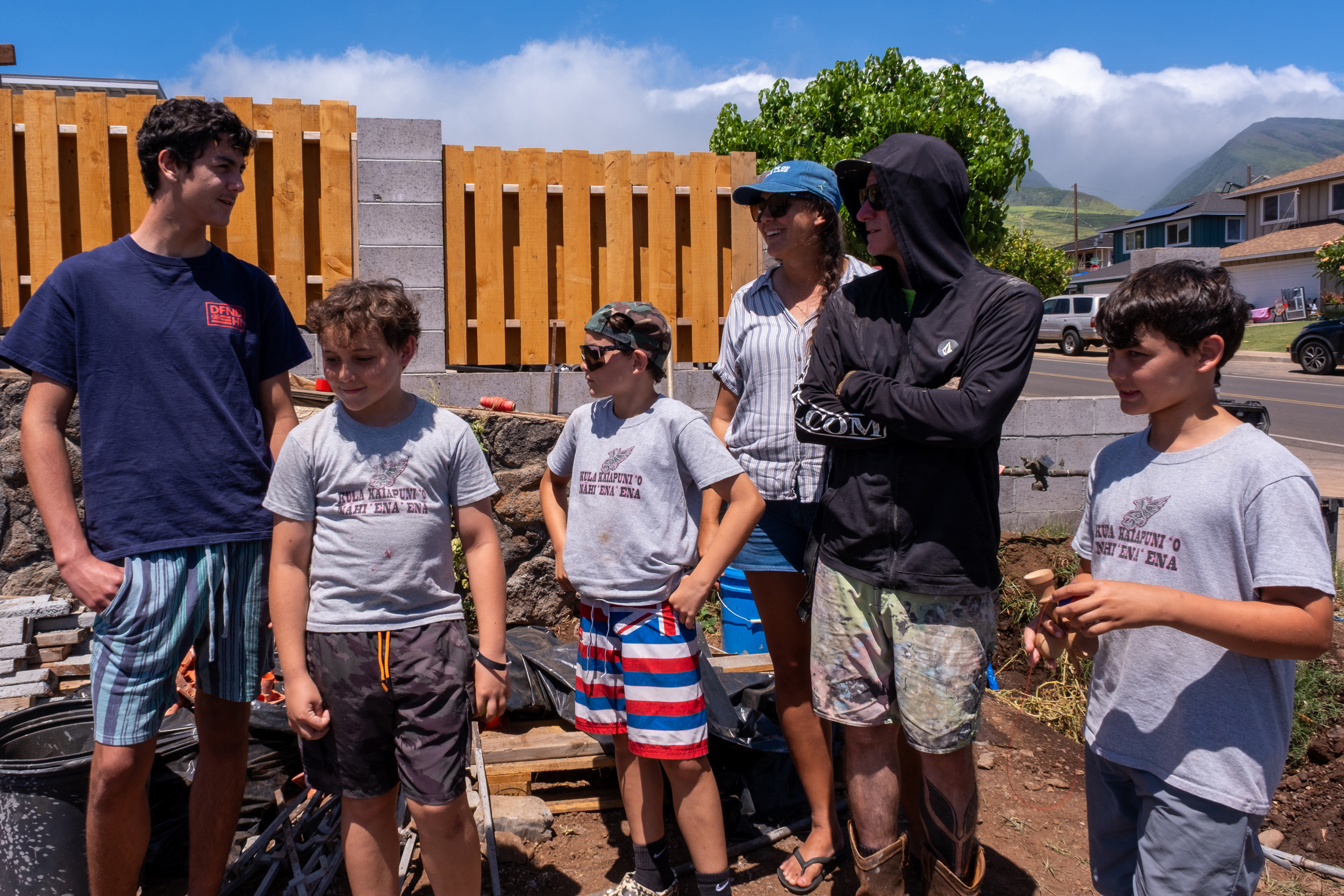
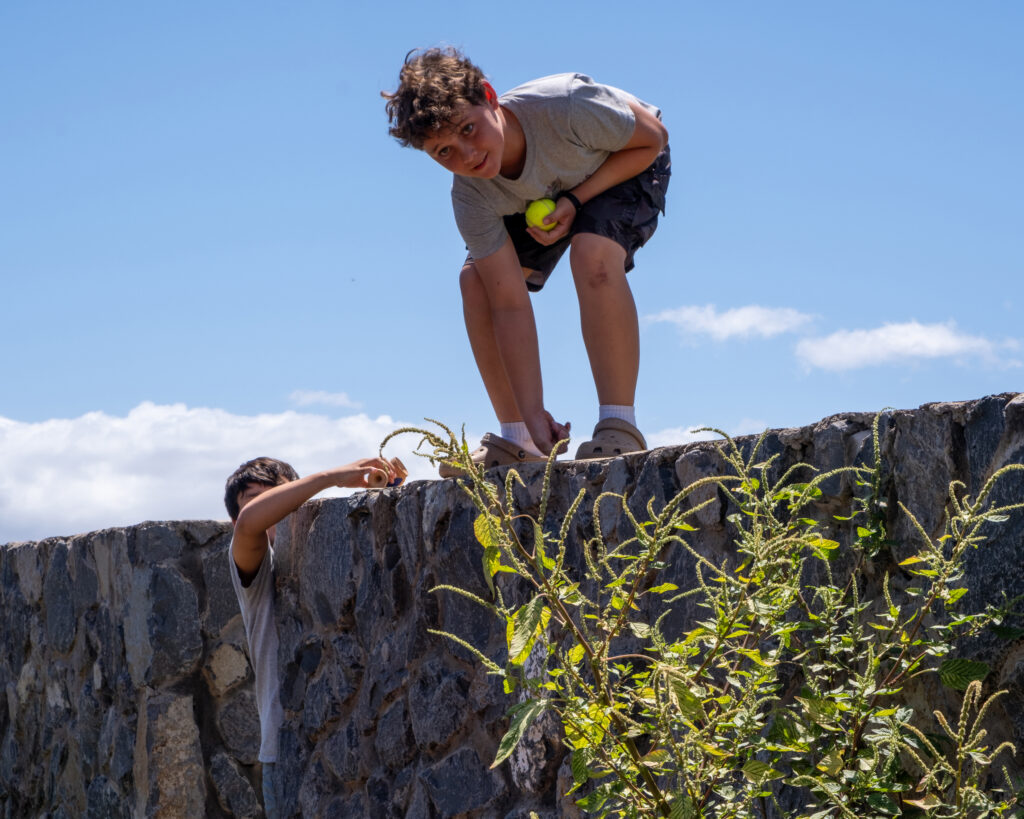
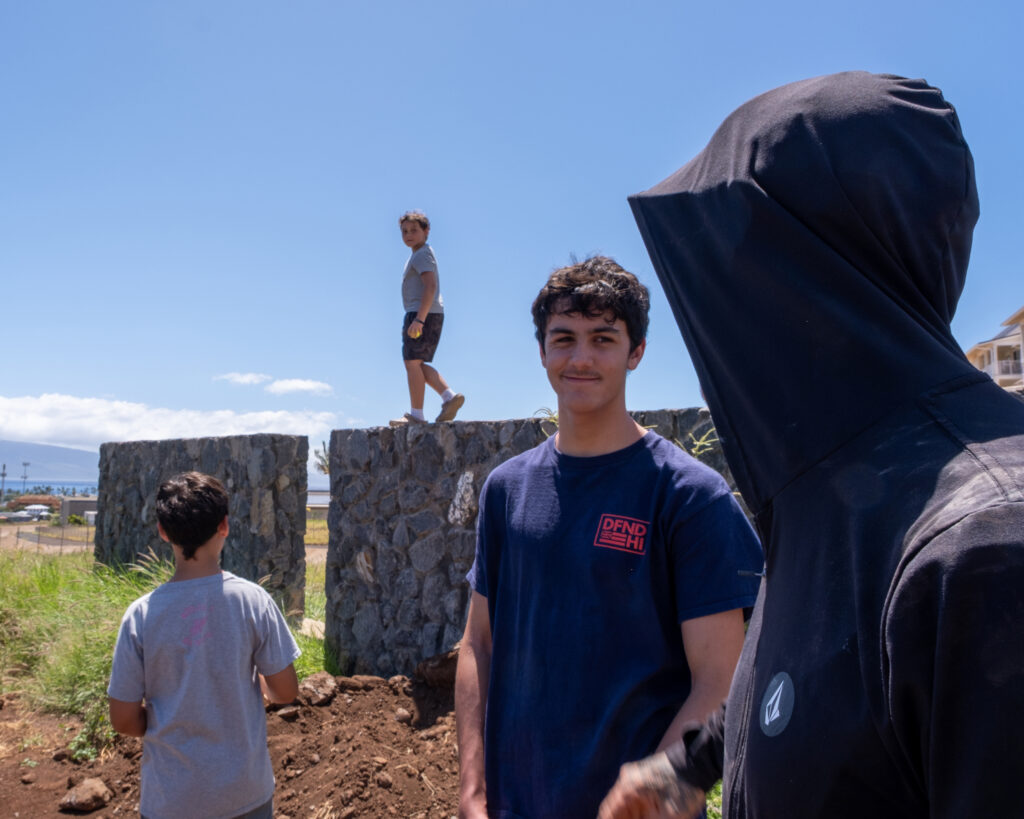
While Maleko stood close to his dad, the three younger boys walked the perimeter of the site, climbing the stone wall behind the house and playing with tennis balls and their kendamas, Japanese wooden toys made of a handle, ball and string. They did tricks for the crew and weaved on and off the sidewalk, running up and down the block.
Before the fires, they were just beginning to fall into a neighborhood crew of kids their age. They’d run to each other’s houses for movie nights in someone’s yard, to ride bikes along the street or to get shave ice from a seller on the corner.
The neighborhood they’re renting in now has few kids and no sidewalks. It’s not built for play.
It’s another item on Mikey’s list of many worries since the fires. They might have lost the chance to build those bonds, moving back only after aging out of that magical era when their lives could revolve around exploring their neighborhood with a little goonie squad.
As she fretted, a blonde-haired boy from the neighborhood rolled in on a scooter, recognizing the boys and stopping to play. They laughed on the sidewalk, passing their kendamas back and forth.
The road ahead was long and full of challenges. Mikey knew she would have to continue to fight—to avoid foreclosure and secure insurance funds, to find building materials and trustworthy contractors, to make time for the family’s health in the midst of everything else. The boys would soon have to stop seeing their therapist as the emergency funding ran out. She didn’t know what would happen to MauiWES.
But that day, something was taking shape.
It was nearly 3 p.m., the sun still high. The boys sat in the back of their father’s truck, eating pizza and making each other laugh. Rob and Mikey took shade under a lone tree on the sidewalk, each leaning on a branch as they faced their land. And across the new foundation of the Burkes’ future home, the crew kneeled as they smoothed out the corners of the now-hardening concrete.
Epilogue: HO‘ĀLA-Maui
As the summer began, Ruben Juarez and Alika Maunakea—the two University of Hawai‘i researchers leading the study that got the Burke boys into therapy—looked for a Hail Mary.
They met with local funders. In June, they flew to Washington, D.C., to talk with their state’s congressional delegation and a handful of program officers at the National Institutes of Health and the Centers for Disease Control and Prevention, explaining their vision for an expansion of MauiWES that would combine screening and data collection with care navigation, referrals and community outreach in mobile clinics across the island.
They’re calling the initiative HO‘ĀLA-Maui, using a Hawaiian word that means to re-awaken or restore as an acronym: Health Outreach ‘Āina-based Lifecourse Alliance.
Long term, they are dreaming even bigger.
Juarez and Maunakea want to use what they’ve learned to build a new national blueprint for responding to disasters: a combination of data collection and care rooted in Mauli Ola, a Hawaiian concept that describes how physical, mental, social and environmental health and well-being are inextricable.
At the end of June, they got a breakthrough.
An email from NIH announced that one of their applications had been approved: $2.2 million over three years from the National Institute on Minority Health and Health Disparities.
It was enough to bring staff back to MauiWES.
And after that, the funds began to flow in earnest.
On July 1, Maui County officials allocated another $2 million to the HO‘ĀLA initiative, to focus on the remote corners of the island that are most impacted by healthcare shortages.
In mid-August, an NIH grant Juarez and Maunakea applied for a year and a half earlier was approved: $3.6 million for a five-year study on a new 1,000-person cohort to better understand the impacts of wildfire exposure and legacy pollutants from the state’s plantation history on lung and heart health—a follow up to their recent findings. And in September, NIH granted them another $3.7 million over five years for further research on health impacts to children.
Juarez and Maunakea believe that these funds, along with some renewed charitable support, are enough to keep the effort going.
On a hot evening in mid-July, the two professors walked northbound along the lakefront trail in downtown Chicago.
They were there for just a few days, attending a symposium on science and safety. The next afternoon, Maunakea would speak about MauiWES on a panel about ecosystem resilience.
Juarez looked out at Lake Michigan, the water glistening, tinged purple with the promise of a soon-setting sun, and remarked how much it looked like the ocean.
They walked for a bit before stopping at a little outdoor restaurant with a view of the sailboats docked in the harbor. The sun began to set as they ate and sipped their drinks—Maunakea, a piña colada and Juarez, a glass of rosé.
Maunakea was thinking about climate change. Hawaiʻi is experiencing rising temperatures and sea levels, coastal erosion, ocean warming and acidification, coral bleaching, changes in rainfall, greater wildfires and more intense storms and hurricanes triggering flooding and landslides. This year, the state has faced relentless, back-to-back disasters that leave little time to recover in between and lay bare systemic gaps in the state’s healthcare system. It makes this work, combining research with intervention, all the more urgent.
Sitting on Chicago’s lakefront, the two men felt cautiously optimistic.
Juarez and Maunakea have shared their findings with researchers studying the impacts of 9/11 debris exposure on first responders in New York City and water contamination in Flint, Michigan. They have consulted with a team in Los Angeles implementing a similar project to track health impacts from the 2025 fires there. As wildfires roared through Utah and Colorado in June and killed four wildland firefighters, the MauiWES team connected with a local researcher almost immediately to talk about potential next steps. And after tensions with their state’s health department, they were feeling hopeful about working more closely with the agency.
As he and Maunakea finished their dinner, Juarez was enthralled by dozens of spiders of all different sizes that surrounded them on the lakefront, running up and down nearly invisible threads of silk between shrubs, their chairs and the umbrella that shaded their table. He’d never seen so many in his life.
They reminded him of Lahaina, the web of interwoven social and environmental dimensions of the community. Everything connected, but easily broken by a single disruption.
“You just need one thing to destroy this web,” Juarez said. “You have a disaster, and it’s gonna shock all of them at the same time.”
“Or they’ll recover and build a new one,” Maunakea said.
“It depends on how resilient they are,” Juarez said.
Maunakea, seemingly unimpressed with the metaphor, stared pointedly at him, and Juarez laughed.
By then the sun had set. The two men walked back to their hotel, stopping for gelato on the way.
As they flew back to Oʻahu two days later, wildfire smoke from Canada swept in over the lake and shrouded Chicago in a thick yellow haze.
About This Story
Perhaps you noticed: This story, like all the news we publish, is free to read. That’s because Inside Climate News is a 501c3 nonprofit organization. We do not charge a subscription fee, lock our news behind a paywall, or clutter our website with ads. We make our news on climate and the environment freely available to you and anyone who wants it.
That’s not all. We also share our news for free with scores of other media organizations around the country. Many of them can’t afford to do environmental journalism of their own. We’ve built bureaus from coast to coast to report local stories, collaborate with local newsrooms and co-publish articles so that this vital work is shared as widely as possible.
Two of us launched ICN in 2007. Six years later we earned a Pulitzer Prize for National Reporting, and now we run the oldest and largest dedicated climate newsroom in the nation. We tell the story in all its complexity. We hold polluters accountable. We expose environmental injustice. We debunk misinformation. We scrutinize solutions and inspire action.
Donations from readers like you fund every aspect of what we do. If you don’t already, will you support our ongoing work, our reporting on the biggest crisis facing our planet, and help us reach even more readers in more places?
Please take a moment to make a tax-deductible donation. Every one of them makes a difference.
Thank you,

Keerti Gopal
Reporter, Health and Justice
Keerti Gopal covers intersections between climate change, public health and environmental justice at Inside Climate News. Previously, she covered climate activism and movement repression. She is a National Geographic Explorer and has received fellowships from Fulbright, the Solutions Journalism Network, The Lever, and the National Press Foundation.