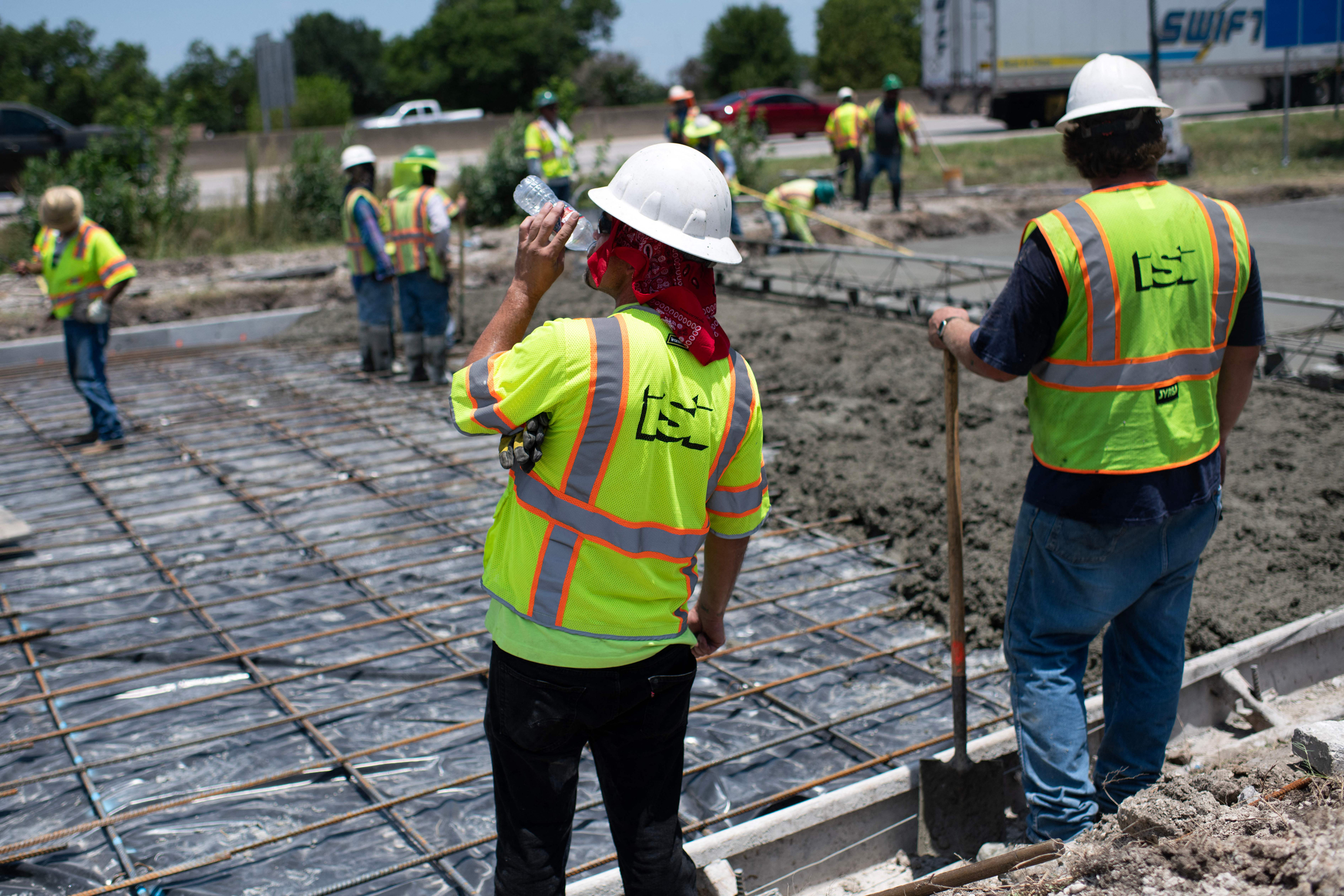


A warming climate exposes more and more workers to increasingly hotter conditions every year, yet soon after taking office, Donald Trump indefinitely froze a heat illness prevention rule proposed under the previous administration and gutted the only agency that studies workplace health and safety.
And on Thursday, a little more than a week after a new analysis placed 2025 on track to be the second-warmest year on record, House Republicans held a hearing that attacked the agency responsible for protecting worker health and safety as “burdensome.”
The Republican-dominated House Education and Workforce Committee’s Subcommittee on Workforce Protections called the hearing to review actions by the Occupational Safety and Health Administration, or OSHA, under the Biden administration, said Chair Ryan Mackenzie (R-PA). The hearing will also “explore common-sense solutions that can return OSHA to fulfilling its purpose of advancing workplace safety,” Mackenzie said.
The hearing, titled “Reclaiming OSHA’s Mission: Ensuring Safety Without Overreach,” revisited the same ground covered in a hearing held by Republicans last year, called “Safeguarding Workers from OSHA’s Overreach and Skewed Priorities.”
In both hearings, Republicans focused on two rules they claimed demonstrated regulatory “overreach” and “skewed priorities”: OSHA’s draft heat injury and illness prevention standard and its proposed “walkaround rule,” which allows workers to authorize a representative to accompany an OSHA official in a workplace inspection.
Republicans on the committee and industry representatives largely stuck to the same talking points about regulatory overreach while Democrats and their one occupational safety expert noted that most of OSHA’s problems stem from a chronic lack of funding and staffing.
“Republicans support common sense policies that reduce regulations while keeping our workplace environment safe,” said Illinois Republican Mary Miller. “Our mission is to protect workers, not just from hazards, but also from the crushing weight of Washington’s failed bureaucratic overreach.”
Democrats treat employers as “greedy money grabbers” who don’t care about the well-being of their employees, Miller said. Biden’s OSHA issued a rushed proposal on heat, injury and illness prevention that had the potential to “wreak havoc on businesses and communities across the country,” she said, noting that the rule “was just a mandate designed to appease climate change activists.”
Heat, the leading cause of weather-related deaths in the United States, led to the death of 479 workers and nearly 34,000 work-related heat injuries between 2011-2022, according to the Bureau of Labor Statistics. Experts caution that statistics for occupational heat-related illnesses, injuries and fatalities are likely vast underestimates due to multiple factors, including a failure by medical examiners to recognize heat as the cause of death or employers to report it.
The Biden administration proposed the heat rule more than 50 years after the National Institute of Occupational Safety and Health, or NIOSH, recommended a standard to protect workers from exposure to heat in the workplace.
Resisting Regulation
As the majority party in the House, Republicans invited three witnesses to testify: Jake Parson, who represents CRH, the largest building materials company in the world; Ben Tresselt, who represents the tree-care industry; and Felicia Watson, senior counsel with the largest legal practice devoted exclusively to representing management in employment and labor law disputes. The few Democrats on the subcommittee asked Jordan Barab, OSHA deputy assistant secretary under President Barack Obama, to testify.
“Recent actions by the Department of Labor threaten to impose unworkable rules that do very little to improve safety,” Parson said, noting that money spent to comply with regulations would be better spent on hiring people, building facilities and creating new products.
Parson took issue with OSHA’s proposed heat rule, calling it a “one size fits all rule,” echoing a complaint made by most trade groups when the rule was proposed.
“The heat standard ignores the work manufacturers already do to protect our employees,” Parson said. In addition, he said, the rule doesn’t recognize that industries operate in diverse geographies with different climates. “When it comes to heat, what makes sense for Maine does not make sense in Texas,” he said.
OSHA’s draft heat standard is intentionally designed to give employers compliance flexibility, Juanita Constible, a heat and climate expert with the Natural Resources Defense Council, told Inside Climate News.
“In other words, the standard is the equivalent of telling employers to put on some pants, not to put on pants of a specific size, fabric, color and style,” Constible said. “And employers need to have a written plan for how they’re going to provide those protections, rather than simply hoping for the best.”
Republicans use the “one size fits all” argument to criticize every OSHA standard, but it makes even less sense with heat, Barab told Inside Climate News. “Sure, some states have different climates, but a worker in Maine who’s exposed to 95 degrees has the same health effects as a worker working in Louisiana or Florida in 95 degrees. The human body is the same, anywhere you’re working, and needs the same amount of water, the same amount of rest time.”

The requirements of the proposed heat standard—to ensure access to adequate water, shade and rest breaks—kick in at specific temperatures, regardless of geography.
Parsons also argued that the heat standard would increase costs while decreasing productivity and that it would be better to let companies take care of their own people.
Yet construction workers make up about 6 percent of the working population, and they suffer 36 percent of all heat deaths, Barab said. “The notion that different industries need their own standards or should be exempt is a red herring.”
Gutting Worker Protections
“Over the past hundred days, President Trump and his administration have decimated the very agencies and resources that have kept workers safe and healthy,” said one of the few Democrats on the committee, Minnesota’s Ilhan Omar. “Now, committee Republicans are following suit by holding this hearing to attack the work of the Occupational Safety and Health Administration.”
All three agencies that Congress established to keep workers safe—OSHA, NIOSH and the Mine Safety and Health Administration, or MSHA—have been chronically underfunded, Omar said. “And largely because of that, they have long struggled to robustly defend workers from preventable injuries, illnesses and death at work.”
This story is funded by readers like you.
Our nonprofit newsroom provides award-winning climate coverage free of charge and advertising. We rely on donations from readers like you to keep going. Please donate now to support our work.
Donate NowNow the Trump administration is endangering workers’ lives with its plans to shut down at least 11 OSHA field offices, including one in a Louisiana region known as Cancer Alley due to the harm caused by its 200-plus chemical plants, Omar said, as well as at least 30 MSHA field offices.
Barab told the committee he objected to the title of the hearing. “OSHA’s problem is not overreach, but rather underreach,” he said.
It’s a tiny agency with a minuscule budget and an enormous mission to ensure the work safety of 11.8 million workplaces covering 161 million workers, Barab said.
In fiscal year 2024, OSHA had only 1,800 inspectors, one for every 84,937 workers, Barab told the committee. “If OSHA was to inspect every workplace in the country, just once, it would take 185 years, almost two centuries, and it only promises to get worse.”
OSHA has lost 10 percent of its staff due to early retirements offered by the administration, and there is very little likelihood that any of these positions will be refilled, Barab said. “This is hardly a recipe for reclaiming OSHA’s mission.”
When Barab testified before the committee last year, he told them about Gabriel Infante, a Texas construction worker who died of heat stroke in 2022.
Infante, 24, was digging trenches in San Antonio when he became disoriented as temperatures reached 100 degrees. No one recognized the signs of heat stroke. He had been on the job less than a week. Baltimore sanitation worker Ron Silver also died working in extreme heat last year—a month before Maryland passed a heat standard.
If an OSHA heat standard had been in place, these heat deaths would have been prevented, Barab said.
Instead, he added, “these preventable tragedies continue.”
Most heat deaths occur within the first few days of working in a hot environment, before the body has a chance to adjust to the temperature. The heat rule would require employers to have a plan to allow new workers to adjust to heat. The standard also requires that employees and supervisors be trained to recognize heat illness in coworkers and the adoption of an emergency response plan.
About This Story
Perhaps you noticed: This story, like all the news we publish, is free to read. That’s because Inside Climate News is a 501c3 nonprofit organization. We do not charge a subscription fee, lock our news behind a paywall, or clutter our website with ads. We make our news on climate and the environment freely available to you and anyone who wants it.
That’s not all. We also share our news for free with scores of other media organizations around the country. Many of them can’t afford to do environmental journalism of their own. We’ve built bureaus from coast to coast to report local stories, collaborate with local newsrooms and co-publish articles so that this vital work is shared as widely as possible.
Two of us launched ICN in 2007. Six years later we earned a Pulitzer Prize for National Reporting, and now we run the oldest and largest dedicated climate newsroom in the nation. We tell the story in all its complexity. We hold polluters accountable. We expose environmental injustice. We debunk misinformation. We scrutinize solutions and inspire action.
Donations from readers like you fund every aspect of what we do. If you don’t already, will you support our ongoing work, our reporting on the biggest crisis facing our planet, and help us reach even more readers in more places?
Please take a moment to make a tax-deductible donation. Every one of them makes a difference.
Thank you,

Liza Gross
Reporter, California
Liza Gross is a reporter for Inside Climate News based in Northern California. She is the author of The Science Writers’ Investigative Reporting Handbook and a contributor to The Science Writers’ Handbook, both funded by National Association of Science Writers’ Peggy Girshman Idea Grants. She has long covered science, conservation, agriculture, public and environmental health and justice with a focus on the misuse of science for private gain. Prior to joining ICN, she worked as a part-time magazine editor for the open-access journal PLOS Biology, a reporter for the Food & Environment Reporting Network and produced freelance stories for numerous national outlets, including The New York Times, The Washington Post, Discover and Mother Jones. Her work has won awards from the Association of Health Care Journalists, American Society of Journalists and Authors, Society of Professional Journalists NorCal and Association of Food Journalists.