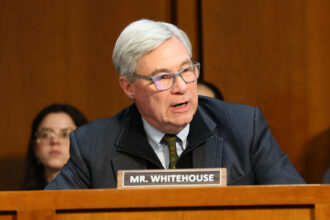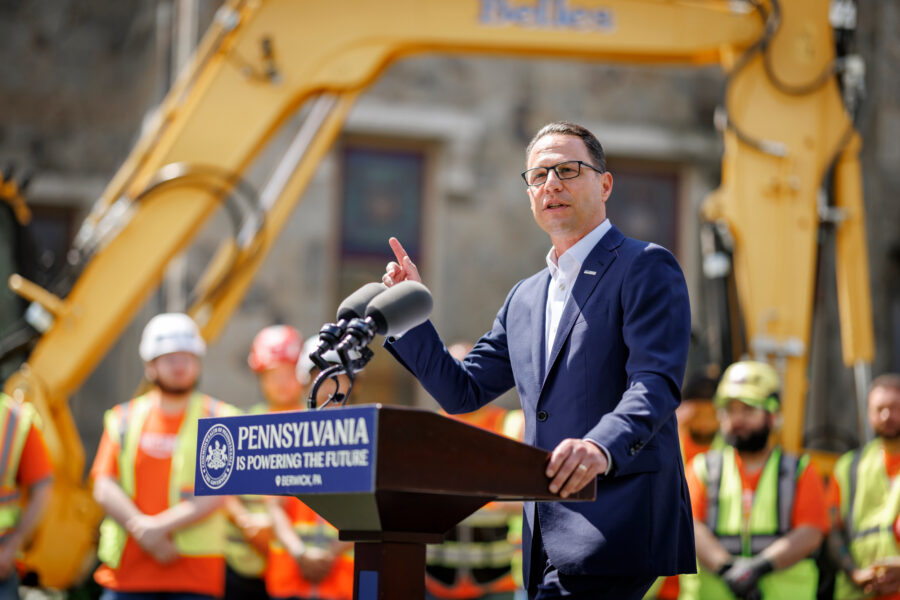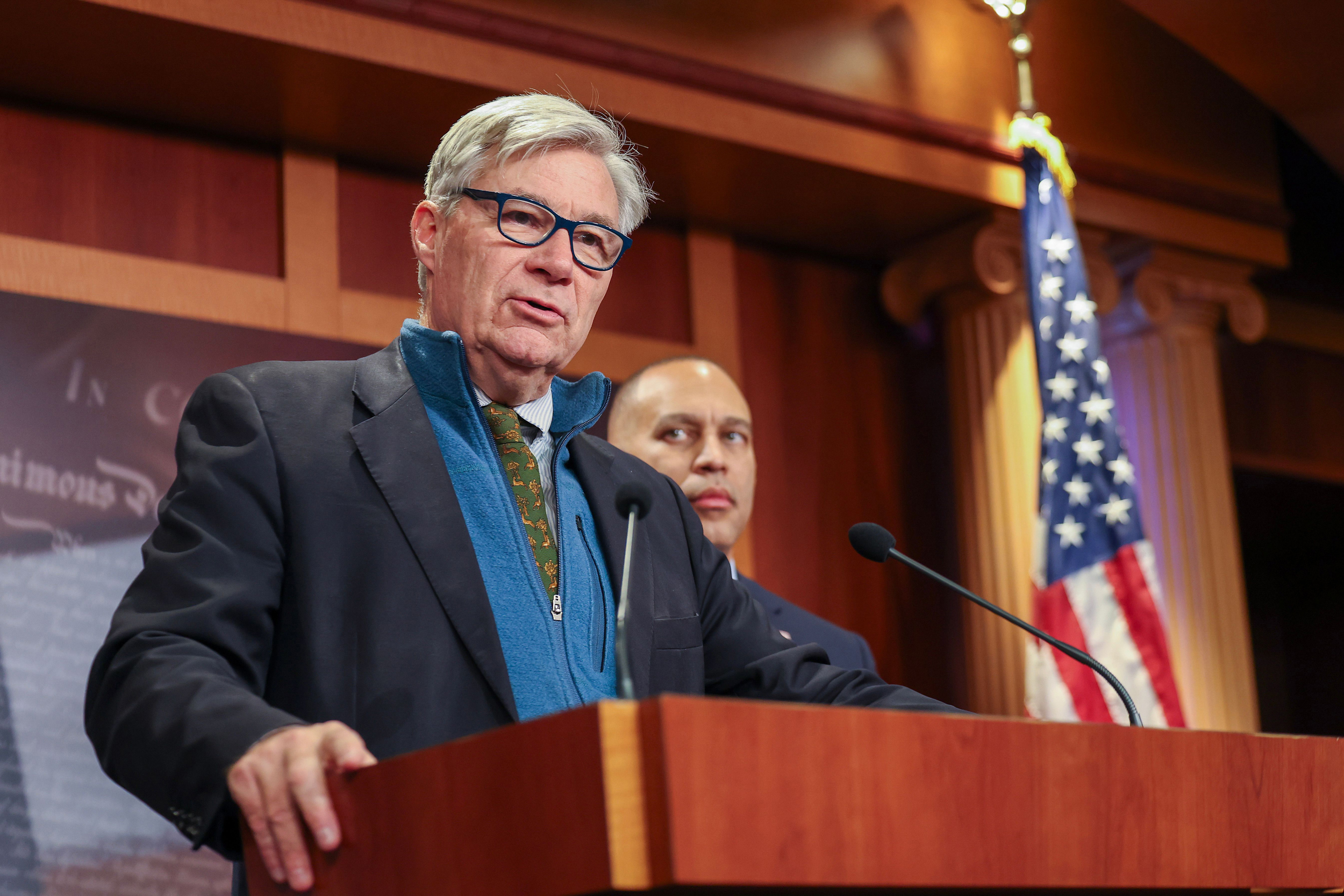


In late January, U.S. Sen. Sheldon Whitehouse of Rhode Island, a long-time climate hawk, said in a thread on X that Democrats should ignore calls to stop talking about climate.
“There’s a thing out there called a ‘climate husher,’” he wrote. “Anyone who cares about what fossil fuel pollution is doing to Earth’s natural systems needs to ignore these so-called ‘climate hushers’—people who think Dems should stop talking about climate.”
Climate hushing is a difficult phenomenon to pin down. As President Donald Trump relied on his climate denialist refrain with a reference to “the green new scam” in January at Davos, there’s no question that corporate America has gone quiet on climate. But the exact pervasiveness of political climate hushing headed into the 2026 midterms is yet to be seen as Democrats wrestle with the best way to talk about a core party principle: the urgency of addressing climate change.
A number of rising Democratic stars, from New York Mayor Zohran Mamdani to Virginia Gov. Abigail Spanberger, are aiming to challenge the Trump administration on energy, electricity prices and climate with a broader focus on affordability. This, many say, is not climate hushing, but a necessary reframing to get their message across to voters.
“ I think it’s a bit of a distraction,” U.S. Rep. Jared Huffman, D-Calif., an influential climate leader and ranking Democrat on the House Natural Resources Committee, said of climate hushing. “I think the fact that we want to sharpen our message for this moment so that we have the most impact should not be misunderstood as backing away from the climate imperative.”
According to Andrew Baumann, a partner at Global Strategy Group and long-time political pollster for Democratic campaigns, this shift is an opportunity driven in part by rising energy costs and the Trump administration’s opposition to clean energy projects.
“Electricity prices are going up at the same time that Donald Trump and Republicans are mounting an incredibly invasive and over the top campaign against clean energy—and this is something that’s really providing a lot of political opportunity for Democrats,” Baumann said.
Affordability First
The Trump administration has cut billions in clean energy investments and research suggests that Trump’s climate rollbacks could cause a $1.1 trillion dollar reduction in U.S. gross domestic product by 2035. The cuts to clean energy come at a time of strong concerns about affordability among voters.
“In an electorate focused on costs, 65 percent say climate change is raising their costs,” said Whitehouse on X, a figure that aligns with findings from the Climate Change in the American Mind project, a bi-annual study of American climate sentiment by the Yale Program on Climate Change Communication.
The study also found that voters rank cost of living second only to protecting democracy among their 2026 voting priorities.
This overlap of climate and affordability may help Democrats harness climate sentiment in the voting booth, which has historically been difficult.
The American Mind survey finds that a majority of U.S. voters would prefer a candidate who supports action on climate change, but when voters are asked to select their priorities, climate change lands in the middle for liberal Democrats behind issues like the economy, health care and cost of living. It ranks low for Republicans. With all registered voters, climate change ranks 17 out of 25 items. In other words, Americans care about climate, but other issues rank higher. Pairing climate with these higher-ranking issues is key for action.
“While it might seem like climate change itself is less of a priority for folks, in many ways it’s just a question of connecting the dots to show them how climate change connects to the things that they do prioritize,” said John Kotcher, co-principal investigator of the Yale climate survey and a research associate professor and director of the Center for Climate Change Communication at George Mason University.
Baumann echoes Kotcher’s sentiment.
“We continue to see that it [climate change] is a concern of voters and that voters generally want to see action on climate change, but I’m not gonna pretend it’s at the top of their list of issues,” Baumann said. “But I think the broader conversation about energy is a lot more salient.”
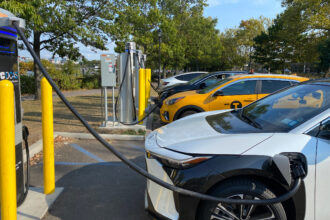
Renewable energy is increasingly cheaper and the quickest way to bring new energy online, and Democrats have an opportunity to lean into affordability and clean energy as a central message, Baumann said. He points to the gubernatorial races last year in New Jersey and Virginia, where both Mikie Sherrill and Abigail Spanberger defeated Republican opponents, as examples.
“There’s this force to bring the establishment, to bring the Democratic Party, to the center,” said longtime political pollster Clifford Young, a professor in the Bush School of Government and Public Service at Texas A&M University. “What does the center mean in this case? It means what people are most worried about, and they’re most worried about affordability.”
Who is a Climate Husher?
There is no litmus test for what makes a climate husher. Climate messaging is complicated and, in part, a semantic battle. Does saying the word “climate” mean you are a climate champion? Are you a climate champion if you don’t mention climate by name but promote climate solutions like clean energy?
The Searchlight Institute, a Democratic think tank run by veteran Democratic political strategist Adam Jentleson that opened its doors in 2025, made waves with its focus on shifting Democratic messaging away from progressive causes, like climate and LGBTQ issues. The think tank is pointed in its stance on climate messaging. A report released in the fall reads, “The First Rule About Solving Climate Change: Don’t Say Climate Change.”
“While battleground voters overwhelmingly agree climate change is a problem, addressing it is not a priority for them,” the report said. Similar to the American Mind Survey, Searchlight found that a majority of Americans believe that climate change is a problem, but rank it below other key issues, like affordability. Searchlight also found high partisan (Democratic) association with the terms “climate” and “climate change” and suggested jettisoning mentions of both altogether.
“ I don’t think it’s climate hushing,” said Tré Easton, vice president of public policy at Searchlight. “I think it’s being clear-eyed about where the voters are.”
He elaborated that Searchlight’s stance is not that the issue of climate change will go away if Democrats talk about it less. It’s a strategic decision, he said, to get Democrats who care about climate elected.
This story is funded by readers like you.
Our nonprofit newsroom provides award-winning climate coverage free of charge and advertising. We rely on donations from readers like you to keep going. Please donate now to support our work.
Donate NowHuffman said that the tone breaking through to lawmakers is largely “an affirmative message about affordability, not a negative one about climate hushing.”
For some, like Baumann, climate change is not a centerpiece of energy affordability messaging, but “a useful secondary piece.” Other politicians have also grown quiet on mentioning climate explicitly.
Tom Steyer, who announced his candidacy for California governor in November, has embraced economic populism as his rallying cry. Climate change was a central part of Steyer’s 2020 presidential run, but the topic was not mentioned at all in his campaign launch ad for governor.
“I’m talking about climate all the time in terms of clean air, economic competitiveness, insurance costs, electricity costs, all the different places where people are being affected,” Steyer said at a recent governors’ forum. He added: “It’s not climate hushing.”
Others, like Whitehouse, are still pushing for Democrats to talk about climate explicitly. “When leaders don’t talk about something, enthusiasm falls among voters. In politics, you can often make your own wind, or you can make your own doldrums,” he wrote on X.
Winning in the Midterms
Huffman, a former senior attorney at the Natural Resources Defense Council, is worried that conversations about climate hushing are painting a misleading picture of conflict and divide between Democrats. While there are differences, with affordability as its ballast, Huffman said, Democrats are broadly supportive of climate action. “We’re just trying to have a conversation about strategic impact,” he said.
But some of those differences are big. Some Democrats are pushing for an all-of-the above energy approach, like Pennsylvania Gov. Josh Shapiro, who is thought to be contemplating a run for president in 2028. Others, like Whitehouse, are pushing for a quicker transition away from fossil fuels. These variations are long-seated and not necessarily surprising. Headed into the 2026 midterms, voters can expect to see variation regionally.
“How a Democrat talks about climate in one place is maybe different than how a Democrat talks about climate in a different place, and I think we have to be comfortable with that,” said Jed Ober, managing director of political affairs at the NRDC Action Fund, which works to advance the Natural Resources Defense Council’s environmental goals.
To win, Democrats say they are trying to avoid the failures of the 2024 election cycle, when Trump owned messaging about the high cost of living as inflation spiked in the aftermath of the pandemic. “ Democrats botched the entire affordability issue in 2024. Big time. It’s part of the story of that disastrous election cycle,” said Huffman.
What is clear, is that while it is still early to pick apart midterm campaign strategies, experts seem to agree that affordability messaging will be key. Packaging climate and affordability may not amount to hushing, but the move signals a pragmatism heading into what most Democrats consider to be the most consequential midterms in their lifetimes.
About This Story
Perhaps you noticed: This story, like all the news we publish, is free to read. That’s because Inside Climate News is a 501c3 nonprofit organization. We do not charge a subscription fee, lock our news behind a paywall, or clutter our website with ads. We make our news on climate and the environment freely available to you and anyone who wants it.
That’s not all. We also share our news for free with scores of other media organizations around the country. Many of them can’t afford to do environmental journalism of their own. We’ve built bureaus from coast to coast to report local stories, collaborate with local newsrooms and co-publish articles so that this vital work is shared as widely as possible.
Two of us launched ICN in 2007. Six years later we earned a Pulitzer Prize for National Reporting, and now we run the oldest and largest dedicated climate newsroom in the nation. We tell the story in all its complexity. We hold polluters accountable. We expose environmental injustice. We debunk misinformation. We scrutinize solutions and inspire action.
Donations from readers like you fund every aspect of what we do. If you don’t already, will you support our ongoing work, our reporting on the biggest crisis facing our planet, and help us reach even more readers in more places?
Please take a moment to make a tax-deductible donation. Every one of them makes a difference.
Thank you,

Claire Barber
Fellow
Claire Barber is a fellow at Inside Climate News and masters in journalism student at Stanford University. She is an environmental and outdoor journalist, reporting primarily in the American Southwest and West. Her writing has appeared in The San Francisco Chronicle, Outside, Powder Magazine, Field & Stream, Trails Magazine and more. She loves to get lost in the woods looking for a hot spring, backpacking to secluded campsites and banana slugs.