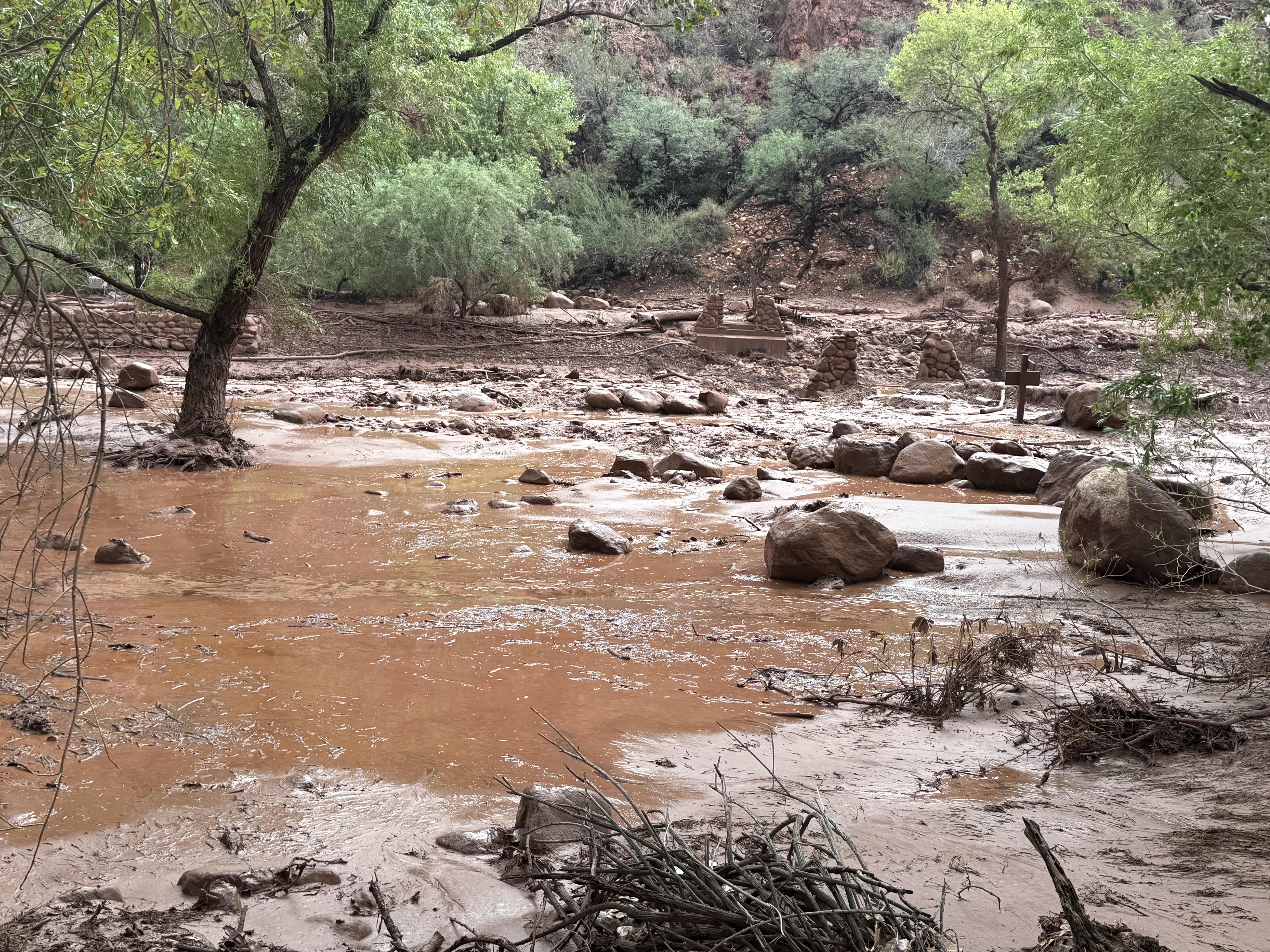


An intense downpour at Grand Canyon National Park transformed hiking trails and shallow creeks into deadly rapids over the weekend, killing at least two people.
Following scattered showers Saturday morning, around an inch of rain pummeled parts of the storied Arizona park in just a half hour later that day. Flash floods carried water, mud and debris through the rocky peaks and winding, narrow paths that scores of recreationalists traverse each year. Ahead of the storm’s apex, hikers scrambled to reach higher ground, some forced to find refuge in a cactus patch. Overall, around 80 people were evacuated over the weekend from the area near Bright Angel Creek at the bottom of the Grand Canyon. Authorities are still searching for at least one missing person.
Though the damage in the area is still being assessed, the National Park Service said this violent flooding had “significant impacts” on infrastructure, destroying nearly all footbridges in the Bright Angel Creek area and roughly 40 percent of the Transcanyon Waterline, a crucial water supply line for the park. This could cut off freshwater access for visitors and the hundreds of people living in the park, and will likely take more than six months to fix, officials say.
The recovery “first starts with safety, search and rescue operations, moves to stabilization, and then we’ll start working on what that recovery looks like in the planning process over the next two weeks,” Brian Drapeaux, the deputy superintendent of Grand Canyon National Park, said at a Monday press conference.
The Southwest is one of the country’s driest regions. Even so, flash flooding is not uncommon during monsoon season, which lasts from June to late September. But experts say the El Niño climate phenomenon—on top of longer-term, human-caused climate change—may have supercharged the storm, while a burn scar left behind by a severe fire last year paved the way for faster flooding.
The Grand Canyon continues to face drought, wildfire risks and flash-flood threats simultaneously, underscoring the compounding threats made worse by rapid warming in the region.
Deadly Flash Floods
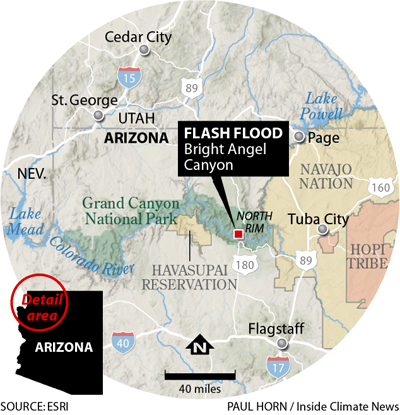
Stretching from the North Rim of the Grand Canyon to the Colorado River, the Bright Angel Canyon area hosts the most-used hiking trails descending into the national park. But the tight, winding paths and tall natural walls that make these trails so popular also make them dangerous.
Thunderstorms developed over the area on Saturday and dropped bursts of heavy rain on the dry landscape. The flooding rapidly funneled downstream through the canyon walls as visitors fled for their lives.
“The entire time it was raining—the entire time I’m going through all this and packing—I’m just keeping my eyes upstream, just praying that a wall of water isn’t coming toward us,” hiker Daniel Evans told The Associated Press.
Videos of the storm’s aftermath show muddy brown water rushing under bridges and through the area’s swollen creeks. The storm pummeled part of an area burned during last July’s Dragon Bravo Fire, an inferno that tore through nearly 150,000 acres and destroyed the historic Grand Canyon Lodge. As I reported last year, burn scars can exacerbate flooding by scorching vegetation and altering soil in ways that repel water.
On a webpage about the fire, the National Park Service website warns visitors of these risks, urging them to “exercise extreme caution in all affected watersheds during monsoon season, as burned areas are more prone to flash flooding and debris flows.”
“There’s not a great deal of vegetation to hold the runoff back, and so floods like this are not uncommon, and especially with this rainfall falling down on a huge fire scar in the drainage basin of Bright Angel Creek, it added to the intensity of the flood,” Wayne Ranney, a geologist and former backcountry ranger at the park, told me.
Living in Flagstaff, Arizona, for decades, Ranney is deeply familiar with the park’s rugged terrain and the severe dangers that monsoon season can bring. Officials confirmed on Monday that the floods killed two people, and one more remains missing. The flooding and threat of additional storms are disrupting rescue efforts, though searches continue this week, The New York Times reports.
At a press conference on Monday, Drapeaux said an emergency alerting gauge system was installed in the Bright Angel Creek after the Dragon Bravo Fire that informed officials about rising water. But the system went offline as the water progressed, and Drapeaux said it is not yet clear why.
Long-Term Threats at the Grand Canyon
Grand Canyon National Park is still open to visitors, though several trails were washed out by the floods. And damage, including to the 12.5-mile-long Transcanyon Waterline, could impact the entire park long after the floodwaters recede.
On Monday, the National Park Service closed overnight hotel accommodations within the park and turned off spigot access at the campgrounds on the South Rim. Since 2010, the pipeline has broken more than 85 times, and repairs have been complicated due to the remote, rugged landscape.
In 2023, the federal government launched a $208 million project to rehabilitate the pipeline, which was supposed to be finished next year. Officials say the latest damage will delay the completion by at least a few months. The National Park Service said about two weeks of water is available in storage.
Flash flooding is far from the only weather threat in the Grand Canyon during the summer. As of Monday evening, a roughly 300-acre wildfire was burning through Mount Emma on park lands, Drapeaux said, and park officials are prohibiting all wood burning and charcoal fires in the South Rim and inner canyon to prevent other blazes.
Heat fueled by climate change is also a growing risk, particularly in the inner canyon, where lower elevations trap warm air. The National Park Service reported three deaths in the Grand Canyon caused by apparent heat-related illnesses earlier this summer.
A persistent drought in the Southwest may have also made soil less likely to absorb the recent rain, triggering faster flooding, the Los Angeles Times reported. A recent study found that short-term, intense summer downpours in the U.S. West have become 10 percent stronger since 2000.
And as these weather extremes feed into each other, the more than 4 million people who visit Grand Canyon National Park each year could be at risk.
“We are mourning the lives that have been lost and thinking of those still missing, and of their families and loved ones,” Alex Johnson, the Southwest director of the nonprofit National Parks Conservation Association, said in a statement. “Last year’s devastating North Rim fires followed by this flash flood are a stark reminder of the increasing frequency and intensity of disasters that our parks face and of the need for proper resources to protect these places and all who visit them.”
More Top Climate News
The death toll from the catastrophic floods in Nepal last week has topped 1,000, with thousands more still missing. The economic toll is also steep: A Nepali official said the country will need $5 billion for recovery, and requested support from the United Nations’ climate-disaster recovery fund to help with the damages, Chico Harlan reports for The New York Times. Maheshwar Dhakal, the country’s climate change chief in the Ministry of Agriculture, Forest and Environment, told the news outlet that anthropogenic warming contributed to the glacial collapse that triggered the deluge. However, the fund—agreed upon by countries in 2023—has only $820 million in pledges.
A new report found that the fashion industry’s greenhouse gas emissions rose by nearly 14 percent in 2023 and 2024, Olivia Raimonde reports for Bloomberg News. In 2024 alone, the industry’s emissions share was equivalent to Japan’s entire climate footprint. Experts attribute this rise largely to the increase in global fiber production—particularly freshly produced polyester versus recycled materials.
The Trump administration is mulling a deal to give a small chunk of California’s Yosemite National Park to a private developer, Jake Spring reports for The Washington Post. The deal would exchange this parkland for privately owned land elsewhere in California. The company plans to use the parkland to build a road leading directly to its planned housing development. The Interior Department told the Post that it had not yet made a final decision.
About This Story
Perhaps you noticed: This story, like all the news we publish, is free to read. That’s because Inside Climate News is a 501c3 nonprofit organization. We do not charge a subscription fee, lock our news behind a paywall, or clutter our website with ads. We make our news on climate and the environment freely available to you and anyone who wants it.
That’s not all. We also share our news for free with scores of other media organizations around the country. Many of them can’t afford to do environmental journalism of their own. We’ve built bureaus from coast to coast to report local stories, collaborate with local newsrooms and co-publish articles so that this vital work is shared as widely as possible.
Two of us launched ICN in 2007. Six years later we earned a Pulitzer Prize for National Reporting, and now we run the oldest and largest dedicated climate newsroom in the nation. We tell the story in all its complexity. We hold polluters accountable. We expose environmental injustice. We debunk misinformation. We scrutinize solutions and inspire action.
Donations from readers like you fund every aspect of what we do. If you don’t already, will you support our ongoing work, our reporting on the biggest crisis facing our planet, and help us reach even more readers in more places?
Please take a moment to make a tax-deductible donation. Every one of them makes a difference.
Thank you,

Kiley Price
Reporter
Kiley Price is a reporter at Inside Climate News, with a particular interest in wildlife, ocean health, food systems and climate change. She writes ICN’s “Today’s Climate” newsletter, which covers the most pressing environmental news each week.
She earned her master’s degree in science journalism at New York University, and her bachelor’s degree in biology at Wake Forest University. Her work has appeared in National Geographic, Time, Scientific American and more. She is a former Pulitzer Reporting Fellow, during which she spent a month in Thailand covering the intersection between Buddhism and the country’s environmental movement.