

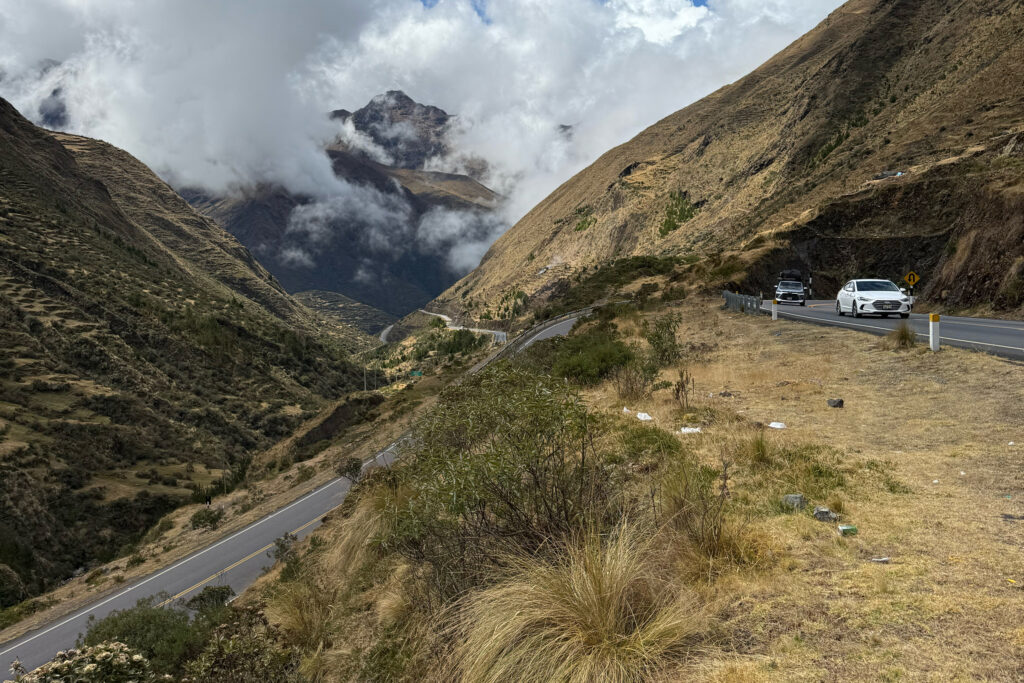
The two-lane Interoceanic Highway climbs from the humid flatlands of Peru’s Amazon rainforest upward toward the famed Incan city of Cuzco. Along the way, it serpentines across rivers, through clouds, past rocky hillsides stippled with grazing llamas and alpacas. The air at the very crest of the highway—at more than 15,500 feet—is so thin, everything seems to move in slow motion.
In 2011, when the highway was completed, it connected the Brazilian state of Acre, in Brazil’s western Amazon, to the coast of Peru. The road runs 1,600 miles from Brazil, westward through the city of Puerto Maldonado, then winds up the Andes to Cuzco, and back down to Lima.
The intent of the developers was to boost commerce between the two countries by finally connecting them by road. Brazil, in particular, wanted its agricultural products to reach the continent’s west coast and Asian markets faster. But the construction process was mired in corruption and today, critics say, it is scarcely used—at least for legitimate trade.
Instead the road has become a conduit for rampant deforestation and illegal gold mining that has turned Puerto Maldonado and the surrounding state of Madre de Dios into the illicit gold mining capital of Peru.
“It was the kind of place where, if someone had too much to drink, they’d fall asleep on a bench and wake up in the morning with their wallet still in their pocket,” said Robin Van Loon, an American who has lived near Puerto Maldonado, where he has run a reforestation organization, for two decades “It was this idyllic jungle city in the middle of nowhere. Now it’s filled with illegal activity and gangs.”
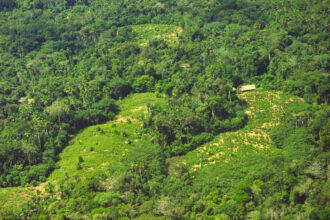
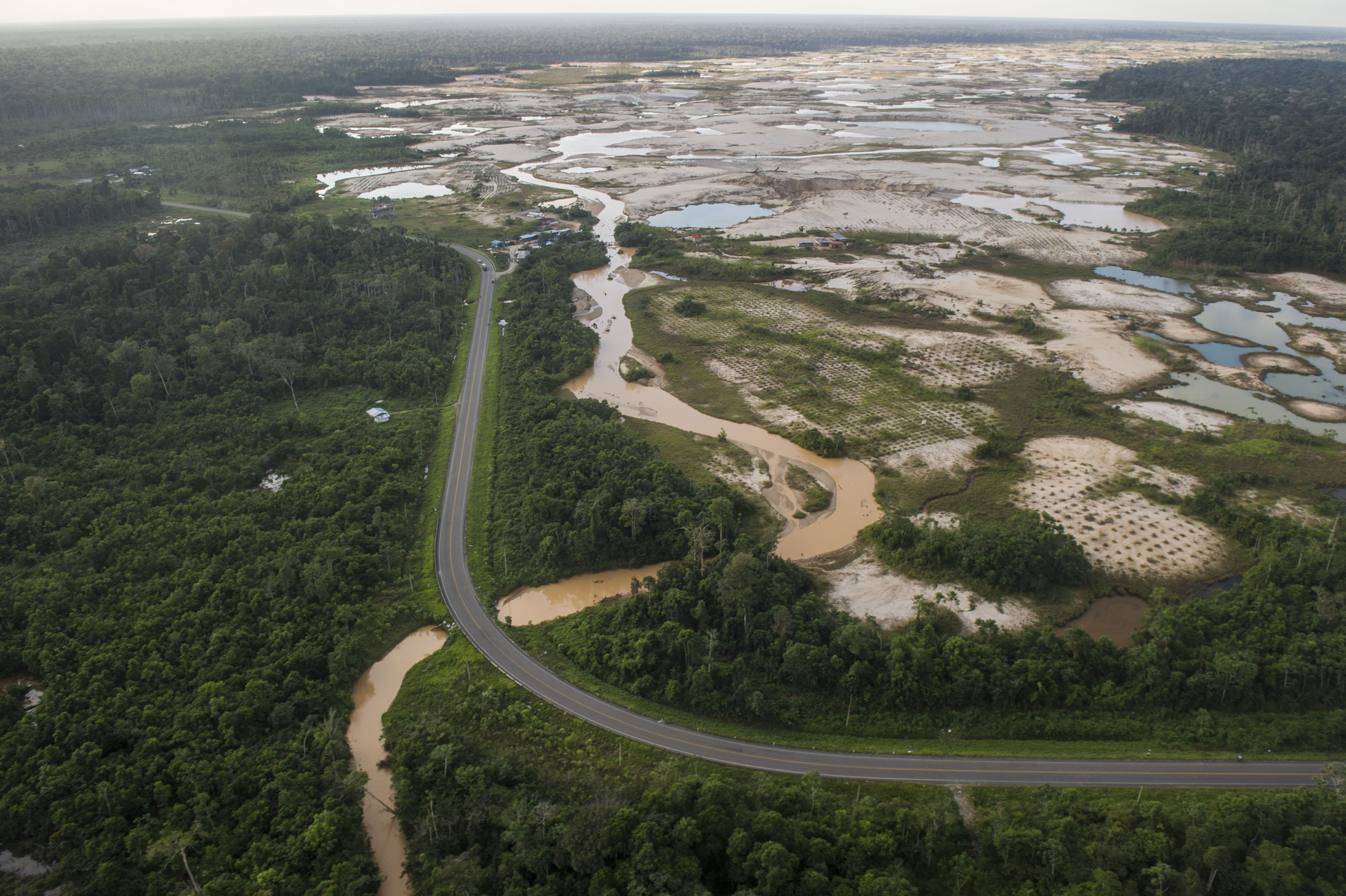
The highway led to an explosion in illegal gold mining in the region, and with it, a surge in deforestation. Peruvian researchers have attributed 350,000 acres of lost forest, mostly in Madre de Dios, to illegal gold mining alone.
Today, outside Puerto Maldonado, a sandy wasteland spreads along both sides of the highway. The area, known as La Pampa, used to be lush tropical rainforest. But after years of gold mining, it is a denuded expanse where shallow toxic waters pool in sickly brownish-yellow puddles and pale leafless trees spike across the horizon. Small settlements have sprouted along the highway—and within them, prostitution, human trafficking and violence, much of it connected to organized crime.
Luis Fernandez, executive director of Wake Forest University’s Center for Amazonian Scientific Innovation has extensively studied the impact of small-scale mining on deforestation in the Amazon. He says Madre de Dios has always been known to have alluvial gold deposits. But the wastelands of La Pampa are there for one reason: “The highway, the infrastructure,” Fernandez said. “If you have to bushwhack through the jungle, you might find a lot of gold, but it’s going to cost you a lot of money, so you don’t.”
The highway also coincided with a surge in the price of gold, which began climbing in 2008 and hasn’t stopped. Lured by the promise of riches in the jungle, people from poor Andean communities flowed into the region along the new highway. A population boom followed. Today, most people in Madre de Dios are of Andean, not Amazonian, descent. “There’s been a huge in-migration,” Fernandez said. “It was kind of a perfect storm.”
With more people in this once-isolated region, a cascade of ecological problems followed.
After miners exhausted the creeks and rivers, they moved into the forest and cut down patches of trees to mine there. “Then that starts to fragment the forests,” Fernandez explained. “And then you start to get to even bigger areas. And once they start to interconnect, you change the water table, and then you start to lose a lot more carbon. … These big standing forests are starting to dry out because you’re changing the groundwater, and then they burn.”
Unlike boreal forests, which burn naturally and regeneratively, rainforests don’t. Climate models are projecting that the Western Amazon will get drier in coming years and turn into savannah. “When you have these multiple stressors, not just mining, they start to weaken the fabric, so when the fire comes through, it’s going to burn a lot more intensely,” Fernandez said. “You’re going to get a more profound loss of the ground carbon—that upper level of carbon that gets released when you have really hot fires.”
This story is funded by readers like you.
Our nonprofit newsroom provides award-winning climate coverage free of charge and advertising. We rely on donations from readers like you to keep going. Please donate now to support our work.
Donate NowGold mining has been the driving force behind the destruction of the forest in this corner of the Amazon. Farther north and east, other drivers are timber, palm oil plantations, soy and cattle—the latter being the biggest force behind deforestation in the Amazon region, writ large.
Roads allow these industries to gain purchase and expand.
“Access is everything,” said Meg Symington, vice president of global integrated programs at the World Wildlife Fund, who has extensively studied the Amazon. “Ninety-five percent of deforestation happens within five-and-a-half kilometers of a road, or one kilometer of a river.”
Symington added: “Roads are incredibly destructive. And the Interoceanic Highway, specifically, is an example of a bad road.”
“A road is always the death of the rainforest, and that’s been borne out by literally every case you can think of.”
— Geoff Gallice
Not only has it ushered in illegal gold mining and other extractive industries that are wrecking swaths of this region, it bears the added insult of poor construction.
“They used bad materials,” Fernandez said. “They didn’t stabilize it. They put it through soils which essentially just fall apart every time it rains, so you get all these landslides.”
The highway is not being used to move agricultural commodities from Brazil because it’s too narrow and serpentine for the large dual-carriage trucks that haul soybeans in the Amazon to navigate.
“A road is always the death of the rainforest, and that’s been borne out by literally every case you can think of,” said Geoff Gallice, an American biologist who lives about an hour north of Puerto Maldonado. “The intended goal of the highway was to increase trade—an economic boon, and it hasn’t been that at all.”
Pilar Delpino Marimón, a Peruvian researcher with Clark University’s School of Geography, focuses on infrastructure development in the Western Amazon. Delpino says the highway is a 1,600-mile long cautionary tale—a warning of what could happen when projected new routes bore through sections of the world’s largest rainforest.
“We know from past experience what those will look like,” she said. “If we don’t have the appropriate regulations and protections, and normative teeth so that people follow the laws, we’re going to see something very similar to what’s happening—illicit activities, deforestation.”
About This Story
Perhaps you noticed: This story, like all the news we publish, is free to read. That’s because Inside Climate News is a 501c3 nonprofit organization. We do not charge a subscription fee, lock our news behind a paywall, or clutter our website with ads. We make our news on climate and the environment freely available to you and anyone who wants it.
That’s not all. We also share our news for free with scores of other media organizations around the country. Many of them can’t afford to do environmental journalism of their own. We’ve built bureaus from coast to coast to report local stories, collaborate with local newsrooms and co-publish articles so that this vital work is shared as widely as possible.
Two of us launched ICN in 2007. Six years later we earned a Pulitzer Prize for National Reporting, and now we run the oldest and largest dedicated climate newsroom in the nation. We tell the story in all its complexity. We hold polluters accountable. We expose environmental injustice. We debunk misinformation. We scrutinize solutions and inspire action.
Donations from readers like you fund every aspect of what we do. If you don’t already, will you support our ongoing work, our reporting on the biggest crisis facing our planet, and help us reach even more readers in more places?
Please take a moment to make a tax-deductible donation. Every one of them makes a difference.
Thank you,