

Last year was the hottest on record, but global warming isn’t just overheating the planet. It’s killing workers.
Now a new analysis of the impact of state-implemented outdoor heat standards on worker deaths adds to the growing body of scientific research showing that requiring employers to take simple precautions to prevent heat stress can reduce the risk of injury, illness and death from exposure to high temperatures on the job.
Similar precautions are included in the heat standard the Biden administration proposed last year, which the U.S. Occupational Safety and Health Administration is expected to finalize by early next year.
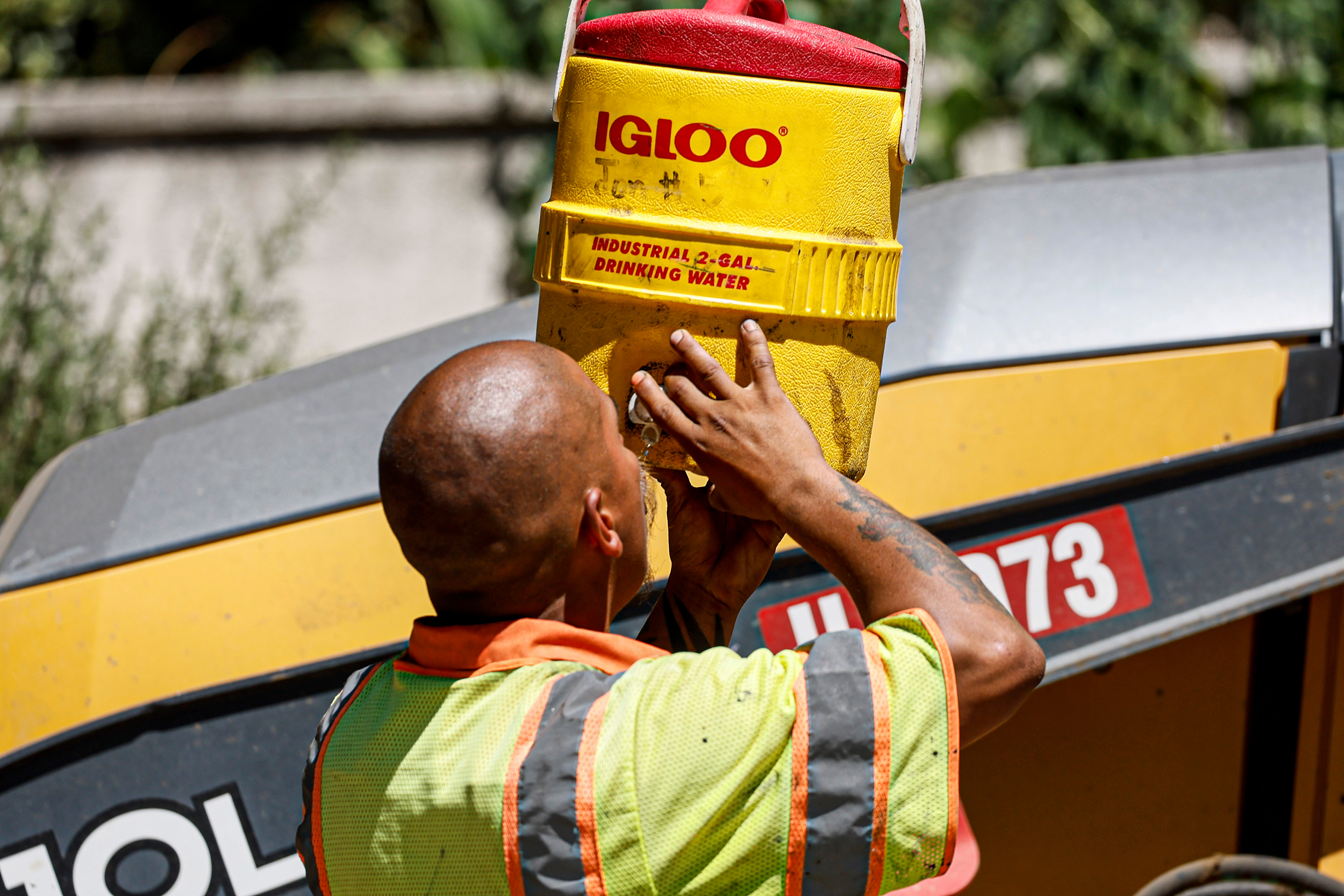
Under the proposed federal rule, employers must provide adequate water, rest and shade when the heat index—a measure of how humidity amplifies heat’s effects on the body—reaches 80 degrees Fahrenheit, and take additional measures, such as providing paid 15-minute breaks every two hours, once the index reaches 90 degrees.
For nearly two decades, California was the only state to mandate such protections for outdoor workers. Over the past three years, Colorado, Maryland, Nevada, Oregon and Washington have passed similar rules.
In the new study, published in the peer-reviewed journal Health Affairs, labor policy experts compared heat-related deaths among outdoor workers in California, which adopted the nation’s first outdoor heat standard in 2005, with neighboring states that have similar climates but lacked a standard during the study period, from 1999 through 2020.
Critics argued that the 2005 standard was not actively enforced and its ambiguous wording allowed employers to skirt requirements. In keeping with those critiques, the researchers saw a drop in worker deaths relative to the surrounding states only after 2010, when the state enhanced enforcement and subsequently strengthened requirements to ensure workers had access to water, shade, breaks and emergency services during hot days.
The California standard became increasingly effective over time, said study author Adam Dean, an associate professor of political science at George Washington University, while worker deaths in the neighboring states of Arizona, Nevada and Oregon increased.
“After 2010, we’re finding a statistically significant association between the heat standard and heat-related outdoor deaths,” said Dean, meaning that the effect seen was not due to chance.
And there was a significant drop in heat-related deaths after stronger enforcement was implemented, Dean said, calling the observed 33 percent reduction in deaths “a conservative estimate.”
California officials ramped up enforcement of the heat standard starting in 2010 by increasing workplace inspections, issuing more citations for violations and expanding educational outreach to both employers and workers.
“The study’s methods are sound and its results are of great importance, documenting the life-saving impact of a comprehensive workplace heat standard,” said epidemiologist David Michaels, a professor at George Washington University’s Milken Institute School of Public Health and a former top OSHA administrator who was not involved in the study.
“The finding that the revised standard so successfully prevented worker heat deaths is evidence that a clear, comprehensive workplace standard is an effective tool for saving lives,” said Michaels.
Undercounting Heat Deaths
Far too many workers are getting sick and dying from preventable heat-related illnesses, former OSHA deputy assistant secretary Jordan Barab said in formal comments in October as the agency considered a heat standard more than 50 years after government scientists first recommended one.
“And because of severe undercounting,” Barab said, “far more are dying than we even know about.”
Heat-related deaths are routinely undercounted for various reasons, including a failure to recognize how high temperatures trigger fatal heart attacks, strokes and deadly accidents as well as inconsistent reporting by medical professionals and coroners. Heat exposure is extremely risky for workers with underlying heart or lung conditions, especially if they’re laboring in polluted air.
Because working in hot conditions can impair cognitive function and lead to accidental injury and death, Dean and his colleague Jamie McCallum, an expert on worker struggles at Middlebury College, included vehicular deaths related to equipment in agriculture, construction and transportation as potentially caused by heat stress.

While the study didn’t attribute every vehicular fatality to heat, Dean said, if the heat standard is effective, they would have expected to see a decline in those types of deaths relative to other states after implementing the policy. “What we’re saying is that the fact that these kinds of deaths in California decreased relative to those deaths in the neighboring states after the heat standard was passed is evidence in favor of the heat standard having been effective.”
In all, the team identified more than 6,000 heat-related deaths among outdoor workers in 126 counties in Arizona, California, Nevada and Oregon, about 300 deaths a year on average, between 1999 and 2020. Arizona had the most deaths overall and holds the county with the highest number of deaths in a year, Maricopa County, which had 233 deaths in 2020.
All the states had spikes in worker deaths until 2010, when a very rapid increase in deaths in Arizona, plus spikes in Oregon and Nevada, together accounted for the 33 percent drop in California deaths relative to the other states, Dean said.
Dean said the study makes no claim that California’s 2010 enforcement campaign was “perfectly successful.” In fact, he said, worker deaths in California have actually increased since 2010 on average, but the increase in the surrounding states that lack a standard is much more extreme.
This story is funded by readers like you.
Our nonprofit newsroom provides award-winning climate coverage free of charge and advertising. We rely on donations from readers like you to keep going. Please donate now to support our work.
Donate NowCalifornia still had about 100 heat deaths a year from 2010 to 2020. But applying the conservative estimate that worker deaths decreased by 33 percent after 2010, Dean said, suggests the stronger standard saved about 34 lives per year.
“Climate change and increasing extreme heat is increasing the risk of heat-related deaths among outdoor workers everywhere,” Dean said. “Heat-standard precautions can mitigate the worst risk.”
Officials with U.S. OSHA did not respond to questions from Inside Climate News about when they expect to finalize the proposed heat standard or whether they will require employers to ensure workers have adequate water, shade and rest periods during hot days.
“Chronic and Persistent Vacancies”
The finding that worker deaths decreased over time in California is notable given perpetual understaffing challenges at Cal/OSHA, the state occupational safety and health agency, as outlined in a recent California State Audit report.
The study indicates that regulations on paper, especially those with loopholes, mean very little without effective enforcement by regulators, said Garett Brown, a retired Cal/OSHA field inspector who now serves as an agency watchdog.
“California’s enforcement gains are currently being undermined by chronic and persistent vacancies among field inspectors,” Brown said, noting that as of September 1, Cal/OSHA was operating with 95 inspector vacancies, a third of the available positions, and a $16 million cut in its enforcement budget.
“California has some of the strongest heat illness prevention standards in the nation,” said Denisse Gómez, a Cal/OSHA spokesperson. “Cal/OSHA continues to strengthen these protections through proactive inspections and by improving how the division responds to complaints.”
As for staffing, Cal/OSHA’s field inspector vacancy rate as of September 30 is 25 percent, Gómez said, adding that 71 of 280 positions remain vacant.
Still, just having a standard on the books can help save lives, said Michaels. Many agriculture employers learned about the stronger standard, heard about citations being issued by Cal/OSHA and decided to comply with the standard by providing water, shade and rest breaks, he explained.
“More farmworkers are alive today than would be if the stronger standard were not in effect,” Michaels said. “And more lives will be saved if federal OSHA adopts a similar standard.”
As temperatures continue to rise with greenhouse gas emissions, enforcement will be ever more critical to protecting undocumented workers and others who fear retaliation for taking the precautions that save lives, Dean and other labor experts say.
“We hope the federal government will implement a federal heat standard,” Dean said. “We also worry that it will not be effective in protecting workers unless it’s matched by the kind of increased enforcement that we’ve seen in California since 2010.”
Clarification: This story has been updated to include comments from Cal/OSHA that had not arrived by the time the story was initially published, and to clarify when positions were vacant at the agency.
About This Story
Perhaps you noticed: This story, like all the news we publish, is free to read. That’s because Inside Climate News is a 501c3 nonprofit organization. We do not charge a subscription fee, lock our news behind a paywall, or clutter our website with ads. We make our news on climate and the environment freely available to you and anyone who wants it.
That’s not all. We also share our news for free with scores of other media organizations around the country. Many of them can’t afford to do environmental journalism of their own. We’ve built bureaus from coast to coast to report local stories, collaborate with local newsrooms and co-publish articles so that this vital work is shared as widely as possible.
Two of us launched ICN in 2007. Six years later we earned a Pulitzer Prize for National Reporting, and now we run the oldest and largest dedicated climate newsroom in the nation. We tell the story in all its complexity. We hold polluters accountable. We expose environmental injustice. We debunk misinformation. We scrutinize solutions and inspire action.
Donations from readers like you fund every aspect of what we do. If you don’t already, will you support our ongoing work, our reporting on the biggest crisis facing our planet, and help us reach even more readers in more places?
Please take a moment to make a tax-deductible donation. Every one of them makes a difference.
Thank you,

Liza Gross
Reporter, California
Liza Gross is a reporter for Inside Climate News based in Northern California. She is the author of The Science Writers’ Investigative Reporting Handbook and a contributor to The Science Writers’ Handbook, both funded by National Association of Science Writers’ Peggy Girshman Idea Grants. She has long covered science, conservation, agriculture, public and environmental health and justice with a focus on the misuse of science for private gain. Prior to joining ICN, she worked as a part-time magazine editor for the open-access journal PLOS Biology, a reporter for the Food & Environment Reporting Network and produced freelance stories for numerous national outlets, including The New York Times, The Washington Post, Discover and Mother Jones. Her work has won awards from the Association of Health Care Journalists, American Society of Journalists and Authors, Society of Professional Journalists NorCal and Association of Food Journalists.