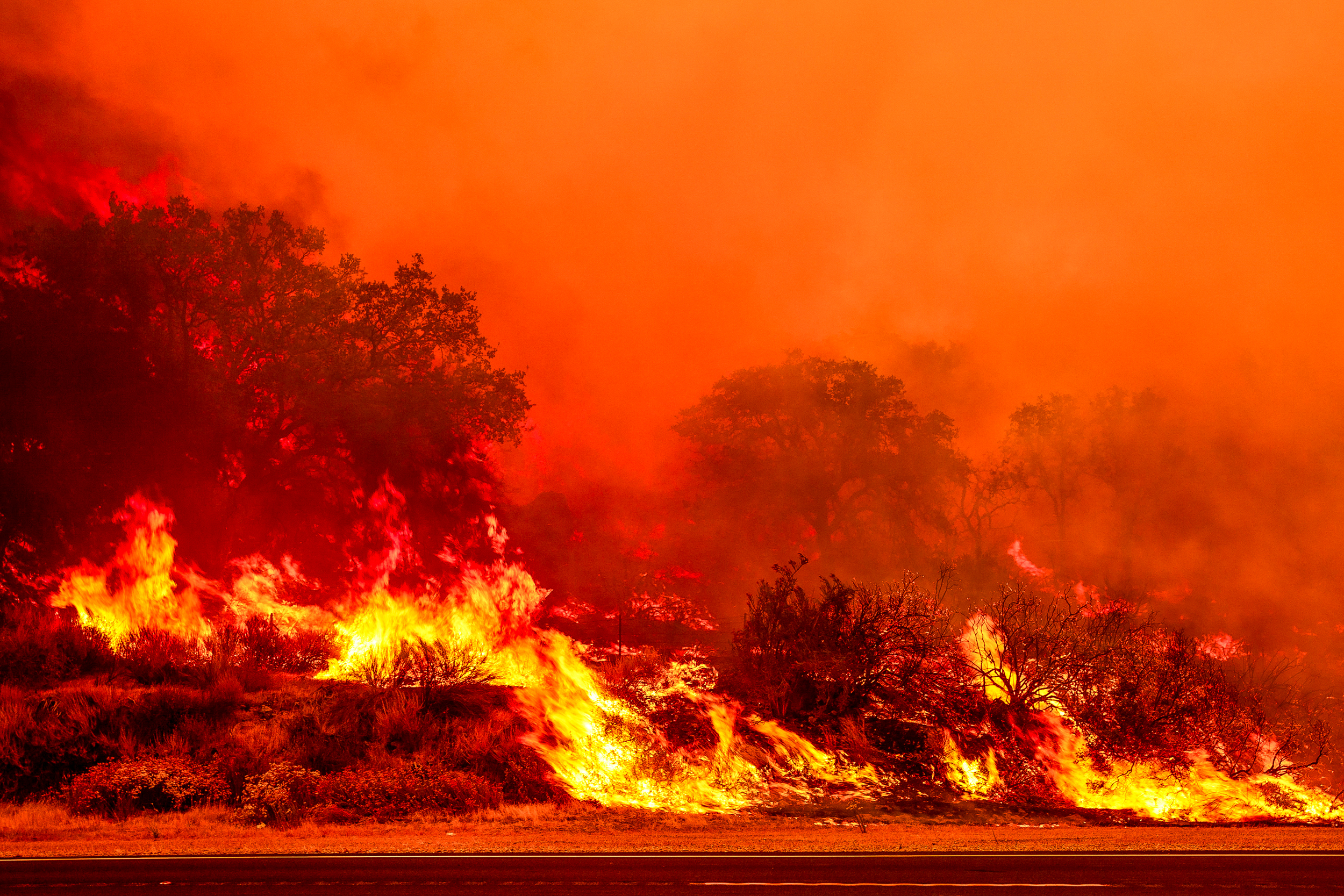


Lawmakers from both parties agreed at a congressional hearing Tuesday that the federal government must act to address the growing threat of catastrophic wildfires, but they were sharply divided over how, and whether pending legislation known as the Fix Our Forests Act offers the right path forward.
The House of Representatives passed the FOFA legislation on a bipartisan 279–141 vote in January 2025, and its companion bill is pending in the Senate. Despite some support from Democrats, the act has created sharp divisions among lawmakers and drawn fierce backlash from conservation groups.
Republican supporters of the bill championed its focus on fast-tracking the thinning and clearing of forests on large tracks of land by making exceptions to requirements in bedrock environmental laws. They argue that those steps are a fix for intensifying fires.
“Environmental laws adopted in the 1970s made land management impossible,” said Rep. Tom McClintock (R-Calif.). He cited the Endangered Species Act and National Environmental Policy Act, which require the federal government to assess the environmental impact of proposed projects, among the laws he sees as problematic.
The proposed wildfire legislation would allow certain projects to bypass some ESA and NEPA reviews, increasing the size limit on such exceptions from 3,000 acres to 10,000 acres. The bill would also limit the public’s ability to ask courts to review the legality of such moves.
Last year, President Donald Trump signed an executive order aimed at expanding timber production on public lands by taking aim at the Endangered Species Act and other environmental protections.
The forestry industry, including timber companies, has long directed significant campaign contributions to Republican candidates, according to the figures compiled by nonpartisan research group OpenSecrets.
Democrats on the House Committee on Natural Resources subcommittee that held the hearing, meanwhile, sharply criticized parts of the wildfire bill, arguing that it unnecessarily erodes environmental safeguards and expands logging, despite limited evidence that either makes communities safer.
“There are some good things in FOFA,” said Rep. Jared Huffman (D-Calif.), noting provisions that would deploy new wildfire monitoring tools. But he warned the legislation reflects misplaced priorities and lacks “real funding solutions” to back up lawmakers’ stated commitments to fire resilience.
Democrats also voiced frustration with Republicans for holding repeated hearings on FOFA while declining to examine how the Trump administration is reshaping, and in some cases hollowing out, federal agencies tasked with managing public lands and fighting fires.
“How much is it going to cost? Is it going to save money? Is it going to make us safer? Nothing. Crickets,” Huffman said.
Democrats also criticized shifts in federal spending priorities under the Trump administration. Money, they said, that could protect communities from wildfire has been funneled in vast amounts to Immigration and Customs Enforcement.
David Calkin, a leading wildland fire researcher, told lawmakers at the hearing that the United States has “fundamentally misdiagnosed” the wildfire problem. He said the cultural obsession with stopping fires when they break out rather than taking the steps needed to reduce risk has created a “debt that has come due,” resulting in a system that is “strained to the point of breaking.”
Calkin pointed to a two-fold action plan: strengthening the “built environment,” such as constructing fire-resistant homes, and strategically reintroducing fire into America’s landscape with low-intensity fires that can clear out excess vegetation that could otherwise fuel massive blazes when fire weather is extreme.
“Resilient landscapes require fire, and the only way to be safer and more effective in responding to fire is to do less of it,” he said.
Calkin also warned that fire policy needed to be insulated from “the political whims of the day” and that making fire go away is “not achievable.” He said he supported shifting funding from reactive fire suppression to proactive community hardening—making homes more resistant to fire.
Outside of the hearing, scientists and environmental advocates also criticized parts of FOFA, arguing that the bill is a gift to the logging industry and fundamentally misaligned with wildfire science.
This story is funded by readers like you.
Our nonprofit newsroom provides award-winning climate coverage free of charge and advertising. We rely on donations from readers like you to keep going. Please donate now to support our work.
Donate NowChad Hanson, an ecologist and co-founder of the John Muir Project, which wants to end federal timber sales, said the Fix Our Forests Act would allow logging on public lands without meaningful limits on how many trees, or which ones, could be cut. He also accused Republicans of leveraging the anniversary of the deadly Los Angeles fires to advance a bill that prioritizes logging.
“The Fix Our Forests Act is a logging bill cynically masquerading as a community wildfire protection measure, and the bitter irony is that the bill would likely exacerbate wildfires and put communities at even greater risk,” he said.
Ralph Bloemers, director of Fire Safe Communities, part of the nonprofit Green Oregon, said U.S. wildfire policy has long been driven by a flawed premise: that cutting and thinning forests will protect communities, despite repeated evidence to the contrary.
The most destructive fires in recent years, he said, were driven by wind and embers that ignited homes and spread rapidly through neighborhoods, overwhelming suppression efforts regardless of fuel treatments.
“Fire is inevitable. Home loss is not,” Bloemers said, emphasizing that real protection comes from ember-resistant construction and defensible space immediately around homes, not logging miles away.
Continuing to prioritize forest thinning over those measures, he added, reflects a deeper failure to confront reality: “We don’t have a wildfire problem. We have a truth problem.”
At the hearing, Democrats underscored that point, noting the Trump administration’s efforts to “airbrush” climate change from federal policy discussions, even as climate-driven drought and extreme winds intensify fires.
Two other bipartisan wildfire bills are also pending in Congress. One is sponsored by Huffman, which he said would directly support communities and put money “on the table” for wildfire preparedness. Sen. Alex Padilla (D-Calif.) introduced the other bill, which is focused on community resilience as well as the improvement, restoration and resilience of land in the National Forest System.
About This Story
Perhaps you noticed: This story, like all the news we publish, is free to read. That’s because Inside Climate News is a 501c3 nonprofit organization. We do not charge a subscription fee, lock our news behind a paywall, or clutter our website with ads. We make our news on climate and the environment freely available to you and anyone who wants it.
That’s not all. We also share our news for free with scores of other media organizations around the country. Many of them can’t afford to do environmental journalism of their own. We’ve built bureaus from coast to coast to report local stories, collaborate with local newsrooms and co-publish articles so that this vital work is shared as widely as possible.
Two of us launched ICN in 2007. Six years later we earned a Pulitzer Prize for National Reporting, and now we run the oldest and largest dedicated climate newsroom in the nation. We tell the story in all its complexity. We hold polluters accountable. We expose environmental injustice. We debunk misinformation. We scrutinize solutions and inspire action.
Donations from readers like you fund every aspect of what we do. If you don’t already, will you support our ongoing work, our reporting on the biggest crisis facing our planet, and help us reach even more readers in more places?
Please take a moment to make a tax-deductible donation. Every one of them makes a difference.
Thank you,