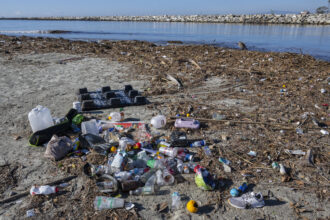


Citing the Trump administration’s promise to “Make America Healthy Again,” the U.S. Environmental Protection Agency placed microplastics and pharmaceuticals on a draft list of contaminants maintained by the agency.
The Sixth Contaminant Candidate List includes known or likely contaminants in public water systems that are currently unregulated but may be subject to future regulation by the EPA.
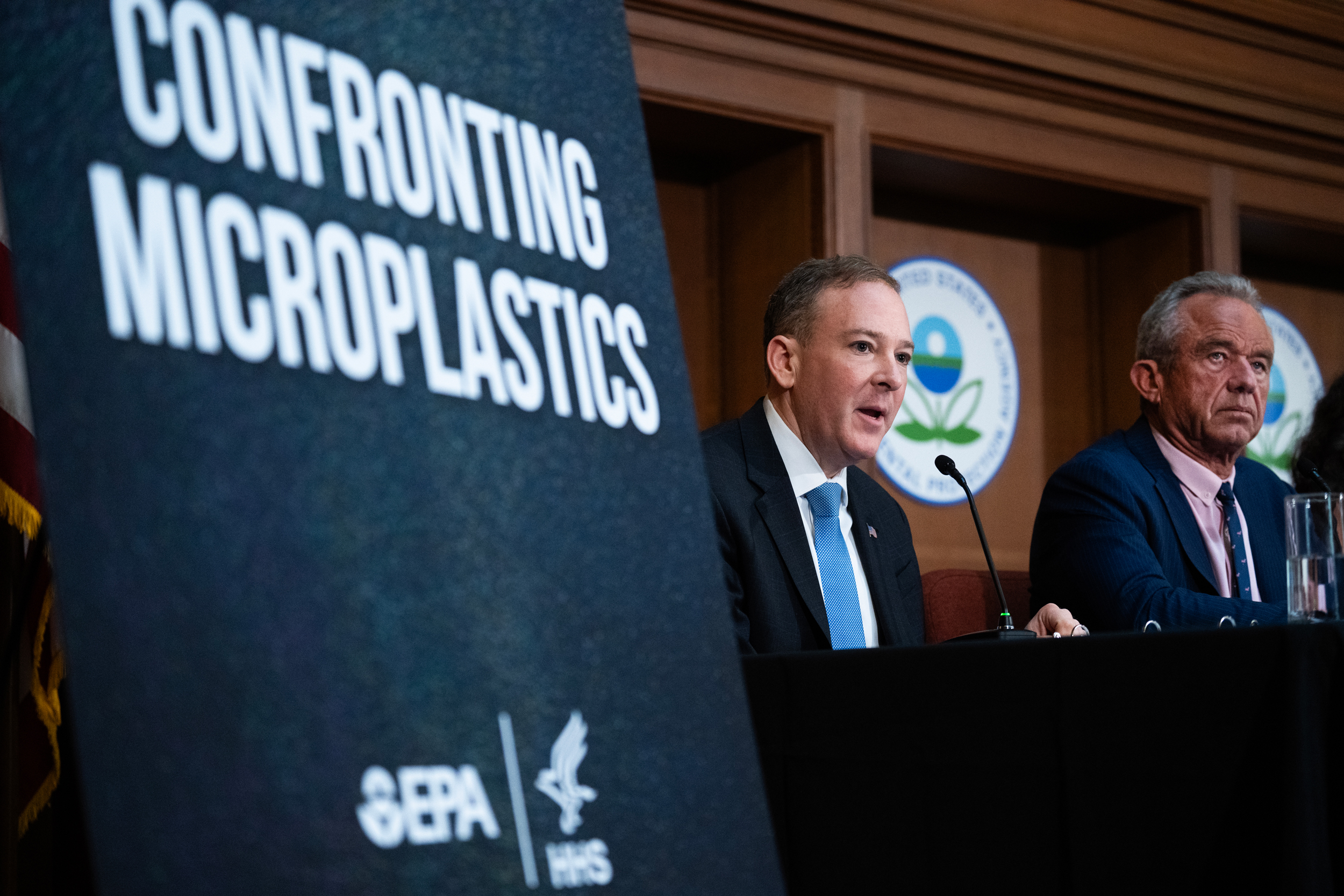
In a joint announcement yesterday with EPA Administrator Lee Zeldin and Health and Human Services Secretary Robert F. Kennedy Jr., the agency heralded the move as a “historic” response to concerns raised by Americans over toxic chemicals and plastic pollution in drinking water.
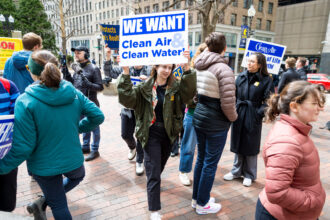
But environmental defense groups, as well as food and water advocacy organizations, have criticized the action as political posturing without any regulatory teeth.
“This is just smoke and mirrors,” said Suzanne Novak, a senior attorney and director of drinking water advocacy at Earthjustice, an environmental public-interest group. “This is the first step in a process that almost always leads to not regulating.”
Placement on the Contaminant Candidate List (CCL) does not guarantee that the agency will eventually regulate microplastics. The Safe Drinking Water Act requires the EPA to publish a new list every five years, which the agency says it uses “to identify priority contaminants for regulatory decision making and information collection.”
But the EPA has set drinking water regulations for an exceedingly small number of new contaminants over the last two decades. And even that small set of recently added regulations has faced aggressive rollback attempts by Trump’s first and second administrations.
In 2011, the EPA decided to regulate perchlorate, a toxin used in rocket fuel and fireworks that has been linked to brain damage in infants. But in 2020, during Trump’s first term, the EPA withdrew its decision before a drinking water standard for the chemical could be set. A federal appeals court overturned the rollback, and the EPA is now required to finalize a maximum contaminant level for perchlorate by May 21, 2027.
Trump’s EPA has also announced plans to roll back Biden-era regulation of PFAS (per- and polyfluoroalkyl substances), the only other new compounds to face national drinking water regulations in the last 20 years.
Microplastics do not need to be on the CCL for the EPA to research their potential health impacts, said Novak. And while the announcement touted a dialed-up commitment to microplastics research, the EPA’s research capacity could be limited, given Zeldin’s 2025 decision to eliminate the agency’s Office of Research and Development and to fire thousands of employees.
Nor does placement on the list require the EPA to monitor microplastic levels in drinking water sources. There is a separate list for that, the Unregulated Contaminant Monitoring Rule (UCMR), the latest version of which is due to be finalized by the end of 2026.
If the EPA wishes to tackle the health and environmental threats posed by microplastics, the agency should commit to monitoring and place them on the UCMR list, said Erin Doran, senior attorney for Food & Water Watch, in a statement released by the watchdog group.
“Today’s announcement of including microplastics on CCL 6, while a step in the right direction, ultimately falls short on its own,” Doran said. “It does not reflect the urgent need for a comprehensive nationwide monitoring program for microplastics in drinking water now.”
At the joint EPA and Department of Health and Human Services briefing, HHS officials also announced a $144 million initiative, called STOMP, or Systematic Targeting Of Microplastics, that will invest in technology to monitor and remove microplastics from drinking water and design experiments to understand their effects on human health.
MAHA Action, a nonprofit organization associated with the Make America Health Again movement, listed the HHS initiative as a “MAHA Win” on their site.
It’s an empty victory, Novak said. “This isn’t news. They’re required to put contaminants on this list. And it says something that they’re trying to make this news to distract from all the actual, tangible actions they are taking to undermine people’s health.”
About This Story
Perhaps you noticed: This story, like all the news we publish, is free to read. That’s because Inside Climate News is a 501c3 nonprofit organization. We do not charge a subscription fee, lock our news behind a paywall, or clutter our website with ads. We make our news on climate and the environment freely available to you and anyone who wants it.
That’s not all. We also share our news for free with scores of other media organizations around the country. Many of them can’t afford to do environmental journalism of their own. We’ve built bureaus from coast to coast to report local stories, collaborate with local newsrooms and co-publish articles so that this vital work is shared as widely as possible.
Two of us launched ICN in 2007. Six years later we earned a Pulitzer Prize for National Reporting, and now we run the oldest and largest dedicated climate newsroom in the nation. We tell the story in all its complexity. We hold polluters accountable. We expose environmental injustice. We debunk misinformation. We scrutinize solutions and inspire action.
Donations from readers like you fund every aspect of what we do. If you don’t already, will you support our ongoing work, our reporting on the biggest crisis facing our planet, and help us reach even more readers in more places?
Please take a moment to make a tax-deductible donation. Every one of them makes a difference.
Thank you,

Anika Jane Beamer
Reporter, Iowa
Anika Jane Beamer covers the environment and climate change in Iowa, with a particular focus on water, soil and CAFOs. A lifelong Midwesterner, she writes about changing ecosystems from one of the most transformed landscapes on the continent. She holds a master’s degree in science writing from the Massachusetts Institute of Technology as well as a bachelor’s degree in biology and Spanish from Grinnell College. She is a former Outrider Fellow at Inside Climate News and was named a Taylor-Blakeslee Graduate Fellow by the Council for the Advancement of Science Writing.