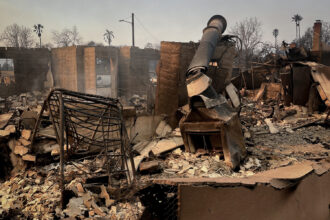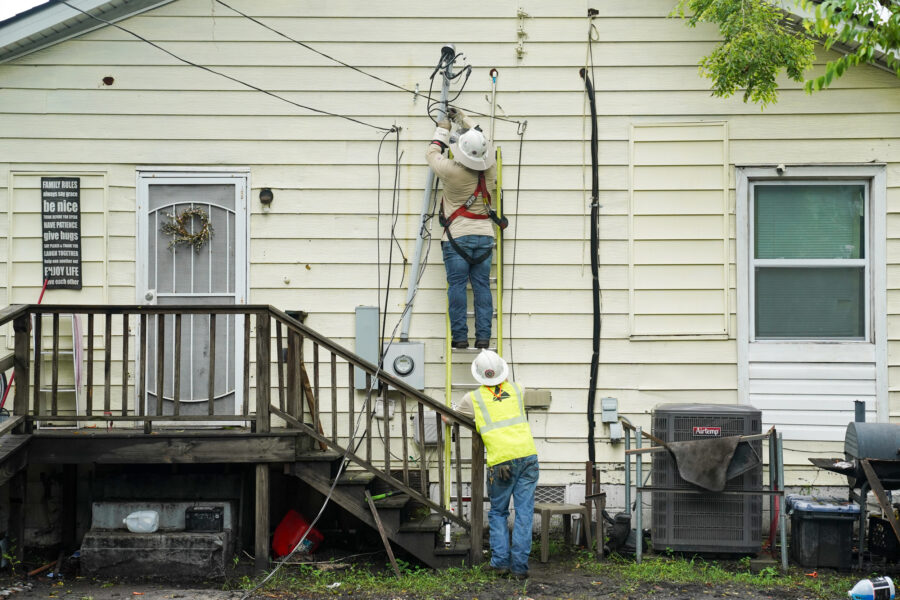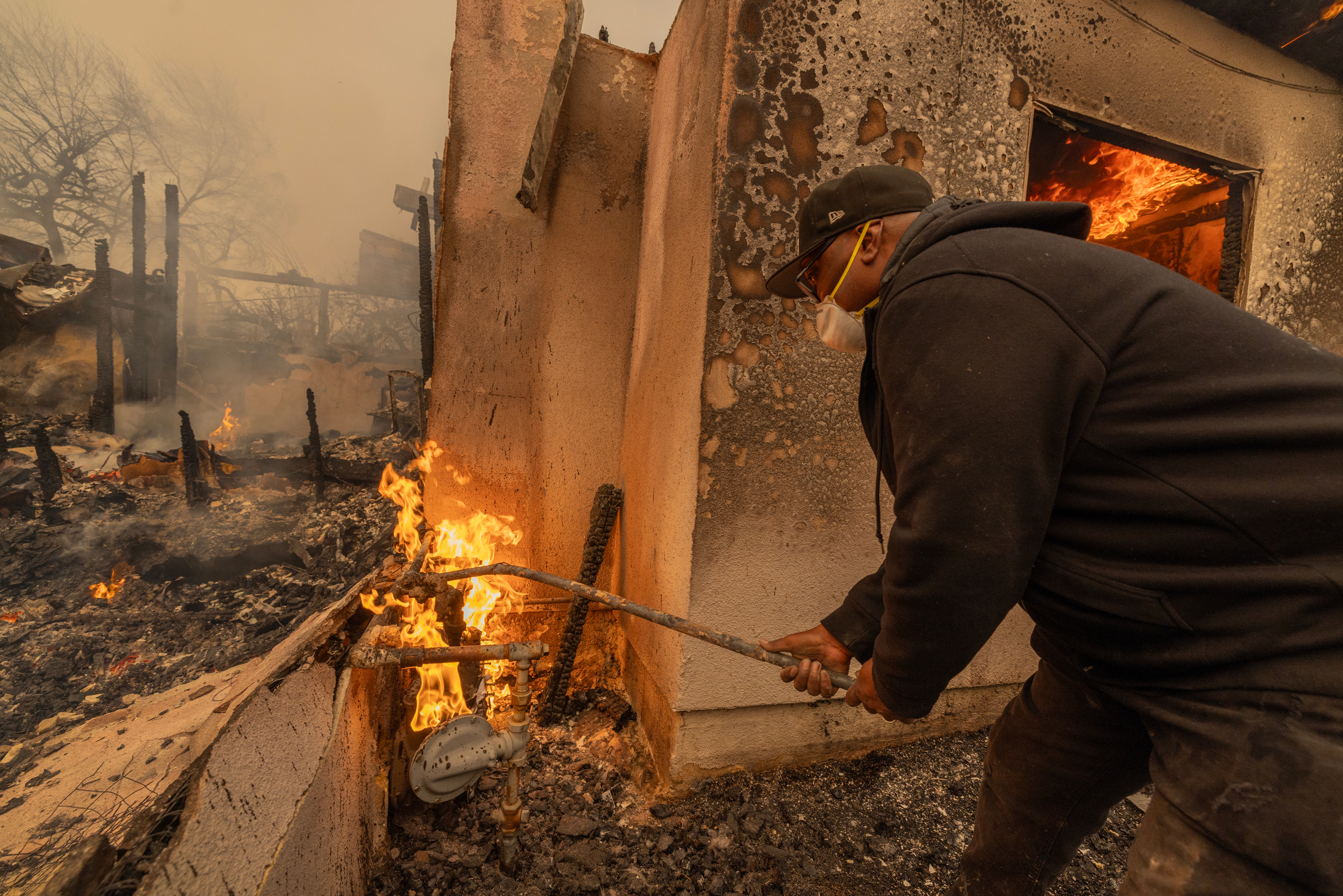


After January wildfires destroyed more than 18,000 buildings in Los Angeles, a growing movement of residents who lost their homes want to rebuild all-electric, recognizing that burning gas in household appliances contributes to the climate-driven increase in the destructiveness of wildfires. An attribution study found that climate change made the January fires 35 percent more likely.
But the country’s largest gas utility, SoCalGas, is using funds from its customers to incentivize wildfire survivors to rebuild with fossil gas instead of going electric.
The monopoly gas provider in Southern California is offering thousands of dollars worth of rebates to wildfire survivors who rebuild with gas appliances. The rebates are paid for by California utility ratepayers through a California Public Utilities Commission (CPUC) energy efficiency program.
SoCalGas customers who are rebuilding from the wildfires qualify for rebates under the Residential Energy Efficiency Fire Rebuild program. Some of the rebates offered, and subsidized by ratepayers, include $600 for a gas patio heater, $750 for a gas fireplace insert, and $2,250 for a gas tankless water heater.
SoCalGas didn’t respond to a request for comment, but a CPUC representative said the company is following the rules. “SoCalGas is using an existing and approved program to offer existing measures that are more efficient to SoCalGas customers,” Terrie Prosper, the CPUC’s communications director, wrote in an email.
Matt Vespa, senior attorney at Earthjustice, said SoCalGas is taking advantage of the CPUC’s outdated rules to put its thumb on the scale of wildfire rebuilding.
“The rules are definitely broken,” he said. “This should not be allowed.”
“I find it infuriating that they’re allowing the continued use of efficiency funds for this,” he said. “This jeopardizes public health, safety, and our climate goals. Rebuilding is this really great opportunity to build back better and all-electric. And the commission is actively undermining that.”
An Exception for Wildfire Rebuilds
Under the current rules, investor-owned gas utilities in California may offer ratepayer-subsidized rebates to wildfire survivors to rebuild with new gas appliances. The rules stem from a 2023 decision by the CPUC that acknowledged these rebates could “‘lock-in’ long-lived GHG-emitting appliances,” but booted the issue down the road, and it remains unresolved today.
“We tried to stop this exact thing [nearly] four years ago,” Vespa said of the CPUC rules.
In January 2022, Earthjustice filed a motion on behalf of the Sierra Club urging the CPUC to move quickly to end efficiency incentives for gas appliances to avoid locking in long-term greenhouse gas emissions. In response, the commission wrote in an April 2023 decision that it would begin phasing out incentives for gas. However, out of concern for equity for disadvantaged communities, the CPUC was “wary” of removing incentives for gas without first adding new incentives that would make electric alternatives “at least equally attractive.”
The commission decided the matter “requires further consideration,” and established a process to create a guidance document for electric rebates that could be attractive alternatives to the gas rebates.
In November, more than two years later, the guidance document still hadn’t been completed.
“The CPUC has been asleep at the wheel on this,” Vespa said, noting that the commission had missed deadlines it set for itself to finish the document. Prosper from the CPUC wrote in an email on Nov. 25 that the staff proposal is “expected in 2025.” After Inside Climate News sent questions to the CPUC in November, the commission issued the long-awaited staff proposal on Dec. 1 making recommendations for phasing out ratepayer-funded energy efficiency incentives for most gas appliances over the next decade.
While the commission deferred action on phasing out the incentives for gas in the 2023 decision, it did make a fateful ruling on wildfire rebuilds. Ratepayer funds should be prevented from incentivizing the use of gas in new construction efficiency measures, the CPUC wrote in that decision, except for wildfire rebuilds.
“We make one notable exception to the new construction program prohibition, however,” the decision states. “The California Energy Commission (CEC) classified many existing building retrofits as new construction, which means some buildings to which our new construction policy would apply have an existing gas line. Many of these retrofits — for example some residential retrofits following major wildfire damage — will not result in a substantial increase in gas consumption. It is reasonable to treat these situations in the same manner as other retrofits and not as ‘new construction’ for the purposes of this policy.” (The CEC is a state agency that is responsible for the statewide building code, which is updated every three years.)
That decision is guiding SoCalGas in its current incentives for LA residents rebuilding from the January wildfires.
“SoCalGas does not consider rebuilds as new construction, as [the decision] states that rebuilds due to wildfire should be treated as Normal Replacement, not new construction for the purposes of qualifying for energy efficiency rebates,” SoCalGas regulatory case manager Pamela Wu wrote in response to a data request sent by Vespa on behalf of the Sierra Club.
This story is funded by readers like you.
Our nonprofit newsroom provides award-winning climate coverage free of charge and advertising. We rely on donations from readers like you to keep going. Please donate now to support our work.
Donate NowVespa said the commission missed an opportunity to eliminate the very same gas appliance rebates that SoCalGas is offering to Los Angeles wildfire survivors today. “They basically carved out an exception for new construction for wildfire rebuilds,” he said. “Their reasoning makes zero sense.”
“There’s an opportunity here to build back safer and better, and reduce gas use, which is what we need to do to meet our climate goals. And they’re passing on that opportunity,” Vespa said.
Inside Climate News asked the CPUC to provide data supporting the assertion that retrofits following wildfire damage would not result in increased gas consumption, but the commission did not provide any. The new staff report on Dec. 1 did not address the issue of incentives for gas appliances in wildfire rebuilds.
Building Back Better
In early January, powerful winds propelled flames through the Palisades, a residential neighborhood nestled in the fire-prone Santa Monica mountains. The blaze killed 12 people and destroyed more than 6,000 buildings, including the homes of Sara Marti and her parents.
“I was in an apartment, and my parents had a house, and both were total losses,” she said.
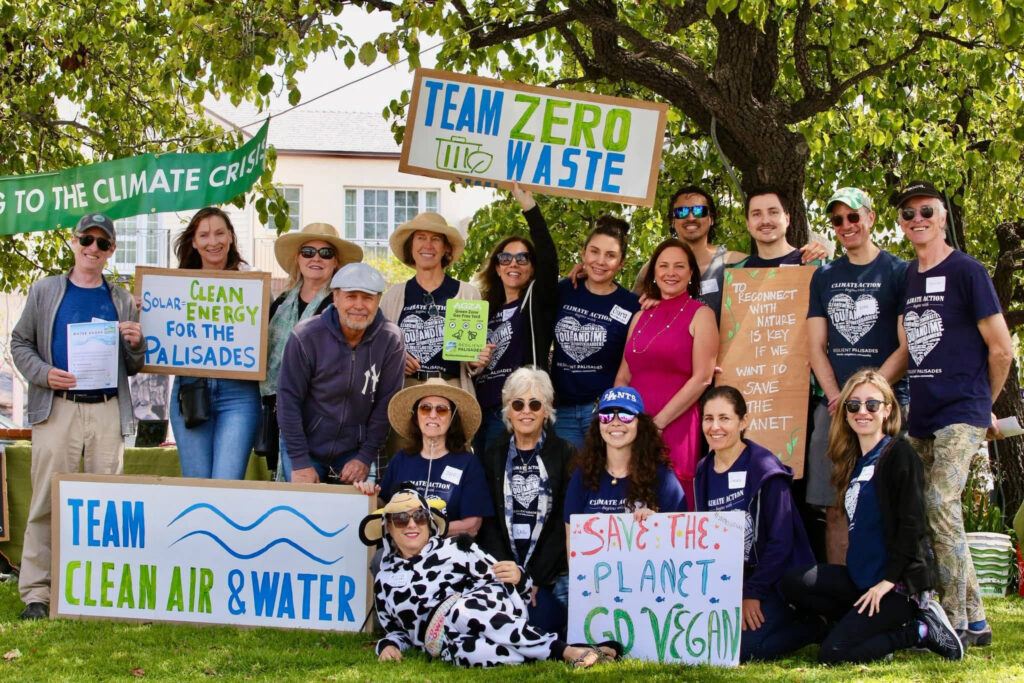
Marti is part of a groundswell of Palisades residents who want to build back without gas.
“Gas emits all kinds of toxins into the air. It’s dangerous because it explodes when there’s fires and earthquakes,” said Marti, communications director for Resilient Palisades. The nonprofit organization was founded by residents who want to adapt to the climate crisis through proven methods like electrification, fire-resilient design, microgrids, native plants and natural soil remediation.
Rebuilding all-electric from the LA fires is cheaper, more climate-friendly and improves indoor air quality, according to research from the University of California Berkeley.
“There’s a lot of enthusiasm around it,” Marti said. “We want to return to a safe environment. My parents are putting up a prefab [home], and they are going all-electric.”
SoCalGas is“putting profit over people” by offering ratepayer-subsidized rebates to rebuild with gas, she said.
“We’re already overwhelmed with decisions. And if you hear about a rebate, it’s confirming that this might be the right way to go,” Marti said.“We’re trying to make rebuilding as easy, safe and clean as possible, as well as more resilient. And right now, these rebates from SoCalGas are doing the exact opposite. So my hope is that people aren’t lured into this opportunistic attempt of theirs.”
Hindering Electrification
It’s not the first time SoCalGas has been accused of undermining electrification efforts. This year, the gas utility was part of a fierce campaign against proposed rules that would have set future sales targets for new zero-emission space and water heaters in Southern California. The opposition campaign involved asking elected officials, including mayors, to send letters ghost written by SoCalGas employees containing misleading information to the South Coast Air Quality Management District. The opposition campaign succeeded in delaying and weakening the rules, which the SCAQMD board ultimately voted to reject in June.
“They’re like a hydra. They have their tentacles everywhere, at every level of government, every program, everywhere,” said Vespa. “It’s a story of a for-profit company that’s desperate to keep people dependent on climate change-exacerbating fuel, but also a story of a regulator that’s not doing its job.”
“It tells you the rules aren’t working properly and they need to change,” he added.
The CPUC says its ratepayer-funder energy efficiency programs are “nation-leading.” Prosper pointed out that in 2025, California ranked number one overall for energy efficiency across all states by the American Council for an Energy Efficient Economy.
The commission has repeatedly said it wants to shift away from subsidizing gas appliances, but has been slow to do so. A 2024 white paper by three state agencies—the CPUC, the California Energy Commission and the California Air Resources Board—identified ways to cut gas demand, including reducing CPUC subsidies for new gas equipment.
The CPUC has an open docket where members of the public can comment on energy efficiency proceedings. Directions for submitting an online comment can be found here, and the proceeding number is R2504010.
“You can express your frustration with this to the commission directly,” Vespa said. “The commission does respond to public pressure and attention on issues. And unfortunately, there hasn’t been as much attention on this as there should be.”
“It’s been sidelined for a long time,” he added. “And I think they need to know that people care about this.”
Update: This story has been updated to include the CPUC staff proposal on Dec. 1 that recommended phasing out ratepayer-funded energy efficiency incentives for most gas appliances over the next decade, but did not deal with such incentives in wildfire rebuilds.
About This Story
Perhaps you noticed: This story, like all the news we publish, is free to read. That’s because Inside Climate News is a 501c3 nonprofit organization. We do not charge a subscription fee, lock our news behind a paywall, or clutter our website with ads. We make our news on climate and the environment freely available to you and anyone who wants it.
That’s not all. We also share our news for free with scores of other media organizations around the country. Many of them can’t afford to do environmental journalism of their own. We’ve built bureaus from coast to coast to report local stories, collaborate with local newsrooms and co-publish articles so that this vital work is shared as widely as possible.
Two of us launched ICN in 2007. Six years later we earned a Pulitzer Prize for National Reporting, and now we run the oldest and largest dedicated climate newsroom in the nation. We tell the story in all its complexity. We hold polluters accountable. We expose environmental injustice. We debunk misinformation. We scrutinize solutions and inspire action.
Donations from readers like you fund every aspect of what we do. If you don’t already, will you support our ongoing work, our reporting on the biggest crisis facing our planet, and help us reach even more readers in more places?
Please take a moment to make a tax-deductible donation. Every one of them makes a difference.
Thank you,