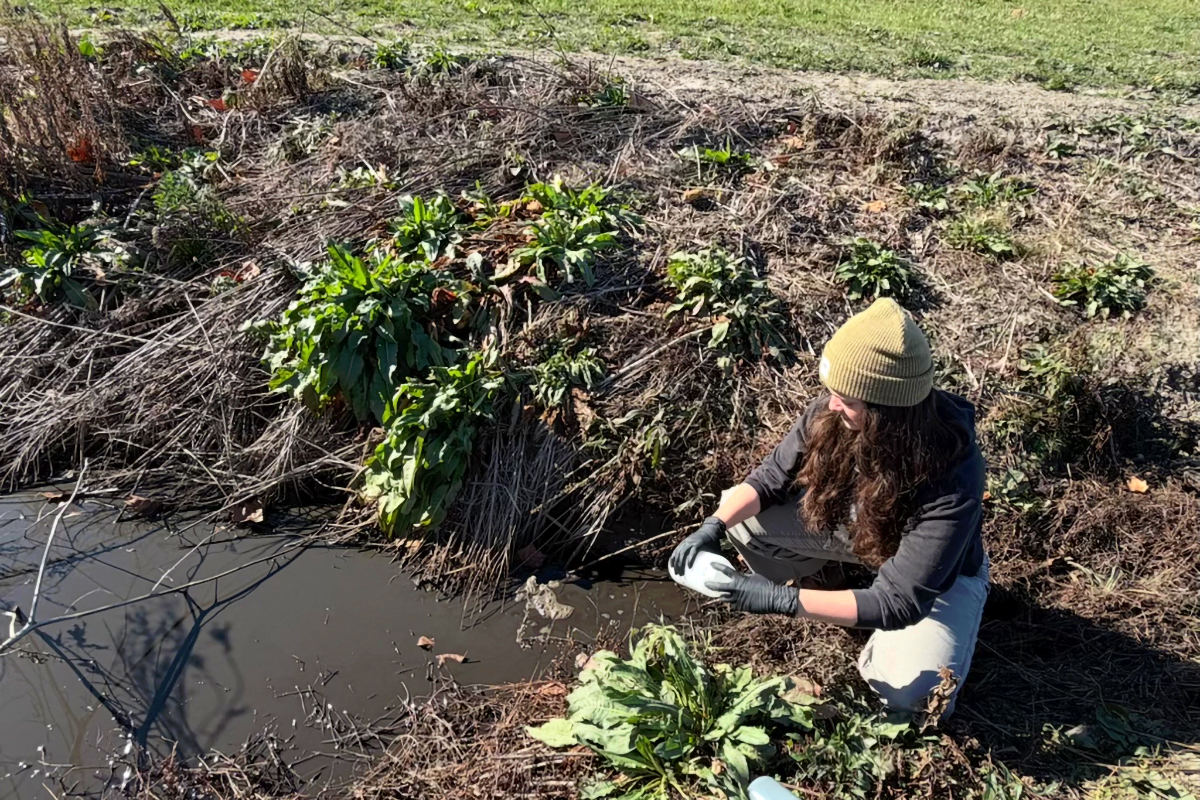


FREMONT, N.C.—On a chilly afternoon in early January, Samantha Krop, the Neuse riverkeeper, and Taylor Register, a water quality specialist, trekked along a ditch near White Oaks Farm in Wayne County.
They work for the nonprofit, Sound Rivers, and had received a tip that something was amiss. It hadn’t rained in two weeks, yet there were several large puddles of what looked like black tar in the ditch. “I hesitate to call it dirty water,” Krop said. “It was like nothing I’ve ever seen before.”
The pair dipped their plastic sampling vials into the black slurry. The containers exploded, Krop said, “like a middle school science experiment.”
The contents of the puddles had reacted with the sulfuric acid in the vials, which, like a volcano, spewed their contents onto Register, covered her glove and melted a hole in it. Sulfuric acid is a stabilizer used in sampling kits.
So began the latest chapter in this saga of a troubled commercial hog farm—one of 2,200-plus concentrated animal feeding operations in the state: a controversial biodigester technology, an even more controversial waste spraying system, a farm foreclosure after the pandemic, an unconventional attempt to produce methane using hotdogs and old deli meats, and a corporate purchase that most recently led to a string of environmental violations.
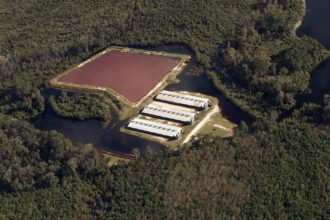
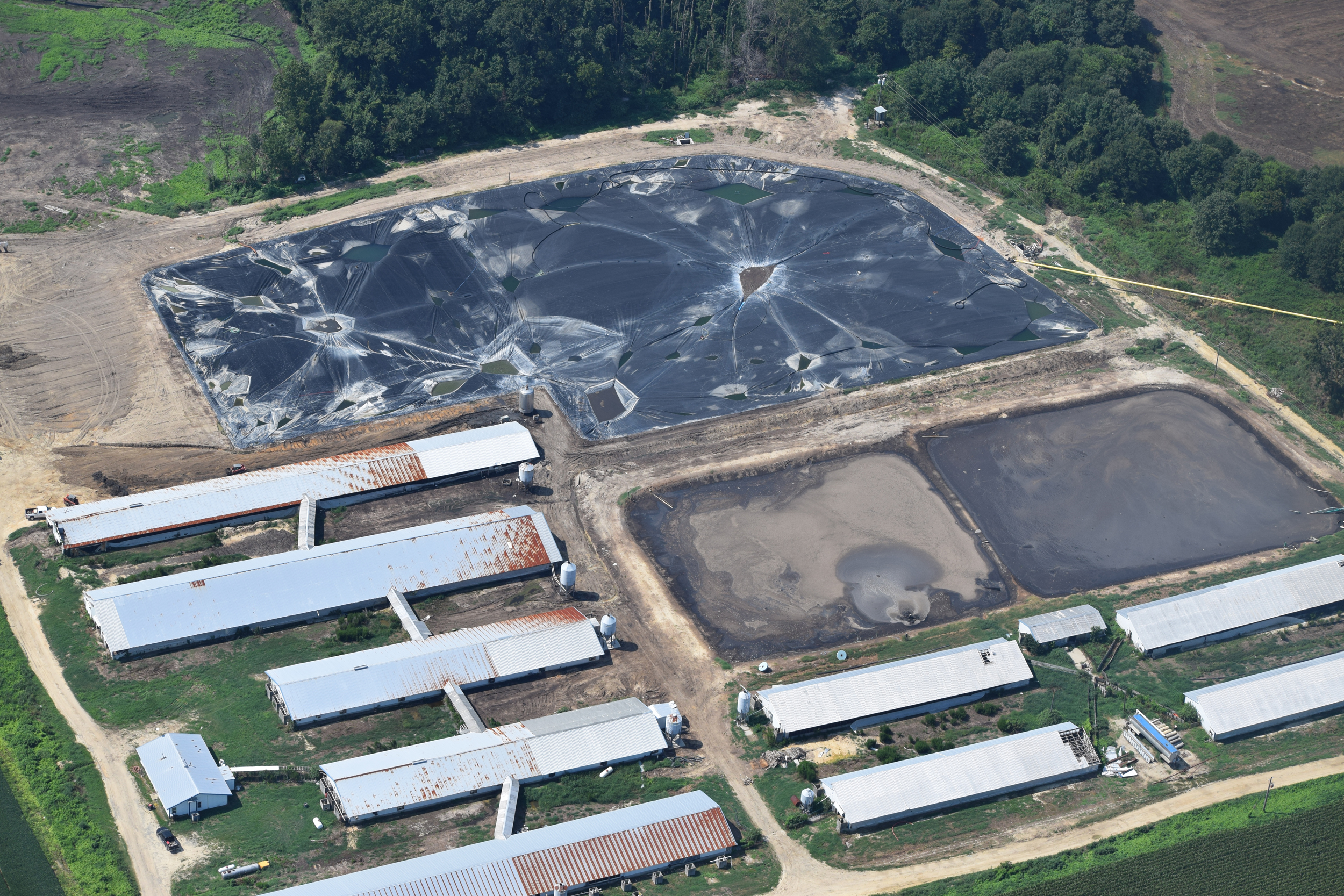
Biox Renewables, a waste-to-energy company in Raleigh, runs the former family CAFO, White Oaks Farm. At one point it housed 5,000-plus hogs but has been closed since 2023. Biox plans to generate methane from existing anaerobic digesters—covered lagoons that trap the potent climate-warming gas wafting from giant lagoons filled with hog waste—that were shuttered by the previous owners who lost the property in foreclosure.
But first Biox had to clean up the old mess. It received a state permit to remove sludge from the digesters and two uncovered lagoons brimming with millions of gallons of hog waste. Now it also has to clean up a mess of its own making.
In mid-December Biox received its operating permit for the waste management treatment system from the North Carolina Department of Environmental Quality. Within two weeks, Biox had already violated the terms, state records show. After four visits to the farm in January, state inspectors found multiple violations:
- Workers had sprayed waste from the lagoons into ditches, fields and woods.
- DEQ sampling showed the ponded water contained bacteria associated with waste.
- Workers failed to inspect the irrigation areas to ensure the wastewater was not ponding.
- There was no certified operator in charge of operating the waste management system.
- The digester cover, which is supposed to capture methane for energy, was “deteriorated,” DEQ records show, and had holes in it.
The violations underscore the environmental problems posed by industrialized hog farms. Even when the farms are outfitted with a digester system, which the pork industry touts as a solution to reducing methane emissions and stench, they still must dispose of waste from the secondary lagoons that are not covered, spraying the hog excrement via large irrigation guns onto farm fields, which can contaminate groundwater and run into wetlands and streams.
The situation at White Oaks Farm is even more tenuous because its four lagoons lie 250 to 500 feet from the 100-year flood plain.
Biox President Wallace Green told Inside Climate News that the water in the ditch was the result of rainwater runoff from agricultural fields. When Green received the notice of violation from the DEQ on Jan. 27, it had rained the day before, but the citations stemmed from inspections conducted on Jan. 6, 9, 13 and 14. At that time, it had not rained for two to three weeks, historical weather data show.
Inspectors wrote that waste had been sprayed at “excessive rates to fields and woods; the ground could not absorb the overload and it ran into the ditches.”
Green said the company is investigating how much runoff “is coming off surrounding cornfields and how much is coming off our property.”
This story is funded by readers like you.
Our nonprofit newsroom provides award-winning climate coverage free of charge and advertising. We rely on donations from readers like you to keep going. Please donate now to support our work.
Donate NowIncidental water that had collected on top of the lagoon cover became contaminated by waste seeping through the holes, DEQ records show. That tainted mixture was then pumped through the removal system and onto an easement.
Green said the company “thoroughly inspected the [lagoon] cover” and “found some minor openings that we are now working diligently to repair.”
The deterioration of the cover also defeats the purpose of the methane capture system, which is intended to prevent the release of the potent greenhouse gas into the atmosphere. It is reminiscent of a lagoon disaster that occurred at the same farm when Todd and Deborah Ballance owned it.
The Ballance family had farmed for decades, and at one time had more than 5,000 hogs, state records show. During the pandemic, that number dwindled to 50, state records show, and they produced too little waste to generate a viable amount of methane.
That’s when the Ballances focused on mixing old deli meats and hot dogs, including some from Smithfield Foods, with dead hogs, softened into a “pumpable slurry,” state records show, to generate methane for sale to Duke Energy.
In May 2022, part of the digester cover ruptured. The underlying lagoon released at least 1 million gallons of foam and slurry composed of liquified dead hogs, swine feces and urine, and discarded hot dogs and deli meat, according to state records. More than 10,000 gallons of waste entered the nearby Nahunta Swamp.
Krop and other river advocates sampled the swamp and waterways downstream of the facility which revealed extremely high levels of nitrogen, fecal coliform and E. coli. The advocates notified DEQ, which launched its own investigation that culminated in a requirement to close the existing covered lagoon.
Over the next two and a half years, DEQ cited the Ballances for multiple violations and eventually fined them $34,000.
The Ballances closed the farm. After the property was sold at a public auction in 2024, Biox filed a permit application to desludge the anaerobic digester and the open and closed lagoons. Green said he plans to sell the sludge to a fertilizer company that would remove it from the farm.
“Our goal is to capture methane and recover organic nutrients for agricultural sustainability and rural economic growth,” Green said.
Only then would Phase II of the project begin, which entails restarting the biogas digester and again raising hogs—to keep the waste and methane flowing.
About This Story
Perhaps you noticed: This story, like all the news we publish, is free to read. That’s because Inside Climate News is a 501c3 nonprofit organization. We do not charge a subscription fee, lock our news behind a paywall, or clutter our website with ads. We make our news on climate and the environment freely available to you and anyone who wants it.
That’s not all. We also share our news for free with scores of other media organizations around the country. Many of them can’t afford to do environmental journalism of their own. We’ve built bureaus from coast to coast to report local stories, collaborate with local newsrooms and co-publish articles so that this vital work is shared as widely as possible.
Two of us launched ICN in 2007. Six years later we earned a Pulitzer Prize for National Reporting, and now we run the oldest and largest dedicated climate newsroom in the nation. We tell the story in all its complexity. We hold polluters accountable. We expose environmental injustice. We debunk misinformation. We scrutinize solutions and inspire action.
Donations from readers like you fund every aspect of what we do. If you don’t already, will you support our ongoing work, our reporting on the biggest crisis facing our planet, and help us reach even more readers in more places?
Please take a moment to make a tax-deductible donation. Every one of them makes a difference.
Thank you,

Lisa Sorg
Reporter, North Carolina
Lisa Sorg is the North Carolina reporter for Inside Climate News. A journalist for 30 years, Sorg covers energy, climate environment and agriculture, as well as the social justice impacts of pollution and corporate malfeasance.
She has won dozens of awards for her news, public service and investigative reporting. In 2022, she received the Stokes Award from the National Press Foundation for her two-part story about the environmental damage from a former missile plant on a Black and Latinx neighborhood in Burlington. Sorg was previously an environmental investigative reporter at NC Newsline, a nonprofit media outlet based in Raleigh. She has also worked at alt-weeklies, dailies and magazines. Originally from rural Indiana, she lives in Durham, N.C.