


Google is seeking to bypass data center zoning rules recently adopted by Linn County, Iowa, by annexing the land for its proposed campus into a city two miles away.
If approved by city officials in Palo, the move would free Google from the water-use and economic agreements that Linn County developed for unincorporated areas with input from the company’s representatives. Though Palo is part of the county, the data center would be subject to the city’s rules, not the county’s.
The workaround is “fundamentally wrong,” said Sami Scheetz, supervisor for Linn County’s 2nd District, in a statement issued by the county on Wednesday. “Let’s be clear about what is happening here. We negotiated in good faith. And Google’s response was to go find a local government that will ask for less.”
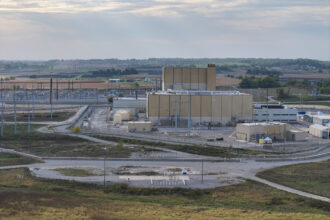
In October, Google informed the Linn County Board of Supervisors of plans to construct a six-building data center campus on 545 acres of unincorporated land adjacent to the Duane Arnold Energy Center.
Interest from the tech giant led Linn County staff to develop an ordinance that set guidelines for data center developers based on the experiences and zoning laws of communities across the nation. Google representatives were closely involved in that process, said Charlie Nichols, director of planning and development for Linn County.
The ordinance, which the Board of Supervisors approved in February, requires data center developers in unincorporated areas of Linn County to conduct a water study as part of their zoning application, enter into water-use and economic agreements with the county and adhere to light and noise pollution rules as well as mandatory setbacks.
In talks with the county, Google bristled at requirements for public disclosure of water use and economic terms that included full property taxation, Nichols said. Nonetheless, he said, the county did not expect Google to sidestep those protections by engaging directly with the city of Palo.
The city has not issued any public comments on the matter, but is likely to go forward with annexing the Google site, Nichols said. It would be considered a “voluntary, non-urban annexation,” meaning the county has no say in the matter.
Members of the Linn County Board of Supervisors expressed their disappointment at a Wednesday meeting. “We were not trying to block this project. We believed in working together in a transparent process for both regional benefits and protections,” said Kirsten Running-Marquardt, chair of the board.
Google had previously verbally agreed to the terms of an economic development plan with Linn County that would have included annual community development payments, a significant strategic partnership fund, environmental stewardship commitments and high-quality job creation, the county stated in its press release.
But on February 26, the same day that the county told Google it would formally consider accepting that economic plan, Google informed county staff it would instead pursue annexation into the city of Palo.
Google did not immediately respond to requests for comment on Wednesday.
Not only would the annexation bypass regulations set for unincorporated areas of the county, but it would also mean the loss of $500,000 in funding that Google committed for a comprehensive regional water balance study.
Now that the company no longer plans to develop through the county, the much anticipated water balance study “is not moving forward,” Nichols told supervisors on Wednesday.
Nichols and all three supervisors are urging the city of Palo to consider adopting a similar code to that laid out in the county ordinance, especially the water study requirement.
“This is going to have regional impacts, regardless of which jurisdiction is going to decide the fate of the project,” Scheetz said. “Our ordinance was pro-growth and pro-community, and I hope that Palo takes that path going forward as well.”
Palo, population 1,407, currently has no zoning codes specific to data centers. City council members have told Nichols they plan to adopt a zoning code for data centers, but that they are working closely with Google and it will not be the same as Linn County’s.
Palo Mayor Bryan Busch declined to comment on the issue Wednesday, but said that the city would be issuing an official statement in the next few days.
Annexing the data center site will likely be a slow process. Over the next few months, Palo officials will have to host a series of public meetings before they can annex the land, write a new zoning code, and establish any tax incentives for the project, Nichols said. After spending more than half a year drafting the county ordinance, that prospect gives him little comfort.
“I felt like we had a workable ordinance that puts in place really bare minimum requirements of information reporting,” he said. “So for Google to really throw a fit over that, it’s a little bit disheartening.”
About This Story
Perhaps you noticed: This story, like all the news we publish, is free to read. That’s because Inside Climate News is a 501c3 nonprofit organization. We do not charge a subscription fee, lock our news behind a paywall, or clutter our website with ads. We make our news on climate and the environment freely available to you and anyone who wants it.
That’s not all. We also share our news for free with scores of other media organizations around the country. Many of them can’t afford to do environmental journalism of their own. We’ve built bureaus from coast to coast to report local stories, collaborate with local newsrooms and co-publish articles so that this vital work is shared as widely as possible.
Two of us launched ICN in 2007. Six years later we earned a Pulitzer Prize for National Reporting, and now we run the oldest and largest dedicated climate newsroom in the nation. We tell the story in all its complexity. We hold polluters accountable. We expose environmental injustice. We debunk misinformation. We scrutinize solutions and inspire action.
Donations from readers like you fund every aspect of what we do. If you don’t already, will you support our ongoing work, our reporting on the biggest crisis facing our planet, and help us reach even more readers in more places?
Please take a moment to make a tax-deductible donation. Every one of them makes a difference.
Thank you,

Anika Jane Beamer
Reporter, Iowa
Anika Jane Beamer covers the environment and climate change in Iowa, with a particular focus on water, soil and CAFOs. A lifelong Midwesterner, she writes about changing ecosystems from one of the most transformed landscapes on the continent. She holds a master’s degree in science writing from the Massachusetts Institute of Technology as well as a bachelor’s degree in biology and Spanish from Grinnell College. She is a former Outrider Fellow at Inside Climate News and was named a Taylor-Blakeslee Graduate Fellow by the Council for the Advancement of Science Writing.