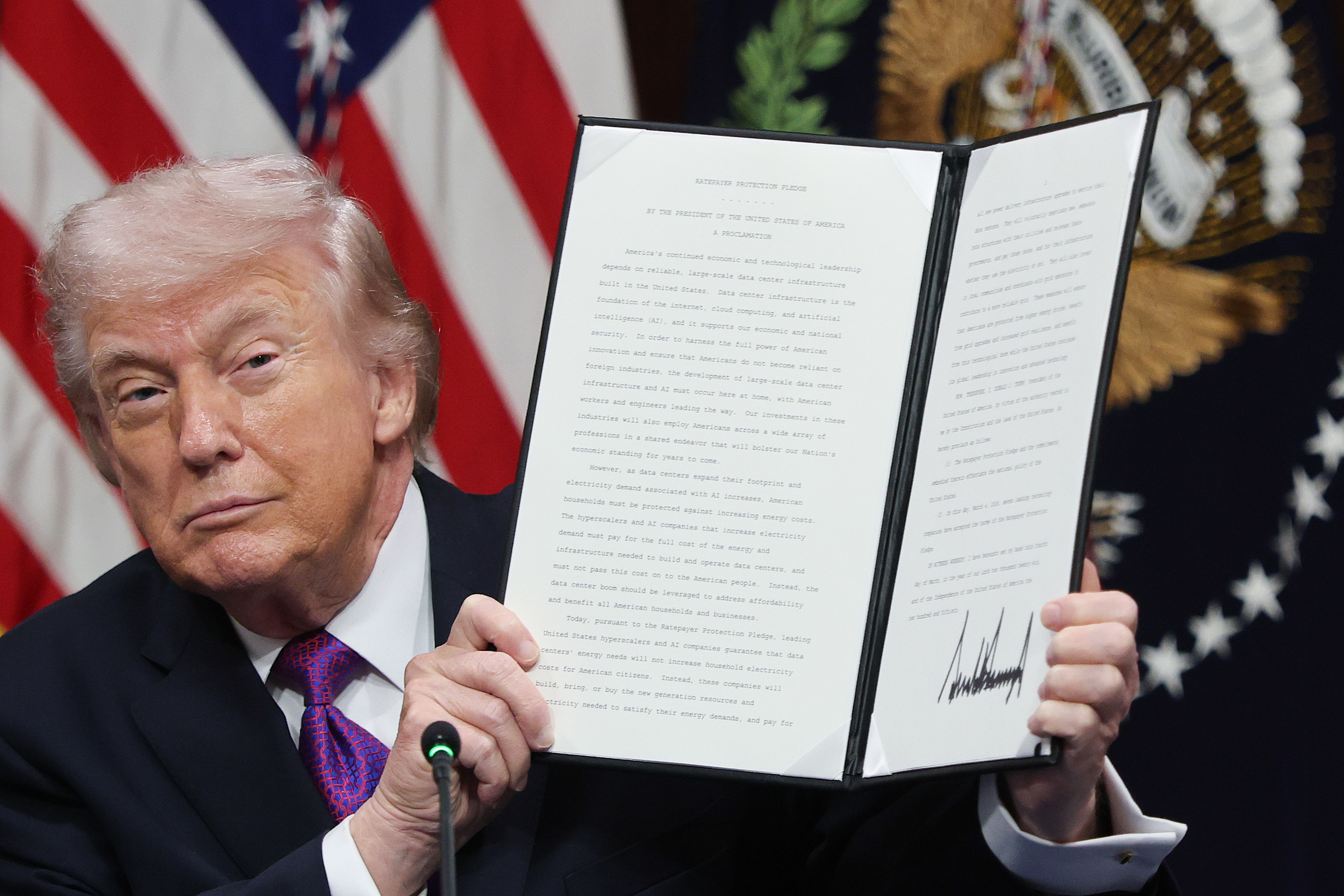


In an effort to quell blowback on data centers, President Donald Trump announced at a White House roundtable on Wednesday the “Ratepayer Protection Pledge,” a set of nonbinding promises that Big Tech companies signed to keep household utility bills from skyrocketing.
“They need some P.R. help,” Trump said of the data centers, “because people think that if a data center goes in, their electricity prices are going to go up, and that’s not happening. It’s not going to happen.”
The announcement comes after Trump’s State of the Union promise last week that tech firms would “provide for their own power needs” by building on-site power generators or securing their own dedicated supply.
For years, Big Tech mostly powered data centers by plugging into the electric grid, but the recent boom in data-center demand is now adding to utility costs for regular customers. And their concerns have become a hot issue for the upcoming midterm elections in November.
The pledge was signed by top officials from Google, Meta, Microsoft, OpenAI, Amazon Web Services, Oracle and Elon Musk’s xAI. While Trump has previously described it as “mandatory,” the pledge is voluntary, unlike a statute or enforceable federal regulation.
In it, the companies committed to provide or pay for all the power their AI projects require and, where possible, to add new capacity by building power stations rather than relying on existing grid supplies.
The companies also agreed to cover the costs of upgrading power infrastructure as their demand requires more investment, as well as to negotiate separate rate structures with local utilities that assign them the costs of new capacity. This included a commitment for them to pay even if they do not end up using all the electricity they requested.
The companies also promised to invest in communities where the data centers will stand, which they say would manifest in jobs, tax revenues and other economic benefits. During times of peak demand when the local grid would be stressed—during heat waves or hurricanes, for example—the companies would feed backup power into the grid, when possible.
Even before the pledge, tech companies have announced plans to supply their own power, or are already using power generation they brought or paid for to run data centers, the massive server farms needed to power AI platforms like ChatGPT.
Amazon has announced a deal to co-locate a data center next to Talen Energy’s Susquehanna nuclear plant in Pennsylvania. Microsoft has signed a long-term deal to buy power from the former Three Mile Island nuclear plant, also in Pennsylvania and restarting under a new name. And Google has announced plans to build data centers in Minnesota alongside new power generation through a partnership with Intersect Power in Texas and Xcel Energy in Minnesota.
Josh Levi, the president of the Data Center Coalition, the sector’s trade association, said in an email that the DCC was “committed to being good neighbors, and that includes our ongoing commitment to paying our full energy costs.”
He added: “The industry will also continue to partner with policymakers, regulators, utilities, and grid operators to ensure that those costs are not passed on to other customers.”
The Limits of a Pledge
The voluntary nature of the pledge means companies can sign on or off any time. The real enforcement would come from their agreements with utilities as well as from formal federal rules.
The Federal Energy Regulatory Commission (FERC), the federal agency that oversees the nation’s electricity system, is reviewing new rules for data centers that want to pair up with power plants under PJM Interconnection, the grid operator for all or part of 13 states and the District of Columbia, where the issue has become most heated.
PJM wants to offer a fast track through its backlogged interconnection queue for developers that bring their own power. At the federal level, FERC is weighing nationwide rules for how data centers hook up to the grid, including cases when they locate next to a power plant.
Joseph Bowring, the independent market monitor for PJM, points out that even if President Trump’s pledge were to be carried out by tech companies, utilities and regulators immediately, its effect on people’s bills would take time to arrive—at least about two years. This is because PJM’s next capacity auction in June will affect electricity prices for the 2028–2029 delivery year, not for this year or next year (which have been completed with record-high results).
Concerns over rising electricity bills will ultimately need to be addressed by the utilities and state commissioners, said Ari Peskoe, director of the Electricity Law Initiative at Harvard University.
“The president talked a lot about building their own facility, but in general, those still have to have some deal with utilities about getting power from the grid, and connecting to the transmission service, being able to exchange energy back and forth, particularly when the data center’s power source isn’t working,” said Peskoe.
The Edison Electric Institute, an association for the country’s major utilities, lauded the announcement, but Peskoe said that’s to be expected because the industry wants to placate Trump. Utilities don’t like data centers generating their own power, Peskoe added, because then grid upgrades that would otherwise make the utilities money can’t be recovered from ratepayers.
At the same time, he said, the utilities that are upgrading to accommodate data-center growth aren’t assigning the full cost to those companies, wanting to attract them and profit from the boom.
A solution could be letting data centers seek competitive electricity deals outside of utilities, Peskoe said, “because the utility is able to spread costs to everybody else.”
Virginia state Sen. David Marsden, D-Fairfax, who’s backed by the utility Dominion Energy, said people should not be “trying to undo everything that we’ve been doing for years that’s worked very well for us.” Virginia, birthplace of the internet, currently has 570 operating data centers, more than any other state—and any country in the world other than the U.S.

But Marsden said that some changes are needed to ensure that Big Tech finances new zero-carbon nuclear projects. “At some point in time here, we will have to change the model,” Marsden said. “I don’t know that the president has thought through exactly how something like this would work and how you migrate towards it.”
Data centers run constantly and require massive amounts of electricity.
While Google has pledged to power all its data centers and computing infrastructure with zero-carbon energy—solar, wind, geothermal, nuclear—to eliminate greenhouse gas emissions, Trump has called climate change a hoax and said he wants data centers powered primarily by fossil fuels.
No Word on the Environment
The pledge Trump announced Wednesday did not include any mention of limiting the potential environmental impacts of data centers bringing their own power generators.
“Bring your own power is part of the right answer, but alone does nothing to ensure that these new large loads don’t increase climate and air pollution from existing and new fossil power plants, or address potential impacts to water supply and quality concerns,” said Jackson Morris, the director of state power sector policy for the environmental advocacy group Natural Resources Defense Council.
This story is funded by readers like you.
Our nonprofit newsroom provides award-winning climate coverage free of charge and advertising. We rely on donations from readers like you to keep going. Please donate now to support our work.
Donate NowEnvironmental advocates say that matters because, in the near term, the fastest power to build at the scale and speed data centers want is often natural gas. Some grid planners and energy analysts have warned that a rush to add capacity quickly could lock in more fossil generation if policies do not steer investment toward cleaner renewable energy.
Backup power is another concern. Data centers typically rely on on-site generators for emergencies and testing, which are commonly powered by diesel engines. Critics say widespread deployment of those generators can add localized noise and air pollution and raise permitting and oversight questions, even if they are intended to run only during emergencies.
Large data centers can also strain water supplies and affect water quality as they use millions of gallons for cooling. The pledge does not address any specific safeguards or reporting requirements for air and water quality.
“There’s no way to hold big tech companies accountable,” said Amanda Garcia, a senior attorney with the Southern Environmental Law Center. “Even if it were written into the pledge, it wouldn’t be practicable because the decisions that govern the siting and the power generation and the cost allocation and all these different pieces are made by hundreds of state and local decision makers across the country. There isn’t a one-size-fits-all, wave-the-magic-wand and all of that goes away.”
For decades the gargantuan data facilities have been approved by localities flush with local tax revenues and temporary construction jobs. But communities are pushing back. Residents in Pittsylvania County, in rural and red Southside Virginia, opposed a data center proposal, withdrawn in April, that would have had its own gas plant. In South Memphis, Tennessee, residents protesting an xAI complex say it has operated gas turbines without permits while polluting the community.
The NAACP held a conference in Washington, D.C., at the end of last year to devise a playbook for communities across the country to fight back.
“The Trump administration refused to create a community-based solution for community problems, and instead is relying on executive orders and other tactics to strong arm AI data centers into communities,” said Abre’ Conner, director of the NAACP’s Center for Environmental and Climate Justice. The organization, Conner said, is committed to stopping “dirty data.”
About This Story
Perhaps you noticed: This story, like all the news we publish, is free to read. That’s because Inside Climate News is a 501c3 nonprofit organization. We do not charge a subscription fee, lock our news behind a paywall, or clutter our website with ads. We make our news on climate and the environment freely available to you and anyone who wants it.
That’s not all. We also share our news for free with scores of other media organizations around the country. Many of them can’t afford to do environmental journalism of their own. We’ve built bureaus from coast to coast to report local stories, collaborate with local newsrooms and co-publish articles so that this vital work is shared as widely as possible.
Two of us launched ICN in 2007. Six years later we earned a Pulitzer Prize for National Reporting, and now we run the oldest and largest dedicated climate newsroom in the nation. We tell the story in all its complexity. We hold polluters accountable. We expose environmental injustice. We debunk misinformation. We scrutinize solutions and inspire action.
Donations from readers like you fund every aspect of what we do. If you don’t already, will you support our ongoing work, our reporting on the biggest crisis facing our planet, and help us reach even more readers in more places?
Please take a moment to make a tax-deductible donation. Every one of them makes a difference.
Thank you,

Rambo Talabong
Contributor
Rambo Talabong is a multimedia climate reporter based in New York City. Before moving to the U.S., he led award-winning investigations into the Duterte drug war for Rappler, the Nobel Prize-winning newsroom in Manila. His reporting has been recognized by the Global Investigative Journalism Network, the Society of Publishers in Asia, and the Human Rights Press Awards. He studied data journalism at Columbia University and is currently pursuing a master’s in science journalism at New York University. He has faced—and won—two libel suits in the Philippines over his reporting.

Charles Paullin
Virginia Correspondent
Charles Paullin is a Richmond, Virginia-based reporter focusing on energy and environment issues. He’s won several awards for his previous work covering state policy with the Virginia Mercury and local news with the Northern Virginia Daily in the Northern Shenandoah Valley. His first reporting gig was with the New Britain Herald in Connecticut, a couple years after attending the University of Hartford, where he first studied sports journalism.