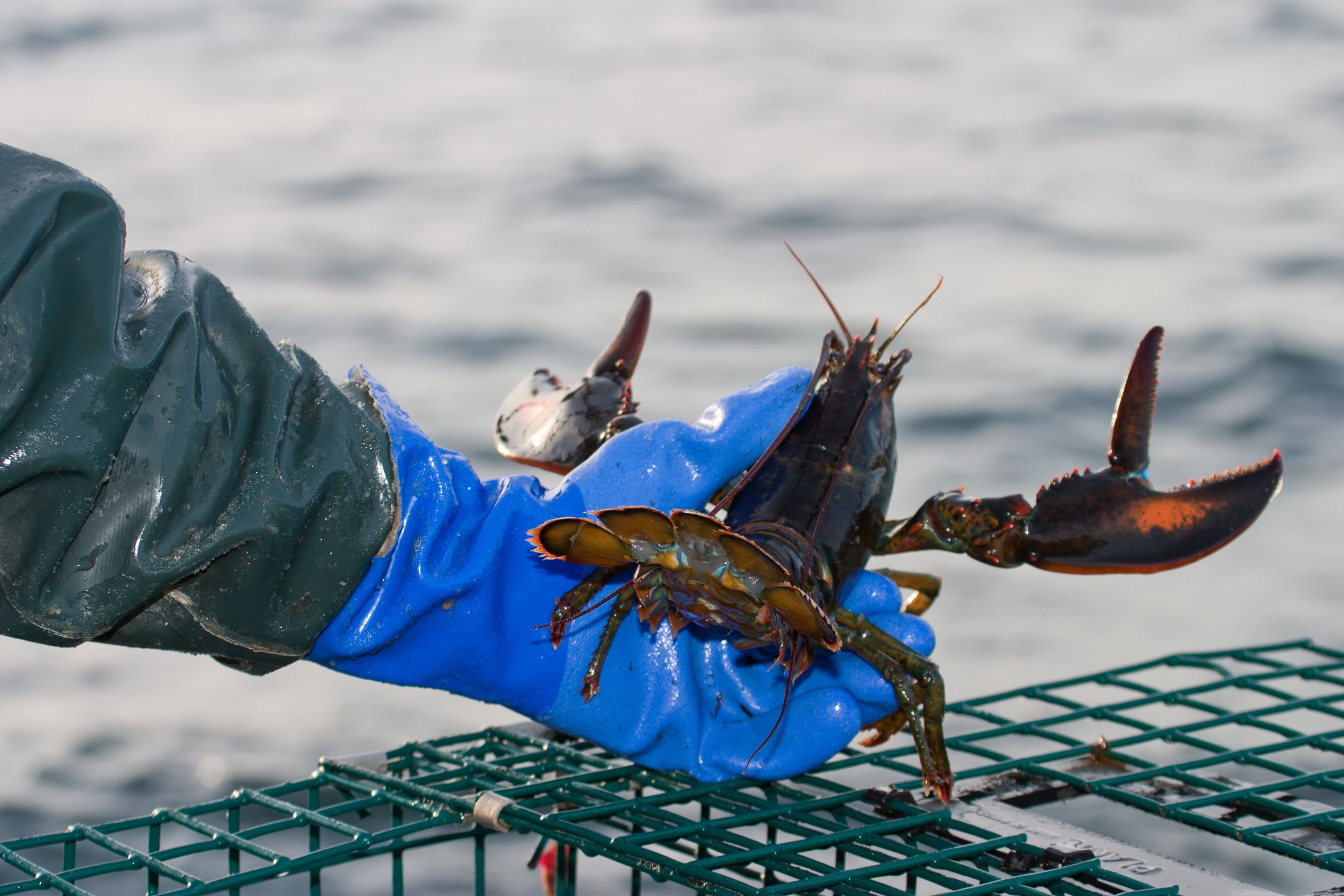


Curt Brown spent his childhood harvesting lobsters along the coast of Maine. As an adult, he went on to earn a Master of Science from the University of Maine, observing the very waters where he spent years fishing for the crustaceans.
With a rapidly changing climate, many researchers worry that Maine’s lobsters will eventually move north to colder waters. Brown isn’t so sure, though, seeing all of the forces affecting the ecosystem as highly complex. His studies in marine biology and policy, along with his continued work as a lobsterman, have helped him understand that the lobster industry depends upon various factors, some beyond man’s control.
Last year, the state of Maine’s lobster fisheries harvested 78.8 million pounds of lobsters, and according to the Maine Department of Marine Resources (DMR), commercial harvesters earned $619 million.
Synonymous with the New England state, lobsters have a documented history in Maine that dates back to 1605. Recent studies, though, show that climate change and a shift in currents are warming up the local waters. In a now well-quoted 2015 study led by Andrew Pershing, researchers found that the surface temperature of the Gulf of Maine is warming 99 percent faster than the rest of the ocean.
Some say this could lead to lobsters moving north to Canadian waters in search of colder temperatures and many wonder what the future of Maine’s fishery will look like.
Brown feels like the rate of warming has been sensationalized as a headline since the Pershing’s study came out, and sees the issues facing lobsters more nuanced and complex.
An October study funded by NOAA National Sea Grant’s American Lobster Initiative looks at the effects that multiple stressors, not just warming waters, have on lobster embryos and their future life cycles.
In the study, “Effects of multiple stressors on embryos and emerging larvae of the American lobster,” researchers look at how the combination of warming waters and ocean acidification affect egg-bearing lobsters and the development and physiology of their embryos in the hopes of getting a more accurate picture of what the future of Maine’s lobster fishery may look like as the effects of human-caused climate change increase.
Miguel Barajas is a Quantitative Research Associate who studies the early life stages of lobsters with the Integrated Systems Ecology Lab at the Gulf of Maine Research Institute. Since lobsters are ectotherms, he explained, they can’t regulate their own body temperature, so they will take on the temperature of their surroundings. Temperature plays a vital role in lobster development, he said, with warmer waters causing them to grow and develop faster with an increased metabolic need. Issues can arise, though, if food isn’t available due to the timing of cycles, or if the temperature increases beyond the ideal 12 to 18 degree Celsius range.
Growing quicker means reaching maturity sooner, but often at a smaller size with less reproductive capacity during a time outside of the ideal harvesting window. Temperature also can be a driver for where lobsters situate themselves, sometimes leading them to move deeper or farther out in the ocean in search of cooler waters.
But Barajas agrees with the recent study that it’s important to look at both the water’s temperature and acidity when considering its effects on the life cycle of lobsters.
“Oftentimes you’ll look at one or the other, but sometimes, when you have those multiple stressors, you can have a synergistic effect, where the sum of them is greater than each one in isolation,” he said.
The recent study chose to look at the combined and individual stress of temperature and pH on lobster embryos and hatching larvae, acknowledging that this was an understudied topic that could provide insight about the possible future of Maine’s lobster fishery.
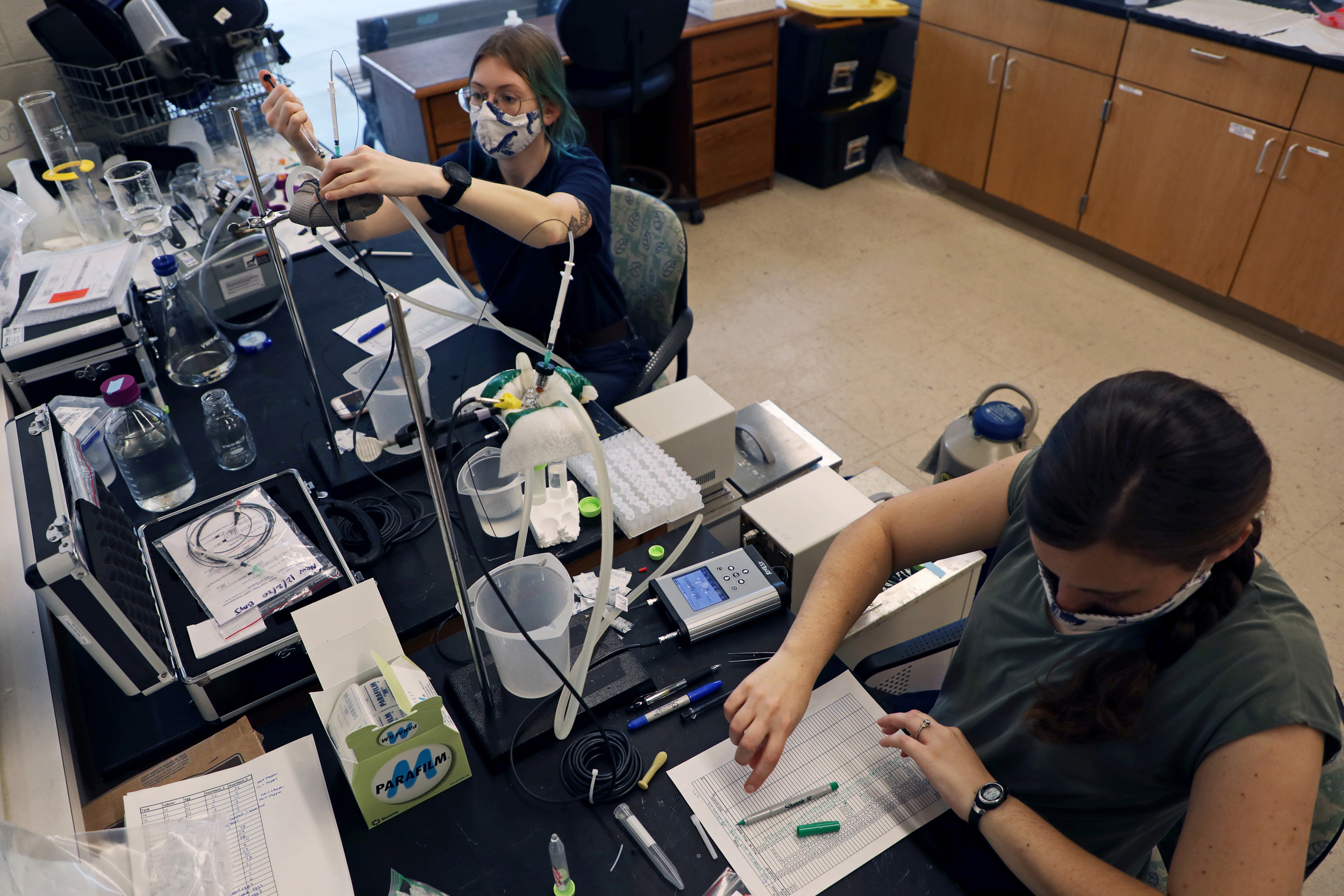
In a controlled laboratory setting over the course of five months, researchers found that the presence of multiple concurrent stressors affected lobster growth, particularly in the early life stages of embryo development and hatching. One of the authors of the study, Emily Rivest, an associate professor at William & Mary’s Batten School of Coastal & Marine Sciences and the Virginia Institute of Marine Sciences, said that they found the embryos to be tolerant to acidification conditions, but sensitive to warming temperatures.
The researchers brought in 24 lobsters from the Gulf of Maine and recreated its conditions in a sophisticated Virginia lab where they could monitor warming water and acidification both together and separately. The lobsters were observed under two temperature levels, one mimicking present day temperatures, and a higher one set in line with temperature forecasts for the year 2100.
Over a five-month span, both the present day and future temperatures varied to reflect seasonal changes of Northeastern waters. There were also two acidification amounts, one representing present day levels and the other representing more acidic conditions projected for 2100.
Researchers collected egg samples off the lobsters over the five months to measure the egg development rate and heartbeats as well as the total protein and oxygen consumption of the embryos. The hatching process was also closely monitored.
“The larvae that were experiencing warmer temperatures were smaller in size when they hatched,” said Rivest. “That’s a potential issue, because they might not be able to complete that life stage at a smaller size, so they could more easily be eaten by fish predators.”
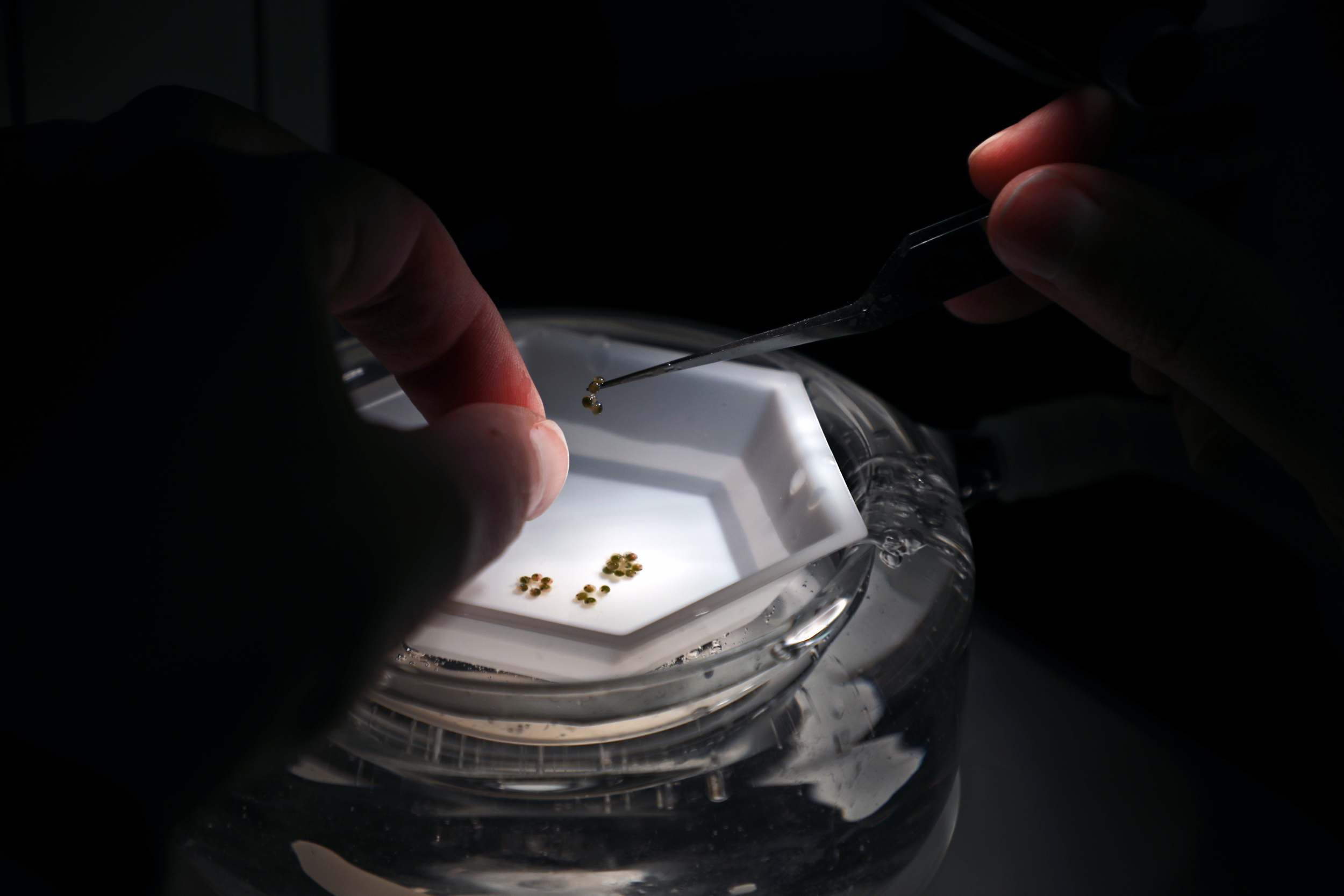
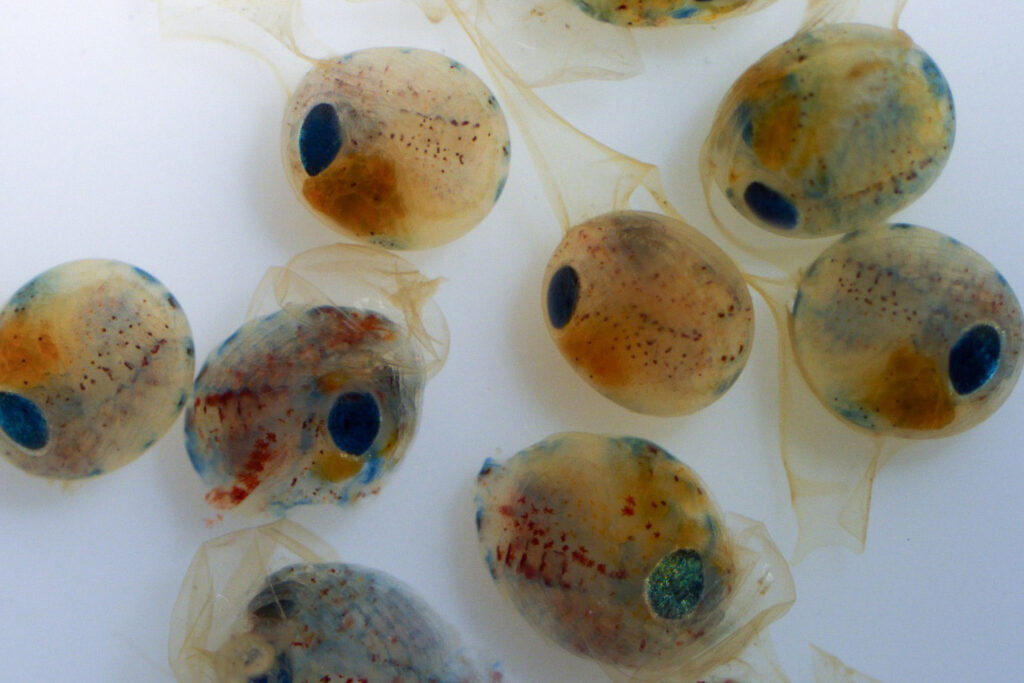
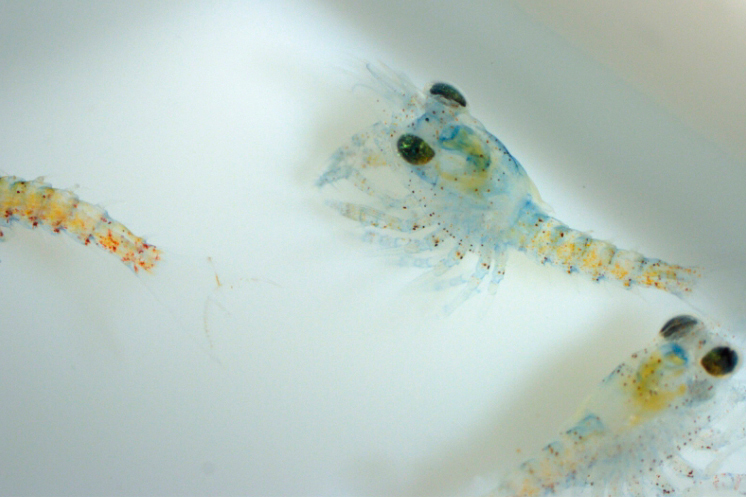
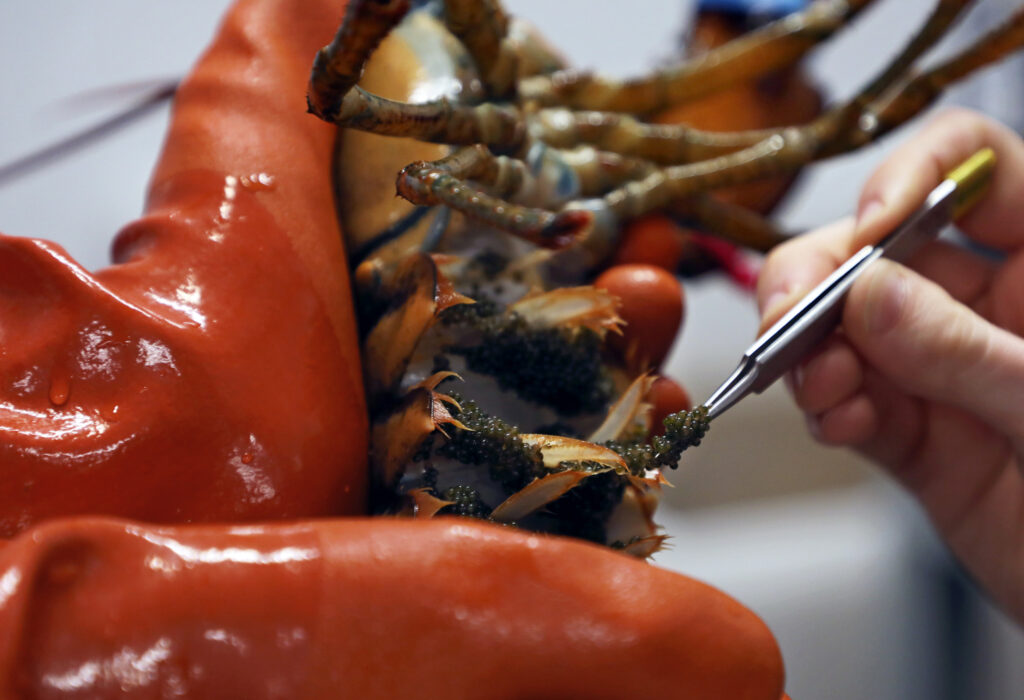
Lobster eggs and larvae are seen under the microscope. Credit: Abigail Sisti/Virginia Institute of Marine Science
According to Rivest, this is crucial, because transitioning to a juvenile life stage is the point where lobsters move down to the ocean floor, which is an important part of the process for the fishery. Rivest said that they can take some lessons from the collapse of the Massachusetts lobster fishery where warm temperatures resulted in stress and disease in the lobsters, eventually causing them to relocate further north.
Protecting female egg-bearing lobsters is important to the future of the fishery. A female lobster reproduces every two years. The Lobster Institute at the University of Maine reports that a “1-pound female lobster usually carries approximately 8,000 eggs,” and a “9-pound female may carry more than 100,000 eggs.”
The female lobster carries these eggs inside her for nine to twelve months, and then externally for another nine to twelve months. Very few eggs survive to hatch into lobsters that reach maturity, with NOAA estimating that two out of every 50,000 eggs develop into lobsters that grow to the minimum legal size to be harvested.
Among the long-running protective efforts to ensure a sustainable lobster fishery is V-notching, a practice started in 1917 in which lobstermen cut a small, V-shaped notch in the tail of egg-bearing female lobsters to indicate they should not be harvested.
In 1948, the state of Maine passed a law prohibiting the harvesting or selling of female lobsters with a V-notch, and then in 2002, the Atlantic States Marine Fisheries Commission (ASMFC) enforced the practice along many parts of the northeastern U.S. coastline. By allowing the female lobster to reproduce many times in its lifetime, the practice is intended to protect the future of the fishery.
This story is funded by readers like you.
Our nonprofit newsroom provides award-winning climate coverage free of charge and advertising. We rely on donations from readers like you to keep going. Please donate now to support our work.
Donate Now“There’s no denying that there are environmental changes affecting the fishery,” said Michelle Brown, the Lobster Research and Extension Coordinator for the University of Maine, funded by the Maine Sea Grant, who emphasized how research like the new study is critical to the lobster industry’s future. “I think if anything, it has underscored to the industry just how important it is to try to understand what those changes are.”
As the list of uncertainties lobsters face grows year to year, Brown notes that researching patterns can help the fishery plan for the economic costs of climate change. She knows this firsthand from her husband, Curt, the longtime lobsterman.
Curt Brown, who also owns Bold Coast Seafood, sees the changes in the water and how it affects his lobster harvest year to year. While the overall temperature has increased, there have been some years that were outliers, with colder temperatures.
“Everyone can understand data when it’s in the language of temperature,” he said.
But Brown feels that focusing solely on surface temperature oversimplifies what’s actually going on in the Gulf of Maine and said it’s essential to also track temperatures at the bottom of the ocean given the last two years have seen colder, lower salinity waters coming from the north, which can slow the lobsters’ molting cycle and lead to catches that don’t pick up until later in the summer.
In an email, Mike Doan, Staff Scientist with the Friends of Casco Bay, who specializes in studying ocean acidification, agreed that the issues are nuanced. He said that he is also concerned about the cumulative impacts of sea water’s salinity, temperature and acidification but feels the latter two are the most important to follow.
“Our role at this point is to simply track changes in the parameters we measure, and hope that data is useful in the bigger picture,” he said.
Doan also tracks shifts in the region’s seas’ water source, which have been one contributor to the change in water temperatures as meltwater from the accelerating thaw of glaciers in Greenland surges into the Atlantic.
Charles Tilburg, professor of oceanography at the School of Marine Environmental Program at the University of New England in Maine, studies the effects of a changing Labrador Current, which determines the amount of cold water that flows into the Gulf of Maine.
Tilburg describes the northern Atlantic Ocean as a bathtub, with the Gulf of Maine on the left side and the shallow waters of Georges Bank on the right. A circulation of water in between those sees the Labrador Current bring cold water down from the Arctic and the Gulf Stream bring warm water up from the tropics. Right now, he said, a weakened Labrador Current is resulting in the warm water tap being turned on a bit more.
Looking ahead, Tilburg projects that the Gulf of Maine will keep warming between 1.1 and 2.4 degrees Celsius by 2050, depending on how much humans accelerate climate change.
“We don’t know how humans work. We don’t know what humans are going to do,” he said. “So the largest part of the uncertainty on determining what’s going to happen in the Gulf of Maine isn’t the physics, it’s not chemistry, it’s not the biology, it’s the psychology and sociology.”
“Are we going to address this existential crisis now or are we going to wait?” he asked. “That, to me, is the biggest question.”
Rivest and her co-researchers’ findings show lobsters to be most affected and highly sensitive to increased ocean temperatures, which will change lobsters’ eggs, shells and size, and consequently, the fishery. With a better understanding of how warming and acidifying waters are affecting the early life stages of lobsters, they hope the fishery can become more resilient for years to come.
Curt Brown, himself, is hopeful as he teaches the trade of lobstering to his children. He tells his children that the most important part of “change” is keeping your finger on the pulse of what’s happening and, as co-chair of the Coastal and Marine Working Group of the Maine Climate Council, he recognizes that the cooling trend the state has been seeing over the last two years does not negate climate change, but demonstrates the complexity what is happening in the Gulf of Maine. He understands that confronting the rapid changes affecting his ability to make a living on the ocean requires societal actions, such as changing the sources of energy it relies on.
“What we’re doing isn’t sustainable,” he said.
About This Story
Perhaps you noticed: This story, like all the news we publish, is free to read. That’s because Inside Climate News is a 501c3 nonprofit organization. We do not charge a subscription fee, lock our news behind a paywall, or clutter our website with ads. We make our news on climate and the environment freely available to you and anyone who wants it.
That’s not all. We also share our news for free with scores of other media organizations around the country. Many of them can’t afford to do environmental journalism of their own. We’ve built bureaus from coast to coast to report local stories, collaborate with local newsrooms and co-publish articles so that this vital work is shared as widely as possible.
Two of us launched ICN in 2007. Six years later we earned a Pulitzer Prize for National Reporting, and now we run the oldest and largest dedicated climate newsroom in the nation. We tell the story in all its complexity. We hold polluters accountable. We expose environmental injustice. We debunk misinformation. We scrutinize solutions and inspire action.
Donations from readers like you fund every aspect of what we do. If you don’t already, will you support our ongoing work, our reporting on the biggest crisis facing our planet, and help us reach even more readers in more places?
Please take a moment to make a tax-deductible donation. Every one of them makes a difference.
Thank you,