

Forest disturbance across Europe could more than double by the end of the century with continued global warming, fundamentally reshaping landscapes from the cork oak woodlands of Portugal to ice-etched birch thickets in northern Finland, according to a sweeping new study published Wednesday in the journal Science.
The researchers developed a continent-wide forest model powered by artificial intelligence that simulated linked forest processes in a spatially realistic way.
About 40 percent of Europe is forested. By zooming in on plots the size of two football fields, the researchers could see how waves of drought, extreme heat and other stressors unfold together and amplify each other, and how repeated disturbances can push forests back to earlier growth stages before they mature.
Even in a low-emission future, warming-fueled disturbances across European forests are projected to increase about 30 percent by the end of the century. But if emissions and global warming slow in the next few decades, disturbances would peak by mid-century rather than continuing to intensify, the authors wrote.
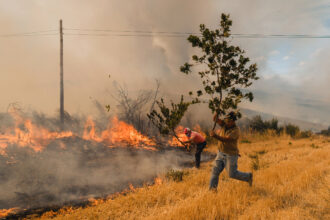
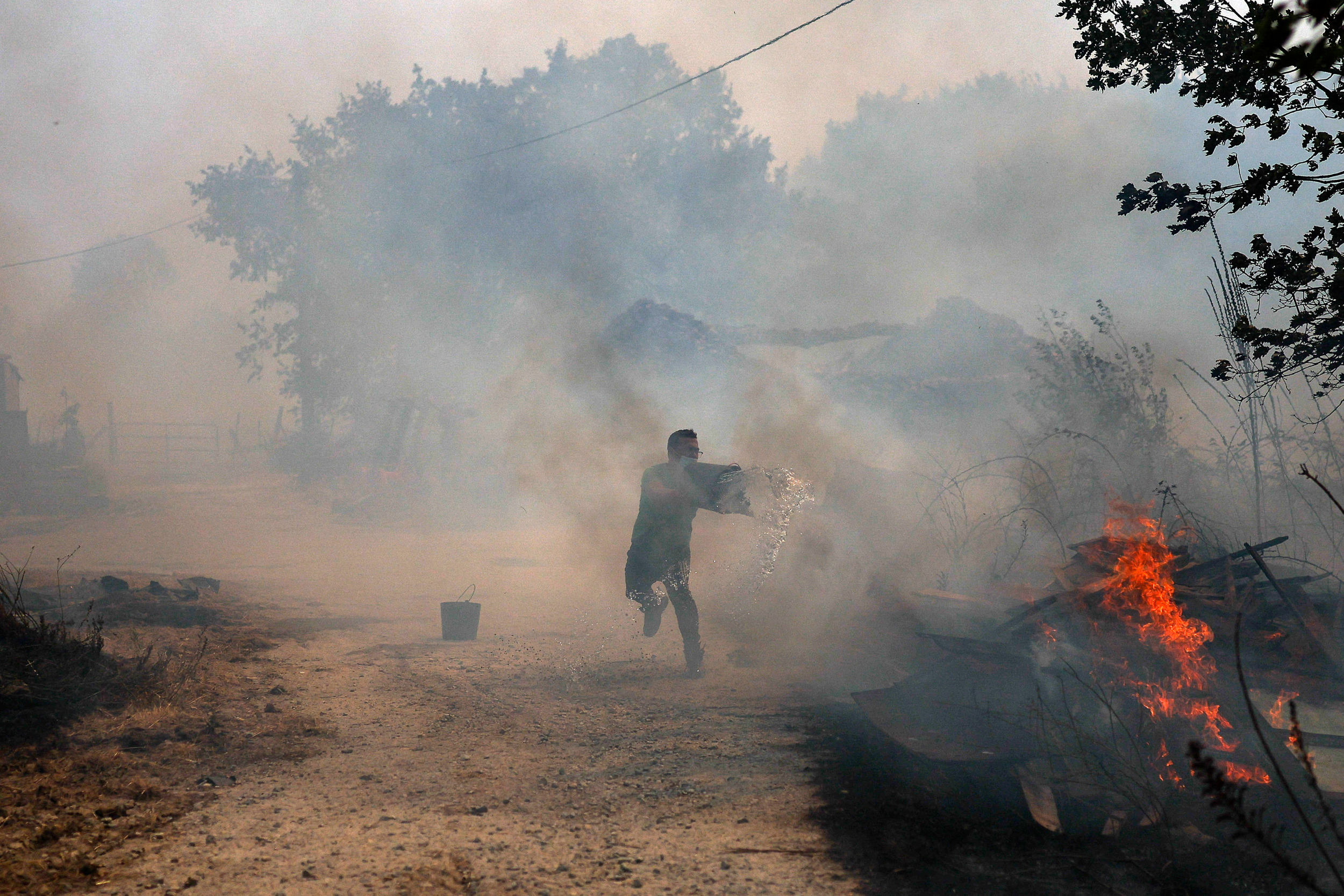
The model identified wildfire as the most climate-sensitive cause of future disturbances, especially in southern Europe, where hotter temperatures and drier air drive a sharp increase in burn areas. In the simulations, insect outbreaks also intensify as the warmer temperatures speed up reproductive cycles and reduce winter insect mortality.
Over time, the compounding pressures shift the structure of Europe’s forests away from older stands toward a growing share of younger forests, especially in the Mediterranean region and temperate, mid-latitude forests. That shift has consequences: Mature trees store more carbon and provide habitat for species that depend on undisturbed forests.
As disturbance increases, the stability of Europe’s forest carbon sink weakens, and ecosystems that evolved under longer growth cycles face a faster reset. That carbon sink is central to the continent’s climate and biodiversity goals, so more frequent disturbance raises questions about the long-term stability of its forest carbon sink and the resilience of its ecosystems.
The study’s new approach enabled the researchers to draw on existing local forest models from across Europe, rather than relying on a single, generalized model for the continent, said co-author Rupert Seidl, a professor of ecosystem dynamics at the Technical University of Munich’s School of Life Sciences.
“We’ve developed an entirely new paradigm for modeling forests across large spatial domains, using novel AI approaches,” he said.
Seidl also said it accurately simulated spatial processes, such as beetles moving through forests, rather than relying on single-frame snapshots. The research team assumed they would see more disturbances in the future, he said, but thought there would be a greater balancing effect from regrowth.
Seidl has co-authored several other recent papers, including studies on how global warming will affect forest carbon storage, as well as a 2020 study showing that warming can cause “irreversible alterations” in mountain forests.
Big changes in forests also affect the land and how water moves across it. When trees die or burn, rain falls on bare soil instead of leaves and needles, running off more quickly and carrying sediment downhill. Slopes once held together by roots can loosen. In mountain headwaters, those changes can ripple into rivers that supply farms, towns and hydropower plants far from forests.
This story is funded by readers like you.
Our nonprofit newsroom provides award-winning climate coverage free of charge and advertising. We rely on donations from readers like you to keep going. Please donate now to support our work.
Donate NowFor people who live near forests, the potential risks are immediate. Fire seasons could stretch longer and reach into places that once felt sheltered. Waves of beetles or wind damage could decimate the timber industry, tourism and small rural economies.
What once seemed like rare disasters, such as a bad fire season or a localized tree die-off, will probably be commonplace toward the end of the century in some regions, as human-caused warming drives overlapping stresses.
Regional Nuances
Europe’s forests cover an area slightly larger than Alaska, stretching about 3,000 miles from Norway to Portugal and the dark beech and spruce forests of the Carpathian Mountains and southern Balkans.
In Scandinavia and other parts of northern Europe, the model projects a different disturbance pattern than in the Mediterranean. Wildfire risk has already increased in a warming world, but windstorms and insect outbreaks remain dominant drivers of change in boreal forests.
Warmer temperatures lengthen the growing season and can boost tree growth in some areas, but they also favor bark beetles and other pests whose survival and reproduction improve with milder winters.
Overall, the study shows that northern forests may initially benefit from longer growing seasons, but those gains are offset over time. Increasing disturbances would interrupt the development of older stands, with implications for carbon storage and boreal biodiversity.
The findings highlight the importance of actively adapting forest management in Europe’s northern forests, “where disturbance levels have historically been low and may increase less dramatically than in other areas of Europe,” said co-author Katharina Albrich, a researcher at the Natural Resources Institute Finland.
Forests play a particularly large economic and societal role in the Nordic countries, and ensuring that they can cope with climate change is essential, she said. Management goals include promoting mixed stands of trees rather than monocultures to enhance climate resilience.
The study identifies the Mediterranean Basin as Europe’s clearest hotspot of disturbance. Under high emissions, disturbance increases across nearly nine of every 10 forested areas in the region, far more than elsewhere. Hotter summers and distinctly drier air, which draws moisture from vegetation, will push landscapes closer to combustion.
The researchers also found that once warming passes 2 degrees Celsius, Mediterranean forests’ shifts can accelerate abruptly, reducing the share of older carbon-rich forests more sharply in Southern Europe than anywhere else.
“Our results show that these disturbance interactions significantly amplify overall tree mortality,” Seidl said. “They thus hold the potential for substantially changing forests.”
About This Story
Perhaps you noticed: This story, like all the news we publish, is free to read. That’s because Inside Climate News is a 501c3 nonprofit organization. We do not charge a subscription fee, lock our news behind a paywall, or clutter our website with ads. We make our news on climate and the environment freely available to you and anyone who wants it.
That’s not all. We also share our news for free with scores of other media organizations around the country. Many of them can’t afford to do environmental journalism of their own. We’ve built bureaus from coast to coast to report local stories, collaborate with local newsrooms and co-publish articles so that this vital work is shared as widely as possible.
Two of us launched ICN in 2007. Six years later we earned a Pulitzer Prize for National Reporting, and now we run the oldest and largest dedicated climate newsroom in the nation. We tell the story in all its complexity. We hold polluters accountable. We expose environmental injustice. We debunk misinformation. We scrutinize solutions and inspire action.
Donations from readers like you fund every aspect of what we do. If you don’t already, will you support our ongoing work, our reporting on the biggest crisis facing our planet, and help us reach even more readers in more places?
Please take a moment to make a tax-deductible donation. Every one of them makes a difference.
Thank you,

Bob Berwyn
Reporter, Austria
Bob Berwyn is an Austria-based reporter who has covered climate science and international climate policy for more than a decade. Previously, he reported on the environment, endangered species and public lands for several Colorado newspapers, and also worked as editor and assistant editor at community newspapers in the Colorado Rockies.