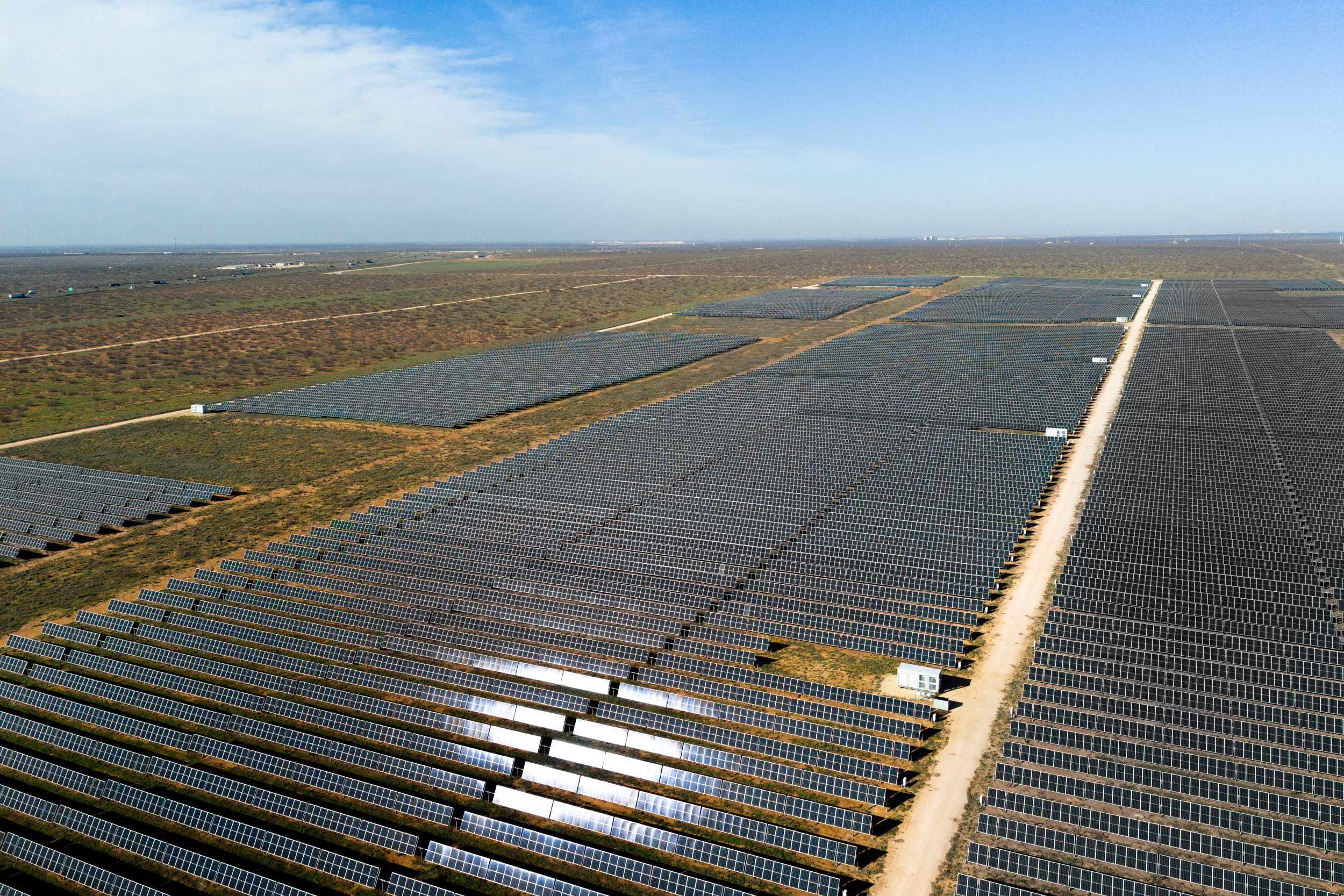


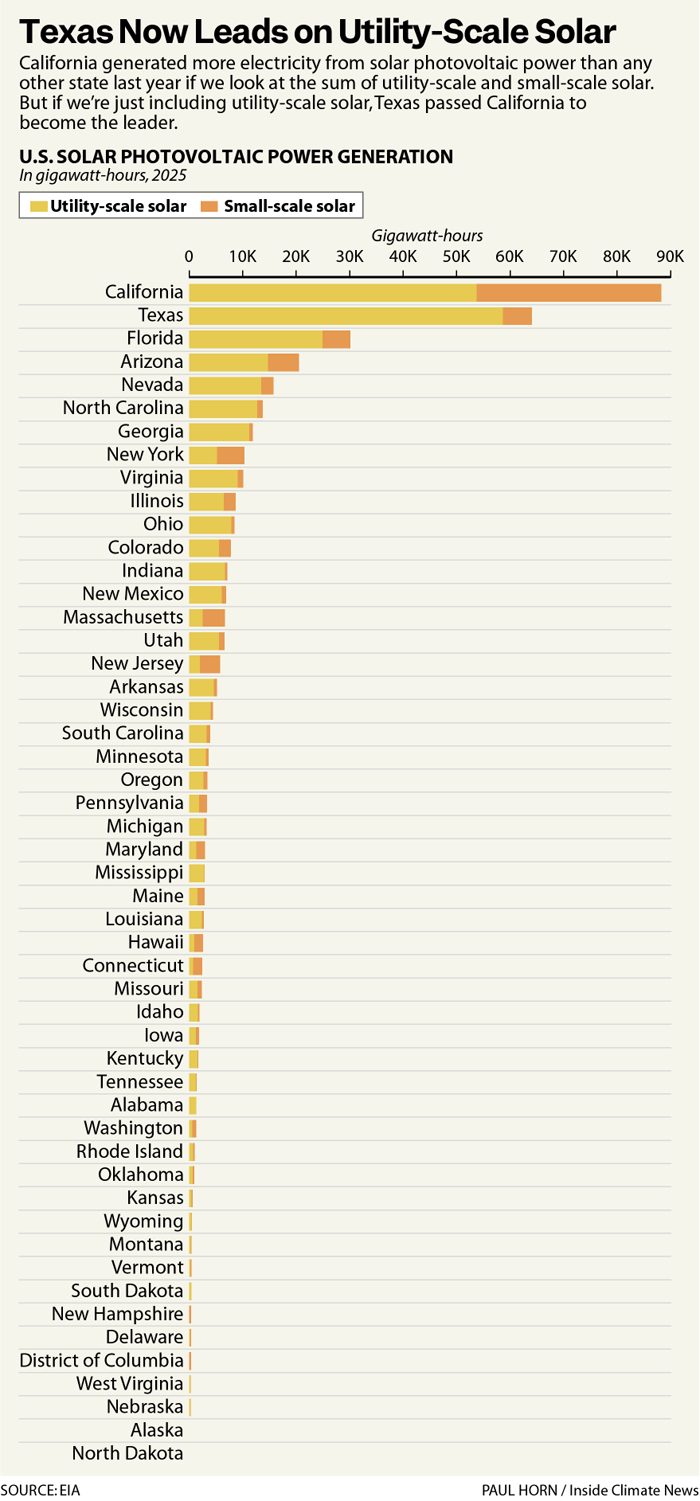
Texas, which already leads the country in electricity generation from natural gas, coal and wind, has passed California to become the leader in utility-scale solar.
Data for 2025, released last week by the U.S. Energy Information Administration, shows that Texas generated 58,634 gigawatt-hours from utility-scale solar, enough to pull ahead of California’s 53,713 gigawatt-hours.
But California can continue to claim the distinction of leading the country in electricity from small-scale solar, which EIA defines as any project with capacity of less than 1 megawatt. And if we look at the sum of utility-scale and small-scale solar, California remains ahead.
I’m highlighting utility-scale solar because it was the fastest-growing electricity source in the United States last year, with an increase of 35 percent. But it’s still just one-sixth of the gigawatt-hours of the leader, natural gas.
While gas remained on top, it was down 3.3 percent, largely due to high prices that led it to lose market share to other sources.
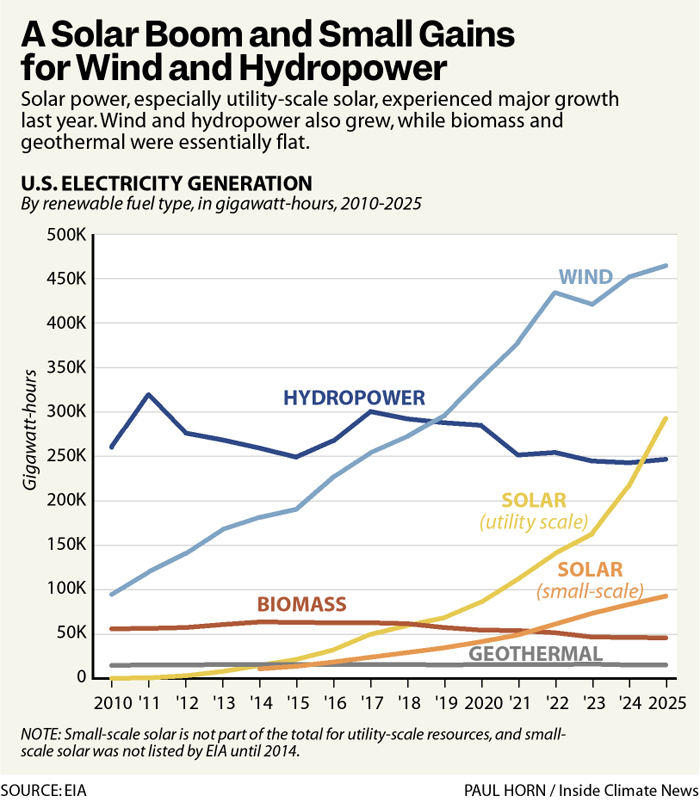
If we view renewable energy—including wind, hydropower, utility-scale solar and others—as a single category, it was second only to gas, and up 9.5 percent.
Among the other major sources, nuclear was essentially flat, increasing 0.4 percent.
Coal gained ground, adding 13 percent, benefiting from favorable price competition with gas and high electricity demand.
Here are the latest figures and how they fit into what’s happened since 2010:
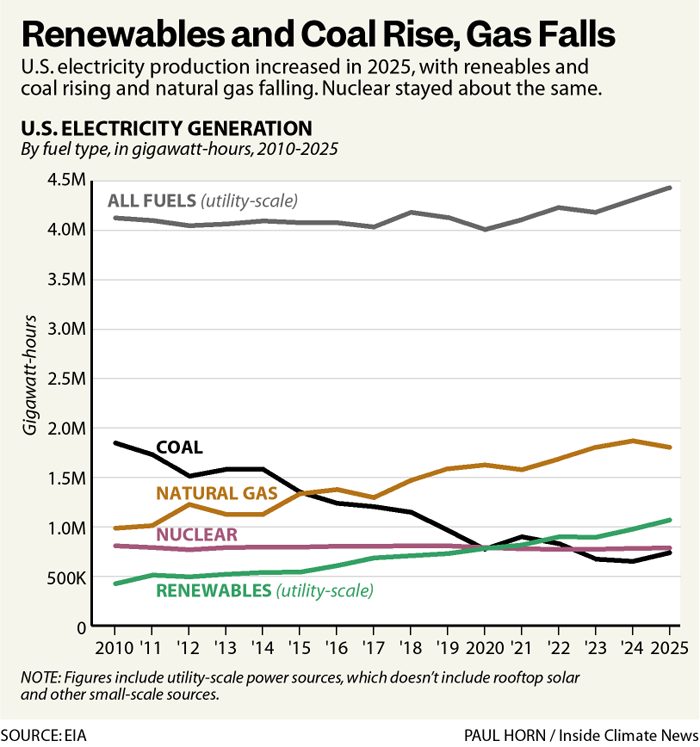
Another way to look at this is to visualize slices of a pie. Natural gas had the largest slice with 40.8 percent. Next was renewables at 24.1 percent, followed by nuclear at 17.7 percent and coal at 16.6 percent. This left about 1 percent under the “other” category, which included less-used fossil fuels such as petroleum liquids.
EIA lists this data as preliminary and subject to revision, but in my experience, any revision is likely to be small.
Here is some detail on the changes in renewables:
I spoke with four people this week to help understand the 2025 figures.
Kevin Kircher, a mechanical engineering professor at Purdue University, said the growth of utility-scale solar is “an amazing success story.”
“I’ve been working on clean energy for about 15 years, and when I started, solar was still a boutique sort of thing that you would put on satellites and that some nerds had on their roofs, but it wasn’t really a thing that was ready for scale,” he said. “Now solar has hit the mainstream.”
He said Texas’ embrace of solar shows the positive side of a state regulatory climate that makes it easy to build. The downside, he said, is that it’s also easy to build dirtier things, such as fossil-fuel infrastructure.
It’s not a surprise that Texas has taken the lead in utility-scale solar generation, considering the pace of growth over the last few years. Texas passed California in installed utility-scale solar capacity in 2024, and then 2025 was the first full year in which Texas’ solar projects generated more electricity than those in California.
I asked Catie Hausman, an associate professor in the School of Public Policy at the University of Michigan, for an example of an especially important number in the new data. Rather than focusing on any one power source, she looked at the big picture of electricity generation from all utility-scale sources, which was up 2.8 percent in 2025 compared to the prior year. She explained why that’s a significant increase.
“Total generation is up for two years in a row,” she said. “One year might have been a blip, but now we’re seeing two years in a row after decades of flat demand growth, and that’s entirely consistent with what we know about data centers and also electrification and other broad market trends.”
Data centers, with their outsized thirst for electricity and water, are forcing officials to think carefully about how to manage infrastructure spending and limit the share of costs that fall on residential consumers.
Bryan Hubbell, an economist and senior fellow at the think tank Resources for the Future, took a close look at the increase in electricity from coal-fired power plants. He said the shift was due to several factors, including extreme weather that drove high demand across almost all power sources, actions by the Trump administration to prevent old coal plants from closing and high gas prices.
Hubbell worked for 27 years at the U.S. Environmental Protection Agency, ending last summer when he was head of the air, climate and energy research program. He took early retirement when the Trump administration announced it planned to eliminate his office.
I asked him if he thinks coal plants will continue to increase their output in 2026.
“I am not convinced we’ve hit peak coal yet,” he said.
This story is funded by readers like you.
Our nonprofit newsroom provides award-winning climate coverage free of charge and advertising. We rely on donations from readers like you to keep going. Please donate now to support our work.
Donate NowHigh electricity demand, plus support from the Trump administration, could help slow or pause the decline that had been happening before President Donald Trump returned to office, he said.
“It depends on the administration’s [level of] determination to keep coal on life support,” he said.
But those efforts run counter to another declared priority of Trump: reducing energy prices. I’ll be looking for signs that the administration has reached a point where it views coal subsidies as too expensive to justify.
Most states increased their use of coal for electricity last year, but a few were responsible for a disproportionately large share of the increase.
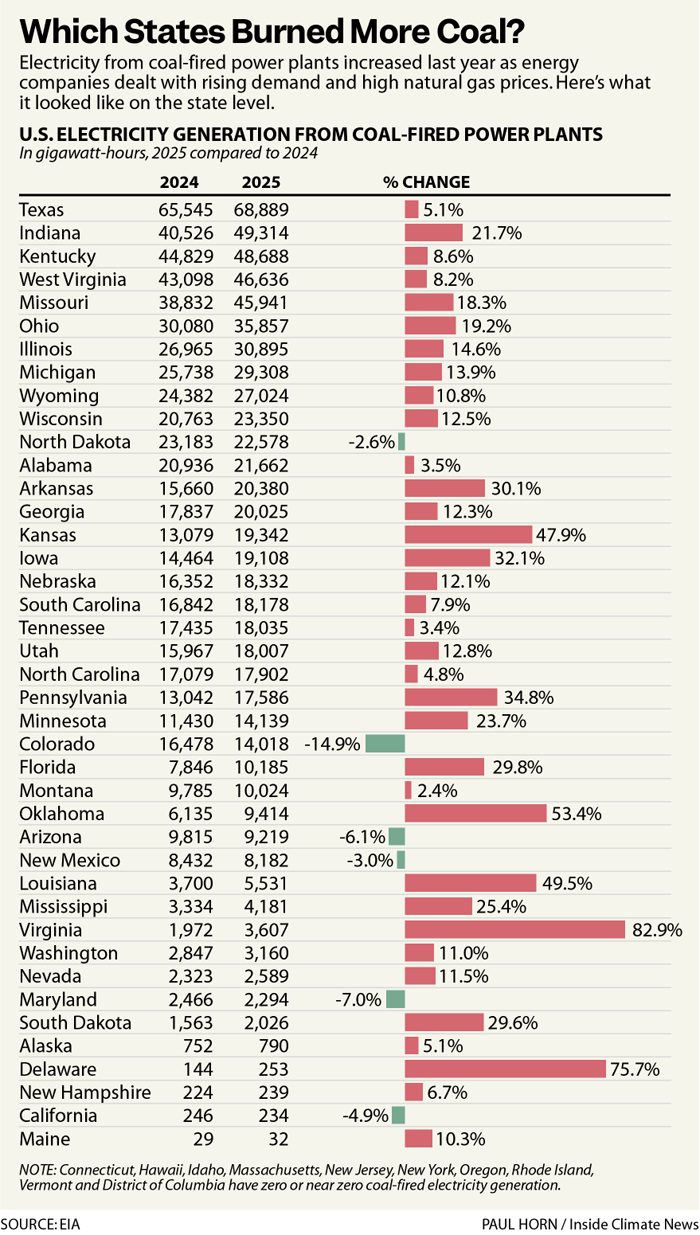
Indiana stands out, having increased its electricity from coal by 21.7 percent, enough to leapfrog West Virginia and Kentucky and become No. 2 in coal power, right behind Texas.
The shift in Indiana was largely due to a few large coal plants increasing their output substantially, said Ben Inskeep, program director for Citizens Action Coalition, an Indianapolis-based consumer advocacy and environmental group.
The plants had run less in prior years because of lower demand, high operating costs and maintenance issues, he said. But conditions changed in 2025, with demand rising so much that operators were less daunted by the costs.
“It is concerning to see Indiana’s utilities increase electricity generation by using old, expensive coal-fired power plants instead of investing in clean and affordable generation resources,” Inskeep said in an email. “Hoosiers are paying the price to keep these dilapidated and unreliable power plants online, both through soaring electric bills and serious health and environmental impacts caused by their pollution.”
While Indiana increased its use of coal power, it is also seeing investment in utility-scale solar. The largest project is Mammoth Solar in north-central Indiana, which the developer, Doral Renewables, has said will have capacity of 1,300 megawatts when complete. An initial phase of 400 megawatts went online in 2024.
Just a few years ago, 400 megawatts of utility-scale solar was so large that it was difficult to imagine. Now, if you look at visualizations such as the Solar Energy Industries Association interactive map, projects of that size have become almost commonplace.
This is what energy researchers such as Kircher are talking about when they react to development that has blown past expectations and continues to accelerate.
Other stories about the energy transition to take note of this week:
How the Iran War May Affect Global Renewables: The Iran war remains in its early days, but there are some indications that the conflict and related volatility in fossil fuel prices could create political and economic reasons to invest in renewable energy, as Christa Marshall and Corbin Hiar report for E&E News. The extent of the boost for renewable energy may depend on the level of damage and disruption to Middle East oil and gas infrastructure.
Why Electricity Bills Are So High—and How the Blowback Could Hit Trump: U.S. residential electricity rates rose by an average of 5 percent last year and many consumers feel like the growth is out of control. The reasons for the increase are complicated and vary substantially by state, as Marianne Lavelle and I report for ICN.
Private Equity Makes a Major Acquisition of a U.S. Power Producer: A consortium including BlackRock’s Global Infrastructure Partners and the Swedish private-equity firm EQT AB has reached an agreement to buy AES Corp., a Virginia-based company that is a major developer of clean energy projects and owns local utilities in Ohio and Indiana. At $33.4 billion, including debt, this is one of the largest acquisitions in the power sector, as Sumit Saha reports for Reuters. This continues private equity’s move into the power sector amid rising demand from data centers and other large users. Last year, Minnesota regulators approved the sale of Allete, a utility, to Global Infrastructure Partners.
EV Sales in China Are Way Down So Far This Year: Several major Chinese automakers, including BYD, reported February sales that show a major decline within China, the world’s largest automobile market, as Al Root reports for Barron’s. This is probably bad news for Tesla, which got 22 percent of its revenue from China last year. It’s not surprising to see some speed bumps in China following several years of growth.
Inside Clean Energy is ICN’s weekly bulletin of news and analysis about the energy transition. Send news tips and questions to [email protected].
About This Story
Perhaps you noticed: This story, like all the news we publish, is free to read. That’s because Inside Climate News is a 501c3 nonprofit organization. We do not charge a subscription fee, lock our news behind a paywall, or clutter our website with ads. We make our news on climate and the environment freely available to you and anyone who wants it.
That’s not all. We also share our news for free with scores of other media organizations around the country. Many of them can’t afford to do environmental journalism of their own. We’ve built bureaus from coast to coast to report local stories, collaborate with local newsrooms and co-publish articles so that this vital work is shared as widely as possible.
Two of us launched ICN in 2007. Six years later we earned a Pulitzer Prize for National Reporting, and now we run the oldest and largest dedicated climate newsroom in the nation. We tell the story in all its complexity. We hold polluters accountable. We expose environmental injustice. We debunk misinformation. We scrutinize solutions and inspire action.
Donations from readers like you fund every aspect of what we do. If you don’t already, will you support our ongoing work, our reporting on the biggest crisis facing our planet, and help us reach even more readers in more places?
Please take a moment to make a tax-deductible donation. Every one of them makes a difference.
Thank you,

Dan Gearino
Reporter, Clean Energy
Dan Gearino covers the business and policy of renewable energy and utilities, often with an emphasis on the midwestern United States. He is the main author of ICN’s Inside Clean Energy newsletter. He came to ICN in 2018 after a nine-year tenure at The Columbus Dispatch, where he covered the business of energy. Before that, he covered politics and business in Iowa and in New Hampshire. He grew up in Warren County, Iowa, just south of Des Moines, and lives in Columbus, Ohio.