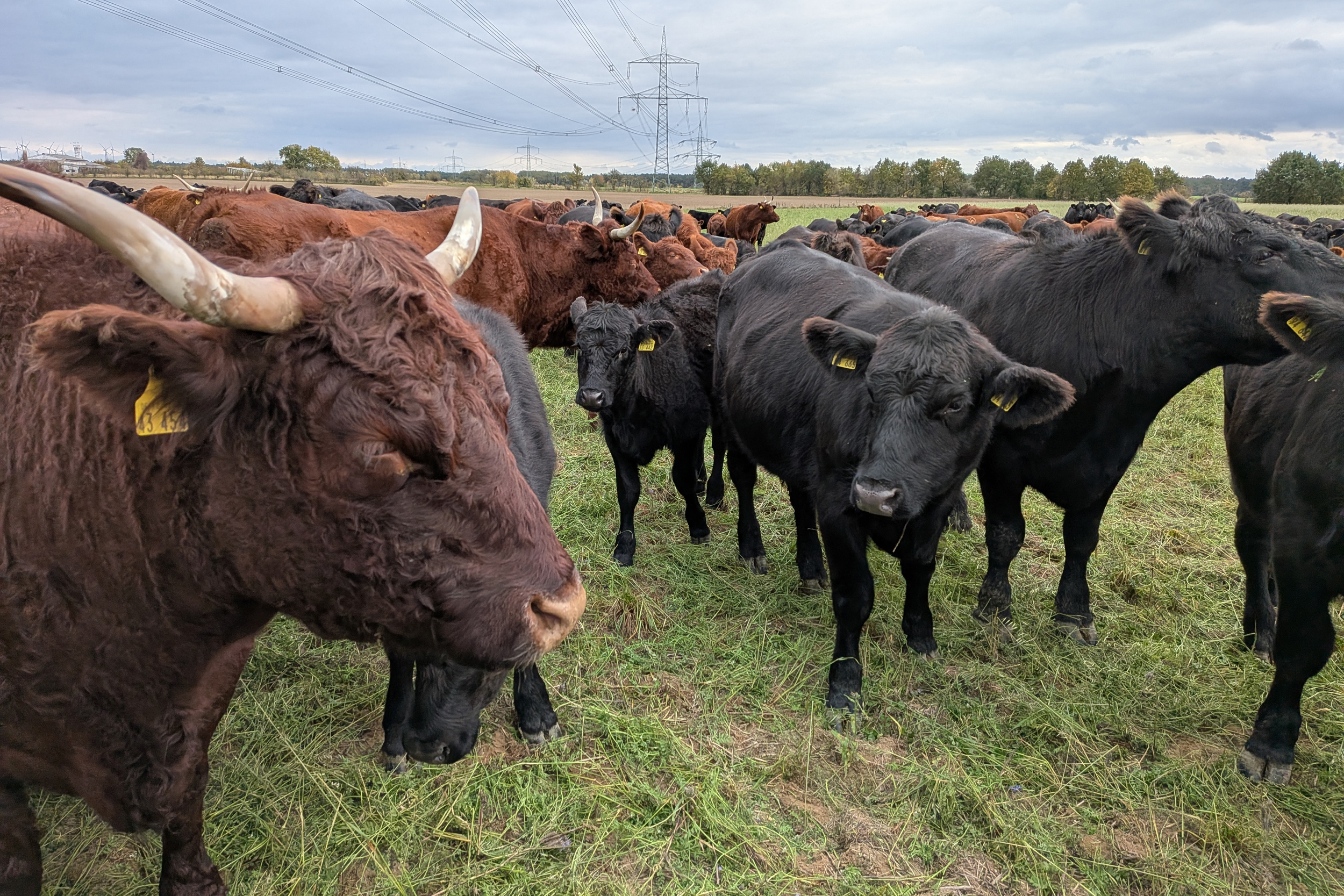


Samantha Kemnah looked out the foggy window of her home in New Berlin, New York, at the 150-acre dairy farm she and her husband, Chris, bought last year. This winter, an unprecedented cold front brought snowstorms and ice to the region.
Over the past five months, I spent numerous hours talking with Kemnah and other American farmers to better understand the ways health care affects small farms in the United States—and how the system might be improved. Germany, another high-income country with an advanced agricultural sector, seemed like a logical comparison. I also come from a long line of farmers in the Texas Hill Country that trace their roots back to what is now Germany (that’s where the “Gass” in my surname comes from).
One thing I hadn’t really contemplated, as my reporting also took me to rural Germany, was a commonality between American and German farmers: the degree to which climate change touched virtually every aspect of their working lives.
And this epiphany led to another. A ripple effect of the German health care system is giving farmers the economic, and emotional, flexibility to cope with the vagaries of a changing climate in ways their American counterparts struggle with.
In Germany, government financed health care helps make the country’s climate-conscious agriculture sustainable and affordable for farmers; while America’s broken health care system and diminishing support from Medicaid often prevent farmers from making the necessary investments in climate-friendly farming strategies.
Research from the U.S. Department of Agriculture in 2024 showed that many American farmers face significant challenges in diversifying their crop rotation—long considered a good practice for the climate—due to economic constraints, lack of incentives and knowledge gaps. The USDA found that if farmers rotated their crops they’d actually save money in the long run by reducing their use of fertilizer. They’d also reduce their risk of crop failure from climate change-related threats.
Thus, as the USDA provides $19.5 billion to support climate-friendly agriculture across the country, those funds will be offset by billions of dollars of federal health care cuts that will disproportionately affect small farmers, who remain heavily dependent on Medicaid.
Meanwhile, as health care dollars are cut, peer-reviewed research has documented how farmers and farm workers face elevated threats from climate-induced heat and wildfire smoke. And research in 2025 found that due to ”high-stress agricultural working environments,” farmers are at high risk for mental illness, including anxiety, depression and suicide. “These challenges are exacerbated by rural settings with limited access to mental health care and pervasive mental health stigma,” according to researchers at Ohio State University.
“Our level of OK is only based on the fact that we dump a ton of money into our very small farm,” said Samantha, 50. She and Chris work off-farm with Northeast Organic Farming Association of New York.
The Importance of Medicaid in Rural America
In the U.S., nearly half of rural residents, including farmers, are uninsured or insured by government-funded programs such as Medicaid or Medicare. Nearly one in four people under the age of 65, like the Kemnah’s, have Medicaid coverage, according to a 2023 survey conducted by KFF, formerly the Kaiser Family Foundation.
Though it typically pays hospitals and other providers very low rates, Medicaid plays a crucial role in rural health care, helping to keep facilities open that wouldn’t be able to shoulder the cost of caring for legions of uninsured patients.
Now, even this system is in peril as millions of Americans are expected to lose coverage as a result of pending changes and cutbacks to Medicaid under the Trump administration’s One Big Beautiful Bill.
As a result, some farmers risk losing their lifeline and becoming uninsured. It would leave them even less prepared to do farm work and to tackle the oncoming impact of climate change.
Congress has now set aside $50 billion to offset the loss of Medicaid funding for rural areas. That will be shared among states over the next five years under the Rural Health Transformation Program. Each state is guaranteed $100 million annually from the fund, with the rest of the money being awarded based on a series of factors.
But Kevin Bennett, director of the South Carolina Center for Rural and Primary Care and the rural health fellow with the Commonwealth Fund, said this funding won’t offset the more than $1 trillion in federal health care spending cuts.
“So many rural hospitals and facilities are just trying to keep their doors open that the cuts are not going to be helpful, and this is not going to prevent many of them from closing services or altogether,” Bennett said.
Rural hospitals nationwide are set to lose 21 cents of every dollar they receive from Medicaid, amounting to about $70 billion over the next decade, according to a recent report co-authored by the National Rural Health Association and Manatt Health.
Bennett is optimistic that some states will use money from the Rural Health Transformation Program to help farmers and other rural residents get health insurance. Wyoming has plans to use some of its funds for this. But Bennett emphasized that’s not the program’s stated goal.
Even with health insurance, 43 million Americans live in rural areas with a shortage of primary care physicians, according to a recent study by the nonprofit Commonwealth Fund. And rural residents often have to travel long distances to get health care, often with limited public transportation options. During extreme weather events, fueled by the changing climate, rural health care systems can become overwhelmed.
The health insurance challenges in rural areas are also exacerbated by health care workforce shortages and hospital closures. Since 2010, 152 hospitals have closed or reduced services across the U.S. because they could no longer afford to stay open, according to the University of North Carolina’s Cecil G. Sheps Center for Health Services Research.
Small Farms on the Edge
On the Kemnah’s farm in New York last winter, their cows tolerated the frigid temperatures, but climate change is making farming more risky. Small farms, like the Kemnah’s, often bear the brunt of a warming planet and require increased investments for climate adaptation—investments that often become prohibitive for farmers struggling with health care costs.
For years, the Kemnah’s and their children had different health insurance plans through off-farm jobs. Then, in 2010, when Chris left his job to farm full time, they wanted to enroll their children in New York State’s health insurance plan for kids and found out the entire family was eligible for Medicaid. Kemnah said they calculated this was better than switching between costly employer-sponsored insurance plans they would get from jobs off the farm.
The Kemnah’s, who have farmed on rented properties in New York State for 19 years, purchased their current farm in 2024.
With $19.5 billion appropriated during the Biden administration in 2022, the USDA has been trying to support “climate-smart agriculture,” which includes crop rotation, no-till planting and methane digesters. But for many American farmers, incorporating sustainable farming practices is complicated by numerous factors, including their search for affordable health care.
The Kemnahs initially grew vegetables, but one of the major reasons they decided to stop was because they were afraid extreme weather events would ruin their crops.
“We really enjoyed growing vegetables,” said Samantha Kemnah. “But we couldn’t continue to commit to people, to raise food, and then have a hailstorm wipe it all out.”
German Farmers Don’t Worry About Health Care
If the Kemnahs lived in Germany, they wouldn’t need to work an off-farm job to get access to adequate, affordable health insurance, and could farm full time. That’s because health insurance is mandatory and provides coverage for nearly everyone living in Germany, regardless of income. The health plans cover most procedures and medications, with no age restrictions or limitations on necessary medical procedures.
Farmers in Germany may be struggling with ruthless economics, but the one thing that’s not on their mind is health insurance. Nor are rural areas in Germany as disproportionately affected by the shortage of primary care physicians, according to Germany’s National Association of Statutory Health Insurance Physicians.
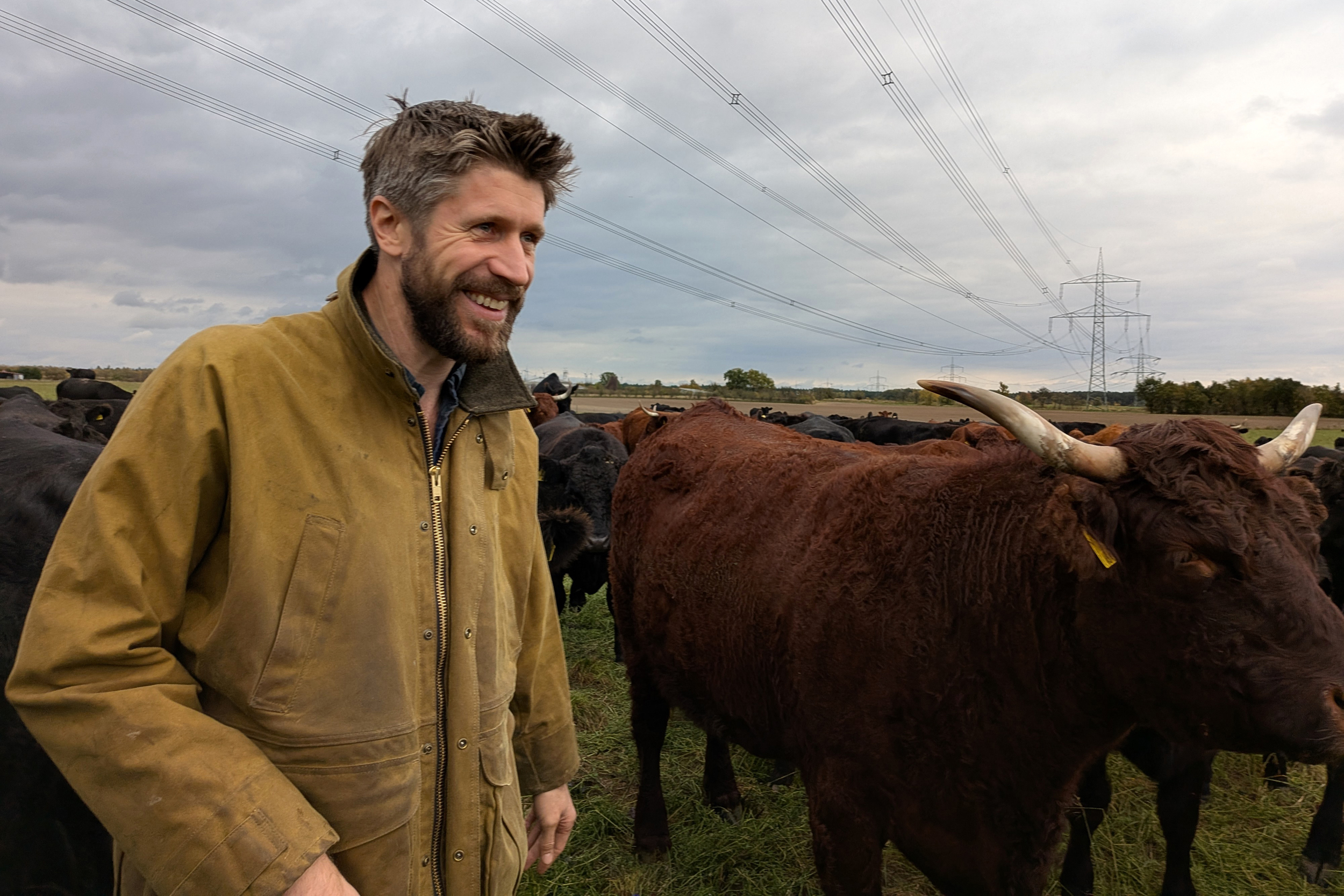
Benedict Bösel is the founder and managing director of Gut und Bösel, a more than 2,000-acre farm just outside Berlin in Alt Madlitz, Brandenburg.
“I don’t have to think about health insurance,” said Bösel, standing in a field surrounded by his 320 cows.
He and his family, like the vast majority of people living in Germany, are covered by one of the country’s not-for-profit health plans, known as sickness funds.
These plans, which are generally funded by a combination of premiums paid by enrollees and employers, offer a basic set of benefits and strictly limit how much patients must pay out of pocket for care.
And because health insurance is not tied to employment, people like the Bösels can keep their plan no matter where they work.
The biggest challenge for Bösel has been the unpredictability of the weather, not health insurance.
Farming in one of the driest parts of Germany is a difficult, full-time job, said Bösel, who quit his job in finance and returned in 2016 to work on his family’s farm.
To help improve the farm’s dry soil, he’s implementing centuries-old regenerative farming practices, like cover crops and no-till, a technique for growing crops without disturbing the soil through tillage, to adapt the land to a changing climate.
“I knew I had to drastically change and transform the farm into something that could sustain a livelihood for my kids,” he said, referring to climate-friendly practices he was able to afford to implement.
Like Bösel, Stefan Bernickel, a full-time farmer in Gramzow, Brandenburg, is able to take advantage of reliable government support.
His farm is part of a government program promoting sustainable farming. He invested some of the government funds in a strip-tillage seeding machine, which allowed for no-till farming between harvests.
“I’ve got money from the government that I can invest in the farm,” Bernickel said.
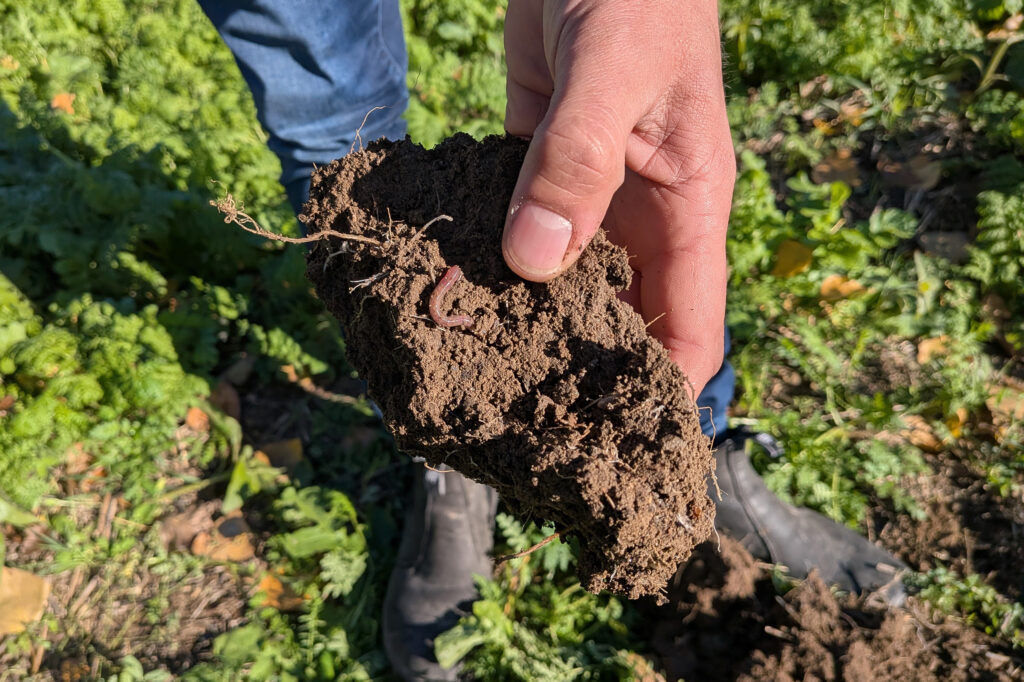
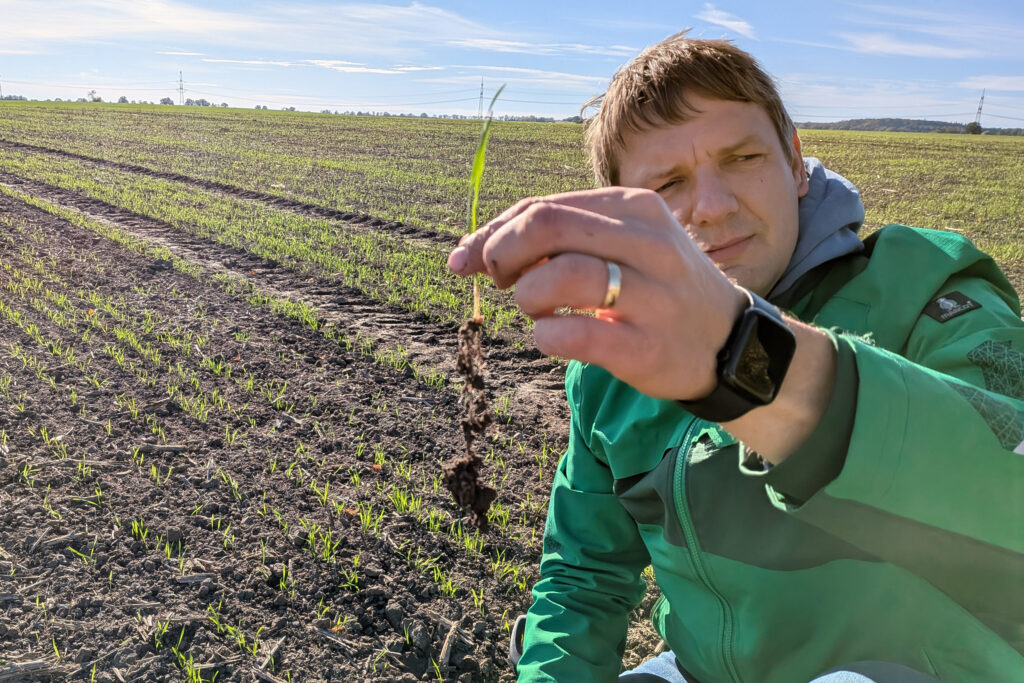
Stefan Bernickel holds a clump of soil with an earthworm to demonstrate his farm’s soil health in Gramzow, Brandenburg. Credit: Aram Zucker-Scharff
While some American farmers are struggling to stay on their farms, the stability of the German health care system allowed Bernickel to leave his job as an engineer in Berlin five years ago to run his family’s farm full time.
In that time, Bernickel’s been able to implement farming practices that help increase the land’s soil health and reduce erosion. A point of pride for him are the pink earthworms wriggling around in the soil, the original tillers of the Earth.
“That is healthy soil,” he said.
The Mental Health Toll
Farmers in the U.S. and Germany are struggling with tariffs, inflation and other policy changes. They also face shared climate threats—droughts, floods and heatwaves—that are driving significant income losses.
One reason is economic uncertainty. So much about farming is outside of a farmer’s control, said Conor Hammersley, a research scientist at the New York Center for Agricultural Medicine and Health who focuses on farmer mental health.
Being a farmer takes commitment and the ability to withstand unexpected hurdles that include economic shocks and weather extremes.
Farmers in the U.S. are 3.5 times more likely to die by suicide than the general population, according to a 2021 report by the National Rural Health Association.
While financial uncertainty and health care struggles play a part, Hammersley said it’s more than economics. Some farmers he’s talked to in New York feel they’re being unfairly cast as the villain in climate discussions.
This story is funded by readers like you.
Our nonprofit newsroom provides award-winning climate coverage free of charge and advertising. We rely on donations from readers like you to keep going. Please donate now to support our work.
Donate Now“It’s how society views farmers as being the big perpetrators of climate change, not the system of farming,” he said. “Farmers feel like it’s coming at them from every angle, like, ‘No matter what I do, I’m trying to do my best to maintain this small farm, and they’re telling me that I’m the problem for climate change.’”
Indeed, American farmers face pressure from every side. Climate change makes it harder to maintain a productive farm, health care cuts threaten farmers’ ability to work the land and cuts to the programs that could help with both mean their lives are more uncertain than ever.
The “Climate-Friendly” Cure for American Farms: Health Insurance
Florence Becot, the Nationwide Insurance early career professor in agricultural safety and health at Penn State, said removing burdensome health care coverage would allow farmers to focus on their work without the fear of high premiums or medical debt. This support could also help new farmers enter the profession.
In Germany, proactive programs dealing with changing climate allow farmers to experiment and develop or re-discover the best ways to keep their farms running and healthy, all while the reliable, relative stability of their health care system means far less to worry about.
Robin Ellis, a farmer in New York’s Hudson Valley, works part-time as a hospice nurse in order to get health insurance. Her off-farm job gives her a unique vantage point, allowing her to see the health—and health insurance—struggles of farmers as both patient and health care provider.
If it wasn’t for health insurance, Ellis, 51, said she’d be growing vegetables and grains full time, working to adapt her methods to more extreme and unpredictable weather. “As farmers, basically, the onus is on us to adapt to different conditions,” she said.
But as she knows as well as anyone, farmers without health insurance won’t be able to keep up with climate change—and most likely won’t, in the long run, keep their farms.
“It would be great if there were ways to farm that didn’t require an insane amount of personal sacrifice,” said Ellis. “That may or may not be possible, but I think stable health insurance is one thing that we could do to take the edge off of how hard it is to be a farmer. I personally say the solution for farmer health care is a solution for everybody’s health care.”
This project was supported by a grant from the Association of Health Care Journalists, with funding from The Commonwealth Fund.
About This Story
Perhaps you noticed: This story, like all the news we publish, is free to read. That’s because Inside Climate News is a 501c3 nonprofit organization. We do not charge a subscription fee, lock our news behind a paywall, or clutter our website with ads. We make our news on climate and the environment freely available to you and anyone who wants it.
That’s not all. We also share our news for free with scores of other media organizations around the country. Many of them can’t afford to do environmental journalism of their own. We’ve built bureaus from coast to coast to report local stories, collaborate with local newsrooms and co-publish articles so that this vital work is shared as widely as possible.
Two of us launched ICN in 2007. Six years later we earned a Pulitzer Prize for National Reporting, and now we run the oldest and largest dedicated climate newsroom in the nation. We tell the story in all its complexity. We hold polluters accountable. We expose environmental injustice. We debunk misinformation. We scrutinize solutions and inspire action.
Donations from readers like you fund every aspect of what we do. If you don’t already, will you support our ongoing work, our reporting on the biggest crisis facing our planet, and help us reach even more readers in more places?
Please take a moment to make a tax-deductible donation. Every one of them makes a difference.
Thank you,

Jordan Gass-Pooré
Contributor
Jordan Gass-Pooré (she/her) is an award-winning independent podcast producer and investigative journalist with more than a decade of journalism experience. Presently, Gass-Pooré is the executive producer of “Fumed,” an investigative podcast from Public Health Watch and distributed by Texas Public Radio.