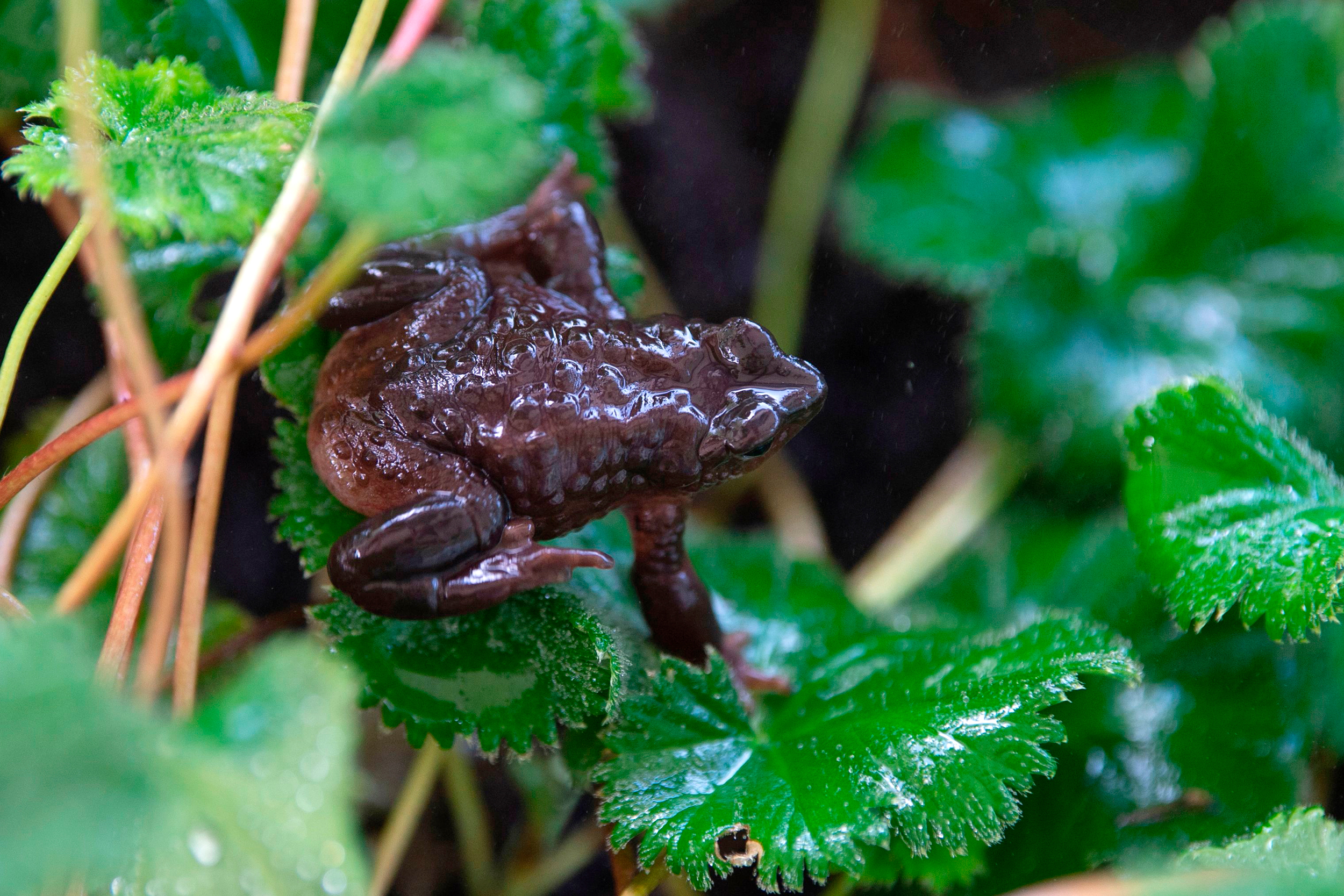


An Ecuadorian court has blocked construction of a highway after ruling it poses an imminent and irreversible threat to the rights of a critically endangered toad, a decision that underscores the country’s unique constitutional protections for nature.
The opinion, issued Sunday by Judge Milton Gustavo Hernández Andino of a provincial court in Pujilí, suspended all work on the planned highway, citing the risk it poses to the Jambato harlequin toad—a species found nowhere else on Earth but in the parish of Angamarca, in Cotopaxi province.
Ecuador is the only country in the world whose constitution recognizes nature’s rights to exist, regenerate and be restored, though hundreds of court rulings, local laws, nonbinding declarations and other initiatives worldwide recognize nature’s rights in some form.
The Jambato harlequin toad is recognizable by its bright orange belly and glossy black back. Water is essential to its survival. During the breeding season, females lay their eggs in clear streams and rivers, the tadpoles developing beneath riverbed stones. Protecting the toad’s interconnected terrestrial and aquatic habitats is critical to its survival.
Once thought to be extinct, the Jambato harlequin toad was rediscovered in 2016 by a child in Angamarca. Scientists estimate the population to be somewhere between 92 and 359. Because its numbers are so small, research suggests the species may have limited genetic diversity, making it less capable of adapting to new threats.
The Ecuadorian court found that the highway project, which had been slated to begin its most intensive phase on Jan. 5, would cause “massive earthmoving,” debris dumping and disturbances in nearby streams where the toads reproduce, potentially irreversibly damaging or destroying their only known habitat.
“This road poses an imminent and serious threat to the constitutional rights of this species,” the judge wrote in his decision.
The Ecuadorian government, Hernández Andino added, “must prevent and restrict activities that cause the extinction of species, the destruction of ecosystems or permanent alterations of natural cycles.”
He ordered all use of heavy machinery halted until comprehensive environmental studies on the road’s projected impact on the Jambato harlequin are completed and a species protection plan is approved. The court also found that provincial authorities had relied on an environmental certificate intended for low-impact maintenance work, despite the project’s significant repercussions in an area designated for special conservation.
“Despite early warnings and formal requests made since 2024 by organizations such as the Jambato Alliance, provincial and environmental authorities have responded only partially or have shirked their responsibilities,” the opinion said.
The Cotopaxi province did not respond to requests for comment. It is not immediately clear whether provincial authorities will comply with the court’s order—locals in Angamarca reported that officials moved heavy machinery to construction sites earlier this week.
“Defending Life in All Its Forms”
Ecuador is one of the most biologically diverse nations on Earth. Its ecosystems, from Angamarca’s high-altitude wetlands to the Amazon rainforest, are home to plants and animals found nowhere else on Earth, with new species still being discovered.
Local environmental defender Nayerli Cañizares Barragán said the ruling offers hope and stands as a symbol of the ongoing fight to defend nature and humans’ environmental rights.
“This ruling reminds us that defending life in all its forms is indeed worthwhile,” said Cañizares Barragán, a volunteer with the nonprofit Jambato Alliance, speaking in Spanish.
This story is funded by readers like you.
Our nonprofit newsroom provides award-winning climate coverage free of charge and advertising. We rely on donations from readers like you to keep going. Please donate now to support our work.
Donate NowThe lawsuit, a request for “precautionary measures” to stop a violation of rights, was brought by lawyer Gustavo Ricardo Redín Guerrero on behalf of the toad. Under Ecuadorian law, anyone can act to enforce nature’s rights.
Redín Guerrero said the decision reflects a core attribute of Ecuador’s rights-of-nature jurisprudence: When there is a risk of extinction, the burden of proof shifts to the government to prove with scientific certainty that its proposed action will not lead to that outcome. Under conventional environmental law, the burden generally rests on environmentalists.
“The judge agreed there is a very high risk,” Redín Guerrero said. “So he ordered the government to stop the road until they can prove it will not endanger the species.”
The case was filed on Saturday, after the province of Cotopaxi posted videos on social media announcing that new construction would begin on Jan. 5. The court issued its decision on Sunday evening.
“You move the road a few meters, you protect the river. Development and conservation are not opposites.”
— lawyer Gustavo Ricardo Redín Guerrero
Redín Guerrero, along with local community members, the Jambato Alliance and the nonprofit Ecuadorian Coordinator of Organizations for the Defense of Nature and the Environment, acted swiftly because they had proactively conducted years of scientific research in the high-altitude wetland ecosystems in the region.
“The scientists and the community already had the studies,” Redín Guerrero said. “Without that work, we couldn’t have done anything.”
He said the highway could be built without endangering the toad by rerouting sections away from rivers and sensitive habitat, with only minimal additional costs.
“We’re not against the road,” he said. “We are saying: Stop construction until there is scientific information that guarantees this species will not go extinct.”
He added: “You move the road a few meters, you protect the river. Development and conservation are not opposites.”
The ruling draws on precedent from Ecuador’s Constitutional Court, including the landmark “Los Cedros” case, which held that the rights of nature requires government officials to apply the precautionary principle, which means that in the absence of adequate scientific evidence, it is better to avoid certain risks that could lead to irreversible damage to ecosystems.
In its Los Cedros opinion, the Constitutional Court invoked Ecuador’s rights of nature laws to protect a cloud forest ecosystem hosting critically endangered species, including Atelopus frogs.
Impinging on those species’ right to exist, the Constitutional Court said, “is a violation of such magnitude that it would be equivalent to what genocide means and implies in the field of human rights.”
The Constitutional Court emphasized that safeguarding endangered species from the outset is essential, noting that their presence signals the health of the broader environment. “Once a species is extinct, the laborious process that has taken nature sometimes millions of years results in an irreparable loss of diversity and knowledge,” the Los Cedros opinion said.
What will happen to both the planned highway and the Jambato harlequin toad remains to be seen. But, Redín Guerrero said, “it’s because we have the rights of nature that this species has a chance.”
About This Story
Perhaps you noticed: This story, like all the news we publish, is free to read. That’s because Inside Climate News is a 501c3 nonprofit organization. We do not charge a subscription fee, lock our news behind a paywall, or clutter our website with ads. We make our news on climate and the environment freely available to you and anyone who wants it.
That’s not all. We also share our news for free with scores of other media organizations around the country. Many of them can’t afford to do environmental journalism of their own. We’ve built bureaus from coast to coast to report local stories, collaborate with local newsrooms and co-publish articles so that this vital work is shared as widely as possible.
Two of us launched ICN in 2007. Six years later we earned a Pulitzer Prize for National Reporting, and now we run the oldest and largest dedicated climate newsroom in the nation. We tell the story in all its complexity. We hold polluters accountable. We expose environmental injustice. We debunk misinformation. We scrutinize solutions and inspire action.
Donations from readers like you fund every aspect of what we do. If you don’t already, will you support our ongoing work, our reporting on the biggest crisis facing our planet, and help us reach even more readers in more places?
Please take a moment to make a tax-deductible donation. Every one of them makes a difference.
Thank you,