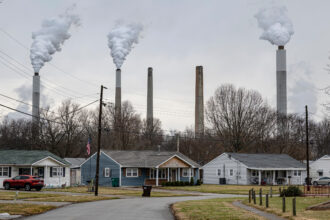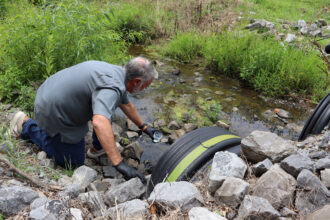


A series of Republican state legislatures are advancing, or have already passed, laws severely limiting the ability of state agencies to set environmental regulations, despite warnings from the scientific community that such measures could increase risk of serious health problems, including cancers.
Versions of a “Sound Science” bill, proffered by the U.S. Chamber of Commerce and supported by other business trade groups, have been signed into law in Alabama and Tennessee, and nearly identical bills are moving through state legislatures in Utah and Kentucky.
The bills require state environmental regulations to rely on the “best available science,” borrowing language from, but going even further than, an executive order President Donald Trump issued last year.
The bills bar state agencies from issuing environmental regulations that are more strict than federal standards, or setting limits for contaminants not regulated at the federal level, unless the state shows a “direct causal link” between a potential contaminant and “manifest bodily harm” in individuals.
But health researchers and physicians say assigning blame to chemical contaminants is rarely that straightforward.
Jeffrey Wickliffe is a professor and chair of the Environmental Health Sciences Department at the University of Alabama at Birmingham School of Public Health. He agreed to speak with Inside Climate News about the Alabama bill in his personal capacity and not as a representative of UAB or the School of Public Health.
Wickliffe said it’s virtually impossible to prove a certain contaminant directly caused a certain disease in a person.
“It’s going to be a standard that’s very difficult to ever meet,” Wickliffe said.
Wickliffe said one exception may be exposure to asbestos, because it is associated with a specific type of cancer, mesothelioma, that has few other known causes. But asbestos is the exception, not the rule. Many cancers or other diseases can have numerous causes, and people who develop those cancers may have been exposed to multiple toxic substances that could be contributing to their disease.
Instead, most toxicology studies rely on tracking large populations of people who were exposed to a particular contaminant.
“[The bill] sort of moves away from what I think is a very balanced way to protect health,” Wickliffe said. “You don’t have to say that [chemical] caused that [illness] in that person, but you can say that exposure to chemical X at these concentrations tends to increase the risk that some individuals may develop the disease.”
The U.S. Chamber of Commerce did not respond to multiple inquiries about scientific opposition to the bills.
Mark Behrens, an attorney who spoke on behalf of the Chamber in multiple state legislatures in favor of the bill, told Alabama legislators in February that the bill was “common-sense legislation” that requires state agencies to use the best available science in setting regulations.
“President Trump’s executive order directs federal decisions to be informed by the most credible, reliable and impartial scientific evidence available,” Behrens said during a public hearing for the bill in the Alabama Senate. “And that’s all the bill would do for Alabama.”
“Insurmountable Burden of Proof”
Critics say the bill does the opposite by excluding major legitimate fields of scientific research.
The versions of the bill in Alabama, Utah and Kentucky, which were proposed in 2026, also block state agencies from setting environmental regulations “based solely on an increased risk of disease.” That provision is not in Tennessee’s law, which passed last year.
Wickliffe was one of 45 scientists, physicians or other healthcare professionals who signed a letter to Alabama legislators opposing the bill, saying it created an “insurmountable burden of proof for agency rulemakings that is out of step with scientific practice.”
The letter argues it might not even be possible to show that smoking “causes” cancer or lead exposure “causes” neurotoxicity based on the criteria in the bill.
“Regulations are based on risk so that we protect humans from getting sick in the first place,” the letter states. “This framework would prevent our state government from protecting Alabama’s most vulnerable populations like children, pregnant women, and the elderly.”
This story is funded by readers like you.
Our nonprofit newsroom provides award-winning climate coverage free of charge and advertising. We rely on donations from readers like you to keep going. Please donate now to support our work.
Donate NowThe Alabama legislation passed anyway, mostly along party lines, although some Republicans voted no, citing potential “unintended consequences.” Gov. Kay Ivey signed the bill without additional comment.
Sarah Stokes, a senior attorney in the Alabama office of the Southern Environmental Law Center, said the law takes Alabama backward in protecting its residents from pollution.
“It makes it even harder for agencies to create protective standards, because they have to show actual bodily harm,” Stokes said. “People have to be dying or hurt by a certain amount of a certain pollutant before they step in.”
Alabama Law Blocks Toxic Water Standards Update
Though the bills are extremely similar, Alabama’s version included an extra provision, stating “[n]o agency shall establish as the default or be required to use values from the United States Environmental Protection Agency’s Integrated Risk Information System in the development of numeric water quality criteria.”
Environmental advocates believe that is a direct response to a decision last year in which the nonpartisan Alabama Environmental Management Commission voted to update the state’s water quality standards to match the IRIS database.
In that rare decision, the AEMC, an appointed board of healthcare, legal, engineering and other professionals that oversees the state environmental agency, sided with environmental groups that petitioned for the updated standards.
The Alabama Department of Environmental Management did not respond to multiple requests for comment about the law and its potential impacts, but the language in it seems to indicate that those EPA water standards will not be enacted.
The new law states that any agency that has used the IRIS database to set standards “shall revise all rules to comply with this subsection not later than nine months after the effective date of this act.”
In addition to the U.S. Chamber of Commerce, representatives from powerful state trade groups, Manufacture Alabama and the Business Council of Alabama, spoke in favor of the bill.
“We believe that striking balance between best available science and regulatory matters is the best way to balance environmental stewardship and economic development as well,” Manufacture Alabama President Jon Barganier said to the legislature. “Our members spend millions and millions of dollars each and every year on environmental compliance and investment in that world. But also, we believe a bill like this will create more consistency and reliability in that environment for our companies who’ve invested so much in the state.”
Stokes said she believes the added provision in the bill was a direct response to the push by environmentalists for higher water quality standards.
“This bill in Alabama, it took this U.S. Chamber of Commerce bill, kind of a similar one that you saw in Tennessee, and then it married it with some provision that industry wanted here, specifically to keep toxic criteria at this high level so that they can continue to pollute at a very high level,” Stokes said. “And so it’s created a perfect storm for basically a blank check to industry.”
About This Story
Perhaps you noticed: This story, like all the news we publish, is free to read. That’s because Inside Climate News is a 501c3 nonprofit organization. We do not charge a subscription fee, lock our news behind a paywall, or clutter our website with ads. We make our news on climate and the environment freely available to you and anyone who wants it.
That’s not all. We also share our news for free with scores of other media organizations around the country. Many of them can’t afford to do environmental journalism of their own. We’ve built bureaus from coast to coast to report local stories, collaborate with local newsrooms and co-publish articles so that this vital work is shared as widely as possible.
Two of us launched ICN in 2007. Six years later we earned a Pulitzer Prize for National Reporting, and now we run the oldest and largest dedicated climate newsroom in the nation. We tell the story in all its complexity. We hold polluters accountable. We expose environmental injustice. We debunk misinformation. We scrutinize solutions and inspire action.
Donations from readers like you fund every aspect of what we do. If you don’t already, will you support our ongoing work, our reporting on the biggest crisis facing our planet, and help us reach even more readers in more places?
Please take a moment to make a tax-deductible donation. Every one of them makes a difference.
Thank you,

Dennis Pillion
Reporter, Alabama
Dennis Pillion is a reporter for Inside Climate News based in Alabama. He joined ICN in 2024 after 17 years working for Alabama Media Group, including nine as the statewide natural resources reporter. His work for AL.com and The Birmingham News, won numerous Green Eyeshade and Alabama Press Association awards for his coverage of environmental issues in Alabama. He was born and lives in Birmingham, Ala.