

Schuyler County in New York is home to a bucolic state park, an automobile race track and one day—if Judy McKinney Cherry has her way—a nuclear power plant.
In summer 2025, Gov. Kathy Hochul ordered the construction of an “advanced nuclear power plant,” and eight upstate communities, including Schuyler County, have expressed interest in hosting it. The New York Power Authority, a state-owned utility, would lead the project in partnership with developers.
McKinney Cherry, who heads the county’s economic development corporation, hopes nuclear technology could provide enough power to bring manufacturing back to the region.
But as the state pushes ahead with plans to build its first nuclear power plant in decades, communities, nuclear power developers and local scientists are questioning Hochul’s plans—which could impact the state’s economy, environment and utility bills for years to come.
Renewed interest in nuclear energy is linked to a recent spike in electricity demand from data centers, which have been quickly reshaping the landscapes of rural American communities—and boosting electricity prices.
Nuclear power plants can be costly to build—and that cost gets reflected in residents’ utility bills. And although industry leaders insist the power plants are completely safe, some academics believe that a closer examination of cancer rates in communities with facilities is necessary.
Robert Howarth, a member of the state’s Climate Action Council, which helped implement New York’s Climate Act, spoke recently at a rally opposing nuclear construction in the county.
Three years ago, the Climate Action Council decided that advanced nuclear technology could be an “emerging resource,” but cautioned that concerns about waste management and storage would need to be addressed before it could be widely adopted across the state.
“Nuclear power is really expensive—far more expensive than solar, wind or hydro or appropriate energy storage—and it’s extremely slow to deploy,” said Howarth, a professor of ecology and environmental biology at nearby Cornell University. “If you want to meet New York’s climate goals, nuclear power is just not going to do it.”
But nuclear developers tout that these plants are zero-emission and can run continuously, usually only needing to go offline for a few weeks every few years for refueling. Zabrina Johal, the senior vice president for nuclear strategy and commercial at AtkinsRéalis, a Canadian company interested in developing a nuclear reactor in New York, said that to meet electricity demand without increasing emissions, nuclear power is the “only option.”
She thinks renewable energy, such as wind and solar, needs to be complemented by nuclear power because it is reliable and has high electricity output.
The New York Power Authority has not yet announced where it will build a new power plant, with whom it will partner or what technology it will use. But environmentalists, unions, legislators and developers will be watching.
Who Wants Nuclear?
Of the eight communities vying for the project, two have already gone nuclear. Oswego County, just southeast of Lake Ontario near the U.S.-Canada border, has three nuclear reactors—the two that make up the Nine Mile Point Clean Energy Center and one at the James A. FitzPatrick Clean Energy Center.
These power plants are boiling water reactors. In this system, water is fed into a nuclear core where fission happens—the process by which an atom is split. The process heats water, turning it into steam, which is then pushed into a turbine to generate electricity. All three plants were built in the 1970s and 1980s.
Constellation Energy Generation operates these power plants, as well as one near Rochester, also on the shore of Lake Ontario. Together, these reactors provided around 20 percent of the state’s electricity in 2024.
A flag sporting the Oswego County seal leans against the corner in county administrator Phil Church’s office. Smack-dab in the seal’s center is the symbol for nuclear energy.
“It’s part of the fabric of our whole community,” Church said.
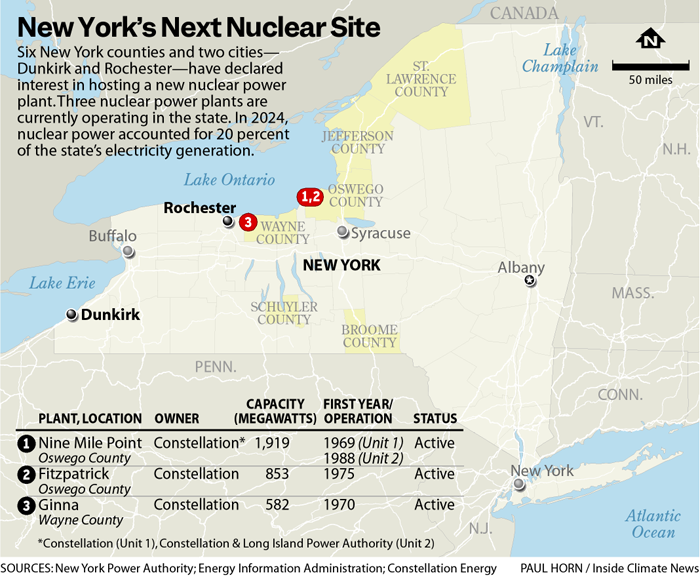
Constellation pays around $48 million a year in local taxes, which help support law enforcement, roads, healthcare and social services in the county, he said.
The company employs 2,100 people across all three of its power plants in the state, said Richard Barlette, Constellation’s director for state government affairs. Another 12,000 work on the power plants as contractors, he said.
Oswego is near the site of a massive semiconductor manufacturing facility that the tech company Micron is building. A new power plant in the county could help power that complex, Church said. Barlette confirmed that Constellation is interested in using land it owns near the Nine Mile Point power station to add to the state’s nuclear fleet.
In total, 23 companies have responded to Hochul’s call for “development partners” on the new advanced nuclear project. Many, including Constellation, are developing small modular reactors—smaller nuclear power plants.
These plants are much smaller than traditional power plants, and many hope they could eventually be mass-produced. They have never operated commercially in the United States, but a growing number of companies are developing them.
Schuyler County’s McKinney Cherry wants to see this new nuclear technology power manufacturing in her region, which includes the state’s Finger Lakes. The county’s economy relies on seasonal tourism—10 percent of all jobs there are supported by the tourism industry, according to a 2024 report commissioned by the state economic development agency.
Many Schuyler residents are working in nearby counties because they can’t find enough employment opportunities in the area, McKinney Cherry said.
In January, concerned New Yorkers rallied outside the Schuyler County Legislature to oppose the possibility of nuclear power in the region. Environmental groups across the state say it’s too costly and too slow to build.
“We see nuclear as an affordability crisis in and of itself,” said Ryan Madden, the Indigenous solidarity director at NY Renews, a coalition that advocated for the state’s Climate Act. “It feels antithetical to an affordability agenda.”
Nuclear’s Costs
Nuclear power is enjoying a “renaissance” amid the data center boom, which has placed increasing demand on the electricity grid.
The Trump administration has backed this resurgence with executive orders that encourage nuclear power development and pilot projects that speed new test reactors through the regulatory process.
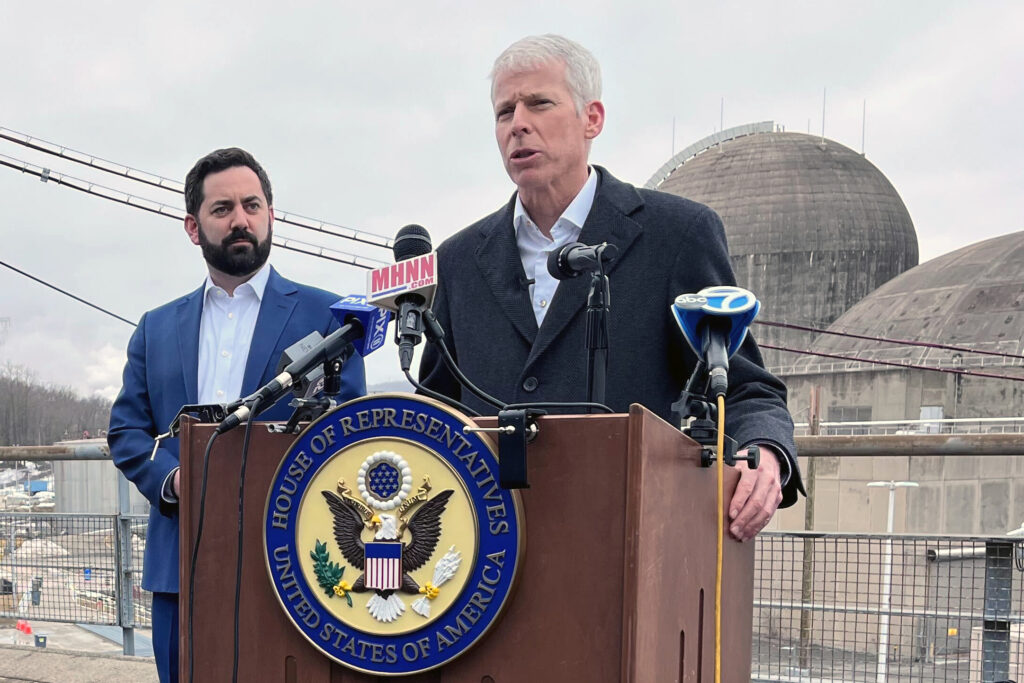
At a Friday press conference, U.S. Department of Energy Secretary Chris Wright, as well as U.S. Rep. Mike Lawler (R-NY), called for Indian Point—a nuclear power plant just north of New York City that is currently being decommissioned—to be “rebuilt and reopened.”
“We’re calling for it to be reopened today, and the governor should take this seriously,” Lawler said. “She can’t decry the nuclear power plant here when she is talking about building nuclear power upstate. It doesn’t make sense.”

Nuclear power has been controversial in New York, with activists raising concerns about health, the environment and costs. Nuclear power production produces “spent” fuel—that’s what happens when uranium fuel, which is used in a reactor, can no longer be used to produce electricity. The substance is extremely radioactive.
An analysis of research on small modular reactor designs, which could be proposed for the state’s new project, found that these smaller power plants could be more costly than traditional ones and produce more waste per unit of energy.
Some epidemiologists, like Joseph Mangano, are also concerned that living near these plants can increase a person’s risk of developing cancer. He has studied cancer death rates near nuclear plants for decades at the Radiation and Public Health Project, a nonprofit educational and scientific organization.
Nuclear power plants release very small amounts of radioactive gases and liquids. Their release into the air and water bodies is reported to the Nuclear Regulatory Commission—the independent agency that regulates these power plants and approves them for commercial use—to ensure that the radioactive materials are diluted and pose no risk to the public.
A recent Harvard study found that U.S. counties located close to operational nuclear power plants experienced higher cancer death rates, especially for older adults—though the study does not prove that the plants cause cancer.
This story is funded by readers like you.
Our nonprofit newsroom provides award-winning climate coverage free of charge and advertising. We rely on donations from readers like you to keep going. Please donate now to support our work.
Donate NowPrevious studies, including by the federal government, have found no correlation, but they often offer a much narrower picture than Harvard’s national study. In 2015, the Nuclear Regulatory Commission canceled plans to update a national study from 1990 that it has relied on.
For Mangano, the Harvard study’s results were no surprise. According to his research, a community’s cancer death rate can jump much higher in the decades after the construction of a nearby nuclear power plant. Over time, he said, the gap between that community’s cancer death rate and that of the state widens.
Obstacles Ahead
In the past, nuclear power projects have struggled to become operational, especially in New York. In 1983, major construction on the Shoreham Nuclear Power Plant on Long Island ended. The plant never opened.
By 1988, it was sold by the local utility to the state-owned Long Island Power Authority for $1 so that it could be decommissioned—the result of long-term local and political opposition.
When the Long Island Power Authority initially acquired the nuclear plant, along with other investments the local utility made, it assumed responsibility for around $6.8 billion in debt, a Department of Public Service spokeswoman said. After nearly 40 years, the debt has largely been paid, but remnants remain. It amounts to “hundredths of a percent” of a customer’s bill today, the spokeswoman said.
“The nuclear industry promises this nuclear renaissance—there’s new technology, there’s this new fervor that it’s going to deliver on all these energy needs,” NY Renews’ Madden said. “We see time and time again that it doesn’t really add up.”
The state’s operating nuclear plants, all owned by Constellation, are also costing New Yorkers. In January, the state body that regulates utility rates—the Public Service Commission—approved a 20-year extension of the zero-emissions credit program, which compensates nuclear plant operators for producing zero-emission electricity.
The Public Service Commission estimates that the average residential ratepayer will see their utility bill increase by around $3.95 in 2029 during the first nine months of the extended program. The maximum cost to ratepayers would be $33.4 billion, though the commission expects a significantly lower amount.
Barlette, Constellation’s director for state government affairs, said the nuclear facilities receive these funds because wholesale electricity markets do not attach financial value to the zero-emission aspect of their energy production. The state’s nuclear fleet, he said, has operated for several decades and will require significant investment to continue operations.
James Walker, the CEO of NANO Nuclear Energy—a company working to develop a modular reactor—is also interested in building a nuclear power plant in New York, though that isn’t without complications. The United States has not invested enough in nuclear infrastructure over the past few decades, making it difficult to obtain essential fuel such as enriched uranium, he said.
“New York wants to attract industry—it doesn’t want to lose industry to other states that are pursuing nuclear more aggressively,” Walker said. “We’ve got very big ambitions here.”
Nicholas Kusnetz contributed reporting to this story.
About This Story
Perhaps you noticed: This story, like all the news we publish, is free to read. That’s because Inside Climate News is a 501c3 nonprofit organization. We do not charge a subscription fee, lock our news behind a paywall, or clutter our website with ads. We make our news on climate and the environment freely available to you and anyone who wants it.
That’s not all. We also share our news for free with scores of other media organizations around the country. Many of them can’t afford to do environmental journalism of their own. We’ve built bureaus from coast to coast to report local stories, collaborate with local newsrooms and co-publish articles so that this vital work is shared as widely as possible.
Two of us launched ICN in 2007. Six years later we earned a Pulitzer Prize for National Reporting, and now we run the oldest and largest dedicated climate newsroom in the nation. We tell the story in all its complexity. We hold polluters accountable. We expose environmental injustice. We debunk misinformation. We scrutinize solutions and inspire action.
Donations from readers like you fund every aspect of what we do. If you don’t already, will you support our ongoing work, our reporting on the biggest crisis facing our planet, and help us reach even more readers in more places?
Please take a moment to make a tax-deductible donation. Every one of them makes a difference.
Thank you,

Lauren Dalban
Reporter, New York City
Lauren Dalban is a New York City-based reporter with a background in local journalism. A former ICN fellow, she now covers environmental issues in all five boroughs. Originally from London, she earned a B.A. in History and English from the University of Virginia, and an M.S. from Columbia Graduate School of Journalism.