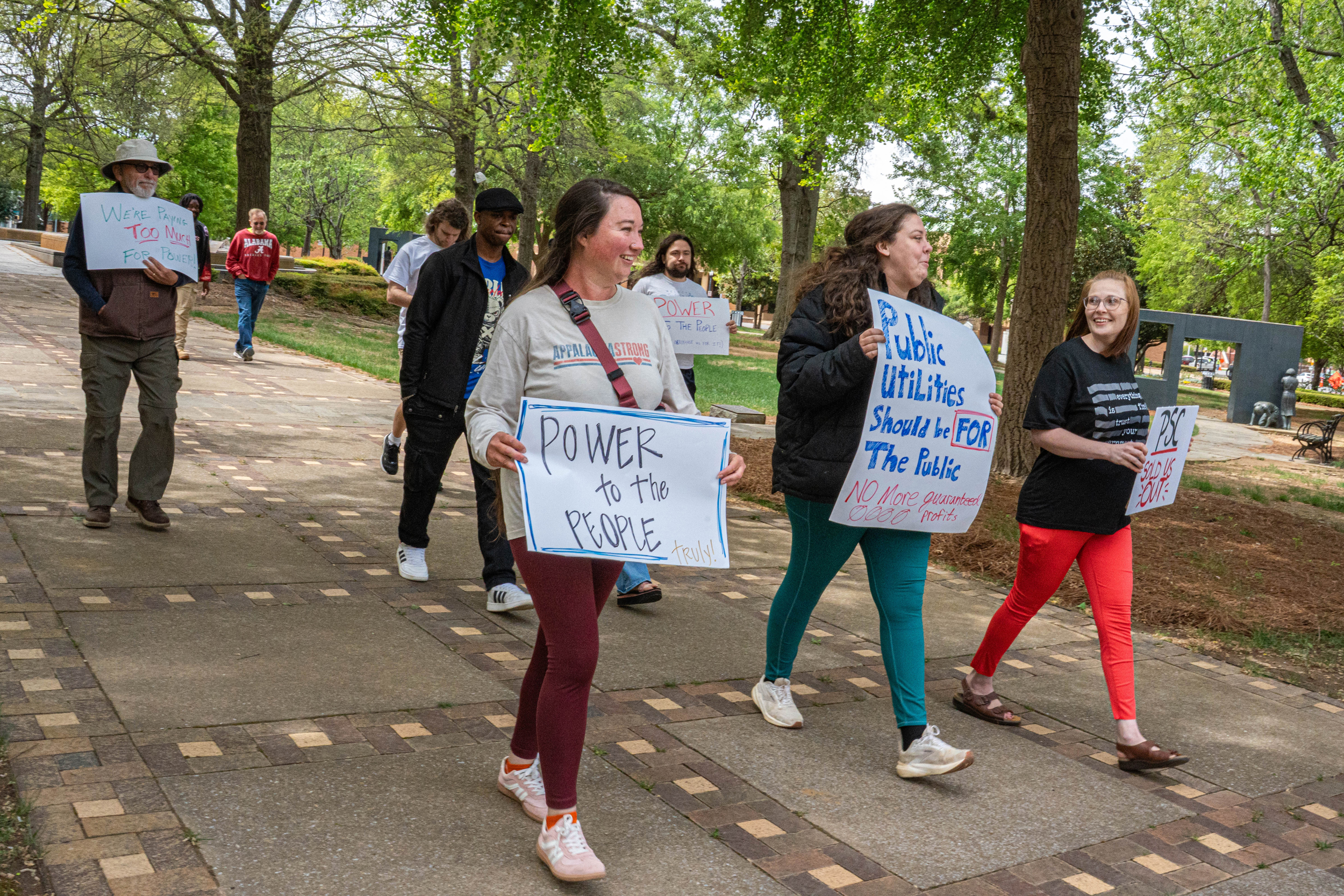


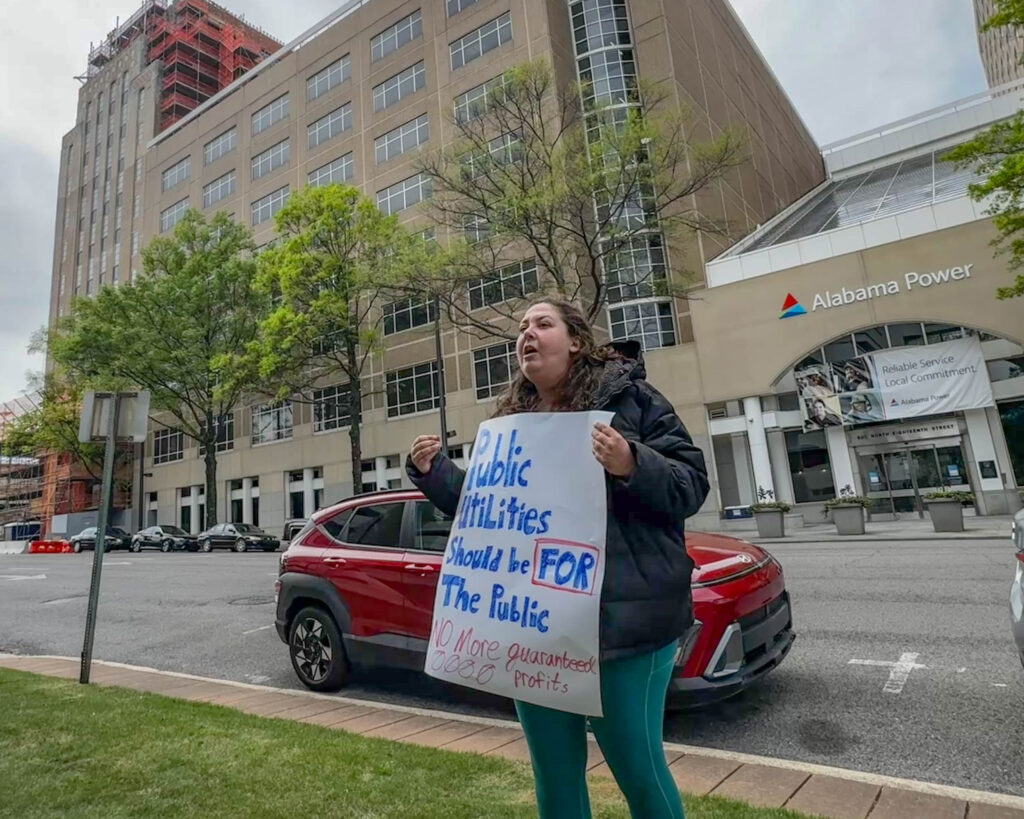
BIRMINGHAM, Ala.—Alabama Power customers aren’t giving up yet. On Monday, around two dozen of them marched from Birmingham’s Kelly Ingram Park to the nearby headquarters of the investor-owned utility company to make that much clear.
“Public utilities should be for the public,” one protestor’s sign said. “No more guaranteed profits.”
“Power to the people,” another said. Then, in italics, “truly.”
The latter was a reference to the Power to the People Act, a piece of legislation passed by the Alabama Legislature last week and signed into law by Gov. Kay Ivey, a Republican.
Despite the bill’s name, Alabamians who have been advocating for utility reform said the wide-ranging legislation is a “wolf in sheep’s clothing”—a law they believe lawmakers transformed from its original form in an Orwellian effort to turn a public demand for lower electricity prices into a win for Alabama Power, arguably the state’s most powerful political entity. Unfortunately, they said, that effort was largely successful.
Alabama Power did not respond to a request for comment.
As originally filed, the legislation would have required the state’s Public Service Commission, the entity responsible for utility regulation, to hold regular rate cases interrogating companies’ requests for electricity price hikes. The last formal rate case scrutinizing Alabama Power, the sole provider of most of the state’s residential electricity, was held in 1982.
As passed, the law includes no such requirement for regular rate hearings. Instead, the newly passed legislation consolidates power over the PSC’s agenda under a secretary of energy, appointed by the governor, and expands the PSC from three members to seven. Instead of regular, mandatory rate cases, such oversight would only be triggered if the secretary of energy or five PSC commissioners deemed it necessary.
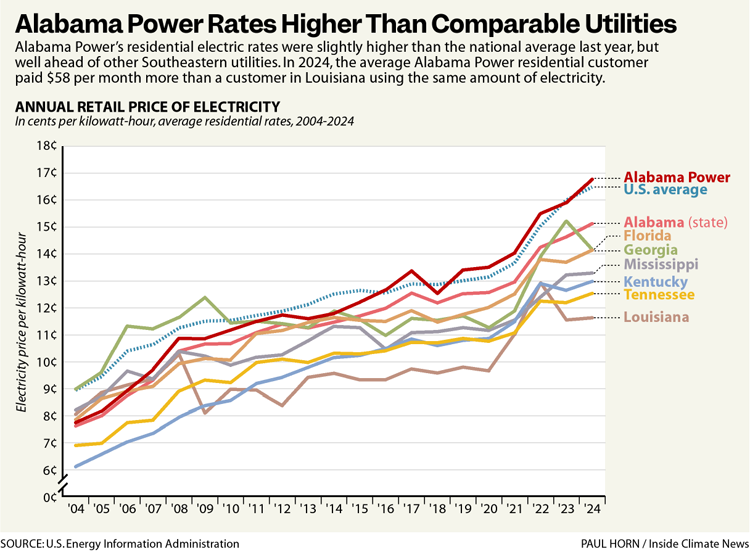
The new law does freeze utility rates at their current levels until 2029, though an Inside Climate News investigation has shown that Alabama Power customers already pay the highest energy bills among comparable electric companies in the nation. The company had already announced a rate freeze through 2027.
Prior to the bill’s final passage, the Legislature had reached an inflection point: Both the House and the Senate had unanimously passed utility regulation legislation. In the House, Republican Rep. Mack Butler’s bill was widely viewed as a strong, consumer-conscious reform measure.
“We thought the original bill was great,” Ashtyn Kennedy, an Alabama Power customer who helped organize Monday’s march to the company’s headquarters, said of Butler’s legislation.
Meanwhile, the Senate unanimously passed what would become, in large part, the Power to the People Act, sponsored by Sen. Clyde Chambliss, also a Republican. The bill, which included the provisions expanding the PSC eventually adopted into law, was viewed by those advocating for reform as weak and, in many ways, problematic. Many viewed efforts to expand the PSC membership as a reaction to November’s public service commission elections in Georgia, where Democrats running on consumer-friendly platforms flipped two traditionally Republican seats.
“They are scared,” Kennedy said of Alabama Power and PSC officials. “But people want change.”
In the end, senators voted to approve the bill after changing a significant portion of Butler’s legislation, substituting its language with many of the provisions of Chambliss’ Senate bill.
In a final vote in the Alabama House, Butler chose to effectively vote against his own legislation, saying he could not support various provisions of the new bill, which was deemed a “Franken-bill” by legislative observers. Despite Butler’s objection, the House voted to concur with the Senate’s changes to the Republican’s bill, 68-31.
Ivey signed the legislation on Thursday, the same day her office confirmed the term-limited governor had been released from a Montgomery hospital following a medical procedure to remove fluid pressing against her lung.
In a statement on her bill signing, Ivey lauded what she called Alabama’s “affordability.”
“Alabama is a top 10 state when it comes to cost of living, and we are the number one state for plain affordability,” Ivey’s statement said. “As I have said before, for Alabama to remain the best state to live, work and raise a family, we have to grow the state, while keeping our cost of living low.”
The Power to the People Act wasn’t the first effort this legislative session to fundamentally change utility regulation. Another, House Bill 392, which would have ended all PSC elections, was labelled “dead” by Senate Pro Tem Garlan Gudger after widespread public pushback earlier this legislative session.
Gudger admitted that the effort to halt future PSC elections, in favor of appointed posts, was a reaction to Georgia’s election results.
“After environmental extremists funded by the most liberal Soros groups captured the Public Service Commission in Georgia, the importance of preventing the same outcome from happening in Alabama became an urgency,” Gudger said.
This story is funded by readers like you.
Our nonprofit newsroom provides award-winning climate coverage free of charge and advertising. We rely on donations from readers like you to keep going. Please donate now to support our work.
Donate NowBut, he added, “after listening to our constituents back home, there is no scenario in which this bill, HB392, can garner the votes necessary to pass.”
Political analysts point to consumer frustration over rising energy prices in Georgia, not outside funding, as the reason for Democrats’ unprecedented success in November’s public service commission races.
At Monday’s protest, participants said they weren’t paid to show up.
“My bank account is too low for that,” one woman said. “Way too low.”
Following Ivey’s signing of House Bill 475, Daniel Tait, executive director of Energy Alabama, a consumer advocacy nonprofit, said he was disappointed but not deterred.
“Ivey had the opportunity to send this bill back and demand the legislature pass something that actually lowers bills for Alabama Power customers,” Tait said. “She refused. The people of Alabama deserved better, and we will not pretend otherwise. But we want to be clear about something: This fight is not over.”
Tait said that much of the focus will now turn to Ivey’s temporary appointment of four new PSC commissioners, the next governor’s appointment of a secretary of energy and elections for two of three existing PSC commission seats being held this year.
“On behalf of the people ignored today, we will be in every one of these upcoming fights,” Tait said.
Butler, who saw his own legislation turned into a law he couldn’t ultimately support, wrote after the bill’s passage that the past few weeks have been his “toughest session ever.”
“The conversation we had on the [H]ouse floor had never been had and was greatly needed,” he wrote in a statement. “I’m certainly not defeated nor am I mad at my colleagues for voting how they felt they needed to vote. I just could not go along. Tonight was the first time I ever voted against a bill with my name on it but if any of you guys knew my dad Harry D. Butler, it is just how he raised me.”
Kennedy said she and others will continue to press Butler and other lawmakers to continue advocating for meaningful utility reform. Many Alabamians have no choice, she said.
“People are having to put their power bills on credit cards,” she said. “That’s just not OK.”
About This Story
Perhaps you noticed: This story, like all the news we publish, is free to read. That’s because Inside Climate News is a 501c3 nonprofit organization. We do not charge a subscription fee, lock our news behind a paywall, or clutter our website with ads. We make our news on climate and the environment freely available to you and anyone who wants it.
That’s not all. We also share our news for free with scores of other media organizations around the country. Many of them can’t afford to do environmental journalism of their own. We’ve built bureaus from coast to coast to report local stories, collaborate with local newsrooms and co-publish articles so that this vital work is shared as widely as possible.
Two of us launched ICN in 2007. Six years later we earned a Pulitzer Prize for National Reporting, and now we run the oldest and largest dedicated climate newsroom in the nation. We tell the story in all its complexity. We hold polluters accountable. We expose environmental injustice. We debunk misinformation. We scrutinize solutions and inspire action.
Donations from readers like you fund every aspect of what we do. If you don’t already, will you support our ongoing work, our reporting on the biggest crisis facing our planet, and help us reach even more readers in more places?
Please take a moment to make a tax-deductible donation. Every one of them makes a difference.
Thank you,

Lee Hedgepeth
Reporter, Alabama
Lee Hedgepeth is Inside Climate News’ Alabama reporter. Raised in Grand Bay, Alabama, a small town on the Gulf Coast, Lee holds master’s degrees in community journalism and political development from the University of Alabama and Tulane University. Lee is the founder of Tread, a newsletter of Southern journalism, and has also worked for news outlets across Alabama, including CBS 42, Alabama Political Reporter and the Anniston Star. His reporting has focused on issues impacting members of marginalized groups, including homelessness, poverty, and the death penalty. His award-winning journalism has appeared in publications across the country and has been cited by the New York Times, the Wall Street Journal and the Washington Post, among others.