

SILER CITY, N.C.—John Alderman opened the letter, sent by certified mail from an attorney in New Orleans.
This is trouble, Alderman thought. It can’t be good news.
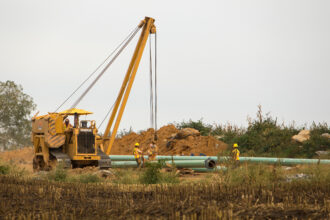
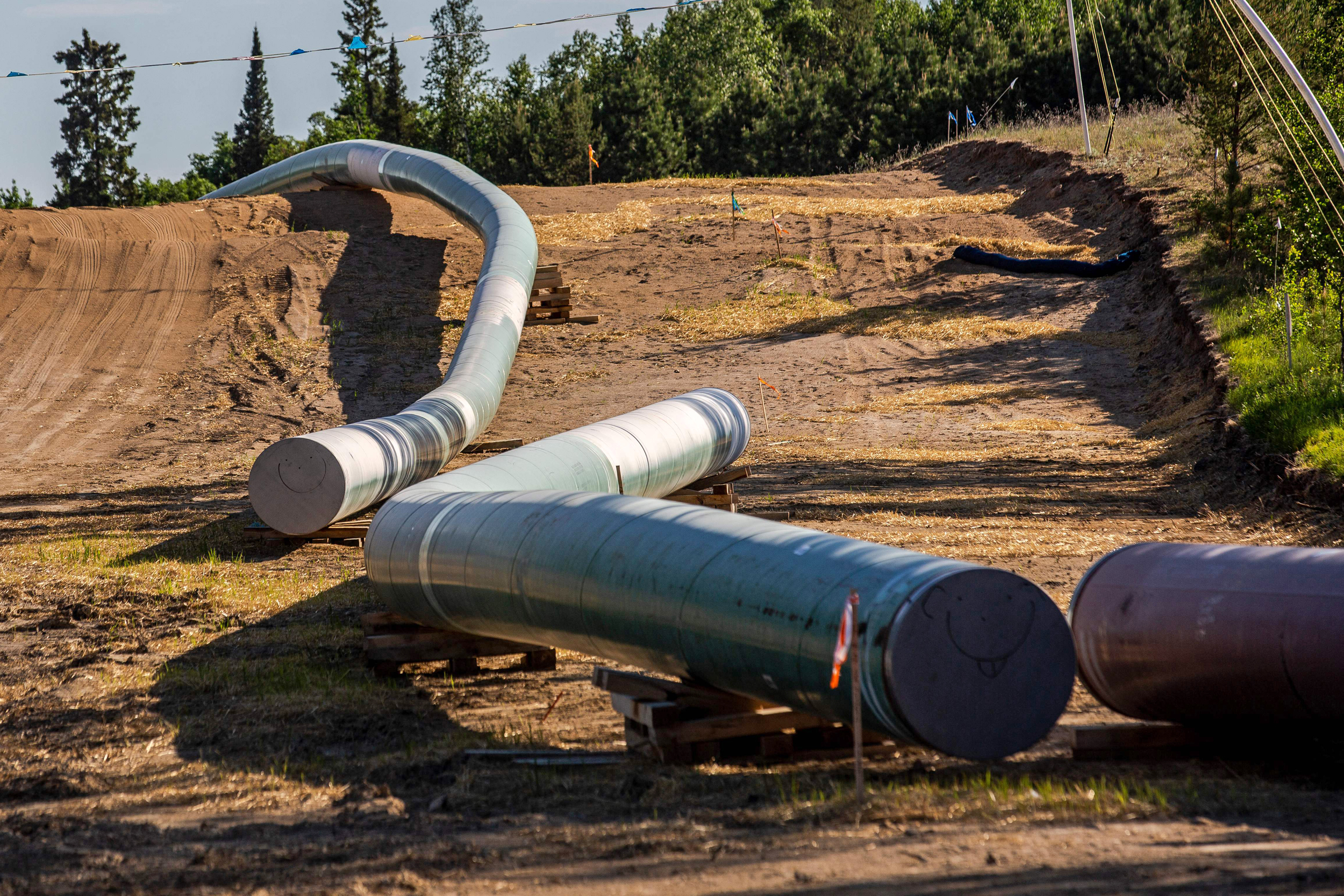
In late April Enbridge, a Canadian company, announced its plans to build a new 28-mile natural gas pipeline through Chatham County, from Siler City to Moncure. As contractors survey potential routes, they want access to Alderman’s land.
“I resent a letter like that,” said Alderman, who lives in western Chatham County. “We are informed, without asking, that someone is planning to trespass on our land. Everything in it is an affront.”
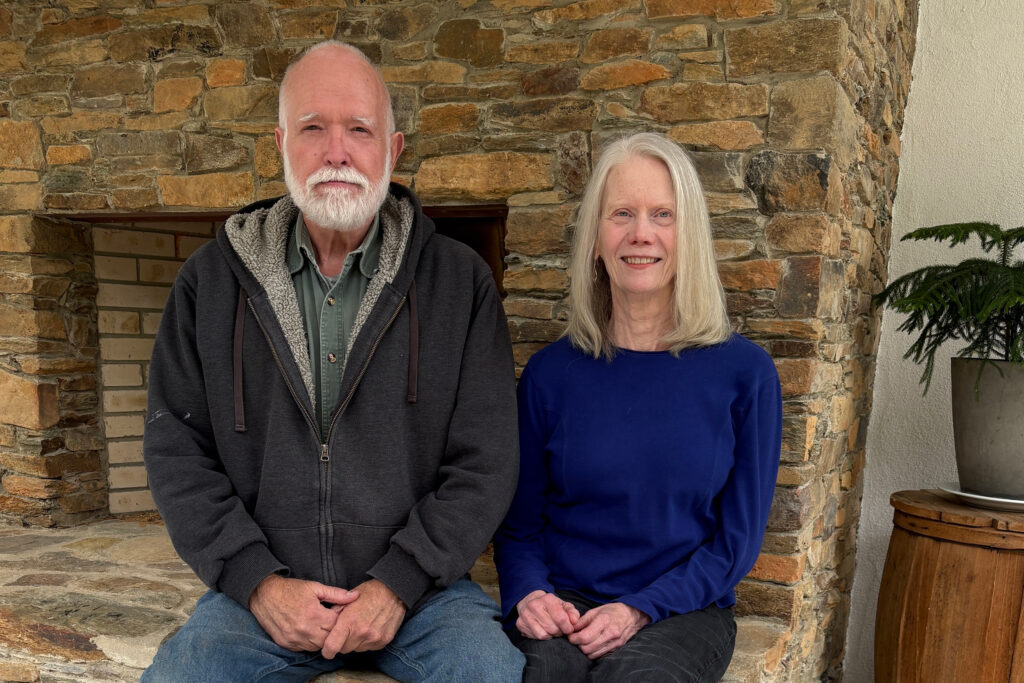
Company spokeswoman Persida Montanez told Inside Climate News the pipeline will serve the broader regional energy needs in fast-growing Chatham and Lee counties, and not specific projects, such as data centers. Preliminary routing shows the pipeline would connect to Enbridge’s existing system near Siler City, head southeast and end near Moncure.
The pipeline would bypass Pittsboro, but could potentially cross several creeks that feed the Deep River, as well as traverse other main waterways, the Rocky and the Haw.
Construction could begin in fall 2027, with a service date of spring 2028. Total project costs have not yet been determined, Montanez said.
Enbridge will have to apply for, and receive, various state permits for the project; if the pipeline crosses waterways, it will need a federal water quality permit as well.
This is Enbridge’s second major pipeline project in the state since 2024, when it bought Dominion Energy’s natural gas business in North Carolina. The first is the T15 pipeline, which will run 45 miles from Eden, in Rockingham County, to Duke Energy’s two new natural gas plants near Roxboro, in Person County.
These projects are part of the state’s immense natural gas buildout that, if completed, will emit hundreds of tons of planet-heating greenhouse gases and other harmful pollutants into the air each year.
Natural gas companies and Duke Energy say the projects are necessary to meet the growing power demands, especially of data centers. Critics, including environmental groups, consumer advocates and the Public Staff of the N.C. Utilities Commission, counter that those demand projections are inflated.
The result, they say, will be hefty profits for fossil fuel interests and higher customer rates, a hotter planet and habitat destruction.
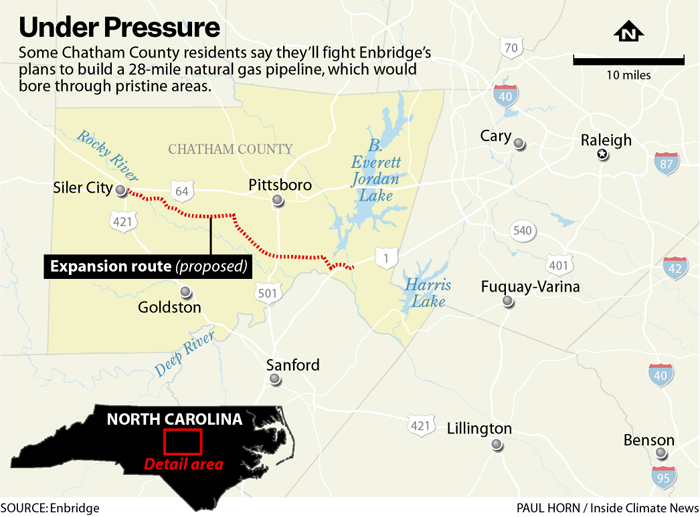
Alderman is 72, of Viking stock and tall with deep-set brown eyes and short white hair. He lives with his wife of 52 years, Gloria, off the grid in a spacious, solar-powered, modern stucco house in a 195-acre woods that once belonged to International Paper. The couple grow their own fruits and vegetables. In 2023 they received a federal grant to sequester carbon in their forest; within two years, it could store as much as 100,000 tons.
“We’re carbon negative,” Alderman said. He drove his Ford Lightning, an electric pickup truck, charged with solar panels, down an old farm road and over a 550 million-year-old fault line that is now his gravel driveway. “Everything we’ve done has been geared toward combating climate change. And here we have the irony of ironies—a stinking gas line going through our property.”
A Threat to Three Rivers
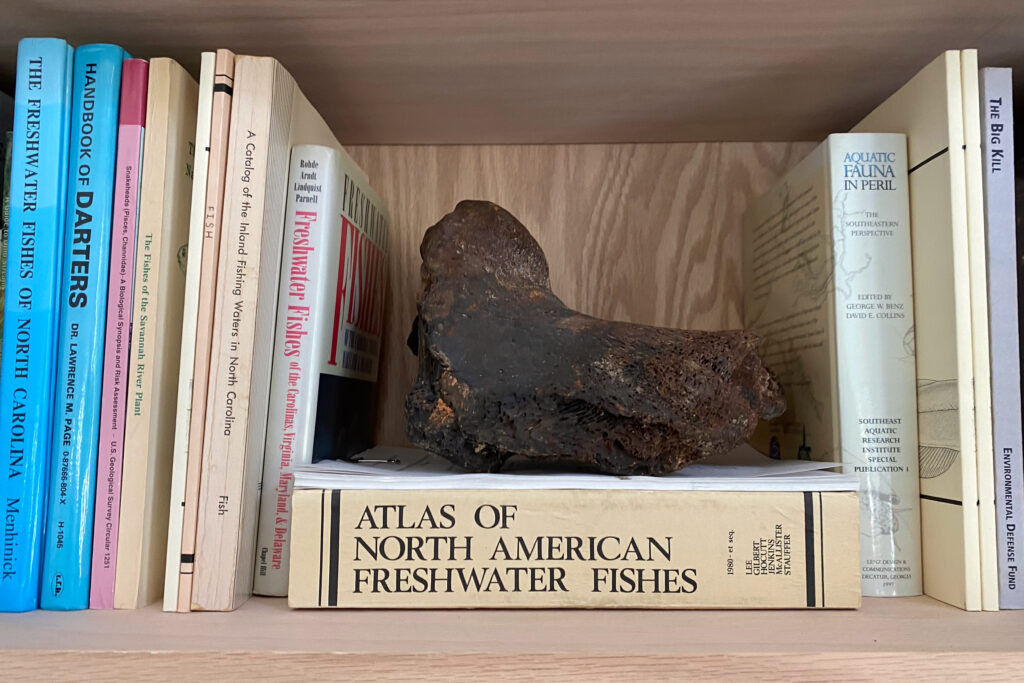
John and Gloria Alderman met as undergraduates in ecology class in 1974. Both became biologists, and he specialized in endangered species, including mussels, fish and snails.
Throughout his long career, Alderman has witnessed species on the brink of extinction—and beyond. He was the last person to see many types of mussels alive in a four-state area. He waded, swam or dove in highly polluted waterways, including wading in radioactive water and mud up to his chest near the Savannah River nuclear site to search for rare mussels.
Inside the Aldermans’ home is a wall of framed newspaper cartoons. One shows Alderman staring down bulldozers that threaten sensitive habitats. In another, his feet are trapped in hardened concrete, as special interests threaten to push him off a pier.
“John’s seen so much,” Gloria said, with admiration in her voice. She is petite, with shoulder-length light hair and kind eyes. “His work was fighting. John is not shy.”
When the Aldermans bought the land six years ago, they knew Duke Energy had a permanent easement toward the front of the property, where the utility runs a high-voltage transmission line. But they couldn’t have known that some day a pipeline could plow through their land and some of the most pristine habitat in Chatham County.
“I think with maps,” Alderman said, projecting the proposed route, overlaid with other geographical features, on his wide-screen TV. He pointed to the route of a new water main, part of an expansion by regional water utility TriRiver, as the first domino to fall.
No one conducted environmental impact studies for the infrastructure project, whose original purpose was for emergency backup. Instead, Alderman said, it has sparked new subdivisions and development throughout western Chatham County. And now here comes the Enbridge pipeline.
“The water line was the catalyst,” Alderman said. “Everything is connected.”
The Rocky and the Deep rivers run through this part of the county and flow into the Cape Fear River Basin, which is besieged by PFAS, 1,4-dioxane and other contaminants. These waterways are ecologically significant, but because of pollution and habitat loss, extensive portions appear on the federally impaired waters list. The Atlantic pigtoe, a native mussel not seen since the 1970s, has been extirpated from these waters, Alderman said.
If the Enbridge pipeline crosses the waterways, more aquatic life could be displaced or even lost, he fears.
“I’ve seen the tremendous effects of climate change on small streams and rivers,” Alderman said. “These rivers are under the gun. If we ever want to restore the Cape Fear River, it’s because we saved the Rocky and the Deep.”
The Triangle Innovation Point
The pipeline would run through a portion of County Commission District 2, represented by Amanda Robertson. She spent years fighting a different project, the Atlantic Coast Pipeline, which would have traversed 150 miles through eastern North Carolina. After intense public opposition, project co-owners Dominion and Duke canceled it in July 2020—but not before hundreds of acres of private land had been irreparably destroyed.
“Now we’ve got yet another pipeline, and I will do everything in my power to find a way to stop that from happening,” Robertson said. “It’ll be a fight.”
About 800 people live in Moncure, an unincorporated town in far southeast Chatham County. Although rural, the area also lies along an economic development corridor that includes long-time industries: Arauco, which manufactures and laminates composite wood panels; two brick factories; a quarry; and Duke Energy’s former coal-fired power plant, now a coal ash recycling facility.
Robertson served on the county planning board when, with the help of a contractor, it developed a “small-area” growth plan for Moncure. She felt delighted that two-thirds of the area would remain as agriculture, woods, parks and conservation.
This story is funded by readers like you.
Our nonprofit newsroom provides award-winning climate coverage free of charge and advertising. We rely on donations from readers like you to keep going. Please donate now to support our work.
Donate NowBut over the past four years, new projects have encroached on the town. The Enbridge pipeline would terminate at the nearby Triangle Innovation Point (TIP), where more than 1,000 acres of forest were clear-cut for the Vietnamese electric vehicle company VinFast to build a factory. The project is four years behind; construction hasn’t begun, but the habitat has been destroyed.
A 750-megawatt data center is also proposed for the TIP, but that venture is in litigation with the county over a moratorium commissioners enacted in February.
“What we’ve seen throughout North Carolina is that where the gas goes, the data centers follow, and vice versa,” said Emily Sutton, the Haw riverkeeper. “There’s an inflated energy projection because of the proposed data centers, and so if we don’t get a handle on data center expansion, we’re going to continue to see more and more of these fossil fuel projects.”
“Surviving Climate Change”
The blueberry bushes are blossoming in the Aldermans’ garden. Swaths of clay soil had been tilled in preparation for a summer garden. The sugar snap peas were sown and now just need some rain.
Gloria worked with an architect to design the Aldermans’ home, with precise measurements that align with the Earth’s revolution around the sun. To capture maximum sunlight, the house and its solar panels face due south, aligned with the South Pole. Two porch pillars signify where the sun rises on the summer and winter solstices.

The house is fireproof. The walls are 9 inches thick. Concrete floors keep the inside cool, even on 90-degree days.
“Surviving climate change, that’s the key to what we’re doing,” Alderman said. “And the pipeline flies in the face of everything we’re trying to do here.”
Eminent domain is a power usually reserved for the government to take private property to build public projects, such as roads. However, the law allows private companies to use the authority as long as the project is in the public interest.
In both cases, the landowners must be fairly compensated for the property.
Landowners can go to court if the parties can’t agree on a price.
Alderman sent a certified letter back to the attorneys representing Enbridge. “I told them in no uncertain terms, ‘You can’t do this. Explore the alternatives,’” he said. “Stay off my property.”
About This Story
Perhaps you noticed: This story, like all the news we publish, is free to read. That’s because Inside Climate News is a 501c3 nonprofit organization. We do not charge a subscription fee, lock our news behind a paywall, or clutter our website with ads. We make our news on climate and the environment freely available to you and anyone who wants it.
That’s not all. We also share our news for free with scores of other media organizations around the country. Many of them can’t afford to do environmental journalism of their own. We’ve built bureaus from coast to coast to report local stories, collaborate with local newsrooms and co-publish articles so that this vital work is shared as widely as possible.
Two of us launched ICN in 2007. Six years later we earned a Pulitzer Prize for National Reporting, and now we run the oldest and largest dedicated climate newsroom in the nation. We tell the story in all its complexity. We hold polluters accountable. We expose environmental injustice. We debunk misinformation. We scrutinize solutions and inspire action.
Donations from readers like you fund every aspect of what we do. If you don’t already, will you support our ongoing work, our reporting on the biggest crisis facing our planet, and help us reach even more readers in more places?
Please take a moment to make a tax-deductible donation. Every one of them makes a difference.
Thank you,

Lisa Sorg
Reporter, North Carolina
Lisa Sorg is the North Carolina reporter for Inside Climate News. A journalist for 30 years, Sorg covers energy, climate environment and agriculture, as well as the social justice impacts of pollution and corporate malfeasance.
She has won dozens of awards for her news, public service and investigative reporting. In 2022, she received the Stokes Award from the National Press Foundation for her two-part story about the environmental damage from a former missile plant on a Black and Latinx neighborhood in Burlington. Sorg was previously an environmental investigative reporter at NC Newsline, a nonprofit media outlet based in Raleigh. She has also worked at alt-weeklies, dailies and magazines. Originally from rural Indiana, she lives in Durham, N.C.