

Several global trends are colliding with disastrous consequences for health and the environment, new research warns.
Plastic production has skyrocketed since the 1950s, from a few million tons a year to nearly half a billion tons today, and is on track to triple by 2060. And since just a small fraction of plastics is recycled, millions of tons of plastic—derived from fossil fuels and loaded with toxic chemical additives—enter the environment as waste every year. That staggering figure is also likely to triple by midcentury.
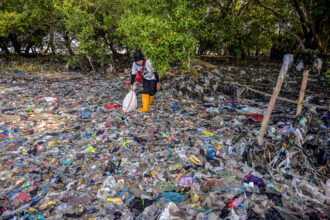
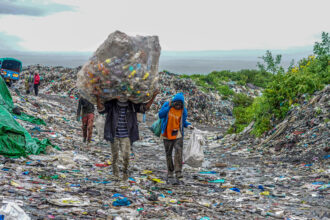
For decades, the United States and other high-income countries have exported their plastic waste to low-income countries in the Global South, many ill-equipped to manage the burgeoning waste stream. At the same time, billions of people across sub-Saharan Africa, South Asia and Latin America lack access to clean cooking fuels, adequate sanitation or waste-management services. As urbanization accelerates at an unprecedented rate across those regions, city dwellers living in extreme poverty often resort to burning debris from the massive mounds of plastic waste that inundate their communities.
Concerned that desperately poor people are increasingly turning to plastic waste as a cheap, convenient fuel, an international team of researchers set out to gauge the prevalence and nature of this emerging public health crisis.
In a survey of more than 1,000 people who work with low-income urban communities across the Global South, the team found that people living in slums without power hookups in more than two dozen countries are burning the plastic waste that surrounds their communities to cook, heat their homes and dispose of garbage.
In a previous paper, a subset of the authors cited anecdotal reports that increasing numbers of poor people living in slums without basic waste-disposal and energy services have resorted to burning plastic trash as an alternative fuel.
In the new study, published in Nature Communications, the team surveyed researchers, government workers and community leaders who work with low-income neighborhoods in 26 countries to better understand a growing health threat that has largely escaped scrutiny.
A third of respondents said it’s common practice to burn plastic waste in traditional cookers, including mud stoves and “three stone” fires. Nearly half of the respondents had witnessed people burning waste to cook meals, while more than a third had seen people burn plastic to heat their homes. Some of the respondents reported doing both themselves.
“Plastic pollution is not just an environmental problem, it’s a daily health and survival issue for tens of millions of people,” said Hari Vuthaluru, a study co-author and professor of chemical engineering at Curtin University’s Western Australian School of Mines.
“If we are serious about climate action and environmental justice, we cannot ignore the hidden practice of plastic burning,” he said.
Public interest groups have campaigned for measures to reduce plastic pollution for years, but no global efforts aim to curb the production, use and disposal of plastics. The United Nations plastic pollution talks ended without a treaty in August, as the U.S. and other major plastic-producing countries rejected demands to stem production, led by countries in the Global South, which bear the disproportionate burden of plastic pollution.
Waste-management infrastructure in many rapidly urbanizing regions has lagged behind the dramatic increase in plastic production, Vuthaluru said, turning low-income communities into plastic dumping grounds.
“It’s fantastic that they did such a large study in 26 countries,” said Lisa Thompson, a professor in the Department of Family Health Care Nursing at the University of California, San Francisco, who was not involved in the study. “I think it gives a really good overview of what’s happening and sensitizing people to this issue.”
Since plastic is made from fossil fuels, it quickly ignites, giving cash-strapped slum dwellers a cheap, easy fuel source while they chip away at the mountains of trash around their homes. But these easily ignitable plastics are also made of thousands of harmful chemical additives.
Plastic combustion releases highly toxic substances that include particulate matter, heavy metals, cancer-causing dioxins and furans, and scores of other compounds that accumulate in the food chain and people’s bodies. Inhaling these compounds causes diverse health problems, including chronic respiratory and breathing problems and cardiovascular stress.
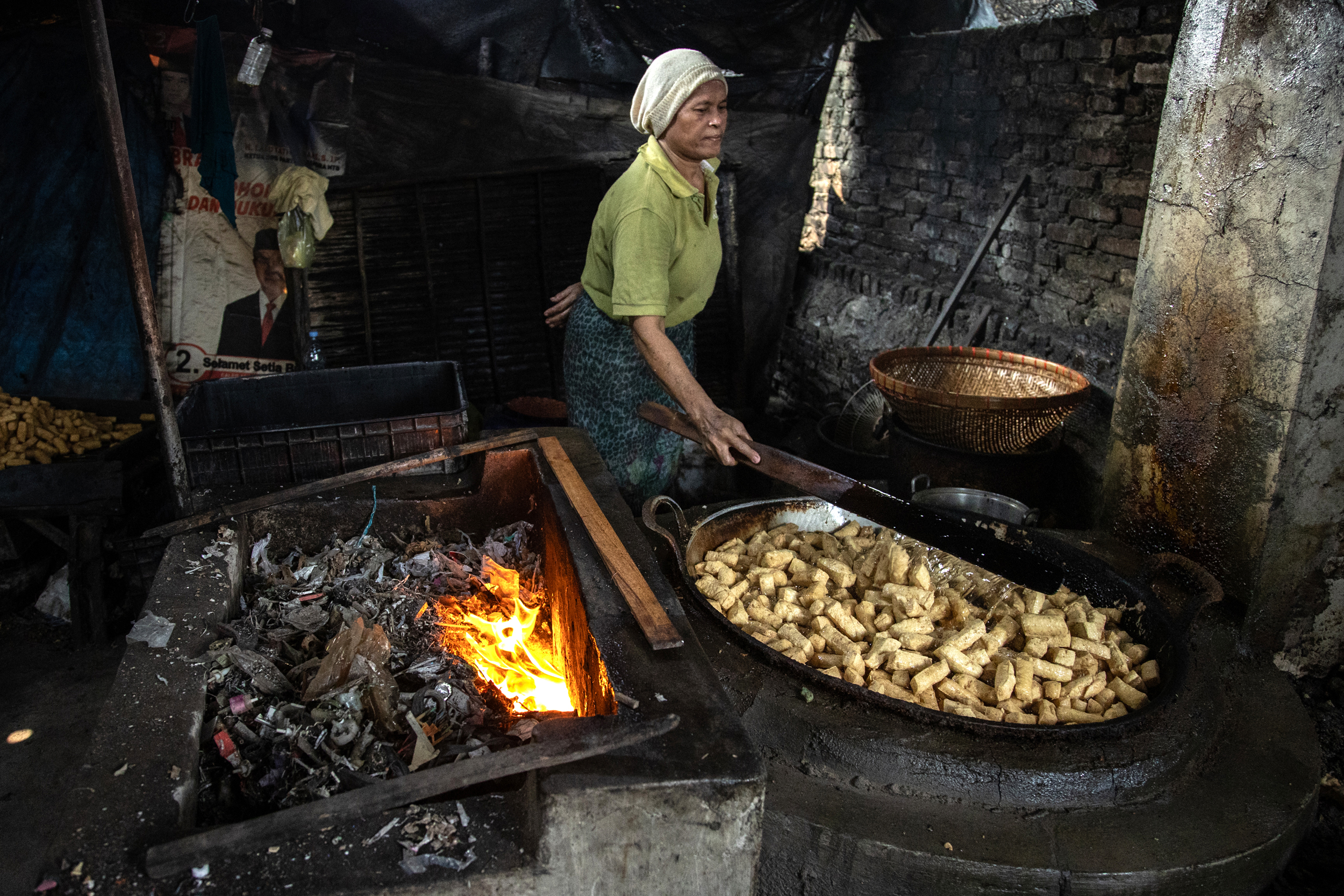
Toxic plastic residues from open fires and makeshift stoves routinely rain down on densely packed neighborhoods and foul the inside of homes, water sources, soil, crops and the food that’s being prepared for meals or distribution. In one high-profile example, reported in The New York Times, plastic waste burned as fuel by tofu makers in an Indonesian village tainted tofu and the eggs of local chickens with dioxin and other deadly chemicals.
And that harmful plastic packaging often stores even more hazardous materials. Of the 366 respondents who said plastic waste was burned as household fuel, nearly two-thirds said people burned plastic containers that held cleaning liquids, fertilizers and pesticides.
A Hidden Problem
Many people who burn these materials also lack access to information about the dangers they pose. Those who know about the risks are forced to choose between forgoing heat and cooked meals or being exposed to hazardous substances.
There’s a lot of attention paid to microplastics and people’s exposure through drinking, eating and wearing clothes, Thompson said. But risks from burning plastics have received less attention, said Thompson, who has studied that hazard in Indigenous villages in Guatemala.
People use plastic to start their fires because it burns so fast, and it’s not unusual to see piles of bottles and bags for kindling alongside logs in people’s homes in Guatemala, she said. Then when they open a bag of pasta or rice, they often toss the empty bag into the fire to get rid of the plastic.
“When you walk by a house that’s burning plastic, you can smell it right away—it’s awful,” she said. “A sharp, acrid, pungent smell, like burning tires.”
Nearly 40 percent of the world’s population burns solid fuels for cooking, and now, on top of that, they’re burning plastic, Thompson said. “It’s an expanding problem that I think not many people are aware of but should be.”
While studying problems with waste management and energy access in low-income urban communities over the past decade, the team behind the latest study kept hearing stories about people burning plastic waste.
“What actually struck us was that this practice was widely known locally, but it was almost invisible in the academic literature and policy discussions,” Vuthaluru said. “That gap or that gray area is what actually motivated us to get into this global study.”
Discussions around environmental and energy policies in developing countries tend to focus on formal systems like power plants while ignoring informal, household-level realities in low-income communities, Vuthaluru said.
“There is also a hidden assumption, or rather implicit assumption, that development will eventually solve these problems,” he said. Such assumptions, he added, delay urgently needed action.
“This is an issue that has largely been happening out of sight in communities and has been difficult to get accurate data on,” said Bishal Bharadwaj, a Curtin Institute researcher and lead author on the study, in a statement.
The study is the first to provide broad global evidence of households burning plastic to not only dispose of waste but also cook food, heat homes, light fires and keep insects away, Bharadwaj said.
This story is funded by readers like you.
Our nonprofit newsroom provides award-winning climate coverage free of charge and advertising. We rely on donations from readers like you to keep going. Please donate now to support our work.
Donate NowCountries with the highest use of polluting cooking fuels, like wood and coal, typically have more people living in slums, Bharadwaj reported in a paper last February, pointing to Chad as an example. More than 80 percent of urban residents lived in slums in this central African nation in 2022, with more than 60 percent relying on fuels that pollute their homes.
In the new study, the team found that people were burning plastic debris with other polluting fuels, making the smoke even more toxic. And women, children, the elderly and disabled people are typically most exposed, they found.
It’s not surprising that women and children are more at risk, Thompson said. Small children are usually near their mother in the kitchen, oftentimes carried on their mother’s back while she’s cooking.
That’s what she found in Guatemala, too. Women are in charge of household tasks, she said, “so they’re the ones who are most exposed.”
Comprehensive Solutions
Simply telling people who have no power source and are surrounded by readily flammable plastic to stop burning it won’t work, the researchers say.
Workable solutions must address the root of the problem, they say, which includes structural inequalities that force billions to live in extreme poverty, without access to affordable clean fuels and adequate waste services.
“We are trying to make the policy regulators aware of these issues so that they can enact some strict regulations in terms of waste disposal and waste infrastructure management practices,” Vuthaluru said.
But without clean and affordable energy alternatives, people will continue to burn whatever is available, he said. “Solutions must tackle both the supply of clean energy and the reduction of plastic.”
Vuthaluru acknowledges that this growing environmental health threat cannot be solved immediately. “We are trying to make everyone aware of this problem so that this particular category of people are protected from further damage to their health.”
Ignoring the problem would lock in another layer of inequality as richer countries transition to cleaner fuels and leave poor nations behind, Vuthaluru said.
If nothing changes, he said, “we will continue to see preventable illness, premature deaths, uncounted climate emissions, mostly affecting those who have contributed least to the problem.”
About This Story
Perhaps you noticed: This story, like all the news we publish, is free to read. That’s because Inside Climate News is a 501c3 nonprofit organization. We do not charge a subscription fee, lock our news behind a paywall, or clutter our website with ads. We make our news on climate and the environment freely available to you and anyone who wants it.
That’s not all. We also share our news for free with scores of other media organizations around the country. Many of them can’t afford to do environmental journalism of their own. We’ve built bureaus from coast to coast to report local stories, collaborate with local newsrooms and co-publish articles so that this vital work is shared as widely as possible.
Two of us launched ICN in 2007. Six years later we earned a Pulitzer Prize for National Reporting, and now we run the oldest and largest dedicated climate newsroom in the nation. We tell the story in all its complexity. We hold polluters accountable. We expose environmental injustice. We debunk misinformation. We scrutinize solutions and inspire action.
Donations from readers like you fund every aspect of what we do. If you don’t already, will you support our ongoing work, our reporting on the biggest crisis facing our planet, and help us reach even more readers in more places?
Please take a moment to make a tax-deductible donation. Every one of them makes a difference.
Thank you,

Liza Gross
Reporter, California
Liza Gross is a reporter for Inside Climate News based in Northern California. She is the author of The Science Writers’ Investigative Reporting Handbook and a contributor to The Science Writers’ Handbook, both funded by National Association of Science Writers’ Peggy Girshman Idea Grants. She has long covered science, conservation, agriculture, public and environmental health and justice with a focus on the misuse of science for private gain. Prior to joining ICN, she worked as a part-time magazine editor for the open-access journal PLOS Biology, a reporter for the Food & Environment Reporting Network and produced freelance stories for numerous national outlets, including The New York Times, The Washington Post, Discover and Mother Jones. Her work has won awards from the Association of Health Care Journalists, American Society of Journalists and Authors, Society of Professional Journalists NorCal and Association of Food Journalists.