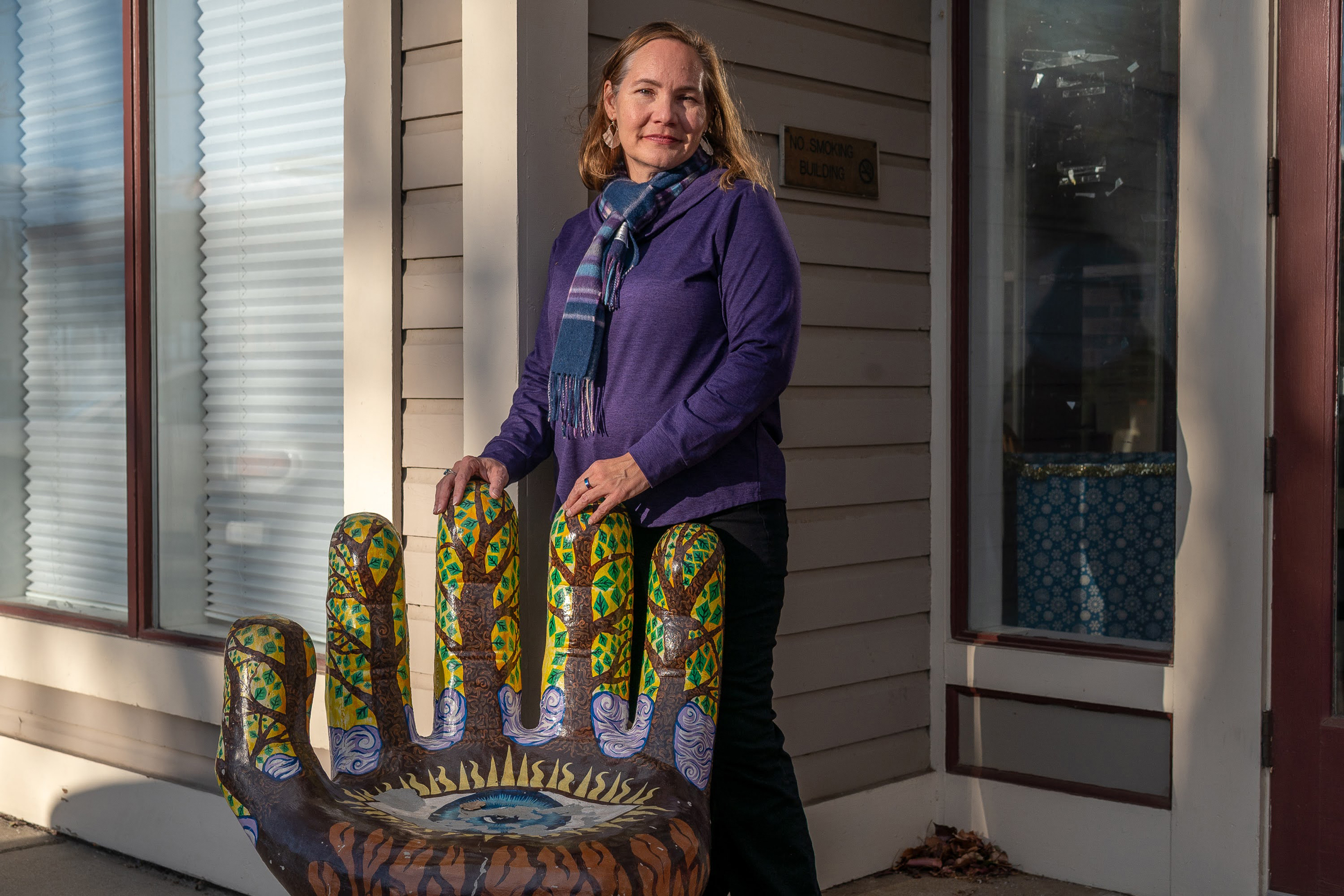


When Stephanie Burris drives by graveyards near her home in Boulder County, Colorado, she sees thousands of tiny landfills: Concrete boxes filled with non-biodegradable caskets, which are lined with polyester padding, filled with synthetic clothing and worst of all, containing PFAS—also known as “forever chemicals.”
“Frankly, I think that’s just barbaric,” says Burris, of the impacts the chemicals have on the living. Exposure to formaldehyde, the primary chemical used in embalming fluids, has been linked to an increased risk of developing brain diseases such as brain cancer, Alzheimer’s disease, Parkinson’s disease and amyotrophic lateral sclerosis. “You’re killing people through a slow and painful death by using embalming chemicals … just for the sake of preserving a body for a week so you can have a funeral where the person’s body looks relatively normal.”
Burris’s 19-year-old son, Mathias Burris Geittmann, died unexpectedly in 2024. It was a shocking loss, but she knew how she wanted to memorialize his life. She held a ceremony at a local farm, where loved ones told stories and placed organic materials with Mathias’s body: handwritten notes, his favorite foods, flowers, branches from a tree the family planted together. His body was then sent to The Natural Funeral in Arvada, Colorado, to be transformed into rich, nutritious soil.
Burris is among an increasing number of Americans opting for a more sustainable disposition of corpses. Last year, more than half of respondents to a National Funeral Directors Association survey reported interest in exploring “green” funerals and natural burial options. Alternatives like water cremation and human composting are rapidly gaining traction, funeral directors say, and with them come significant carbon savings.
New Traditions
Cremation is the most common end-of-life choice in the United States. It is seen as a more environmentally friendly option—no toxic embalming fluids, resource-heavy caskets or land use.
Still, it is a highly energy-intensive process. Each cremation requires maintaining temperatures between 1,400 and 2,000 degrees Fahrenheit for two to three hours, emitting the estimated equivalent greenhouse gas emissions of a car driving between 500 and 700 miles. The process can also release pollutants such as carbon monoxide, nitrogen oxides, sulfur dioxide and mercury and particulate emissions into the air and waterways, though modern crematories use filtration and other technologies to reduce these emissions.
Today, fire cremations in the U.S. alone are responsible for carbon dioxide emissions equivalent to more than 1 billion miles driven by gas-powered cars annually.
“Traditional cremation, by its nature, it’s not green. It does put out emissions, it does use a carbon fuel,” says Jimmy Olson, owner and director at Olson Funeral Home & Cremation Service in Wisconsin. “People don’t want cremation necessarily, but they also don’t want the chemicals and metal buried … we’re seeing green and natural options filling that gap.”
Letting Water Do the Work
Alkaline hydrolysis, also known as water cremation or aquamation, was first invented in 1888 for processing animal remains into fertilizer. It is far less energy-intensive than flame cremations; the water does most of the work. Depending on the machine used, it produces between one-tenth and one-twelfth of the carbon emissions of a fire crematorium.
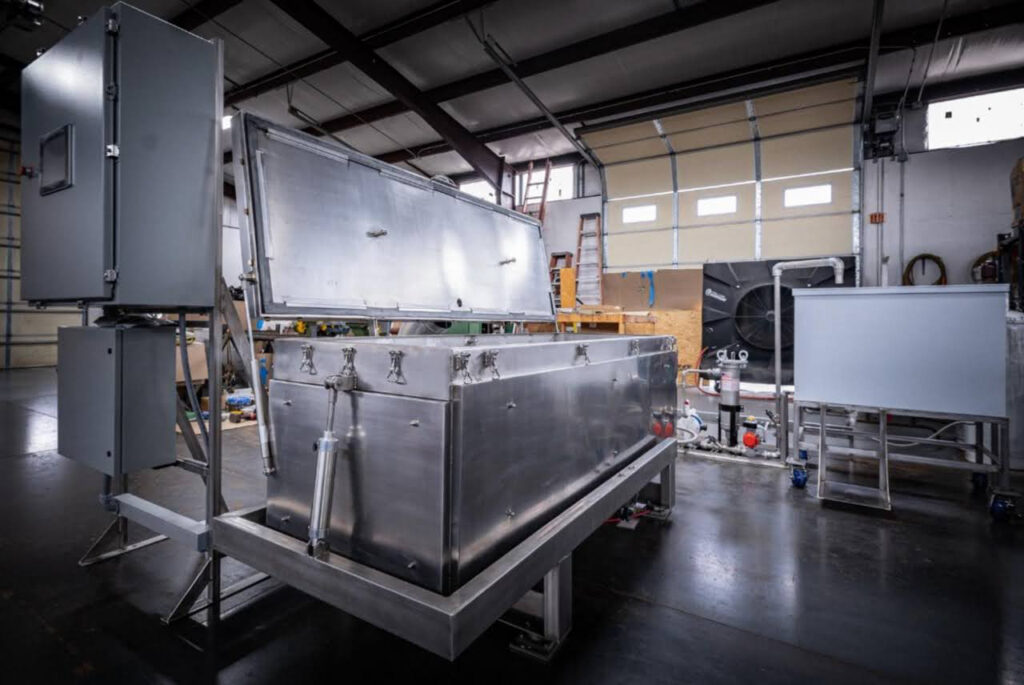
The process involves placing the deceased in a horizontal metal vault with water, potassium hydroxide and a small amount of denatured alcohol. One side of the machine moves up and down, creating a wave of liquid back and forth across the body to accelerate natural decomposition. What’s left is water, bones and any inorganic components like pacemakers or dental fillings.
Alkaline hydrolysis typically uses 200 to 300 gallons of water—2.5 to 3.5 days of the average American’s water use—and takes about 16 hours. But new designs are dramatically reducing those numbers: The Natural Funeral uses a machine developed by Colorado-based Ed Gazvoda that requires just 12 gallons of water and two to three hours. And because the human body is composed mostly of water, the process yields about 25 gallons of effluent per 100 pounds of body weight. This sterile liquid is typically discharged into wastewater systems or used as fertilizer, depending on local regulations.
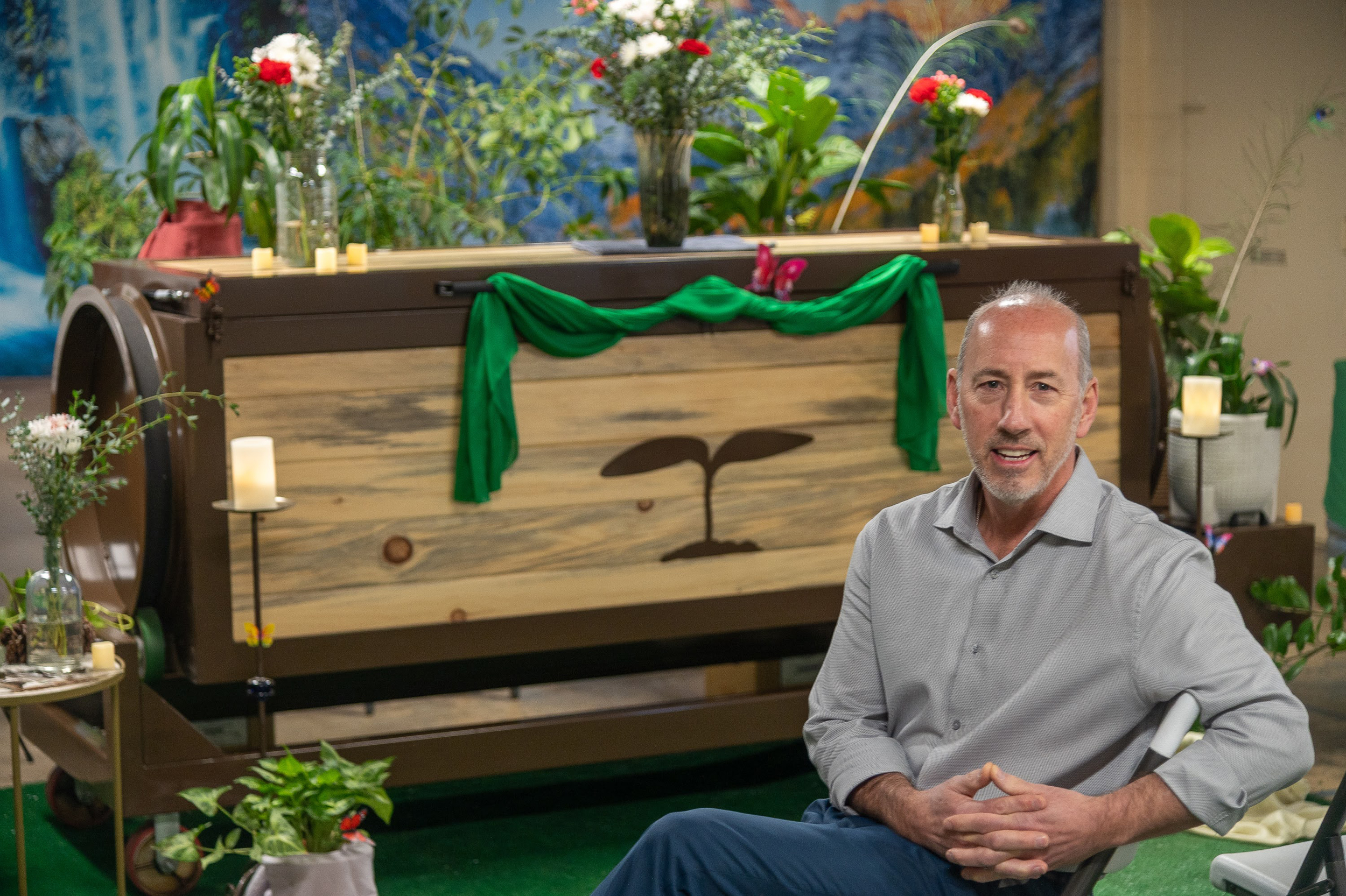
“It’s the reduction of all of our elements to a liquid biostimulant that can be used to foster new life,” said Mike Reagan, CEO of The Natural Funeral. “It’s a beautiful fertilizer.”
Just one tablespoon of effluent diluted into a gallon of water can be used to fertilize trees, bushes, houseplants or gardens. The Natural Funeral donates any liquid from an alkaline hydrolysis that families do not want to bring home to fertilize dahlia flowers and many others at a local farm in Hygiene, Colorado.
Minnesota was the first state to legalize alkaline hydrolysis to break down human remains in 2003, and since then, 28 other states have followed. Today, the process accounts for about 1 percent of all cremations.
But while alkaline hydrolysis emits just a fraction of fire cremation’s carbon footprint, human composting promises to go a step further: body disposition becomes carbon negative.
Return to the Earth
Human composting, also called natural organic reduction or terramation, was first legalized in Washington state in 2019. As of this year, it is legal in 14 states, with several others considering legislation allowing the composting of human remains.
The process involves laying a body in a vessel surrounded by organic materials like wood chips, alfalfa and straw. Over two to three months, the vessel is periodically spun and continuously monitored for optimal temperature, moisture and oxygen, naturally reaching temperatures around 145 degrees Fahrenheit as microbes break down the body. The remaining bones are ground down, and the compost is typically left to cure for 30 days before the soil is returned to the family.
Reagan’s team developed what they call Chrysalis Vessels, patent-pending human composting machines that complete the process in 28 to 33 days, thanks to the company’s proprietary microbial brew of bacteria and fungal agents that help accelerate the natural decomposition process. A handful of the compost coming out of a Chrysalis vessel looks and feels like the dark, nutrient-rich soil of a regenerative farm.
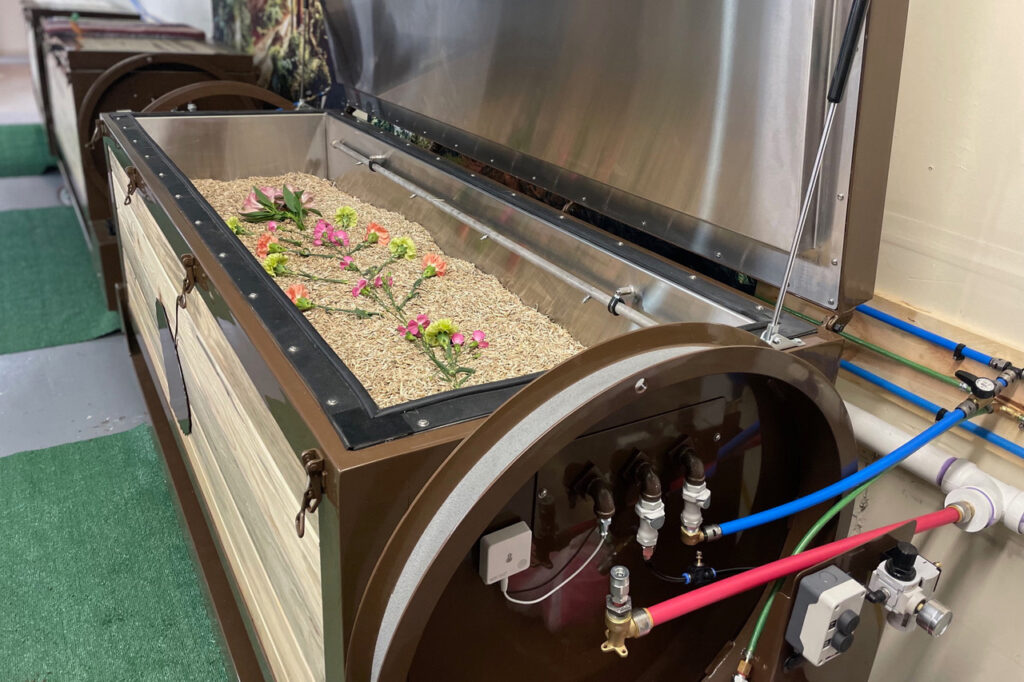
The process requires no chemicals and uses energy only to run the facilities. If the family chooses to use all of the resulting soil to plant new life, according to Reagan, the process becomes carbon negative. “By avoiding the traditional method, [plus] the regenerative attributes of the soil that’s produced from this, it’s just over half a ton of carbon that’s sequestered per process,” he said.
Some states have seen pushback against these methods of disposition, notably from the Catholic Church. In 2023, the U.S. Conference of Catholic Bishops’ Committee on Doctrine issued a statement that both alkaline hydrolysis and human composting “fail to satisfy the Church’s requirements for proper respect for the bodies of the dead.”
And the death-care industry has also been slow to embrace nontraditional methods.
“The problem is … funeral directors, we like our tradition. We like what we know,” says Olson. “Funeral directors don’t like change.”
This story is funded by readers like you.
Our nonprofit newsroom provides award-winning climate coverage free of charge and advertising. We rely on donations from readers like you to keep going. Please donate now to support our work.
Donate NowBut this year, the NFDA Annual Conference saw a steep increase in attendance by human composting providers. With increasing consumer demand, Olson says it is becoming normalized within the industry.
Still, The Natural Funeral is among only a handful of companies in four states—California, Colorado, Washington and Oregon—currently offering human composting services. Elsewhere, the deceased must be flown to a facility that can provide the service, negating some of the environmental gains.
A Bottleneck
Olson says there is no doubt that consumers are asking for more-sustainable body disposition options like alkaline hydrolysis and human composting. But the industry has limited capacity, and even traditional, fire-based cremation won’t be able to keep up.
“If nothing changes, we will not have enough crematories in the United States to keep up with the demand of cremation,” says Olson. “That would be every crematory in the country running 24 hours a day, seven days a week.”
While the capacity issue will vary by region due to differing state policies, NFDA’s 2025 Cremation & Burial Report projects that, between 2023 and 2045, total U.S. deaths will increase by about 26 percent (from approximately 3.1 to 3.91 million) and the cremation rate will increase by 36 percent, meaning 82.3 percent of Americans will choose to be cremated at the end of their lives by that time.
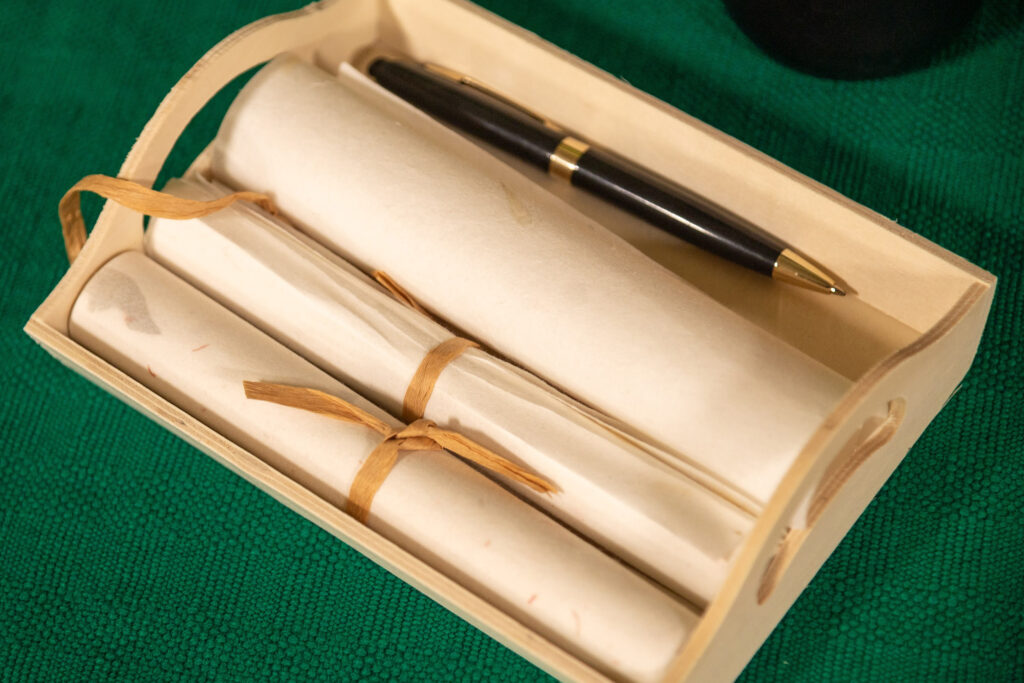
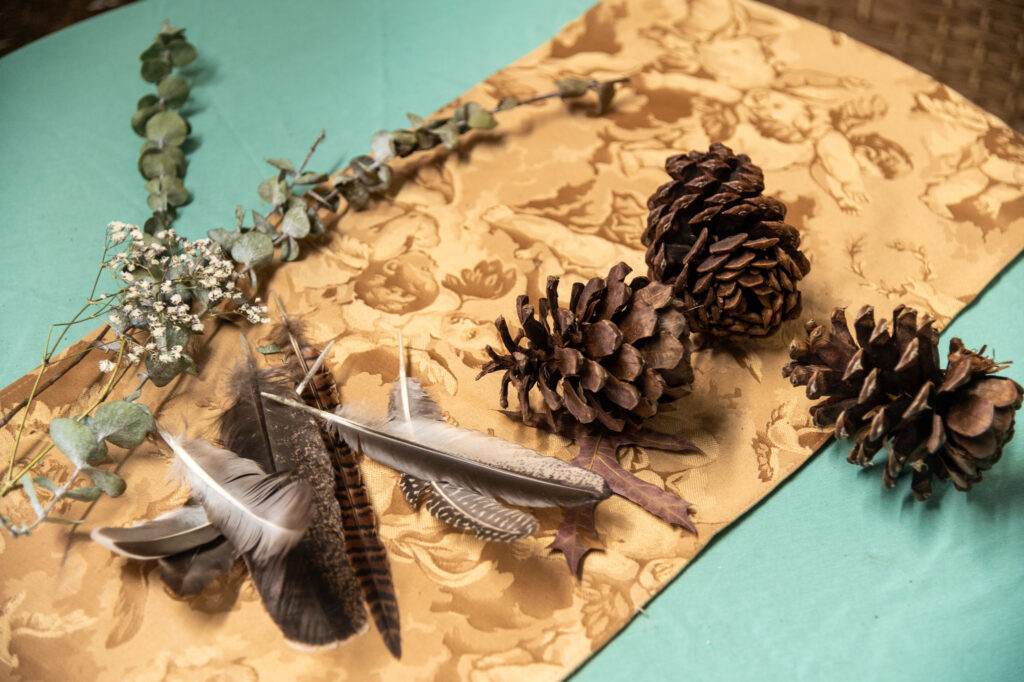
Families who choose to compost a loved one’s body at The Natural Funeral can write notes on biodegradable paper or place meaningful compostable items to be composted with the body. Credit: Michael Kodas/Inside Climate News
However, between 2021 and 2023, the number of licensed crematories in the U.S. increased by only 5.2 percent. At the current growth rate, these 3,400 crematories will not have the capacity to handle the approximately 666,630 additional bodies that will be arriving annually by 2045.
“We need alternatives like alkaline hydrolysis,” says Olson. “I think it’s going to grow exponentially.”
Alkaline hydrolysis and human composting machinery are also more financially sustainable for funeral directors, Olson said. A crematory to conduct fire cremations would occupy the same space as a two-car garage and cost about $150,000, in addition to about $100,000 every two or three years for rebricking due to wear. An alkaline hydrolysis machine, on the other hand, takes up less than half of that space, costs about $200,000 and requires minimal maintenance. Human composting machine prices vary, but The Natural Funeral offers Chrysalis Vessels for $60,000 each, with supporting equipment, such as air filtration, soil curing bins, a bone dehydrator and other supplies needed to run the system, at just over $100,000.
“You buy the machine, just keep using it. You don’t have to reline it. You don’t have to gas it. You don’t have to worry about firewalls and burning down your building and putting out emissions and all the things associated with traditional flame cremation,” said Olson.
And these processes are not cost-prohibitive to families, either. According to the NFDA, in 2023, the national median cost of a funeral with a viewing and burial was $8,300, while the median cost of a funeral with cremation was $6,280. Alkaline hydrolysis and human composting typically cost about the same amount as a fire cremation, according to Olson, depending on the company and services chosen.
Burris says that her mother has also chosen to use human composting, when the time comes, and in her area, it will be more affordable than a fire cremation.
For Burris, the decision to use human composting was rooted in environmentalism. In the end, she says it also helped her begin to come to terms with a tragic loss by returning Mathias’s nutrients to the cycle of life. Burris spread her son’s soil on family burial plots in Missouri, near their favorite hiking trails in Colorado and under a tree planted at their home. She used it to pot three houseplants, which thrive in her bedroom and living room.
“We all have a microbiome. That microbiome is what is keeping us alive and what eventually will break us down as well when we pass away,” said Burris. “The planet knows what it’s doing with breaking down bodies.”
About This Story
Perhaps you noticed: This story, like all the news we publish, is free to read. That’s because Inside Climate News is a 501c3 nonprofit organization. We do not charge a subscription fee, lock our news behind a paywall, or clutter our website with ads. We make our news on climate and the environment freely available to you and anyone who wants it.
That’s not all. We also share our news for free with scores of other media organizations around the country. Many of them can’t afford to do environmental journalism of their own. We’ve built bureaus from coast to coast to report local stories, collaborate with local newsrooms and co-publish articles so that this vital work is shared as widely as possible.
Two of us launched ICN in 2007. Six years later we earned a Pulitzer Prize for National Reporting, and now we run the oldest and largest dedicated climate newsroom in the nation. We tell the story in all its complexity. We hold polluters accountable. We expose environmental injustice. We debunk misinformation. We scrutinize solutions and inspire action.
Donations from readers like you fund every aspect of what we do. If you don’t already, will you support our ongoing work, our reporting on the biggest crisis facing our planet, and help us reach even more readers in more places?
Please take a moment to make a tax-deductible donation. Every one of them makes a difference.
Thank you,