

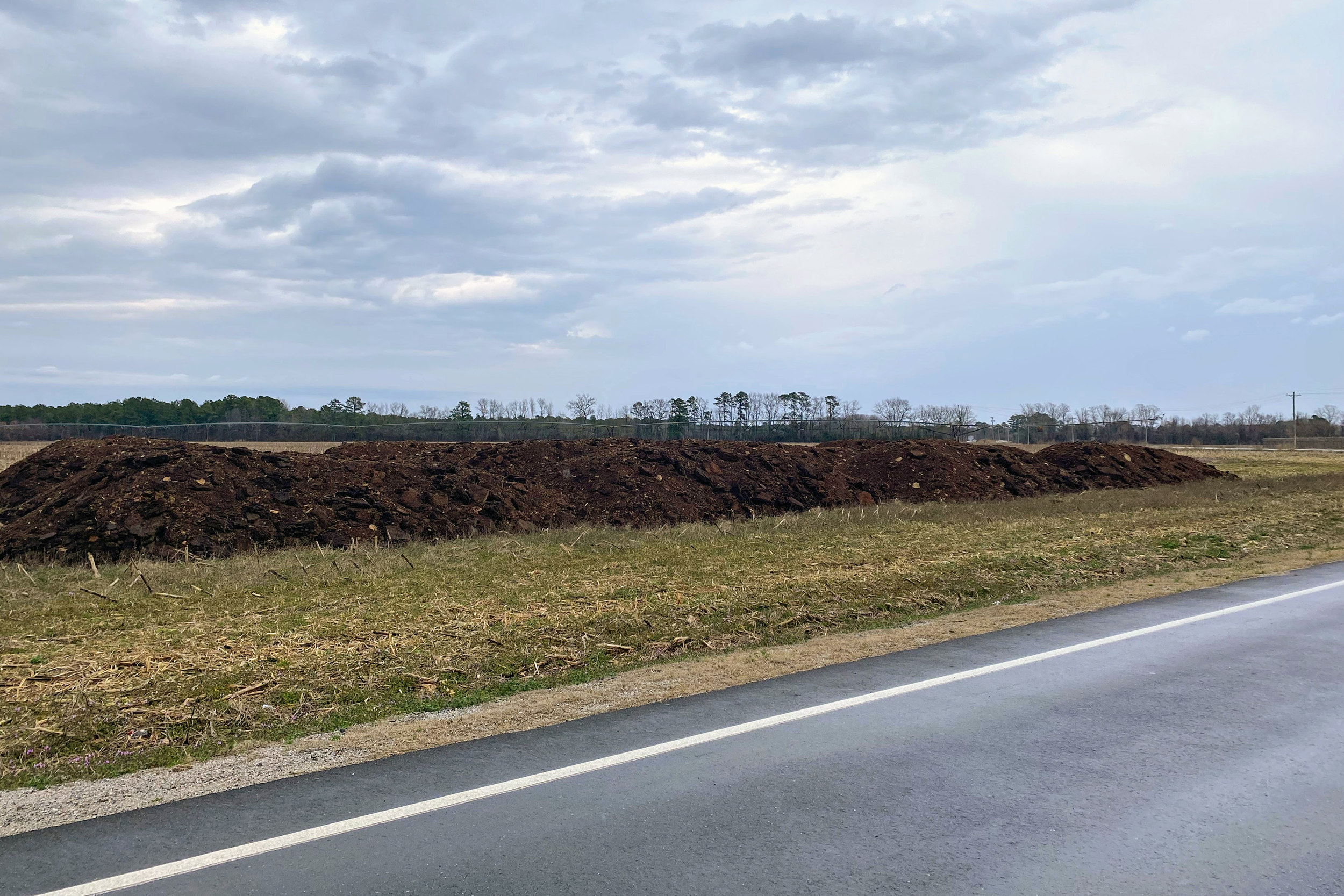
ROWLAND, N.C.—Brenda Schwab stopped her 16-year-old Ford pickup truck on Gaddy’s Mill Road and pointed to a chocolate-colored ridge about 30 feet long and 5 feet high, resting in a field and close to the road. A cold downpour had turned the air clammy. It smelled like a rancid potpourri seeping through the truck windows, singeing the occupants’ sinuses and glomming onto their raincoats.
The dark ridges contained chicken feces intended to be spread on Robeson County pastures as fertilizer. Officials at the North Carolina Department of Environmental Quality call this waste “dry litter” because it is mixed with sawdust and bedding. Poultry farms in North Carolina that use the method of disposal don’t have to obtain a state permit to operate.
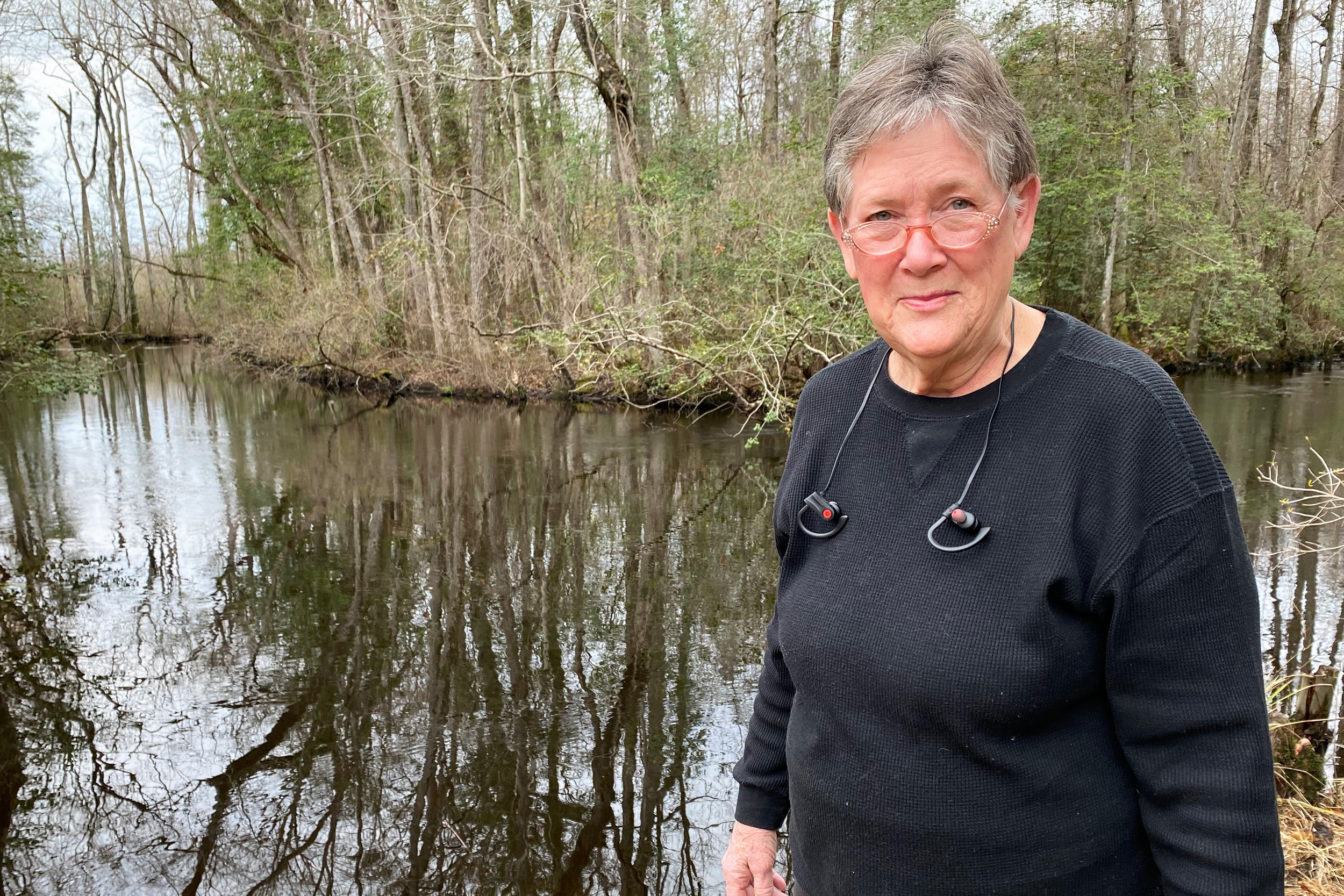
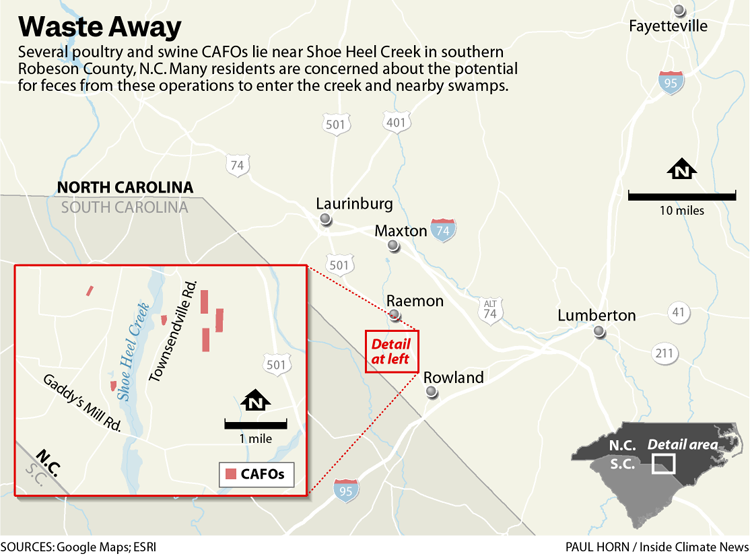
Schwab is in her 70s with short gray hair and works as a health care consultant. She lives a mile and a half downstream and downwind of a million animals raised on concentrated animal feeding operations, known as CAFOs, in southern Robeson County.
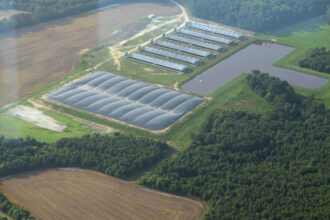
Shoe Heel Creek runs past the CAFOs and through the back half of Schwab’s 73-acre property before entering South Carolina. She is worried about the water quality in the creek and nearby swamps. Farmers legally spray and spread tons of poultry and hog waste from CAFOs onto their fields as fertilizer, which can seep into groundwater and waterways.
She said she has called several state agencies, including DEQ, to report her concerns, including seeing children and their families fishing in the creek. “I don’t feel like anyone is listening to me,” Schwab said.
Schwab’s experience is common. It illustrates the limitations of legal settlements, which included an improved complaint system that DEQ has forged with environmental and civil rights groups over the past nine years.
Environmental advocates say the complaint system has failed to adequately curb water pollution from industrialized farms, leaving contamination from leaking hog lagoons and sprayfields, and mounds of poultry waste, lingering in fields past the statutory 15-day deadline for removal.
DEQ updated its complaint system as part of a 2017 settlement with environmental groups over allegations the agency failed to adequately investigate complaints related to swine CAFOs. The agreement also applied to industrialized poultry farms. It required the agency to give complainants the option of remaining anonymous and to visit the CAFO within five days unless there is an immediate threat to human health or the environment.
A separate civil rights settlement, reached in 2018 between DEQ and environmental and civil rights advocates, contained several provisions that the agency fulfilled. However, one key provision was never enacted: The agreement required DEQ to draft a violation point system for swine CAFOs, which would have assessed demerits to farms based on the severity and frequency of willful violations; ultimately, DEQ would have had the authority to revoke a farm’s permit.
DEQ completed a draft in 2020, but never presented it to the state Environmental Management Commission for consideration, according to meeting minutes. A DEQ spokesperson told Inside Climate News that because of agency turnover, “particular staff involved with that process and communicating with the EMC are no longer with the agency.”
The state’s 2025 Farm Act would eliminate the point system. The Senate passed the bill but it hasn’t yet cleared the House.
Between November 2018 and the end of 2025, DEQ investigated at least 568 complaints about CAFOs, according to summaries posted on its website. (The summary for the final quarter of 2024 was missing.) DEQ found violations in about one in five of these investigations.
“To the extent that the information is available about how many complaints were filed and how many resulted in violations, I think that has worked,” said Blakely Hildebrand, a senior attorney with the Southern Environmental Law Center. “But I think that information is very limited in its utility.”
A state law passed in 2014 mandated details of complaint-driven investigations must remain secret unless inspectors find a violation based on the complaint. So there is no way for environmental advocates to review the adequacy of investigations that gave CAFOs a clean bill of health.
“The numbers speak to the continued challenge the DEQ has in inspecting and investigating complaints, and then in enforcement because of their ongoing resource constraints,” Hildebrand said. “I think the blame needs to be placed on the legislature, not necessarily on DEQ, although certainly DEQ plays a role in how they’re allocating resources.
“But it is a problematic system. The substance of the complaints is still confidential, which I don’t think serves the purpose of increasing transparency around this industry or in giving the public the ability to really evaluate whether DEQ is doing its due diligence with these facilities when they go out and inspect.”
When an environmental advocate or private resident documents a complaint, even with time-stamped photos and water-quality testing by an EPA-certified lab, an agency inspector must independently witness and verify it before pursuing a violation.
A lack of staff and state funding constrains DEQ’s ability to hold the CAFOs accountable, the agency says. There are just 14 people to inspect the 2,200 swine CAFOS, 218 cattle operations, and the 18 poultry farms that have a permit to use a “wet litter” disposal system, according to agency data.
No one at DEQ routinely inspects poultry farms that use the “dry litter” disposal method because those operations aren’t required to have a permit. Under state law, locations of the dry-litter poultry farms are secret, so it’s difficult to know precisely how many there are.
Several Democratic lawmakers introduced a bill in 2023 to require dry litter poultry CAFOs to obtain a permit; the bill sponsors estimated there were 4,800 farms and more than a half-billion poultry in North Carolina. The legislation never got a committee hearing.
Those 14 employees respond to complaints, as well, according to a DEQ spokesman, and they split their time among many programs, so there are actually fewer full-time equivalent positions assigned solely to CAFO inspections and complaints.
“We’ve submitted plenty of complaints that I don’t know that they’ve ever been followed up on at all in the form of a field visit,” Neuse Riverkeeper Samantha Krop said. “Unfortunately, it takes a certain degree of persistence from the complainant to ensure that an investigation is properly opened, that a field visit occurs, and that all of the necessary follow-up happens.”
On Your Street, Thousands of Chickens and Hogs
Schwab is from Monroe, Louisiana, where her parents raised a few hogs on pasture, including her favorite, Sammy, who amused the family one day when he overindulged on Little Debbie snack cakes and fell into a stupor. As a child, she loved the family bull, Bully, and was heartbroken to find him on her dinner plate. “My dad told me that’s how we were able to eat,” she said.
After Hurricane Katrina in 2005, Schwab left Louisiana. A year and a half ago, she bought her farm near Rowland, the back half of which is in wetlands. In front, she raises 40 free-range chickens in her yard, including a rooster with a bad leg named Miracle.
She co-founded the Eighth Leaf Project, which curates and shares research about medicinal plants, including the Great Mullein, which thrives on her property.
Schwab drove down Townsendville Road past a farm with 40 poultry barns, where as many as 900,000 chickens bound for the Mountaire slaughterhouse are raised each year. Across the road, up to 12,595 hogs are jammed into barns at a CAFO owned by Smithfield Foods.
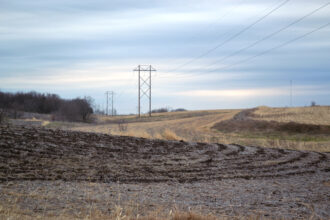
She passed several fields with mounds of feces. The waste can legally sit there for up to 15 days, but without adequate staffing, the provision is difficult for DEQ to enforce. If inspectors receive a complaint and arrive after the 15th day, but the waste is spread, then the agency can’t, under its policy, prove a violation occurred.
A DEQ spokesman said the agency investigates the complaints it receives, “and time is a factor in identifying violations—the sooner detailed information is relayed to our regional offices, the higher the chance conditions at inspection match what a complainant observes.”
Jeff Currie is the Lumber Riverkeeper and monitors water quality and pollution sources in Robeson County. Several years ago, he toured parts of the county with members of the DEQ environmental justice committee, an appointed board of advocates, scientists and community members.
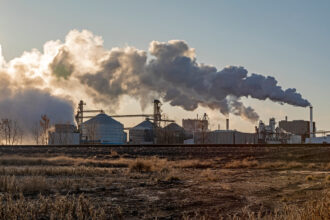
They stopped at the Mountaire slaughterhouse in Maxton, where the company was legally spraying waste on a field. But the wind was blowing the waste across the road, he said, which is a violation.
“I got out to take photographs,” Currie recalled, “and one person in the back seat of their car is feeling sick and heaving, and I’m nauseous.”
The wind shifted, and the waste hit Currie in the face as he took pictures. He sent the evidence to DEQ. “I told them that members of that committee saw it,” he said, but never received a response.
A DEQ spokesman told Inside Climate News that the agency’s violation notices or other enforcement actions are “based on the evidence encountered by staff when they visit a site, either as a result of a complaint or as part of a routine inspection.”
“I got out to take photographs, and one person in the back seat of their car is feeling sick and heaving, and I’m nauseous.”
— Jeff Currie, Lumber Riverkeeper
Larry Baldwin, coordinator for the Waterkeeper Alliance’s Pure Farms, Pure Waters campaign, used to fly over eastern North Carolina in a small plane to document poultry waste mounds, track how long they had sat in the fields and publicize the findings.
But because of the several-day lag between reporting potential violations to DEQ and an inspector arriving on-site, Currie and Baldwin have reduced their surveillance. “We had riverkeepers flying all over the state, and I can’t even tell you how many violations we would have submitted,” Baldwin said. “But we’ve kind of stopped with aerial documentation because what the hell difference does it make?”
Spraying in the Rain
Around 8 o’clock one morning in 2008, Devon Hall drove past a swine CAFO in Duplin County where the grower was spraying waste on fields in the rain, a violation of the operation’s permit. Hall said he called DEQ and spoke with someone about the incident and emphasized the complaint was to be kept anonymous.
Hall’s anonymity was crucial. He is the co-founder and executive director of REACH, an environmental and civil rights group that monitors CAFOs in Duplin County. As a result of his activism, Hall said, he has been trailed in grocery stores and nearly run off the road.
This story is funded by readers like you.
Our nonprofit newsroom provides award-winning climate coverage free of charge and advertising. We rely on donations from readers like you to keep going. Please donate now to support our work.
Donate NowLater that afternoon, Hall said he received a call from a number he did not recognize.
Hall picked up the phone: “Hello.”
“Hello, who is this?” a man asked.
“Who are you?” Hall responded. “You called me.”
Finally, Hall said, the man told him the reason for his call: “Someone with this number called and reported me this morning.”
Hall said he talked with the man, who turned out to be the CAFO owner, for a few more minutes, then called DEQ and eventually spoke with the person who had taken his complaint.
“I told you it was anonymous,” Hall said.
“I wasn’t me,” the DEQ employee reportedly said. “We gave the information to my supervisor and he gave it to the inspector.”
DEQ sent Hall a letter of apology.
“This is why people don’t call and report violations,” Hall said. “They live in the community with the contract grower and that’s what they’d be faced with.”
A DEQ spokesperson said the agency doesn’t record identifying information of people who wish to remain anonymous, whether they call or use an online anonymous comment tool. DEQ “doesn’t reveal the source of complaints in notices of violation or civil penalty documents,” the spokesman said, though the nature of the complaint is subject to the Public Records Act.
The Ridge of Feces Remained
Schwab continued driving through southern Robeson County in a downpour. She wondered where all the water from the farm ditches that are supposed to contain it was going.
She had asked DEQ to test the water in Shoe Heel Creek that runs through her property, but she said an official told her the agency didn’t have the resources to do so. Data gathered from DEQ’s monitoring station at the creek’s headwaters in 2024, about 25 miles upstream of Schwab’s home, showed no exceedances of nitrogen, phosphorus or E coli. More recent data is under review, according to an agency spokesperson.
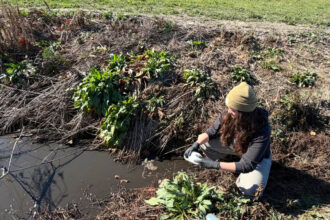
When Schwab tested the water and soil from the banks, she found that contaminants in the creek water were well below state standards and guidelines. But the banks contained high levels of nitrogen and phosphorus, likely accumulated over years of rising and falling water.
After her initial trip around the county, Schwab checked the waste piles again later that week. The ridge of feces on Gaddy’s Mill Road was still there after at least five days, with 10 more remaining before the deadline to remove it. As she sampled water from the canals and swamps, it began to rain again.
Peter Aldhous contributed data analysis for this story.
About This Story
Perhaps you noticed: This story, like all the news we publish, is free to read. That’s because Inside Climate News is a 501c3 nonprofit organization. We do not charge a subscription fee, lock our news behind a paywall, or clutter our website with ads. We make our news on climate and the environment freely available to you and anyone who wants it.
That’s not all. We also share our news for free with scores of other media organizations around the country. Many of them can’t afford to do environmental journalism of their own. We’ve built bureaus from coast to coast to report local stories, collaborate with local newsrooms and co-publish articles so that this vital work is shared as widely as possible.
Two of us launched ICN in 2007. Six years later we earned a Pulitzer Prize for National Reporting, and now we run the oldest and largest dedicated climate newsroom in the nation. We tell the story in all its complexity. We hold polluters accountable. We expose environmental injustice. We debunk misinformation. We scrutinize solutions and inspire action.
Donations from readers like you fund every aspect of what we do. If you don’t already, will you support our ongoing work, our reporting on the biggest crisis facing our planet, and help us reach even more readers in more places?
Please take a moment to make a tax-deductible donation. Every one of them makes a difference.
Thank you,

Lisa Sorg
Reporter, North Carolina
Lisa Sorg is the North Carolina reporter for Inside Climate News. A journalist for 30 years, Sorg covers energy, climate environment and agriculture, as well as the social justice impacts of pollution and corporate malfeasance.
She has won dozens of awards for her news, public service and investigative reporting. In 2022, she received the Stokes Award from the National Press Foundation for her two-part story about the environmental damage from a former missile plant on a Black and Latinx neighborhood in Burlington. Sorg was previously an environmental investigative reporter at NC Newsline, a nonprofit media outlet based in Raleigh. She has also worked at alt-weeklies, dailies and magazines. Originally from rural Indiana, she lives in Durham, N.C.