

When the final gavel fell on Georgia’s legislative session, Big Tech and Georgia Power had little reason to be disappointed.
For years, tech companies have expanded their artificial intelligence ambitions in Georgia by building data centers that benefit from tax exemptions and favorable energy rates. Advocates say the growth has shifted costs onto everyday ratepayers while bringing large industrial facilities into communities, often accompanied by persistent noise and increased air pollution.
A handful of bills sought to address consumer concerns over data center expansion. Each proposal took a different approach, but none made it to a final vote.
“I’m frankly surprised that they did not pass any of the data center legislation,” said Patty Durand, founder of Georgians for Affordable Energy. “They know that Georgians are angry about high utility bills and are scared about all the data centers coming here.”
Among the most aggressive efforts was House Bill 1012, which sought to halt new data center construction altogether. The Democratic-backed bill had little chance in Georgia’s heavily Republican legislature.
Other proposals took a more targeted approach. Senate Bills 410 and 408 aimed to roll back a key tax exemption that Georgia has offered data centers since 2018. The state’s pro-business legislature has long used tax incentives to attract industry and jobs, most notably helping build a booming film and television sector.
Advocates argue that similar tax breaks for data centers—seen as more energy-intensive and infrastructure-heavy—should be scaled back or eliminated. A University of Georgia analysis found that roughly 70 percent of data center construction would have occurred even without the tax exemption.
“States must stop creating new incentive programs for data centers, and pause existing programs like this one in Georgia, where it is draining billions from other programs and services,” said Kasia Tarczynska, a senior research analyst with Good Jobs First, a nonprofit based in Washington, D.C. “It is unconscionable that some of the world’s most profitable companies are taking so much from neighborhoods and families.”
Georgia is projected to lose roughly $2.5 billion in state and local tax revenue from the exemption in fiscal year 2026, according to state estimates, with losses expected to climb to about $3 billion in 2027. By comparison, Virginia—often considered the epicenter of data center development—lost an estimated $1.6 billion in 2025.
Senate Bill 408, which sought to sunset the tax exemption in 2027—five years ahead of schedule—did not reach a vote in the Senate. Senate Bill 410, which would have ended the tax break for new data centers, also failed to advance after crossing over to the House. Without any changes approved this session, the tax exemption is set to remain in place until 2032.
In addition to tax exemptions, a bill sponsored by Republican state Sen. Chuck Hufstetler aimed to protect ratepayers from rising costs tied to data center expansion. Hufstetler is known for his consumer advocacy, trying to reduce utility bills.
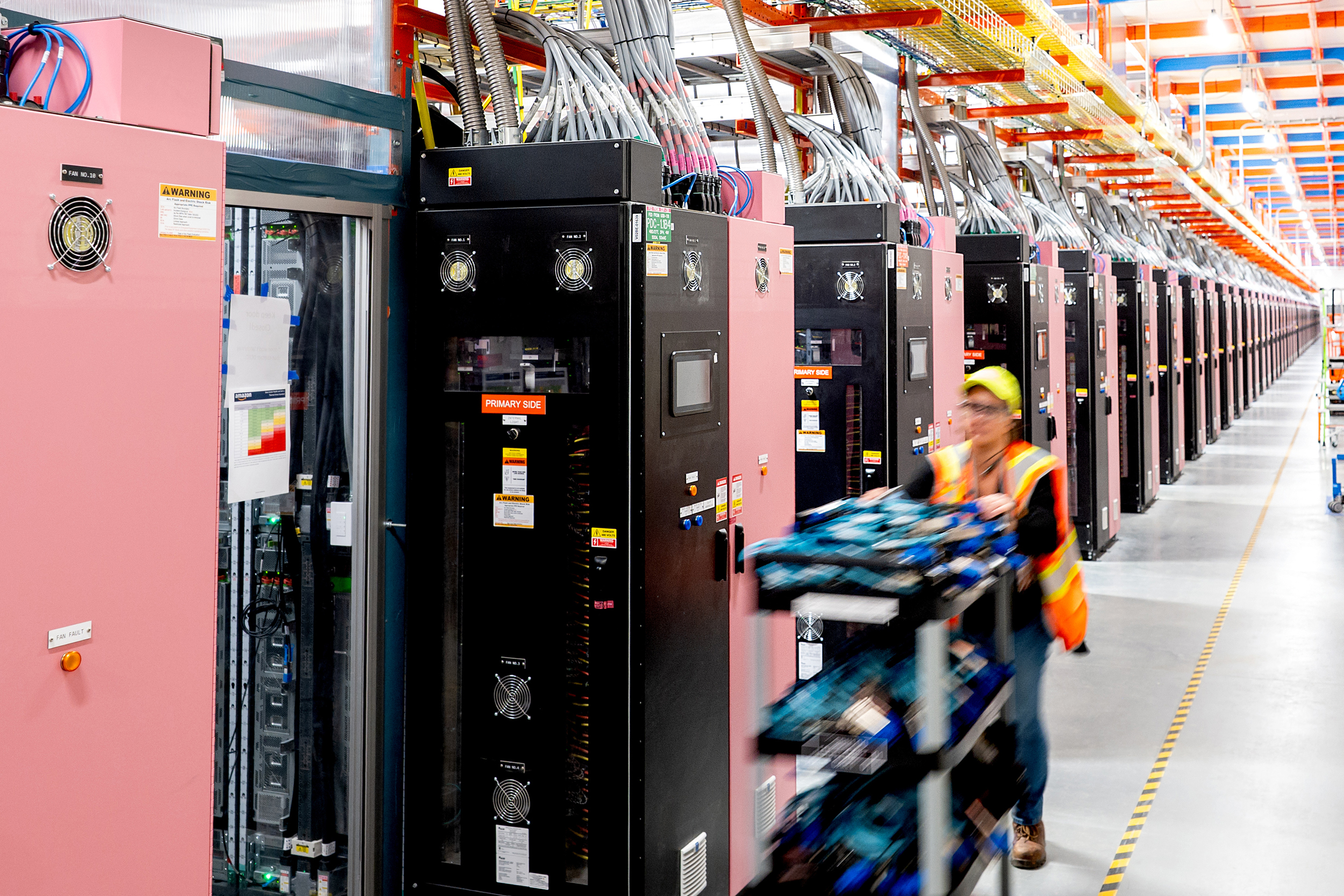
Data centers, including over 100 in Georgia, use large amounts of electricity that often require expensive upgrades to the power grid and can raise overall energy costs. They also frequently strike discounted rate deals with utilities, with residential and small business customers making up the difference through higher bills.
This story is funded by readers like you.
Our nonprofit newsroom provides award-winning climate coverage free of charge and advertising. We rely on donations from readers like you to keep going. Please donate now to support our work.
Donate NowGeorgia Power plans to add about 10 gigawatts of capacity before 2032 to meet growing demand from data centers, with much of the cost expected to be passed on to customers. Hufstetler’s bipartisan bill would have required large electricity users to pay the full cost of the infrastructure needed to serve them, instead of shifting those expenses onto ratepayers.
Georgia Power pushed back on those concerns, saying its rate structure requires large energy users to bear more of the costs associated with their demand. In a statement, the utility said data center growth “means large energy users pay more so you pay less,” and pointed to a recent three-year rate freeze and projected downward pressure on rates.
But consumer advocates and some lawmakers reject that characterization, arguing that the scale of new generation and grid infrastructure required to serve data centers makes it difficult to avoid shifting costs onto residential customers over time. And, even if data centers do not arrive in Georgia, residential and small business customers are not protected from covering the cost of this expansion, according to Liz Coyle, executive director of Georgia Watch, a nonpartisan consumer advocacy organization based in Atlanta.
“It’s really disappointing,” she said. “They had numerous bills they could have acted on if they really wanted to protect consumers.”
Hufstetler said that 80 percent of Georgians supported the measure, yet the bill ultimately failed after a March Senate session was abruptly adjourned just before it was set to come up for a vote. A version of the bill that consumer advocates saw as significantly weaker also fell short in the House.
Even more modest efforts failed as well. Proposals aimed at improving transparency around data center operations did not reach the governor’s desk. They would have required companies to disclose how much water and electricity their facilities use, and blocked local governments from signing nondisclosure agreements that keep those figures secret. Supporters said the measures were intended to give residents and policymakers a clearer picture of the industry’s growing footprint.
Taken together, the outcome leaves the state’s current law and policy on data centers largely unchanged. Tax exemptions passed in 2018 remain in place, and utilities retain broad discretion in how they structure long-term contracts with large energy users. For developers and tech companies, the result means few immediate changes to how projects are financed or built in Georgia, even as the industry continues to expand.
About This Story
Perhaps you noticed: This story, like all the news we publish, is free to read. That’s because Inside Climate News is a 501c3 nonprofit organization. We do not charge a subscription fee, lock our news behind a paywall, or clutter our website with ads. We make our news on climate and the environment freely available to you and anyone who wants it.
That’s not all. We also share our news for free with scores of other media organizations around the country. Many of them can’t afford to do environmental journalism of their own. We’ve built bureaus from coast to coast to report local stories, collaborate with local newsrooms and co-publish articles so that this vital work is shared as widely as possible.
Two of us launched ICN in 2007. Six years later we earned a Pulitzer Prize for National Reporting, and now we run the oldest and largest dedicated climate newsroom in the nation. We tell the story in all its complexity. We hold polluters accountable. We expose environmental injustice. We debunk misinformation. We scrutinize solutions and inspire action.
Donations from readers like you fund every aspect of what we do. If you don’t already, will you support our ongoing work, our reporting on the biggest crisis facing our planet, and help us reach even more readers in more places?
Please take a moment to make a tax-deductible donation. Every one of them makes a difference.
Thank you,