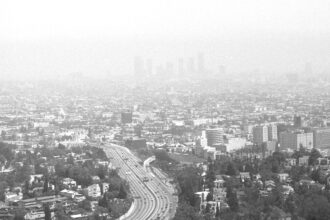
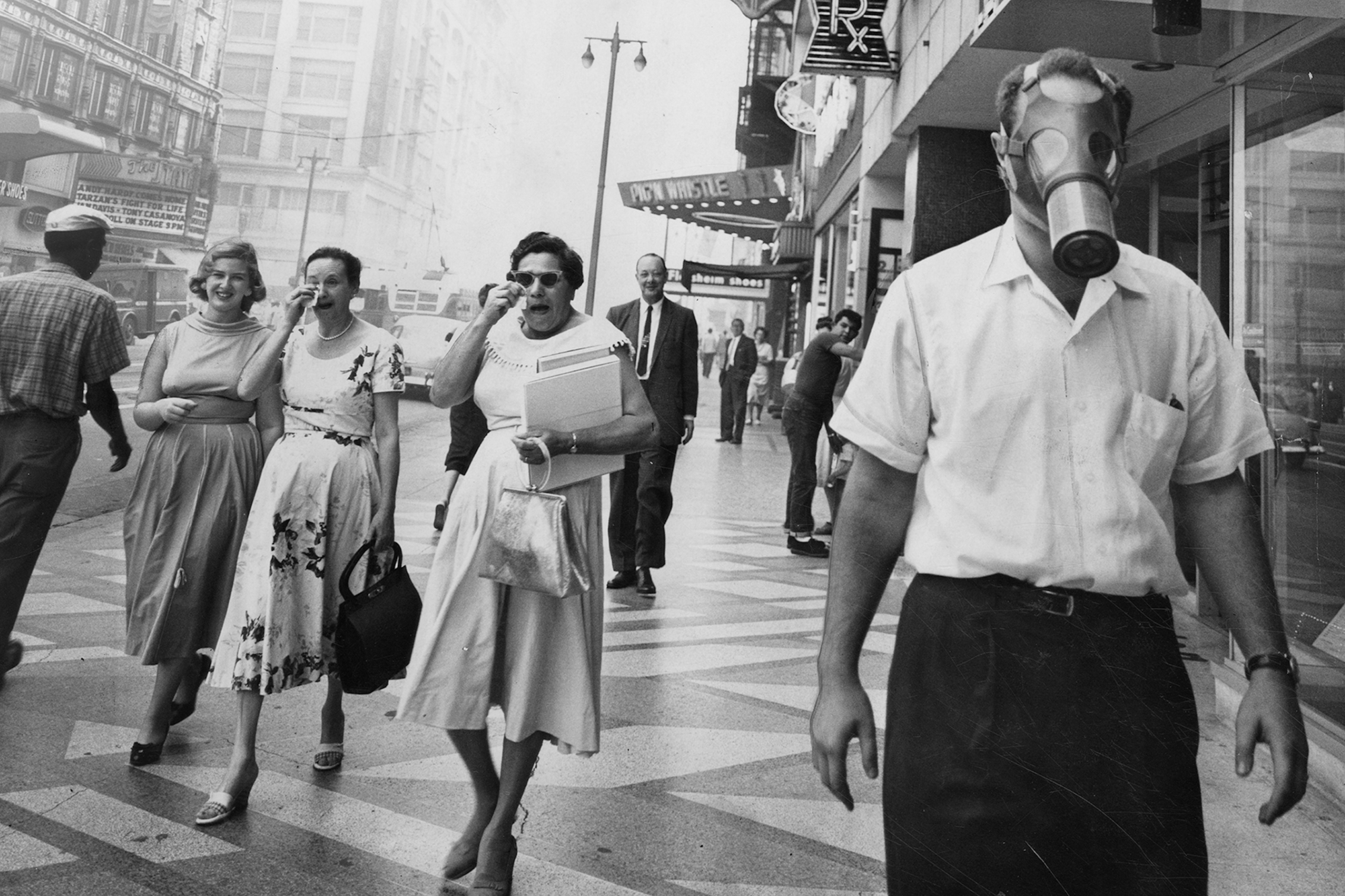


As a child growing up in Southern California, Ann Carlson remembers mountains obscured by haze and yellowish brown air that stung her eyes and made her lungs ache.
It was just “the environment,” her stepfather said of the smog many years later.
It would be decades before Carlson learned the complicated causes of the noxious air, what was to blame—oil companies, automakers and, yes, the environment—and the wide range of people wearing a lot of different hats who deserve the thanks for decades of improvements in Southern California air quality.
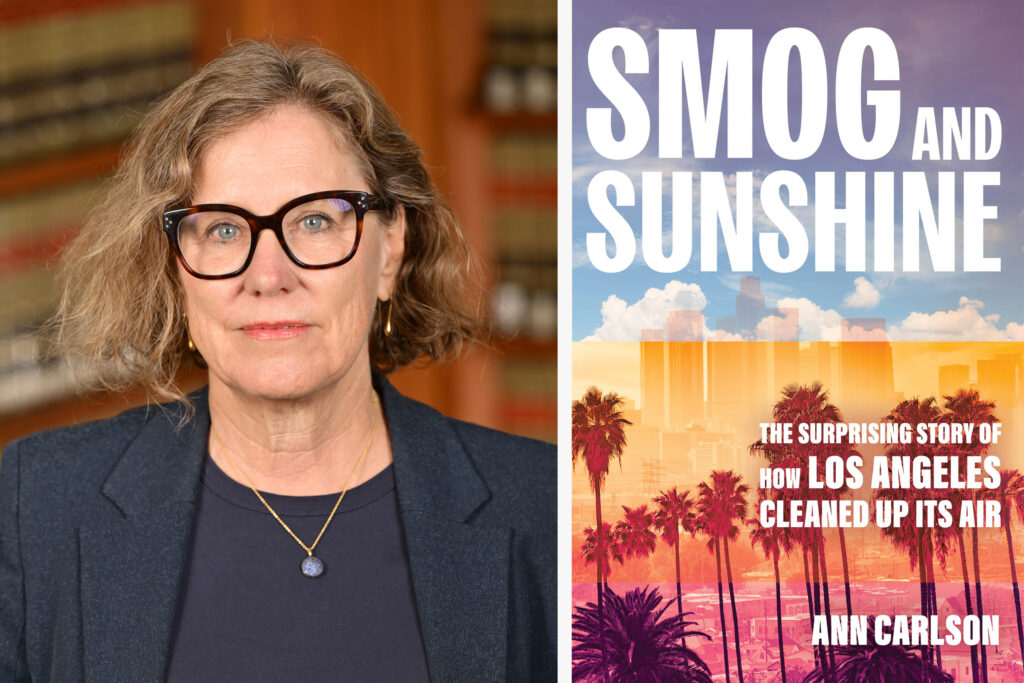
Carlson’s new book, “Smog and Sunshine: The Surprising Story of How Los Angeles Cleaned Up Its Air,” which was published last month, recounts a winding, complex but, ultimately, optimistic tale of Angelenos’ fight to breathe easier.
In the 1940s, ’50s and ’60s, many considered Southern California “uninhabitable,” writes Carlson, an environmental law professor at the University of California Los Angeles and faculty director of the Emmett Institute on Climate Change and the Environment.
Smog alerts for elevated ozone pollution in the Los Angeles Basin warned of “hazardous” stage 3 air quality nine times in 1970.
To compare, the Southern California region has not had a stage 1 smog alert since 2003, and it’s been many years more since it endured a stage 3 smog alert.
In the 1970s, the average child in Los Angeles had lead levels in their blood over 1,000 percent higher than levels of children in Flint, Michigan, after its crisis with lead in drinking water, notes Carlson, who served in the Biden administration as chief counsel and acting administrator of the National Highway Traffic Safety Administration. The biggest source of lead was air contaminated by the exhaust from cars and trucks burning leaded gasoline.
Fine particulate matter in the air also limited visibility. During the 1960s, Southern Californians couldn’t see more than three miles into the distance for about half the year.
Carlson’s book also documents the many environmental justice advocates, community stewards, scientists, lawyers and government officials who all helped Los Angeles air get to where it is today.
But it’s not only an account of how LA achieved clearer skies. It also looks at the current precarity as wildfires threaten air quality and President Donald Trump and other Republican leaders seek to boost fossil fuels in the U.S. while other countries prioritize renewables.
Carlson recently spoke with Inside Climate News about the history of Los Angeles air and the lessons its contamination and cleanup provide. The interview has been edited for length and clarity.
STEVEN RODAS: To start on a quirky, but pertinent, note: How are pineapples linked to the story of Los Angeles cleaning up its air?
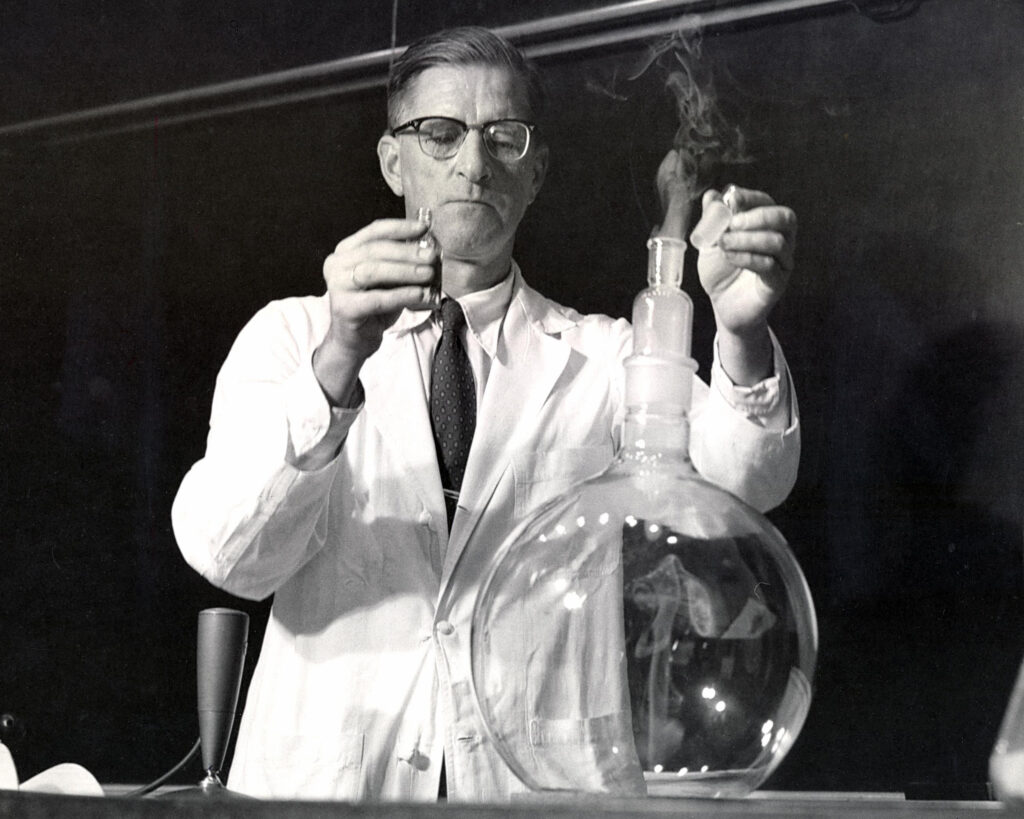
ANN CARLSON: [Caltech scientist Arie] Haagen-Smit studied the flavor of the pineapple. It turns out that pineapple chemistry provided him with the tools to figure out how to study the chemistry of air. Both involve very fine tiny particulates.
But it was puzzling, because the contaminants coming out of tailpipe vehicles weren’t coming out in high enough concentrations to explain the terrible air quality.
He hypothesized that they were being exposed to something else. And his hypothesis was that something else was sunlight. So he built a Plexiglas chamber outside his office, filled it with hydrocarbons, etc., coming out of the vehicles’ tailpipes, and exposed it to sunlight through the Plexiglas. Lo and behold, he had recreated ozone pollution.
RODAS: In light of the history you’ve laid out in your book and the progress Los Angeles has made, why do you think the city still has a reputation for smog-filled skies?
CARLSON: Some of it is history, but I think more importantly, Los Angeles does remain out of compliance with two federal pollution standards. It is the most out of compliance of anywhere in the country for one of those standards. That’s ozone pollution.
Most of the violations [are] through no fault of their own. They take place in the Riverside and San Bernardino areas, which are in the eastern part of the basin. They are ringed by mountains, so there’s a natural barrier that prevents the pollutants from basically blowing into Nevada or Arizona.
We continue to be a city that suffers from air pollution. But levels are so much lower than they used to be.
RODAS: Automakers feature prominently in “Smog and Sunshine.” You highlight that while oil companies fought new science about smog, car companies—namely Ford, GM and Chrysler—turned a blind eye to the connection between air quality and what was coming out of their vehicle tailpipes. What was the truth?
CARLSON: The truth came from Arie Haagen-Smit, the pineapple scientist.
For a while, it wasn’t perhaps surprising that the car wasn’t identified as the culprit, in part because other cities experienced terrible smog that was caused by a different source, and that was the burning of coal for coal-fired power plants to heat homes, to provide electricity.
In the 1940s, The Los Angeles Times actually hired a scientist from St. Louis who had been very instrumental in helping clean up St. Louis air. [Raymond Tucker] came out here and said, you have the same problem. Clean up your stationary sources.
But in fact, Los Angeles really was different from other cities in several respects. One was, we really did have car ownership rates that far exceeded the rest of the country for the decades of the ’40s and ’50s and so forth.
The other thing is that we really are the victims of our own geography. Those mountains trap the air within the basin.
RODAS: But you write that the air quality problem was to a degree due to oil and gas companies, which went on the defensive.
CARLSON: The oil companies attacked Dr. Haagen-Smit pretty viciously. They hire a scientist to try to undermine his work. That scientist confirms that Dr. Haagen-Smit is a genius and is correct and the oil companies bury that report.
The car companies engage in an entirely different tactic with respect to Dr. Haagen-Smit. They simply ignore his research.
Starting in the 1950s, one of our local supervisors started writing to the car companies, saying, “You need to do something to clean up your product.”
And for several years, well after the publication of Dr. Haagen-Smit’s work, they simply deny that there’s any connection between air quality and what’s coming out of the tailpipes of their vehicles. And they engage in more nefarious behavior than mere denial.
This story is funded by readers like you.
Our nonprofit newsroom provides award-winning climate coverage free of charge and advertising. We rely on donations from readers like you to keep going. Please donate now to support our work.
Donate NowRODAS: You also shine a light on Wilmington, California, and the environmental injustices reported in that neighborhood. Why was that important?
CARLSON: Wilmington is really at the crux of two huge sources of pollution. One is the ports and the others are oil refineries.
We’ve got the same issues now with respect to the warehouses, where all this truck traffic is coming in. The communities around the warehouses are predominantly Latino, and so it’s important to focus on those distributional consequences.
RODAS: You outline in your book that the installation of catalytic converters in all cars and trucks beginning in the late 1970s is “the principal reason” Los Angeles air quality has improved so much. Why was that?
CARLSON: People have called it the greatest environmental technology ever invented. Basically, what it did is it took the toxins and unburned hydrocarbons from automobile engines and catalyzed them into something that was much less toxic.
RODAS: It’s hard to travel around Southern California and see the place the same way after reading your book.
CARLSON: I’m glad, that’s what I was hoping.
RODAS: Did anything you find in your research surprise you?
CARLSON: Those lead statistics just blow me away—even though I’ve said that more than once. It just blows me away.
I think the other is the resistance by industry. Even though we know it kind of intellectually, just getting into the letters that car manufacturers wrote to Kenneth Hahn, the supervisor [in Los Angeles County].
RODAS: The book is about acknowledging the work of a lot of different unsung heroes—from activists to government officials to scientists. Can you speak about one person in particular you connected with?
CARLSON: I think Juana Gutierrez [co-founder of Mothers of East Los Angeles] is a remarkable leader. She’s no longer alive. She was a community member who was angry about a problem and she got connected with other community activists.
She changed our understanding of how to think about pollution from a kind of background atmospheric problem to one that affects some communities more than [it] affects others.
That is an incredible accomplishment for somebody whose job wasn’t to be a journalist or to be a scientist or to be a regulator.
This story was updated May 9, 2026, to clarify when Ann Carlson’s stepfather described the smog as just “the environment.”
About This Story
Perhaps you noticed: This story, like all the news we publish, is free to read. That’s because Inside Climate News is a 501c3 nonprofit organization. We do not charge a subscription fee, lock our news behind a paywall, or clutter our website with ads. We make our news on climate and the environment freely available to you and anyone who wants it.
That’s not all. We also share our news for free with scores of other media organizations around the country. Many of them can’t afford to do environmental journalism of their own. We’ve built bureaus from coast to coast to report local stories, collaborate with local newsrooms and co-publish articles so that this vital work is shared as widely as possible.
Two of us launched ICN in 2007. Six years later we earned a Pulitzer Prize for National Reporting, and now we run the oldest and largest dedicated climate newsroom in the nation. We tell the story in all its complexity. We hold polluters accountable. We expose environmental injustice. We debunk misinformation. We scrutinize solutions and inspire action.
Donations from readers like you fund every aspect of what we do. If you don’t already, will you support our ongoing work, our reporting on the biggest crisis facing our planet, and help us reach even more readers in more places?
Please take a moment to make a tax-deductible donation. Every one of them makes a difference.
Thank you,

Steven Rodas
Reporter, California
Steven Rodas covers water, wildfires and agriculture throughout California for Inside Climate News. Based in Los Angeles, he previously reported on the environment in New Jersey, covering energy, pollution, wildlife and development. Steven’s work has appeared in the San Francisco Chronicle, NJ.com/The Star Ledger and Grist. He worked as a copywriter at Google. Steven has a master’s degree from Syracuse University’s S.I. Newhouse School Of Public Communications. He is fluent in English and Spanish (and welcomes your tips).