

A proposed critical minerals mine in southern Arizona that was the first added to a federal permitting process designed to be quicker and more transparent has reported water with levels exceeding the state’s regulatory limits of a mineral that can damage the heart, lungs, stomach and eyes. On Tuesday, the Arizona Department of Environmental Quality (ADEQ) told Inside Climate News that it is launching an investigation into the discharges.
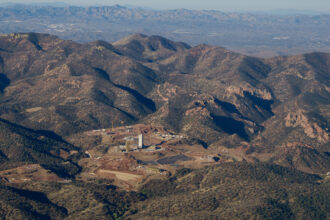
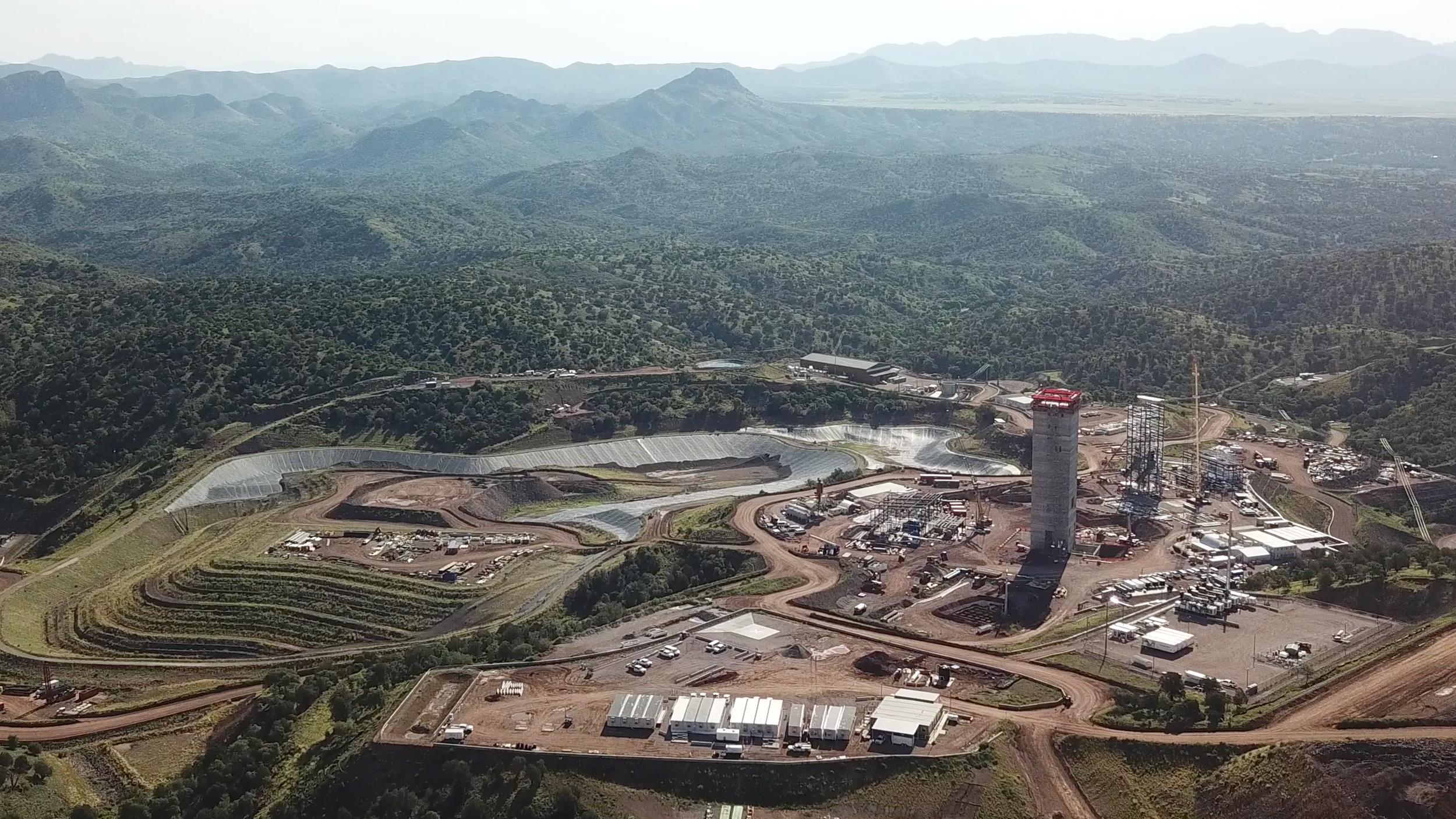
The mine, South32’s Hermosa project located near Patagonia, Arizona, is looking to extract silver, lead, zinc and manganese, with a final decision from the U.S. Forest Service on whether it can proceed expected in February. It’s the first mine in the nation to be added to the Fast-41 program, which is supposed to improve the timeliness, predictability and transparency of federal permitting for selected projects, and could set the standard for others as the nation looks to expand its domestic mineral production.
Lab results from October submitted to ADEQ on Nov. 30 show South32’s water discharge exceeded the allowed levels of antimony, a heavy metal, said ADEQ spokesperson Alma Suarez in a statement. The company, she said, claims the results are a lab error.
“We are still investigating, reviewing the lab reports and South32’s claim,” she said. “ADEQ will hold South32 accountable if our investigation determines that the reported exceedance was not a lab error.”
Records obtained by Inside Climate News through a public records request show this isn’t the first time that antimony in the Hermosa project’s water discharges exceeded the level requiring it to alert the state. In October 2024, the mine’s discharge reached antimony levels above the threshold requiring it to notify the state, but below the state’s exceedance level.
Nearby residents are concerned that the project’s operations are not adequately protecting the local community, and that the company and state regulators have not been transparent in alerting residents about the hazard after citizen scientists and watchdog groups were the first to alert the public of the violation.
Pat Risner, South32 Hermosa’s president, said in an interview with Inside Climate News that the company continues to monitor the well causing the issue and shuts it down when antimony levels get too high. The company is working with ADEQ to demonstrate its compliance with state regulations, he added. The whole purpose of monitoring requirements, he said, is to catch issues like this and address them.
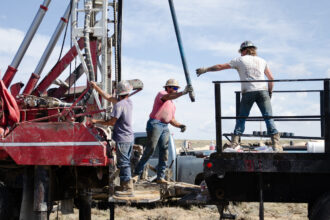
Prior to any mining, South32 has had to prepare the site, removing water from an aquifer that would get in the way of the extraction of the minerals. That water is filled with naturally occurring minerals, many of which are toxic to humans, like antimony. Long-term exposure to the antimony can cause gastrointestinal and respiratory issues.
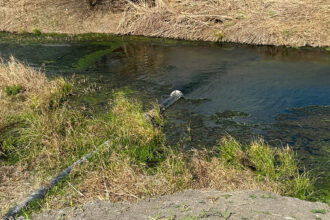
That water removed from the aquifer must be treated before it can be discharged to a new location. Seven wells pump water to a treatment plant on site, which discharges the treated water into Harshaw Creek. But one well at the mine site has had consistent antimony issues, according to South32, leading the discharge to exceed Arizona’s Aquifer Protection Permit (APP) Alert Level, 4.8 micrograms per liter, and approach the state’s regulatory discharge limit under the Arizona Pollutant Discharge Elimination System (AZPDES), which is set at 6 micrograms per liter by the Environmental Protection Agency.
The APP and AZPDES are two different permits—the former protecting aquifers from being contaminated (the state of Arizona legally considers all aquifers to have clean drinking water, even though that isn’t always the case), and the latter, a federal program managed by the state to prevent pollutants from entering waterways.
Mining companies are required to monitor their water discharges. A company is required to report any exceedance to Arizona Department of Environmental Quality within five days, and then conduct a 30-day study to investigate the cause of the exceedance, how long it lasted, test additional samples and determine the corrective actions and mitigations needed.
But citizen scientists and local environmental groups were the first to publicly share that antimony levels at the mine’s discharge site had exceeded the alert levels, which they discovered by tracking discharge monitoring results reported to the Environmental Protection Agency. The results are obtainable via a data download page on the EPA’s site.
“When did they become aware of this? When did they provide the five-day notice [to ADEQ]? When did they collect the verification sample, and when did they submit their 30-day study, if there is one?” asked Chris Gardner, a local hydrologist who has tracked the water discharge readings and first noticed the antimony issue in the EPA data. “That’s transparency. That’s the law. That’s what’s in the permit.”
Suarez said South32 did not send a five-day notice to ADEQ, “failing to meet the APP permit requirements.” The company has until Dec. 26, 2025, to complete the 30-day study. If the levels do not go down, ADEQ has a number of enforcement options, such as formal orders for the company to take specific actions and litigation, if necessary, Suarez said.
According to the EPA-reported AZPDES data, antimony levels first exceeded the state’s warning level amount in June, but the APP results were slightly below the limit. ADEQ told Gardner then that the discrepancy is due to the different permits having different sampling requirements. The APP is a simple grab sample that fills a bottle with water to test at one point in time; the AZPDES requires a composite sample collected over an eight-hour period. Since the minerals and contaminants in the water change over time, a grab sample may not reflect the average. But the agency didn’t tell Gardner that the APP data had found antimony levels exceeding the warning level the previous year as well.
The level of antimony in the water declined in the months after June 2025, but began to rise again in October. AZPDES shows it reached 5.73 micrograms per liter that month, while APP data shows it reached 6.23. The warning level is 4.8 micrograms per liter and the exceedance limit is 6.
“I think the important thing is, this was very short-term [discharge],” Risner said. “It’s actually why the monitoring requirements are in place. We’re dealing with Mother Nature. The way heavy metals leach into groundwater is variable. Depends on the metal, depends on the setting. So we have to be nimble enough to be able to adapt and adjust to that over time, and that’s what we’re doing.”
Testing showed that heavy metals and contaminants would be an issue, he said, so the company designed a “state-of-the-art” water treatment plant to mitigate them. When antimony began to be a problem, they shut down the problematic well and adjusted the reagents used to treat it to make them more effective and have invested more than $280,000 into the plant to address the antimony problem.
Citizen science is the only reason the community knows about this, said Robin Lucky, president of Calabasas Alliance, a local environmental group. If the antimony continues to be an issue, it could spread further down the watershed and affect the community, she fears.
“This water treatment plant was supposed to be the end-all be-all of water treatment plants on mining operations,” she said. “It is failing right now to effectively filter antimony.”
Gardner and other locals worry this is a sign that contamination will be a regular occurrence, not just for water, but for air, too. The EPA tasked ADEQ with updating the mine’s air quality permit, as the initial one failed to meet the standards of the Clean Air Act. Meanwhile, homeowners have received notices that their wells could go dry due to pumping from the mine.
“Are we just going to be this place that industry just dumps in knowingly, and the state does nothing?” Gardner said. All he and others can do is “name and shame.” It’s up to regulators and politicians to take the steps needed to protect the community.
About This Story
Perhaps you noticed: This story, like all the news we publish, is free to read. That’s because Inside Climate News is a 501c3 nonprofit organization. We do not charge a subscription fee, lock our news behind a paywall, or clutter our website with ads. We make our news on climate and the environment freely available to you and anyone who wants it.
That’s not all. We also share our news for free with scores of other media organizations around the country. Many of them can’t afford to do environmental journalism of their own. We’ve built bureaus from coast to coast to report local stories, collaborate with local newsrooms and co-publish articles so that this vital work is shared as widely as possible.
Two of us launched ICN in 2007. Six years later we earned a Pulitzer Prize for National Reporting, and now we run the oldest and largest dedicated climate newsroom in the nation. We tell the story in all its complexity. We hold polluters accountable. We expose environmental injustice. We debunk misinformation. We scrutinize solutions and inspire action.
Donations from readers like you fund every aspect of what we do. If you don’t already, will you support our ongoing work, our reporting on the biggest crisis facing our planet, and help us reach even more readers in more places?
Please take a moment to make a tax-deductible donation. Every one of them makes a difference.
Thank you,

Wyatt Myskow
Reporter, Phoenix
Wyatt Myskow covers drought, biodiversity and the renewable energy transition throughout the Western U.S. Based in Phoenix, he previously reported for The Arizona Republic and The Chronicle of Higher Education. Wyatt has lived in the Southwest since birth and graduated from Arizona State University with his bachelor’s degree in journalism.