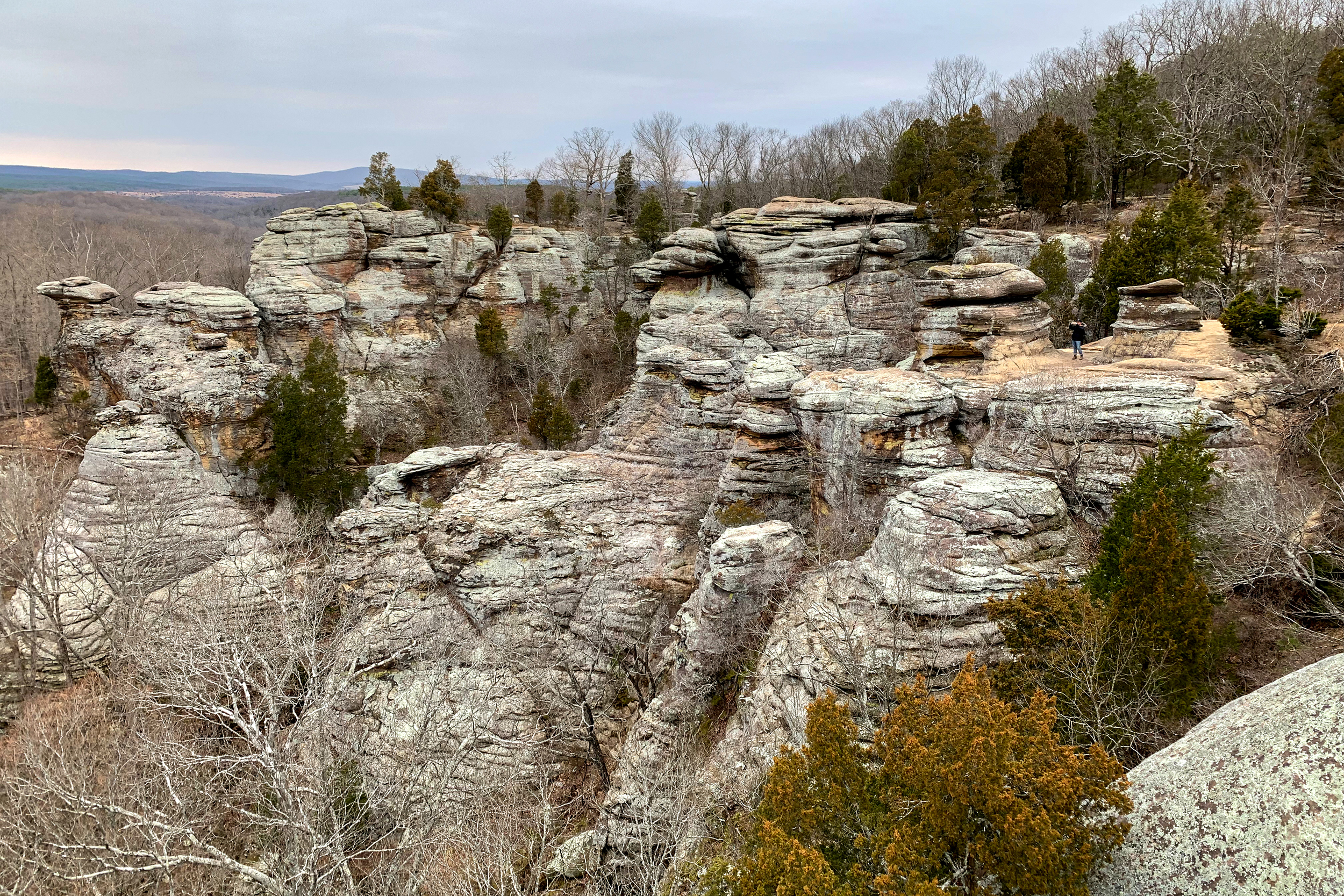


Illinois advocates and legal experts are applauding a congressional bill that would add key protections for certain areas in the Shawnee National Forest, classifying them with special distinctions that could lead to improved biodiversity, habitats and protections moving forward.
The Shawnee National Forest Conservation Act of 2025, introduced in July by Sen. Dick Durbin (D-Ill.) and co-sponsored by Sen. Tammy Duckworth (D-Ill.), aims to promote conservation and protection of three of the largest uninterrupted areas of the 289,000-acre Shawnee National Forest in southern Illinois, which spans across 13 counties. It is part of a larger package of bipartisan bills that would preserve public landscapes across the U.S.
The Senate Committee on Agriculture, Nutrition and Forestry passed the bill in October in a unanimous bipartisan vote.
“We’re hopeful that with that strong bipartisan support, as this legislation goes to the Senate floor, it will pass the Senate and then move on to the House,” said Howard Learner, chief executive officer and executive director at the Environmental Law and Policy Center (ELPC), a Midwest-based nonprofit environmental legal advocacy organization.
The act would specifically designate more than 12,700 acres within the Shawnee as special management areas, meaning that they would receive active management to protect habitat and biodiversity and preserve recreational activities from industry activity such as logging and mining.
The acres that would be designated as special management are within the Ripple Hollow, Burke Branch and Camp Hutchins areas of the forest.
Under the special management designation, the U.S. Forest Service (USFS) would be permitted to engage in more specialized management activities. For example, if an area has been largely overgrown by invasive species, the USFS will be able to clear up the invasives with large equipment or perform fire-management protocols, methods of preservation that are either prohibited or that forest management lacks funding and resources to perform.
“The management work that needs to get done is going to help lead to these becoming more protected wilderness areas, but they need the special management practices first before they meet the wilderness standards,” Learner said.
Many Illinois conservation groups advocated for the act, commending the increased protections it aims to bring to areas of the Shawnee.
“There’s a lot underway right now to allow more logging and mining of our public lands in much of the country. So if in this moment, we can find a way to protect these special parts of Illinois’ only national forest, that would be a really big win for the future,” said Sierra Club Illinois Chapter director Jack Darin.
The Illinois chapter helped Durbin work on the act and advocated for the passage with grassroots organizations of Illinois residents.
“We wanted to find a way to ensure that these areas are protected from exploitation, but in a way that allows the habitat restoration that’s needed to address the threat of invasive species and restore them to even higher quality than they are now,” Darin said.
The act would create a new wilderness area within Camp Hutchins because it already meets the conditions for the wilderness standards, such as being undeveloped, retaining its primeval character and having outstanding opportunities for solitude or recreation and is “an area of undeveloped Federal land retaining its primeval character and influence, without permanent improvements or human habitation,” according to the Wilderness Act.
Learner said that the goal is to get all three areas to qualify as wilderness areas, but since more management is needed, the act moves to first designate them as special management areas so they can move toward that status.
In order for an area to meet wilderness area standards under the Wilderness Protection Act, it sometimes requires a special management distinction so that the USFS has the ability to restore and protect it to the extent that it needs for qualification.
Learner said that if the bill is passed, the wilderness area designations could protect those areas from further federal administrative action that might seek to threaten forest lands.
This story is funded by readers like you.
Our nonprofit newsroom provides award-winning climate coverage free of charge and advertising. We rely on donations from readers like you to keep going. Please donate now to support our work.
Donate NowIn June, Secretary of Agriculture Brooke Rollins said that the USFS would be rescinding the Roadless Rule, which protects thousands of acres in national forests—about 30 percent of National Forest System lands—from logging and road development. The comment period for the notice to rescind the rule concluded in September, with no updates since.
“If Congress designated an area [as subject to] the Wilderness Act, which is a federal law, the administrative changes to the Roadless Rule can’t undo congressional legislation, just as a matter of law,” Learner said.
These protections are also important in preserving the integrity of areas in the Shawnee. Georgie Geraghty, executive director and Midwest partner at the Nature Conservancy, said that the act provides “wilderness protections with a carve-out to allow for prescribed fire, invasive species control and ecological thinning.”
Geraghty said that due to multiple factors including years of fire suppression and “explosive invasive species growth,” the ecological balance of the Shawnee has changed and therefore requires active management.
“It is no longer an intact wilderness system and the processes that once used to keep the forest open and diverse and resilient are no longer happening on their own, and so from our perspective, it’s critical that the Shawnee is protected full stop, but it has to be protected with provisions to allow for active management,” she said.
The Nature Conservancy has a longstanding partnership with the USFS and engages in active management of Forest Service lands in southern Illinois. Geraghty said that it is “neutral” on the legislation, but they are aligned with ELPC, Sen. Durbin “and others in terms of wanting broadly strong protections for the Shawnee National Forest, but our focus is very much on that management and stewardship component.”
Active management performed by the USFS often has to go through a series of approvals before treatment of certain areas can begin, a process that is often time-consuming and results in issues worsening. Geraghty gave the example of the invasive wineberry that spread from four acres to 40 acres within four years.
Had it not been addressed, she said, it would have continued to take over native species.
“Without this active management, the habitat would be overgrown,” she said, adding that areas within the Shawnee that draw tourists—such as Snake Road, Garden of the Gods and the tupelo gum trees in the Lower Cache River area—provide economic benefits for the communities there. “This active management is important for biodiversity, but the implications extend far beyond that.”
This story has been updated to correct the spelling of Howard Learner’s name.
About This Story
Perhaps you noticed: This story, like all the news we publish, is free to read. That’s because Inside Climate News is a 501c3 nonprofit organization. We do not charge a subscription fee, lock our news behind a paywall, or clutter our website with ads. We make our news on climate and the environment freely available to you and anyone who wants it.
That’s not all. We also share our news for free with scores of other media organizations around the country. Many of them can’t afford to do environmental journalism of their own. We’ve built bureaus from coast to coast to report local stories, collaborate with local newsrooms and co-publish articles so that this vital work is shared as widely as possible.
Two of us launched ICN in 2007. Six years later we earned a Pulitzer Prize for National Reporting, and now we run the oldest and largest dedicated climate newsroom in the nation. We tell the story in all its complexity. We hold polluters accountable. We expose environmental injustice. We debunk misinformation. We scrutinize solutions and inspire action.
Donations from readers like you fund every aspect of what we do. If you don’t already, will you support our ongoing work, our reporting on the biggest crisis facing our planet, and help us reach even more readers in more places?
Please take a moment to make a tax-deductible donation. Every one of them makes a difference.
Thank you,