

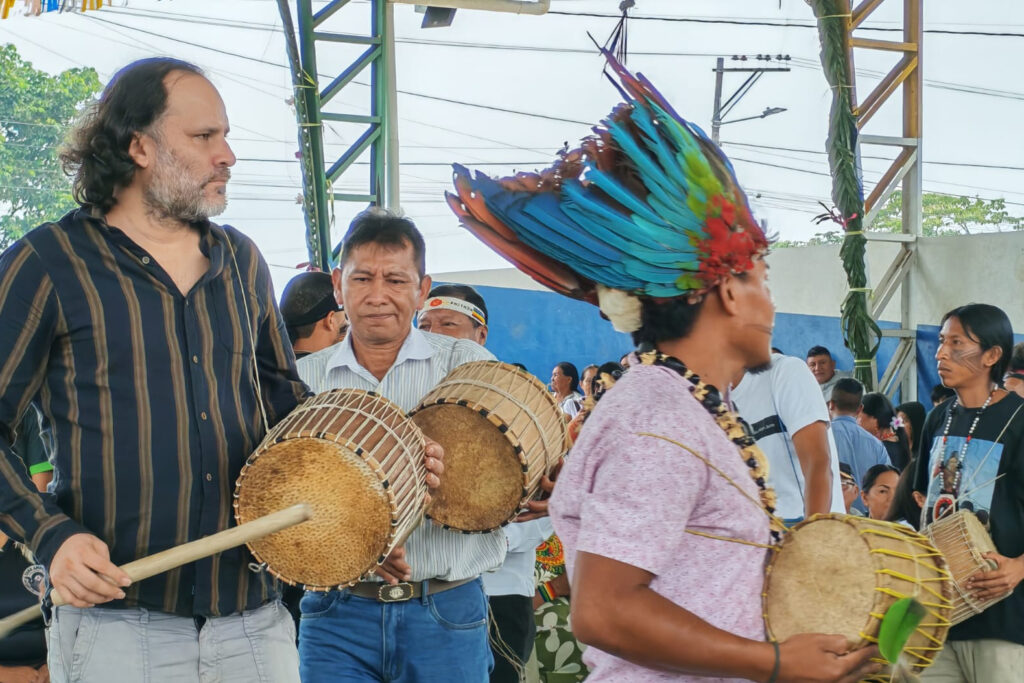
It was a sweltering January afternoon in the Amazonian town of Puyo when Andrés Tapia realized his daughter’s public school fees were due. Like many Ecuadorians, he reached for his phone to make a mobile transfer.
Carrying cash is too risky these days. Ecuador is in the grip of an ongoing security crisis, with transnational criminal organizations spilling in from neighboring Colombia and Peru. But when Tapia tried to log into the Banco Pichincha mobile banking app, a message flashed on the screen: There was a problem with his account, and he should visit the nearest branch.

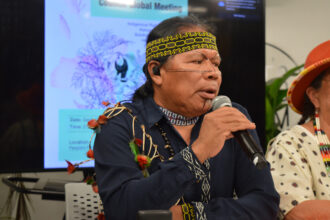
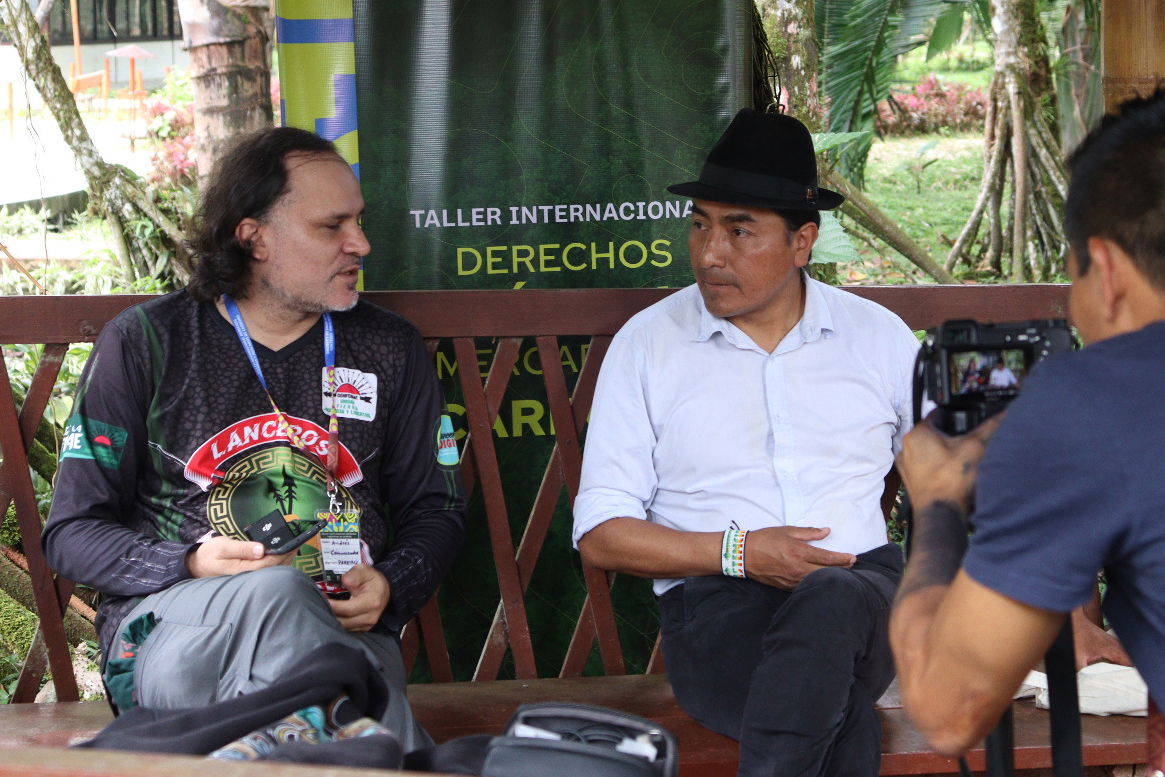
Dread quickly gave way to anger. Tapia, a member of the Indigenous Kichwa community and former communications director for the Confederation of Indigenous Nationalities of the Ecuadorian Amazon, knew exactly what the message meant.
“Financial strangulation,” as he put it, is the latest weapon in the government’s escalating effort to clear the way for expanded mining and oil development in one of the world’s most biodiverse countries.
Months earlier, officials had temporarily frozen the accounts of several of Ecuador’s most prominent environmental defenders, including Tapia, citing investigations into “unjust private enrichment” and “financing terrorism.” When authorities failed to substantiate the allegations against him, a court lifted the freeze.
Even so, prosecutors continued to pursue the charges, and Tapia believes those pending accusations ultimately triggered Banco Pichincha’s internal compliance flags, leading to the permanent closure of his account in January. Tapia said he is one of at least 10 activists that Ecuador’s largest financial institution has “debanked,” a term used to describe the closing or denial of bank accounts absent any proven legal violations.
Tapia said he was able to withdraw what little money he had in his account, but the impacts on him and other affected environmental defenders have been paralyzing. Without access to banking services, they say it has become nearly impossible to receive donations, run their organizations, hire staff, pay taxes or sustain advocacy work.
Banco Pichincha, whose app is like the Ecuadorian equivalent of Venmo, did not respond to requests for comment on the account closures or the justification for terminating them.
Banking law experts say that financial institutions generally have broad discretion to choose their customers, particularly when complying with anti-money-laundering and counterterrorism rules. At the same time, those experts note that governments can exert influence over banks in ways that are rarely made public, creating a system in which customers may never learn why their accounts were terminated.
“When banks are told by a government to do or not do something, that’s generally between the bank and the government,” said Julie Andersen Hill, a banking regulation specialist and the dean at the University of Wyoming College of Law. Hill was speaking of debanking in general, not about the Ecuadorian situation specifically.
“There is no way for a customer to find out if it’s a situation where the government is potentially leaning on a bank in a way that has nothing to do with money laundering but has to do with other political ends,” Hill added.
Neither the Ecuadorian consulate or embassy in Washington, D.C., responded to requests for comment about the debanking of environmentalists.
Last fall, federal prosecutors in the country opened investigations into more than 60 environmental or Indigenous leaders and organizations, though Tapia said he believes that number has now grown to more than 100, based on conversations he’s had with other targeted individuals.
Patricio Meza Saltos, an Indigenous environmental activist from Ecuador’s Amazon region whose Banco Pichincha account was closed, sees the attempted prosecution of so many environmentalists and Indigenous leaders as evidence of a coordinated campaign to silence opposition to the government’s pro-extractive policies.
Many of the people being investigated or prosecuted, he said, “are directly involved in defending water, life, collective memory and food sovereignty.”
Among them is Nayra Chalán, former vice president of the Confederation of the Kichwa Nationality of Ecuador. Chalán lives near one of Ecuador’s most critical “water mountains,” a high-altitude wetland known as the Fierro Urco páramo. Her work has focused on educating locals about mining impacts.
She discovered that a freeze was placed on her Banco Pichincha account in mid-September. Eight days later, federal organized crime prosecutors notified her that she was the subject of a preliminary investigation into “unjustified private enrichment.” While the initial freeze was eventually lifted, the investigation remains open. In February, Banco Pinchincha permanently deactivated her account, citing its “right to freedom of contract.”
“Financial harassment and criminalization have limited my ability to do my job,” Chalán said in Spanish. Like Tapia, she relied on the account to receive payments for consultancy and contract work.
“Organizations prefer to hire people who do not have legal proceedings against them,” she added.
Other activists facing similar investigations also said the unproven claims have stigmatized them and the organizations they represent, prompting donors—including those in the United States—to pull back. With anti-money-laundering and counterterrorism laws embedded in financial systems around the world, international transfers linked to individuals under investigation can trigger scrutiny or automatic freezes, regardless of whether the accusations hold up in court.
“They are successfully cutting off international funds to organizations that were defending areas the government wants to open to mining and oil,” Tapia said.
Human rights experts say attacking activists financially can have a pervasive chilling effect—people will censor themselves to prevent being targeted. Environmental activist José Cueva said he learned his Banco Pinchincha account had been permanently closed on Friday—three days after he posted a widely circulated video on social media expressing solidarity with environmental defenders who had been debanked.
Cueva, who is also being investigated for “unjust private enrichment,” said the bank acted unilaterally in closing his account, as it did when closing the accounts of Tapia, Chalán and Meza Saltos.
While debanking affects individuals across the political spectrum, its impact on environmentalists represents a new frontier in state repression, allowing officials to isolate, stigmatize and ultimately incapacitate green groups. What’s happening in Ecuador comes as an increasing number of leaders—from the United States, to China and Hungary—label nonprofit groups and environmentalists as radicals or terrorists.
Tapia said the tactics he sees in Ecuador echo trends unfolding in the United States, such as government monitoring of immigrant-rights activists. Whether Ecuadorian President Daniel Noboa is drawing inspiration from President Donald Trump or vice versa, he said, the erosion of civil liberties follows a familiar script.
“It’s public knowledge that Ecuador’s president is a Trump fan—and that there’s a shared playbook being used by them both,” Tapia said.
He also pointed to an announcement by the climate group Extinction Rebellion, which said it was under federal investigation in the United States.
“A lot of people may think this won’t touch them, that it’s happening to someone else,” Tapia said. “But it’s spreading around the world and anyone could be next.”
The stakes for environmental defenders in the Global South are intensifying as more wealthy countries seek out critical minerals and metals to fuel their militaries, data centers and energy transitions. In February, the United States signed agreements on critical minerals with several countries, including Ecuador.
Many of the Ecuadorians affected by account freezes and cancellations carry out territorial defense, helping Indigenous and rural communities monitor their lands for illegal logging, mining and other incursions—work that depends on money for practical expenses such as fuel, drones and cell phone plans. Other affected people focus on legal education in remote areas where the state’s presence is limited, ensuring communities can make informed decisions about their futures rather than accept extractive projects out of economic desperation.
“A lot of people may think this won’t touch them, that it’s happening to someone else. But it’s spreading around the world and anyone could be next.”
— Andrés Tapia
“Communities in need of money or services are incentivized to cooperate with extractive industries that supply basic goods, wages or services,” said Angélica María Bernal, a political scientist at the University of Massachusetts Amherst who has conducted extensive fieldwork in Ecuador.
Meza Saltos said the financial and legal pressures have sown fear and uncertainty, weakening the country’s formidable social, Indigenous and environmental movements.
“We are defenseless,” he said, speaking about groups who have lost access to banking.
For Tapia, the toll is also deeply personal.
A trained biologist, he supplemented his income with consulting work. That has largely dried up: Without a bank account, he cannot receive payments from the institutions that previously hired him. He has resorted to carrying cash, a workaround that is more complicated than it sounds. Amid the security crisis, many businesses no longer keep significant cash on hand. Routine purchases may be impossible without exact change.
“I have a wife and children—two young children,” Tapia said. “They ask me what’s wrong, if they can do something—it’s very emotional.”
Environmental Imagination
Ecuador is one of the most biologically diverse places on Earth, a Nebraska-sized nation that holds more tree species per square mile than the entirety of North America. Straddling the equator, it stretches across three distinct worlds: the Galápagos archipelago and coastal lowlands to the west, the snowcapped Andes at its spine and the upper Amazon basin to the east.
Its misty cloud forests, montane wetlands, marine ecosystems and lowland jungles house a staggering share of global life: about 5 percent of Earth’s reptiles, 8 percent of its amphibians and mammals and 16 percent of its birds—while species new to science continue to be discovered there.
That ecological complexity is mirrored by its cultural richness. A self-described “plurinational” state, Ecuador is home to 1.3 million Indigenous people, including groups living in voluntary isolation from the outside world. That Indigenous heritage includes at least a dozen distinct languages, along with unique territorial traditions, spiritual cosmologies and forms of self-governance.
In 2008, these communities and allied groups pioneered a world-changing idea, successfully pushing the government to recognize the rights of nature in the constitution, alongside mechanisms for popular referendums and a reaffirmation of Indigenous peoples’ right to be consulted on any project affecting their territories.
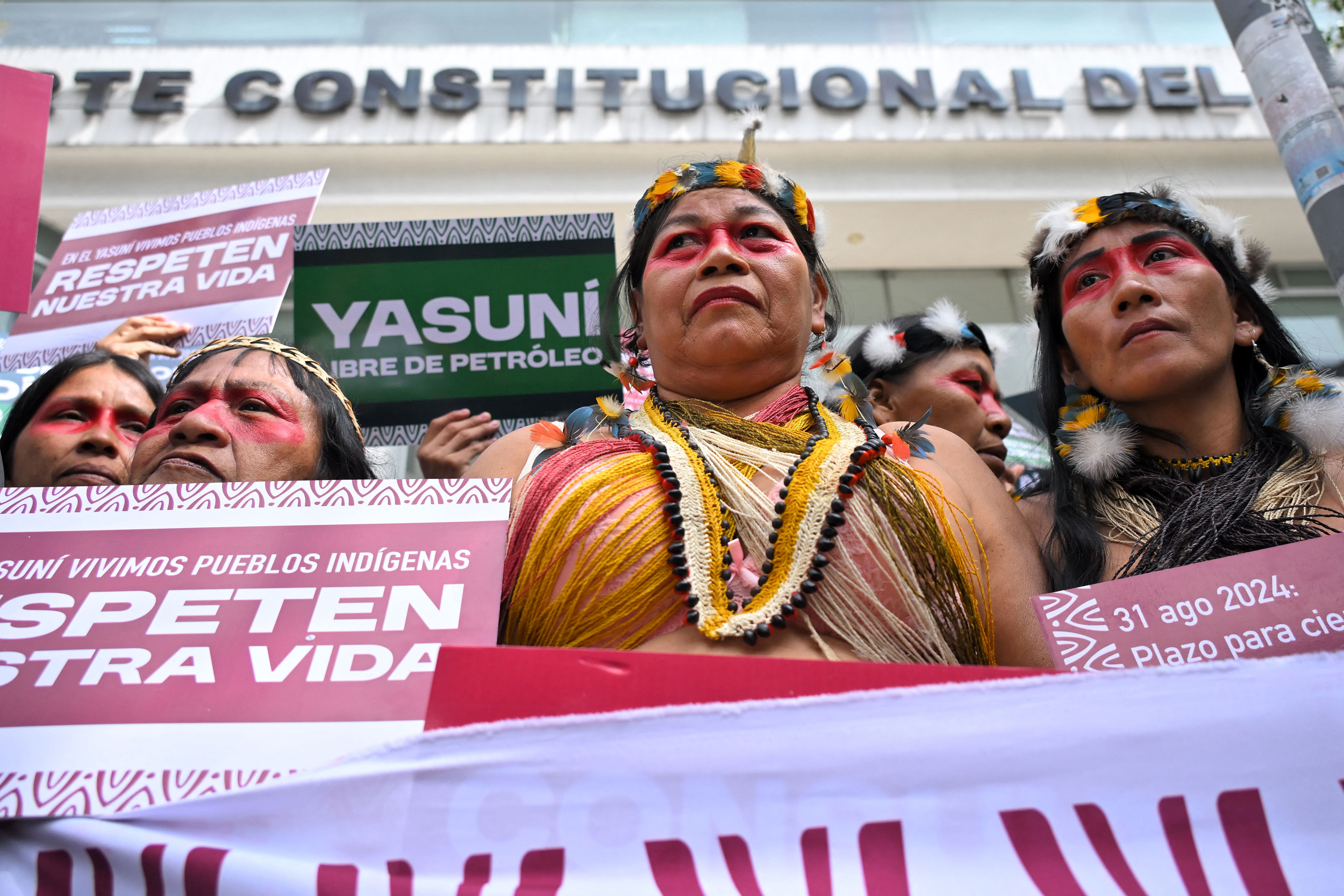
Since then, grassroots groups have drawn on those legal tools to rack up historic wins. Frogs have defeated an industrial mining company in court. The multi-trillion-dollar oil industry has lost out on new concessions because the government didn’t properly consult the Indigenous people whose lands hold the crude. And when Ecuadorians held a referendum on whether they wanted to end oil operations in an especially sensitive part of the rainforest known as the Yasuní ITT fields, the vast majority of voters said yes.
But winning in court and at the ballot box hasn’t been enough.
The Ecuadorian government has often failed to comply with court rulings and the will of voters, such as the 2023 Yasuní ITT referendum. Oil continues to flow from those fields and the government is doubling down on an economic model based on extraction for export.
The impacts of that model fall largely on Indigenous and rural communities. The people pushing back have faced repressive tactics across political regimes, not only that of the current president. Under leftist Rafael Correa, activists were branded “infantile environmentalists” and charged with sabotage or terrorism for blocking roads to protest oil pollution.
But Ecuadorian civil society groups and international experts say the work of land defenders in the country has entered its most perilous era yet. The government has used military force to suppress protests, at times with deadly consequences. Environmental defenders have been killed under other circumstances, too, such as when Indigenous A’i Cofán leader and oil opponent Eduardo Mendúa, 40, was gunned down in his garden at point-blank range in 2023.
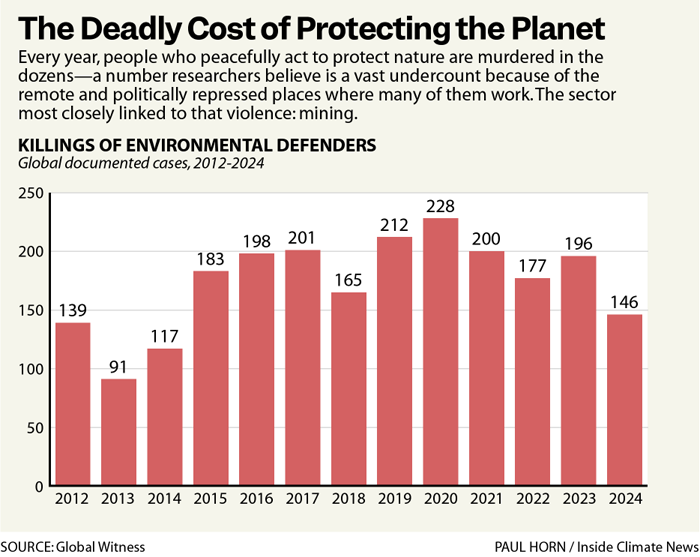
The global rush for “critical minerals” has helped trigger a surge of state-led lawfare—the strategic wielding of the law to paralyze dissent and weaken environmental protections. And for rural defenders, a new front has emerged as the armed criminal groups flooding into the country illegally mine throughout the Amazon, poisoning Indigenous territories with mercury and turning pristine ecosystems into scarred industrial zones.
“Indigenous people are caught in the middle of a weak state that’s losing control and narco-groups that are taking over,” said Bernal, the professor at the University of Massachusetts.
Ecuadorian officials have attempted to link defenders to the very narco-traffickers threatening them, Bernal said. The bank account freezes and pending prosecutions and investigations are carried out through laws passed last year that the government says will address that trafficking.
Last week, the United States and Ecuador began joint military operations to target what the Pentagon said are “designated terrorist organizations” in Ecuador, an expansion of the U.S. military’s presence on the continent under Trump. On Friday, the U.S. and Ecuador bombed alleged drug traffickers’ training camps near the border with Colombia in what officials called operation “Total Extermination.”
“The operations are a powerful example of the commitment of partners in Latin America and the Caribbean to combat the scourge of narco-terrorism,” the Pentagon’s U.S. Southern Command said in a social media post last week about the new Ecuadorian operations.
Since Trump regained office, his administration has invaded Venezuela and carried out lethal strikes against alleged drug vessels in the Caribbean and Eastern Pacific, killing at least 151 people. Human rights experts have said the strikes are extrajudicial killings and that some of the victims were small fishing vessels wrongly labeled as “narco-terrorists.”
This story is funded by readers like you.
Our nonprofit newsroom provides award-winning climate coverage free of charge and advertising. We rely on donations from readers like you to keep going. Please donate now to support our work.
Donate NowLast fall, Ecuadorians voted down a referendum question posed by the Noboa administration to allow foreign military bases in the country. Prior to the vote, the then-head of the U.S. Department of Homeland Security visited officials in Ecuador’s capital.
Human rights organizations have called on the Ecuadorian government to ensure investigations into alleged terrorism financing are based on credible evidence. Tapia and other targeted environmentalists fiercely deny any wrongdoing and say the allegations are politically motivated.
“Being labeled in this way is horrific,” Tapia said. It’s a smear that doesn’t just threaten his freedom, he said, but also his life.
Many of those targeted blame one man.
The Unshackling of Industry
As Tapia and other environmentalists watched Noboa rise to power in 2023 amid spiraling cartel violence and mounting national debt, they sensed what might be coming.
Noboa, heir to a banana-exporting fortune, sees mining and oil expansion as central to his economic and security agenda, often framing environmental opposition as an obstacle to national recovery.
Advancing that vision requires large-scale foreign capital. Noboa quickly turned to international investors to secure it.
Soon after taking office, he became the first head of state to attend Canada’s annual Prospectors & Developers Association convention—widely dubbed the “Super Bowl of mining”—where he touted Ecuador’s mineral reserves and secured billions of dollars in prospective investment commitments. His administration then opened negotiations with Canada for a trade agreement to strengthen protections for foreign investors, including mining firms.
In February, Noboa traveled to Washington to join the White House’s Critical Minerals Summit, where he agreed to deepen cooperation on strategic mineral supply chains. Under Trump, American foreign policy has taken a transactional, extractive turn, prioritizing the control of foreign mineral deposits while gutting criticism of Indigenous rights abuses from the U.S. Department of State’s annual reports on global human rights.
Nearly half of mining operations in Ecuador’s Amazon are on Indigenous territories, according to the nonprofit Fundación EcoCiencia.
Neither the White House nor the U.S. Department of State responded to requests for comment on the critical minerals partnership or the crackdowns on Ecuadorian environmental defenders.
Like the Trump administration’s remaking of the U.S. government, Noboa has used legal and institutional changes to speed extraction. Last year, he eliminated the Environment Ministry, folding its responsibilities into the Ministry of Energy and Mines. In February, lawmakers approved revisions to Ecuador’s mining law designed to accelerate project approvals, modify environmental permitting for some projects and allow for more militarization in certain mining zones.
The Noboa administration has said the changes will help crack down on illegal mining and streamline lengthy bureaucratic processes. A spokesperson for Ecuador’s reconstituted Ministry of Environment and Energy added in a statement written in Spanish that the law would promote development, strengthen legal certainty, boost investment and help the economy “without compromising the health of ecosystems or current environmental standards.”
Opponents fear it will lead to more pollution and violations of Indigenous peoples’ right to be consulted about projects that impact them. Groups are preparing to challenge the law in court.
Chalán said she sees the new mining law, other environmental rollbacks and the targeting of environmental advocates as part of the same effort to open Indigenous territories to multinational corporations.
“Criminalization, media stigmatization, financial harassment and espionage are a clear strategy to go after defenders of nature” and to expand mining, Chalán said.
The potential for increased military force around mining operations deeply worries Bernal, the professor at the University of Massachusetts. She knows what can happen, given the recurring sequence of events across Ecuador in recent years.
Communities see companies or contractors arriving to carry out early prospecting work—sometimes with heavy machinery—before public notice is given or formal approvals are in place, she said.
Protests erupt. Then police or the military are sent in. Activists are criminally charged by the government, using vague laws like “disrupting public services.” At times, protesters have been forcibly disappeared to military sites without due process.
Now, Indigenous groups and environmentalists fear the new mining law will make defending nature even more perilous. Meza Saltos said many projects in the government’s pipeline overlap with critical water sources, including rivers and high-altitude wetlands that supply drinking water to millions.
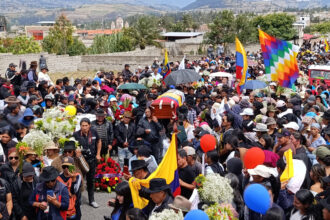
He pointed to the Kimsacocha ecosystem as one such example. Last fall, tens of thousands of Ecuadorians poured into the streets to protest a Canadian company’s planned gold mine in the high-altitude wetland. The project has been on hold, its environmental license revoked. Now, locals fear the project will be restarted.
“The law prioritizes extractive expansion over constitutional guarantees and collective rights,” Meza Saltos said of the new mining reforms.
He contrasted that vision with his organization’s own goals: advancing economic alternatives like agroforestry and ecotourism that sustain communities while safeguarding ecosystems.
“We promote a model that respects life,” he said.
As they fight to regain access to their accounts, Tapia and Meza Saltos are also defending themselves against the government’s claims of unjust personal enrichment and financing terrorism—a task that takes up an enormous amount of time.
In the process, Tapia has learned that the government used its new Intelligence Law to investigate him. That law creates an expansive intelligence-gathering system that, under certain circumstances, can circumvent constitutional rights and protections.
“They have been tracking us,” he said, though he doesn’t know the full extent of the surveillance.
For Tapia, the surveillance, prosecutions and loss of banking are all tools from the same workbox, intended to constrain dissent and the free flow of information.
Indeed, some banking law experts see curtailment of basic financial services as a systemic threat to democratic participation—particularly in places like Ecuador, where only a handful of banks exist. Getting rejected by your town’s sole bank isn’t just an inconvenience; it’s a dead end, making activists think twice before speaking out.
For Hill, transparency is a critical first step toward reform. In a forthcoming Texas A&M Law Review article, she argues that governments could adopt disclosure requirements similar to those enacted by the U.S. Congress to combat redlining—the discriminatory practice of denying mortgages in minority neighborhoods. Lawmakers required banks to provide specific reasons for a denial, such as a low credit score or a poor appraisal. That allows customers to verify if the reason is legitimate or a pretext for discrimination.
Support for such a law could come from an unlikely place: Trump, who has claimed he was wrongly debanked by JPMorgan Chase after the institution cut ties in the wake of the Jan. 6 attacks on the U.S. Capitol. He and the Trump organization are suing JPMorgan for $5 billion.
About This Story
Perhaps you noticed: This story, like all the news we publish, is free to read. That’s because Inside Climate News is a 501c3 nonprofit organization. We do not charge a subscription fee, lock our news behind a paywall, or clutter our website with ads. We make our news on climate and the environment freely available to you and anyone who wants it.
That’s not all. We also share our news for free with scores of other media organizations around the country. Many of them can’t afford to do environmental journalism of their own. We’ve built bureaus from coast to coast to report local stories, collaborate with local newsrooms and co-publish articles so that this vital work is shared as widely as possible.
Two of us launched ICN in 2007. Six years later we earned a Pulitzer Prize for National Reporting, and now we run the oldest and largest dedicated climate newsroom in the nation. We tell the story in all its complexity. We hold polluters accountable. We expose environmental injustice. We debunk misinformation. We scrutinize solutions and inspire action.
Donations from readers like you fund every aspect of what we do. If you don’t already, will you support our ongoing work, our reporting on the biggest crisis facing our planet, and help us reach even more readers in more places?
Please take a moment to make a tax-deductible donation. Every one of them makes a difference.
Thank you,