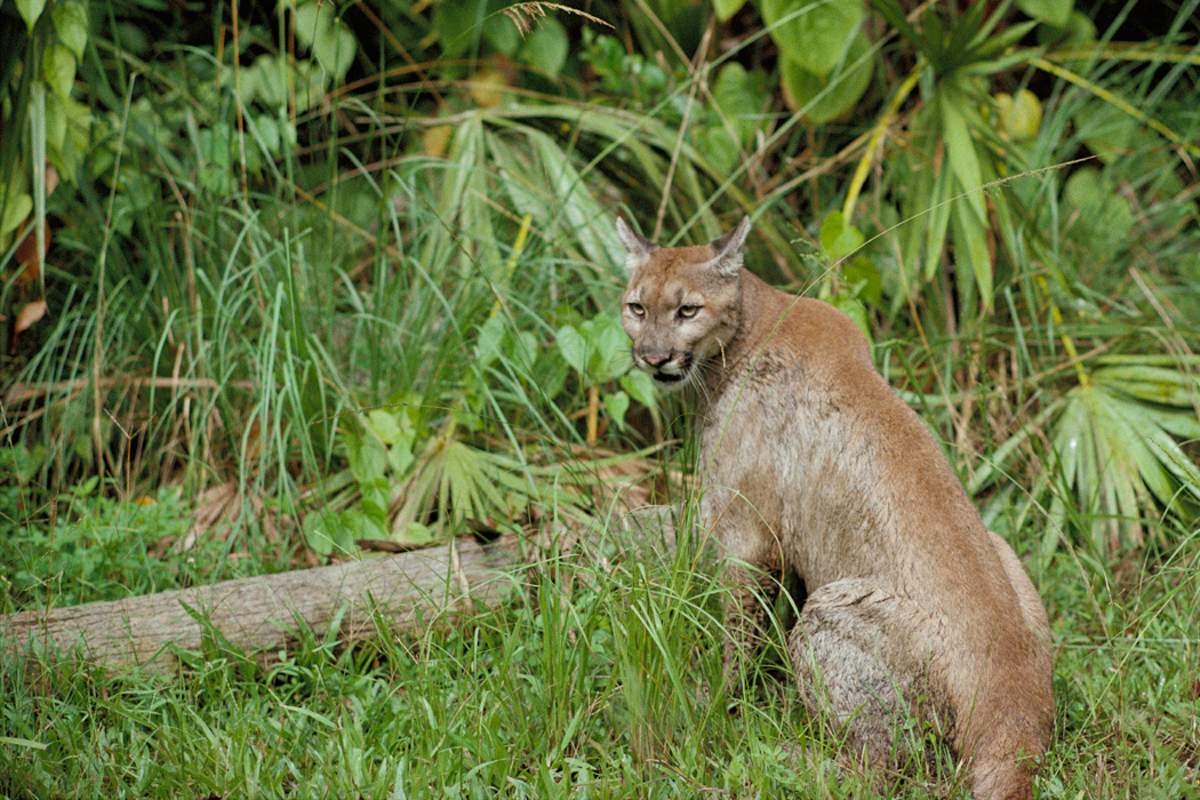


The honey-colored Florida panther inhabits the southwest corner of the state, mostly occupying a remote swath of cypress swamps, sawgrass prairies and other natural and agricultural lands that constitute less than 5 percent of the large feline’s historic range.
Recent research indicates the panther’s population has dwindled over the last decade to a mere 120 to 230 individuals and may be in jeopardy.
Much of the land the panther occupies is protected as part of the Everglades, a vast watershed that is responsible for the drinking water of millions of Floridians. As the state’s explosive growth and development continue to pressure the panther’s habitat, there is another gathering threat. Tides in South Florida are projected to rise by as much as a half-meter by 2040 and a full meter by 2070, according to the U.S. Fish and Wildlife Service (FWS). Just a half-meter of sea level rise would result in the loss of 973 kilometers or 11 percent of panther habitat.
Now, a new development is planned in the heart of the panther’s range. Called the Rural Lands West Project, the mixed-use residential and commercial development will involve 10,300 acres near the Florida Panther National Wildlife Refuge, established in 1989 to preserve the species. Nearly 5,000 acres of panther habitat will be destroyed, according to three conservation groups that joined in January to notify the FWS, the U.S. Army Corps of Engineers and Tarpon Blue Silver King I, LLC, the entity behind the project, of their intent to sue later this month in federal court over the development. The conservation groups characterize the project as an existential threat to the panther and say the federal agencies violated the Endangered Species Act by authorizing the development.
“What’s happening is this phenomenon of death by a thousand cuts,” said Jason Totoiu, Florida policy director and a senior attorney at the Center for Biological Diversity, one of the groups involved in the notice of intent to sue. “What we’re really gravely concerned about is that one day, whether or not it’s this project or the next project or five projects from now, it’s determined that the species has no way out of that region to recover on its own. And now we’re talking about an enormous expenditure of public money and time and resources to undo this harm and try to intervene and build that population up again, which could have all been avoided had enough habitat been properly preserved.”
At the heart of the conservation groups’ intent to sue is a biological opinion the FWS produced in early 2025 under the Endangered Species Act. The document authorized the Army Corps to issue a permit for the Rural Lands West Project, enabling construction to begin. It determined the project’s impact on the panther’s habitat would be minimal in the short term, but acknowledged there could be problems in the long run if development continues. The biological opinion said the FWS would monitor habitat loss and encouraged the developer to make plans to mitigate the project’s effects on the panther.
“The Service notes that many thousands of acres of panther habitat remain in Florida,” the document said. “Therefore, we do not expect this minor loss of habitat resulting from the project to substantially affect the range-wide population size of this species.”
The FWS declined to comment on this story, citing the pending litigation.
The Army Corps also declined to comment because of the pending litigation, but in January celebrated the completion of an Everglades restoration project that, among other things, will enhance panther habitat. The Picayune Strand Restoration Project is aimed at reviving wetlands and improving water quality in a 55,000-acre area in southwest Florida between Alligator Alley and the Tamiami Trail. The 22-year effort involved removing 260 miles of roads and plugging 48 miles of canals. Tarpon Blue Silver King did not respond to multiple requests for comment.
Even after the panther was listed as endangered in 1967, the animal’s status remained dire. It is the most endangered of Florida’s symbols, which also include the American alligator (state reptile), manatee (state marine mammal) and orange blossom (state flower). In the 1990s, as few as 20 to 30 panthers were left in the wild when eight female panthers were brought in from Texas and released in Florida in hopes of enhancing genetic diversity.
The effort helped boost the population. As the panther’s situation has deteriorated in recent years, another such intervention may be necessary. The last annual count was conducted in 2015 and has since been discontinued because of budget cuts, but research suggests the population peaked in 2016 and declined through 2020, according to the conservation groups’ notice of intent to sue. The FWS recognizes the Florida panther as a subspecies of the puma.
“This is the panther’s last stand,” said Matthew Schwartz, executive director of the South Florida Wildlands Association, another group involved in the notice of intent to sue. “It’s not just about this project. It’s challenging the way the Fish and Wildlife Service greenlights one development after another in panther habitat in general.”
He added: “I don’t see a future for the panther if we fail here.”
“Almost Like This Air of Giving Up”
The FWS is the primary federal agency charged with implementing the Endangered Species Act for freshwater and land species.
Like most other federal agencies, the FWS has undergone substantial staff reductions since President Donald Trump returned to office. Between January 2025 and January 2026, the number of employees at the agency declined by 26 percent, to 6,501 individuals, according to an Inside Climate News analysis of federal workforce data released by the Office of Personnel Management. In Florida, the size of the staff decreased by 26 percent, to 245 individuals. By comparison, the federal government as a whole lost 12 percent of its workers over this period.
Even before the past year’s cuts, the FWS was short-staffed, said Noah Greenwald, endangered species co-director at the Center of Biological Diversity, which conducted its own analysis on the reductions based on data obtained through a Freedom of Information Act request. To illustrate his point, Greenwald cited a backlog of more than 400 species awaiting final agency decisions on protection proposals under the Endangered Species Act.
“I’ve been doing this almost 30 years, and I’ve seen a lot of changes,” he said. “What we have now, though, is just totally unprecedented. Not only are they anti-regulatory. They’re just trying to stifle science and shut the agencies down, and this letting go of staff is definitely a part of that.”
This story is funded by readers like you.
Our nonprofit newsroom provides award-winning climate coverage free of charge and advertising. We rely on donations from readers like you to keep going. Please donate now to support our work.
Donate NowThe Trump administration has sought to roll back a gamut of environmental regulations and programs in his second term. Most notably for the panther, his administration has proposed rescinding nearly all habitat protections for endangered species. The proposal would redefine what it means to “take” a plant or animal under the Endangered Species Act to exclude harms caused by individuals, government agencies or corporations that involve habitat modifications or degradation. Under the Endangered Species Act, the word “take” is used in reference to species deaths.
“They are, I think, so overworked and understaffed right now. It is a real barebones operation, and I think it is by design,” Totoiu said of the FWS. “It’s almost like this air of giving up. And they’re charged under the Endangered Species Act to do more, but if they’re so underfunded and understaffed, they can only do so much. And if they’re hearing it from the top not to really do more, then what is left? I guess it’s us with our panther [license] plates and our donations to charitable causes and ranchers who want to see their ranches go on to the next generation. I guess it’s up to us at that point, but the law requires more. Congress intended for it to be a lot more.”
The Wide-Ranging Panther and its Diminishing Range
Some 3,000 panthers once roamed throughout the southeastern U.S. The Florida panther represents the last remaining puma population east of the Mississippi River. The animal can grow to be as long as six feet and is, by nature, elusive and wide-ranging. Males can claim territories as vast as 200 square miles and fight other males to the death when territories collide.
The panther’s survival depends on its ability to expand its range, which is currently bounded on all sides: by the Gulf of Mexico to the east; the Caloosahatchee River to the north; the sprawl of West Palm Beach, Fort Lauderdale and Miami to the west; and Florida Bay to the south. The animal’s best hope is accessing a network of natural lands that extend north up the state’s spine, called the Florida Wildlife Corridor, but that involves swimming across the Caloosahatchee, which few panthers have done.
For the population to be considered recovered and the panther to be delisted under the Endangered Species Act, certain criteria must be met. There must be three separate breeding subpopulations of at least 240, with animals intermingling among the subpopulations to maintain genetic diversity. There must also be enough habitat to sustain the subpopulations.
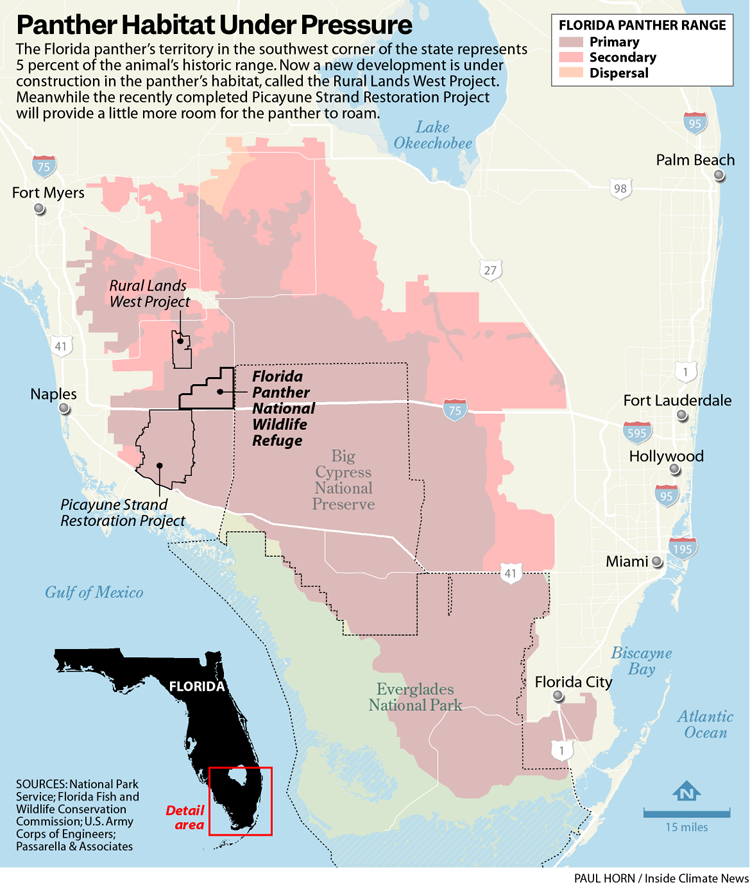
For now, the panther remains confined to a single breeding population. When the FWS issued a recovery plan in 2008, it cited habitat as a major concern and said there was not enough land available to sustain the species. Since then, more than 30,000 acres of the animal’s range have been developed, the conservation groups said in their notice of intent to sue.
Construction on the Rural Lands West Project, which will be situated on the edge of the Everglades in southwest Florida, is already underway. Half of the development’s footprint will involve agricultural lands. As part of the project, the remaining lands will be placed under a perpetual conservation easement and restored, with workers removing non-native vegetation and planting trees and ground cover to support the local wildlife, according to the biological opinion. The workers will also make hydrological improvements and establish 10 acres of marsh to enhance water flow through the area’s wetlands. The natural areas will be structured to allow panthers and other wildlife to pass through the development. The project will take 15 to 20 years to complete.
“It looks like the Florida suburbs,” Schwartz said. “It’s going to be lots of cars. It’s going to be shopping centers and pockets of undeveloped land surrounding this new development in patches, but it’s not going to be the unbroken contiguous habitat that panthers require. It’s going to be a suburban landscape, which is not compatible with panthers.”
The biological opinion assessed the development’s potential impacts on five listed species: the panther, the Audubon’s crested caracara, the eastern indigo snake, the Florida bonneted bat and the tricolored bat, which is currently proposed to be listed as endangered.
While the biological opinion recognized the threat that southwest Florida’s booming growth and development pose to the panther, the document said the habitat loss associated with the Rural Lands West Project will be minimal compared with the lands still available to the animal. The document said the project’s restoration efforts will offset the developed acreage. “In the absence of the Project and the conservation measures included, this area would likely be divided into smaller isolated projects that may not require Service review,” according to the document.
The biological opinion also acknowledged the panther’s vulnerability to climate change and sea level rise, but asserted that “it is difficult to estimate, with any degree of precision, which species will be affected by climate change or exactly how they will be affected.” The document concluded that the Rural Lands West Project is not likely to jeopardize the panther.
The conservation groups characterize the biological opinion as scientifically unsound. They say the document failed to adequately assess how the Rural Lands West Project could harm the panther’s recovery, whether the population is already in jeopardy and whether the development could push the species past a point where recovery is possible. The groups argue that the federal agencies violated the Endangered Species Act by authorizing the project because research shows the panther is in jeopardy, which means the FWS is prohibited from signing off on any action that would cause further harm.
The groups want the FWS to prepare another biological opinion and Collier Enterprises to abandon the project, consider a smaller footprint or delay the work until another biological opinion is completed. Tarpon Blue Silver King is a real estate, land management and insurance investment company associated with the influential Collier family in southwest Florida, for whom Collier County is named.
“It’s so lacking in scientific rigor. And I will say I myself am not a scientist, but they just completely ignore the scientific data, and there’s just study after study and just critical pieces of information that weren’t included in this,” Totoiu said. “It’s looking at each project in a vacuum rather than in the totality.”
Totoiu said the biological opinion is unclear about how panthers will use the natural lands set aside as part of the project. Much of the area will be interwoven with residential areas and roadways. “We don’t want panthers to use those areas,” he said. “Instead, we want them in these big contiguous unspoiled blocks of habitat away from people’s houses and away from roads.”
He hopes the FWS will conduct an assessment of how much more development the panther can withstand within its range in southwest Florida, and whether there is a tipping point. The true gravity of the panther’s situation is not well understood, he said.
“We just don’t know,” Totoiu said. “It’s the Fish and Wildlife Service’s responsibility to tell us.”
Peter Aldhous contributed to this report.
About This Story
Perhaps you noticed: This story, like all the news we publish, is free to read. That’s because Inside Climate News is a 501c3 nonprofit organization. We do not charge a subscription fee, lock our news behind a paywall, or clutter our website with ads. We make our news on climate and the environment freely available to you and anyone who wants it.
That’s not all. We also share our news for free with scores of other media organizations around the country. Many of them can’t afford to do environmental journalism of their own. We’ve built bureaus from coast to coast to report local stories, collaborate with local newsrooms and co-publish articles so that this vital work is shared as widely as possible.
Two of us launched ICN in 2007. Six years later we earned a Pulitzer Prize for National Reporting, and now we run the oldest and largest dedicated climate newsroom in the nation. We tell the story in all its complexity. We hold polluters accountable. We expose environmental injustice. We debunk misinformation. We scrutinize solutions and inspire action.
Donations from readers like you fund every aspect of what we do. If you don’t already, will you support our ongoing work, our reporting on the biggest crisis facing our planet, and help us reach even more readers in more places?
Please take a moment to make a tax-deductible donation. Every one of them makes a difference.
Thank you,

Amy Green
Reporter, Florida
Amy Green covers the environment and climate change from Orlando, Florida. She is a mid-career journalist and author whose extensive reporting on the Everglades is featured in the book MOVING WATER, published by Johns Hopkins University Press, and podcast DRAINED, available wherever you get your podcasts. Amy’s work has been recognized with many awards, including a prestigious Edward R. Murrow Award and Public Media Journalists Association award.