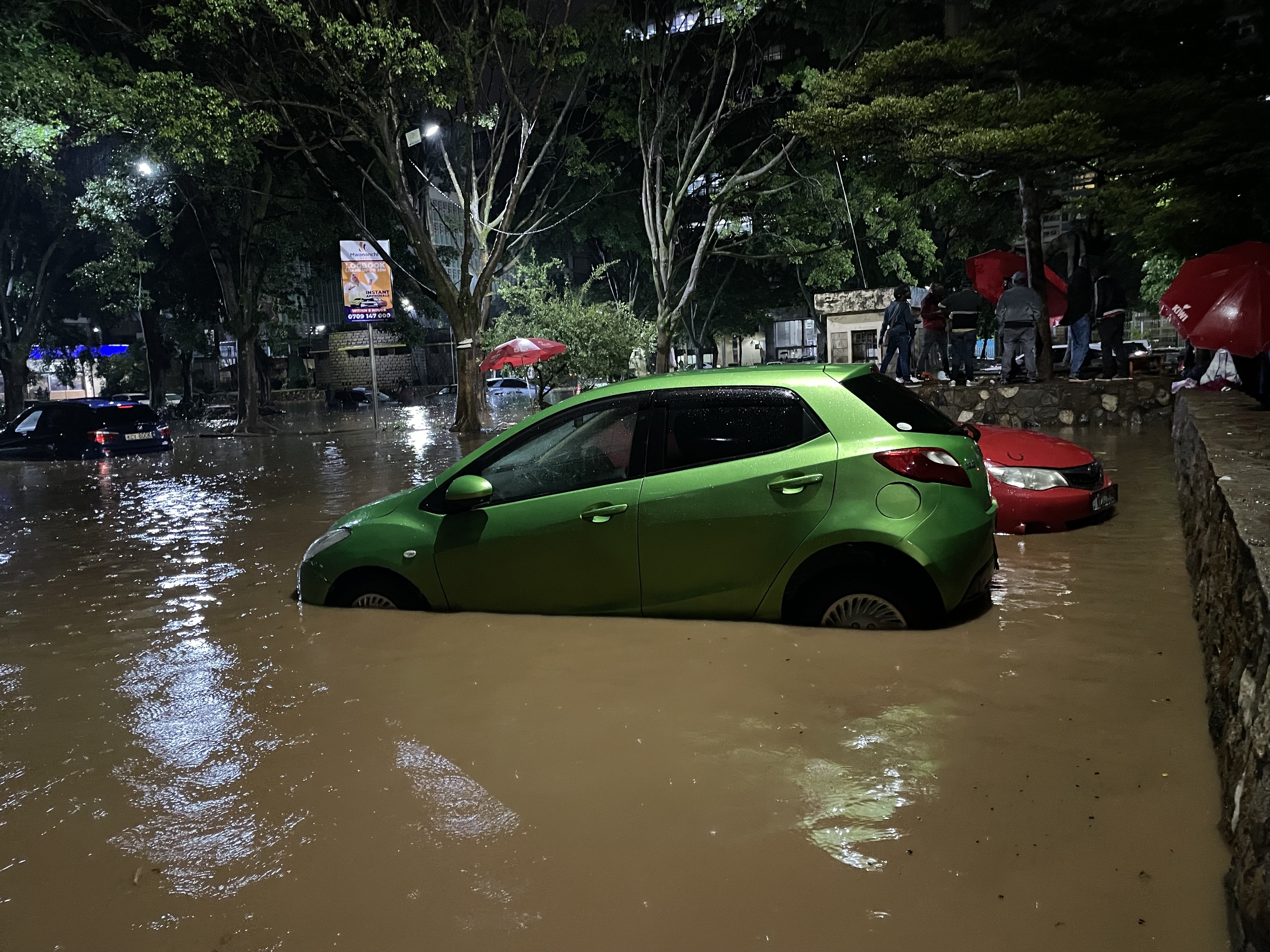


After months of intense drought conditions, Kenya was inundated by rain late last week, triggering severe flooding that killed more than 40 people. In the country’s capital city, Nairobi, a month’s worth of rain fell in 24 hours.
“The ongoing flooding in parts of Nairobi and several other areas of our country has caused immense distress to many families, resulting in the tragic loss of lives, displacement of residents, and damage to homes, property, and livelihoods,” Kenya’s president, William Samoei Ruto, said Saturday on X. “[W]e recognise that these floods once again highlight the urgent need for lasting solutions to the perennial challenge of flooding in our urban areas.”
Intense storms are fairly typical across the region from March to May. But research shows that global warming is causing “climate whiplash”—making droughts more severe and longer lasting, while fueling wetter storms. At the same time, cities across East Africa are developing rapidly, often in areas that expose communities to greater flooding.
Scientists are urging governments—in East Africa and beyond—to reconsider where and how they build to reduce their flood risk. Making cities “spongier” can help, they say.
Converging Extremes
East Africa has long been a hotspot for weather extremes. Due to the region’s proximity to the equator and changing tropical weather patterns, it has two distinct rainy seasons and two dry seasons. The floods that swept through Kenya last week fall within the typical period of “long rains” in this area.
But as temperatures warm, these seasons are becoming more unpredictable—and oftentimes more intense, scientists say.
From October 2020 to early 2023, East Africa experienced five consecutive “failed” rainy seasons, marking the worst drought in 40 years. A recent study assessing the 2021 to 2022 period found that high heat caused by anthropogenic climate change exacerbated the conditions, resulting in major crop and pasture losses and widespread water shortages.
Then, in March through May 2024, the skies opened in East Africa, with devastating consequences. A series of heavy rains and floods killed hundreds of people and displaced hundreds of thousands. Dams failed and rivers overflowed, drowning droves of livestock and destroying schools and health facilities. A 2024 rapid attribution study found that an event like this has become about twice as likely and 5 percent more intense in today’s climate, largely because warmer temperatures enable the sky to hold more moisture. (Scientists have not yet conducted an attribution study for the latest rains.)
“We see decline in rainfall in the season in general, but punctuated by very strong and intense rainfall,” said co-author Joyce Kimutai, a climate scientist at Imperial College London. These opposing weather extremes play off each other in dangerous ways, she added.
Droughts, including the one earlier this year, increase flooding risk because prolonged dry conditions reduce the soil’s ability to absorb rainwater. Meanwhile, floods and droughts require different response measures from governments, so it’s difficult for them “to move from one extreme of a response to the other one,” said Kimutai, who is currently in Nairobi.
“It’s very clear … that Nairobi is not prepared for these events,” she said.
Urbanization Issues
Hundreds of households were affected during last week’s flooding in Kenya, which experienced major losses of farmland and structures, Al Jazeera reports. Countries in East Africa are experiencing some of the world’s fastest urban growth rates.
In places such as Nairobi and the surrounding region, many structures have been built—often illegally—on low-lying or riparian areas, which are particularly susceptible to flash floods and river overflows.
“When you’re constructing all these new buildings on floodplains or on riparian land, you are … blocking the natural path of the river flow,” Hussam Mahmoud, a civil and environmental engineering expert at Vanderbilt University, told me. Further exacerbating the issue, governments often rip up ecosystems that absorb floodwater to build roads and sidewalks made with water-resistant materials such as concrete or asphalt.
“That in itself has a major impact because your ground is no longer able to absorb and contain the water, or heavy rain that comes down,” Mahmoud said. “Ultimately, the water has to go somewhere. It cannot seep through the ground, and it ends up … causing cities to flood.”
Kenya has worked to demolish buildings and homes in flood-prone areas, but residents have struggled to find new housing, The Associated Press reported in 2024. Though Nairobi has been upgrading its drainage systems, Mahmoud doubts countries in East Africa will be able to handle the extreme flood intensity fueled by climate change. Many major cities around the world, such as New York and London, are experiencing similar issues due to development.
Some urban hubs are turning back to nature to help adapt. For example, in Rwanda’s capital city of Kigali, officials have spent the last decade converting degraded swamps into functioning wetlands, which they hope will help absorb water and climate-warming carbon, Yale Environment 360 reports. Meanwhile, cities such as Philadelphia and Copenhagen have been restoring wetlands and fortifying drainage systems as part of a broader effort dubbed the “Sponge City” movement.
But climate change is largely outpacing these efforts, particularly in many areas of East Africa that lack the resources to make significant infrastructure updates in existing urban areas. And these approaches don’t address a major root cause of the intensifying weather extremes, Kimutai notes.
“We need to phase out fossil fuels, and I think that needs to happen like yesterday, because we know for sure that we can’t run away from this if we still continue pumping these warming-inducing gases in the atmosphere, which will continue to fuel these storms,” she said.
East African countries aren’t the ones driving those emissions, even as they suffer the consequences. Kimutai stressed that it is critical to provide post-disaster resources and support for impacted communities because “they are really at the front line of the crisis.”
More Top Climate News
After the U.S. and Israel launched strikes on Iran last week, oil prices shot up—reaching nearly $120 per barrel on Monday. Though prices have since fallen, this spike displays the oil market’s vulnerability to geopolitical issues, as my colleague Dan Gearino reported. Some experts say that diversifying energy sources with renewables can help buffer countries against future price spikes.
Weeks after entering office, President Donald Trump terminated a first-of-its-kind report on the state of U.S. land, water and wildlife, which more than 150 scientists were in the midst of compiling. Many of the researchers—most of whom were volunteers—decided to finish it anyway, and last week they released the final draft to the public for comment and scientific review, Catrin Einhorn reports for The New York Times. The findings paint a dark picture, with an estimated 34 percent of plant species and 40 percent of animal species at risk of extinction. However, the authors found that conservation and restoration can help avoid that fate if the country ramps up investment.
A new study found that as many as 132 million more people than previously estimated are in the path of rising seas as climate change accelerates, Lauren Sommer reports for NPR. The authors say this gap is likely because much of the previous research uses sea level metrics that are inches or even feet lower than they are currently, particularly in Southeast Asia. Sea levels have already risen around 9 inches globally since 1880.
Postcard From … Massachusetts
This week’s installment of “Postcards From” is courtesy of ICN’s founder and publisher, David Sassoon. He shared photos and thoughts from a series of beach walks throughout the year, capturing how the sea changes like the seasons.
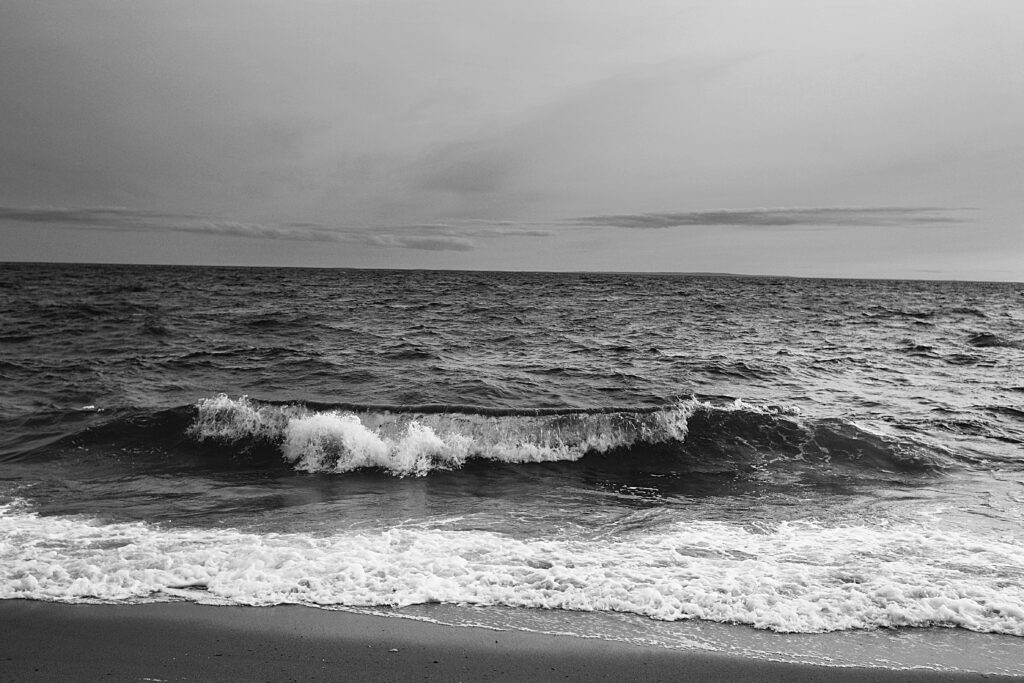
I went to Herring Cove in Provincetown, Massachusetts, one evening last spring as the sun was setting, thinking to make a portrait of a wave like one would make a portrait of a person, and like a person the ocean agreed to strike a pose.
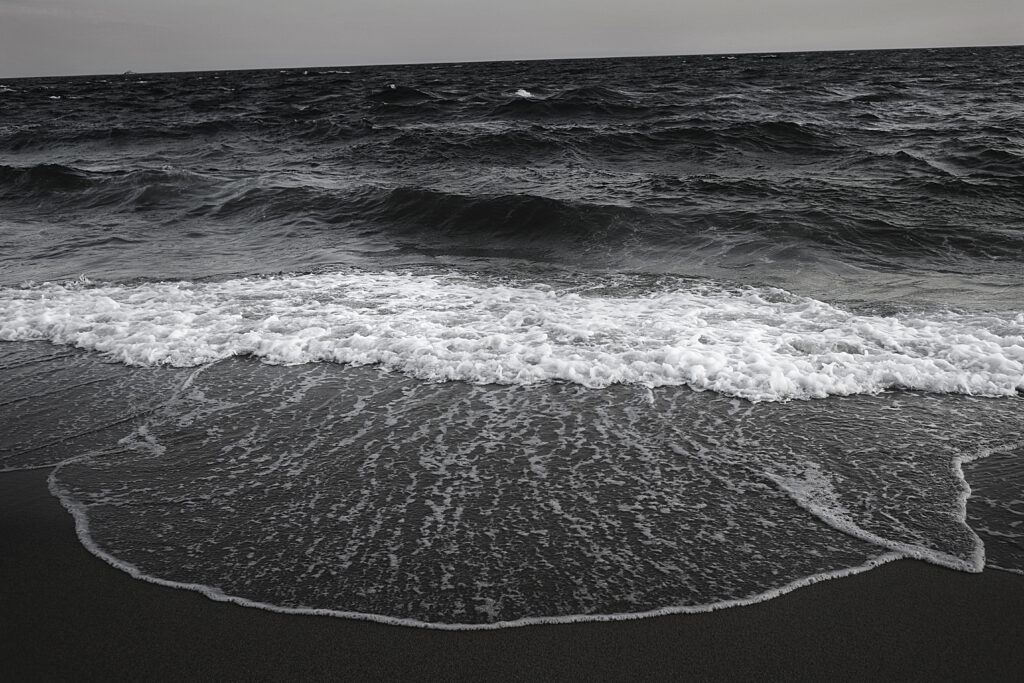
I returned the next evening and was given to see many more of its faces, each expression opening and vanishing, sounding the endless music of its waters. I didn’t know it at the time, but I had embarked on an exploration of the shorelines of the Outer Cape, this meeting place of sapiens and the sea.
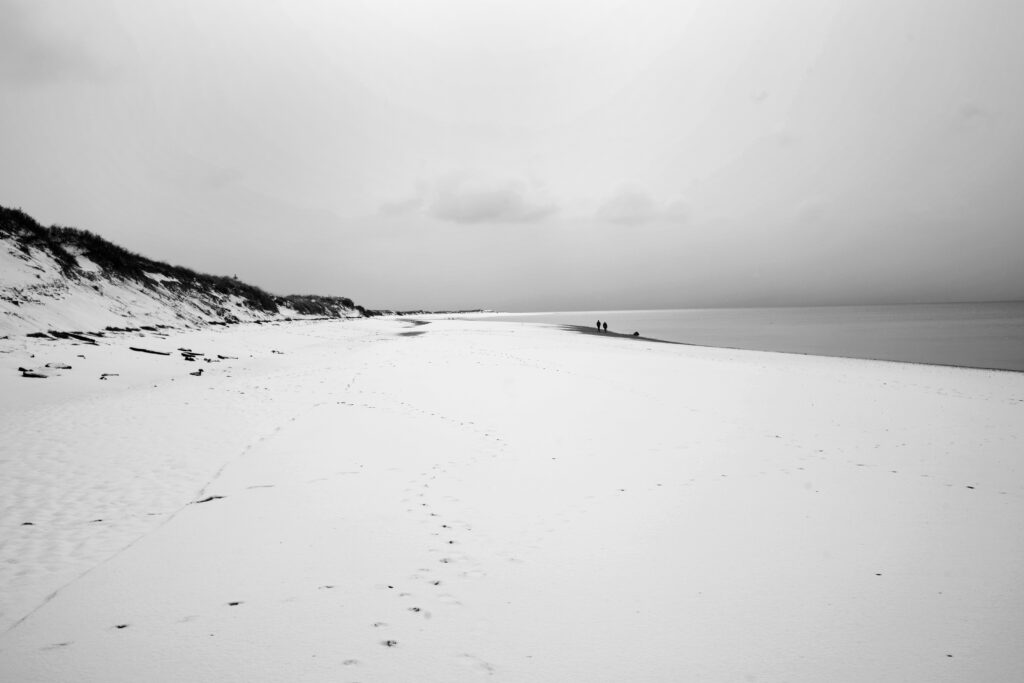
I took pictures in the summer and the fall, too, and have just returned from a winter visit. The shorelines were covered in a fresh blanket of snow, a rare sight on this sliver of land curling 50 miles out to sea. I scarcely imagined during the August heat that such frigid wind and ethereal beauty would come to capture this place, our species barely a footnote in the landscape.
About This Story
Perhaps you noticed: This story, like all the news we publish, is free to read. That’s because Inside Climate News is a 501c3 nonprofit organization. We do not charge a subscription fee, lock our news behind a paywall, or clutter our website with ads. We make our news on climate and the environment freely available to you and anyone who wants it.
That’s not all. We also share our news for free with scores of other media organizations around the country. Many of them can’t afford to do environmental journalism of their own. We’ve built bureaus from coast to coast to report local stories, collaborate with local newsrooms and co-publish articles so that this vital work is shared as widely as possible.
Two of us launched ICN in 2007. Six years later we earned a Pulitzer Prize for National Reporting, and now we run the oldest and largest dedicated climate newsroom in the nation. We tell the story in all its complexity. We hold polluters accountable. We expose environmental injustice. We debunk misinformation. We scrutinize solutions and inspire action.
Donations from readers like you fund every aspect of what we do. If you don’t already, will you support our ongoing work, our reporting on the biggest crisis facing our planet, and help us reach even more readers in more places?
Please take a moment to make a tax-deductible donation. Every one of them makes a difference.
Thank you,

Kiley Price
Reporter
Kiley Price is a reporter at Inside Climate News, with a particular interest in wildlife, ocean health, food systems and climate change. She writes ICN’s “Today’s Climate” newsletter, which covers the most pressing environmental news each week.
She earned her master’s degree in science journalism at New York University, and her bachelor’s degree in biology at Wake Forest University. Her work has appeared in National Geographic, Time, Scientific American and more. She is a former Pulitzer Reporting Fellow, during which she spent a month in Thailand covering the intersection between Buddhism and the country’s environmental movement.