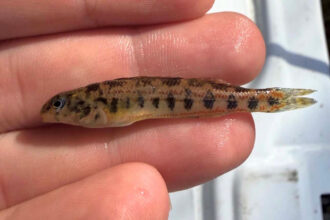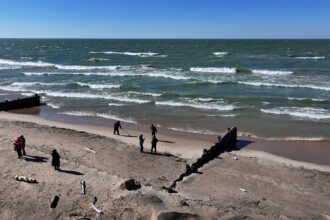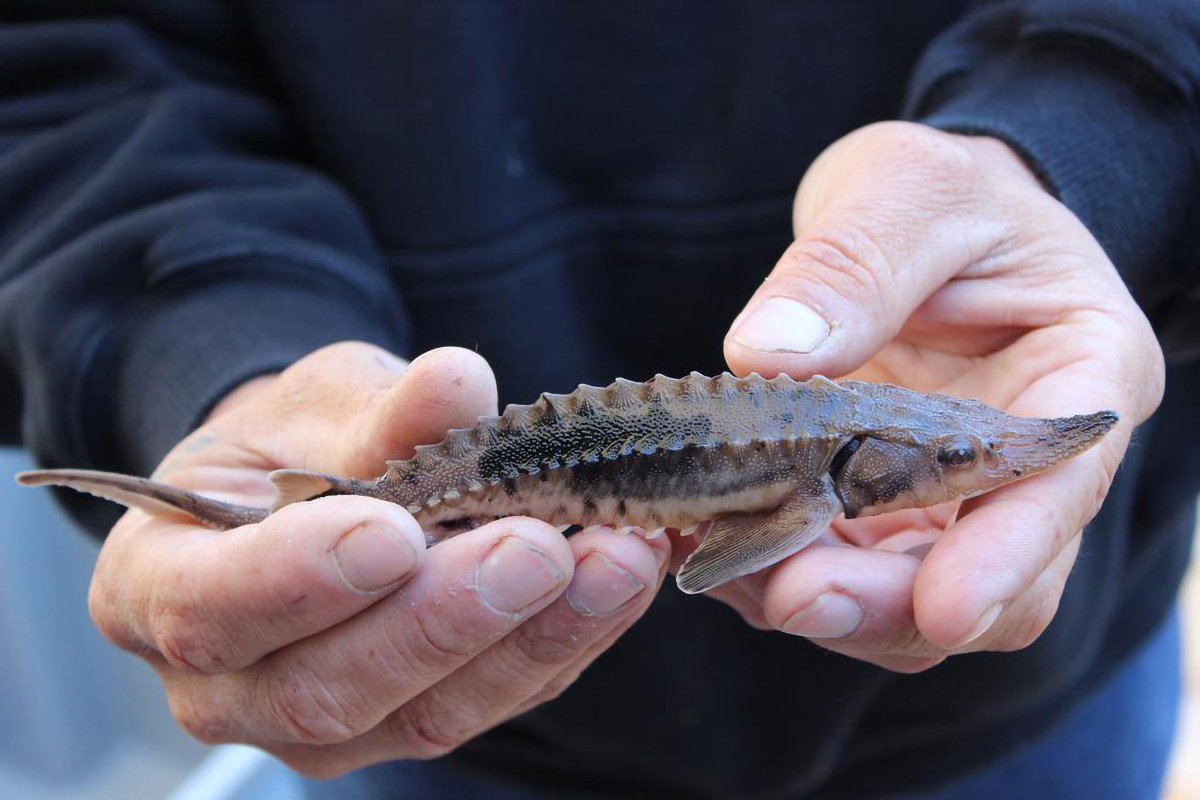


On a cool October morning, members of the St. Croix Chippewa Tribe gathered at the Clam Lake boat landing in northern Wisconsin, carrying five-gallon buckets of small, wriggling lake sturgeon. After a short prayer calling on their ancestors, they tipped the six-month-old fish—raised in the Tribe’s newly built hatchery—into the lake. It was the Tribe’s first sturgeon release and the latest chapter in one of North America’s great freshwater conservation success stories.
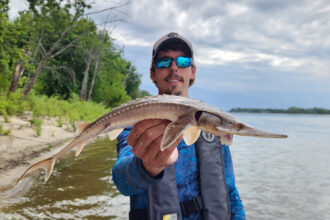
Lake sturgeon—ancient, torpedo-shaped fish armored with bony plates and a shark-like, asymmetric tail—can grow up to six feet in length and live for more than a century. They once ranged widely across the Great Lakes and Mississippi River basins. By the early 1900s, however, the species had been nearly wiped out, hammered by overfishing, pollution and dam-building. Wisconsin was one of the few places where they endured, especially in the Lake Winnebago watershed.
With firm protections, deep community involvement and volunteers guarding spawning fish each spring, Wisconsin rebuilt the Winnebago sturgeon and several other populations. Their offspring are now helping restore rivers from Milwaukee north to the Saint Louis, and supporting tribal-led projects like Clam Lake, evidence of the recovery spreading beyond its home waters.
Wisconsin has become virtually synonymous with the species’ survival. “The fact that we’ve got multiple locations throughout the state where you actually have a chance to harvest lake sturgeon sustainably is just incredible,” said Margaret Stadig, a fisheries biologist with the Wisconsin Department of Natural Resources.
But even a hardy, long-lived species like the lake sturgeon faces uncertainty. As winters warm and become less predictable in Wisconsin, ice cover shrinks and spring flows shift. Scientists don’t yet know how these changes will alter spawning cues, juvenile survival or the future of the spearing tradition that has anchored conservation for decades. The question is how, or even whether, a fish that has survived 150 million years can adapt fast enough to the pressures of climate change.
Older Than Dinosaurs
Sturgeon are among the most endangered groups of animals on Earth. Dating back more than 150 million years, they evolved with long lifespans, late maturity and infrequent spawning, traits that once helped them endure dramatic environmental shifts but now leave them vulnerable to overharvest, habitat loss and technological advancements such as dams.
Of the 27 recognized sturgeon species worldwide, most are threatened and several have already disappeared. In North America, Atlantic sturgeon are gone from many East Coast rivers, while pallid sturgeon in the Missouri River basin now rely on hatcheries. Lake sturgeon declined similarly, falling from once-abundant fish to only scattered remnant populations by the 1950s.
While most sturgeon species migrate between rivers and the ocean, lake sturgeon live entirely in freshwater. Females may not spawn until age 20 or 25, and then only every four to seven years. “Being a slow growing, slow-reproducing species [makes them] particularly vulnerable to” human pressures, said John Lyons, fish curator at the University of Wisconsin-Madison Zoological Museum.
Unlike other states where lake sturgeon populations collapsed, Wisconsin imposed early restrictions dating back to 1915: harvest limits, bans on commercial exploitation and science-based quotas that shut the fishery the moment thresholds were reached. Those safeguards remained in place for decades and laid the foundation for recovery.
The heart of that recovery is Lake Winnebago, a broad, windswept lake fed by the Fox and Wolf rivers. Each February, it becomes the stage for an unusual fishery: a winter spearing season carried out from wooden shanties on the ice. Spearers cut a square hole, sit in silence, and wait for a sturgeon to pass. If one big enough appears, they take it—and their season is over.
It’s a community tradition that dates back more than a century and is grounded in even older native practices. Far from threatening the species, it has become part of its protection. Families pass down shanties, spears and stories, creating a community of stewards as much as fishers. Stadig says the spearers have been essential to the sturgeon’s recovery. “They’re one of the most incredible groups I’ve ever met,” she said. “They know the science.”
Equally critical is the Sturgeon Guard program, launched in the 1970s to protect spawning fish during their vulnerable upriver migrations. Every spring, hundreds of volunteers line the riverbanks in rotating shifts, deterring poaching and alerting biologists when fish begin to spawn.
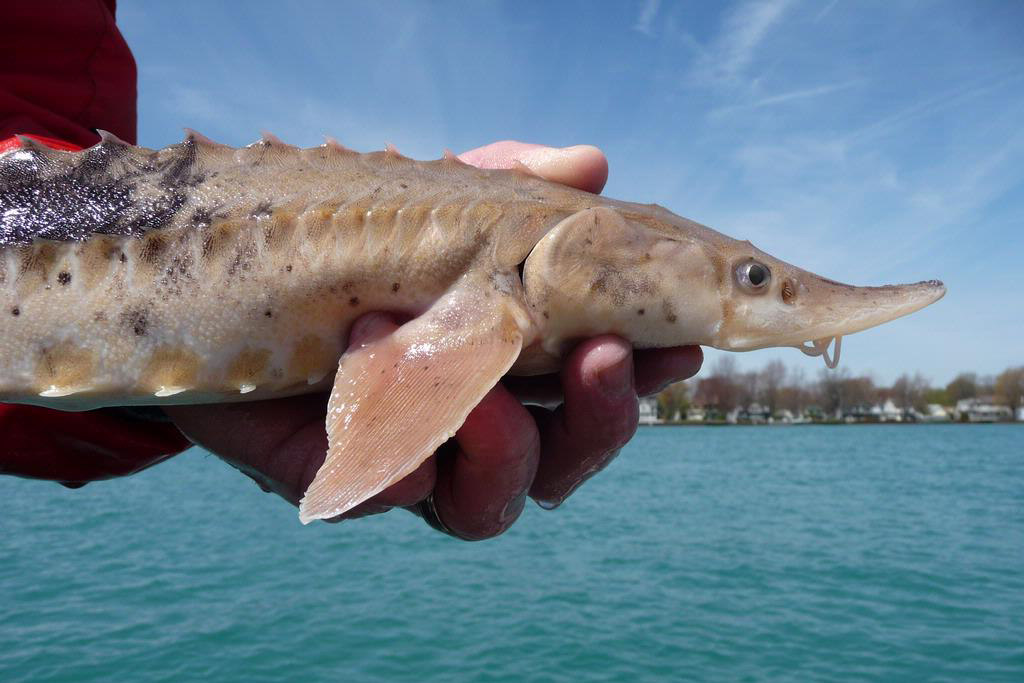
Over time, the effort has grown into a local spectacle: School groups, families and curious onlookers often gather to watch six-foot fish thrash in the shallows, turning stretches of the Wolf and Fox rivers into a living corridor of public guardianship.
“Public support is absolutely key in that this support is critical to get the public funding necessary to effectively manage a sturgeon resource,” said Ron Bruch, a retired sturgeon biologist with the Wisconsin Department of Natural Resources. “This support is much easier to develop and sustain if there is a fishery the public can participate in.”
The strength of Wisconsin’s lake sturgeon population has allowed the state to help rebuild the species elsewhere. Eggs taken from the Winnebago system now support restoration in the Milwaukee, Menominee and Saint Louis rivers, as well as reintroduction programs in Georgia, Tennessee and North Carolina. Many of these efforts are beginning to show encouraging signs, including the return of adult fish to waters where sturgeon had long been absent.
Knowledge Holders
For decades, the Menominee, located in the Winnebago basin, have been Wisconsin’s leading Tribal stewards of lake sturgeon. Their example is now being taken up by other Tribal Nations, including Ojibwe communities such as the St. Croix Chippewa, whose northwestern Wisconsin homelands once supported abundant fish. For many, restoring sturgeon is part of a broader revival of culturally important foods, from walleye to wild rice.
For the St. Croix Chippewa, the effort at Clam Lake marks a return to a fish with deep cultural meaning. Their reservation lands form a patchwork across the forested St. Croix watershed, an area known for wild rice lakes, marshes and slow-water rivers like the Clam, Yellow and St. Croix. These waters once supported the migrations of lake sturgeon, which Tribal Chairman Conrad St. John describes as “knowledge holders and knowledge passers.”
Restoring sturgeon, St. John says, is about reconnecting with what was lost. “For us, this is cultural,” he said.“It’s not just about putting fish in the water. We are the protectors of these resources and we’re really going to fight tooth and nail to maintain and preserve them.”
Until recently, the Tribe’s hatchery raised only walleye, a staple game fish across the Upper Midwest. But as interest in cultural restoration grew, and with a remnant sturgeon population still hanging on in the Clam River system, the Tribe expanded the facility, adding a modern recirculating aquaculture system capable of raising lake sturgeon indoors.
This story is funded by readers like you.
Our nonprofit newsroom provides award-winning climate coverage free of charge and advertising. We rely on donations from readers like you to keep going. Please donate now to support our work.
Donate NowThis spring, biologists collected eggs and sperm from spawning sturgeon in the nearby Yellow River, fertilizing them at the water’s edge before transporting the eggs to the hatchery. They hatched within a week. After two weeks absorbing their yolk sacs in fry tanks, the young fish began feeding, first on brine shrimp and then on bloodworms. By October, the young sturgeon had grown to six to eight inches and were ready for release.
Those fish—about 3,000 in total, including the first 400 released on that inaugural day—formed the opening cohort in the tribe’s 20-year restoration plan. “It was a really nice day to get everybody involved,” said Jeremy Bloomquist, the tribe’s land and water resources manager. “It was a long time coming, something that we have been wanting to do for many years.”
All juveniles were tagged before release so biologists can track movement and survival, guiding future decisions on where and how many fish to stock. Studies suggest annual stocking for 20 years is needed to rebuild the population, with roughly 80 percent expected to survive their first year. “We want to see them come back for our children and grandchildren,” says St. John. “It means a lot that we’re doing this in a good way, for future generations.”
A Hardy Survivor Meets Accelerating Change
As promising as Wisconsin’s recovery is, the lake sturgeon faces a challenge that regulations, hatcheries and community stewardship cannot easily buffer: a rapidly warming and increasingly unpredictable climate. The threat is not just higher temperatures, but the uncertainty they create and how that uncertainty may disrupt the finely tuned seasonal cues sturgeon rely on.
Wisconsin’s winters are warming faster than other seasons thanks to climate change. Ice forms later, melts earlier, and behaves far less predictably. Soon, says fisheries ecologist Zach Feiner of the University of Wisconsin-Madison, we could see “novel ecosystem states” with consequences no one yet fully understands.
The changes are already affecting anglers. In recent warm winters, ice on Lake Winnebago thinned so quickly that vehicles could no longer travel on it, forcing the spearing season to be curtailed. On such a large lake, walking isn’t an option. A shortened or canceled season complicates biological monitoring and disrupts the rhythms that have guided management for generations.
For the fish, the risks are more complex. “Fish in temperate environments are adapted to seasonal cycles,” says Feiner. Lake sturgeon rely on the timing of winter’s end—the gradual melt, snow-fed river pulses and a synchronized rise in temperature. If those cues shift, spring spawning can be mistimed, causing eggs to hatch out of sync with river conditions or early-season food. Because females spawn so infrequently, a single mistimed year could set multiple cohorts back.
Earlier or erratic spring flows may also shift the moment when adults migrate upstream, while changes in river temperature and depth can affect whether eggs survive once they’re laid. Summer brings additional risks: warming lakes can shrink the cool, oxygen-rich habitat that juvenile sturgeon rely on.
Lyons, a longtime sturgeon researcher, notes that scientists still lack critical physiological data for lake sturgeon. “We don’t have really good numbers on what their preferred temperatures are,” he said. Yet the climate projections he has analyzed show that “some areas of the river might get stressful or even lethal for a lake sturgeon,” even if those hotspots are short stretches.
Whether the species can adjust to these rapid changes remains unclear. “You could argue they’ll adapt, and you could make an argument that they might really suffer,” Lyons said. Both outcomes are possible, he believes—a reminder that even one of Earth’s oldest survivors faces a future shaped by uncertainty.
Stefan Lovgren writes about freshwater issues globally and works with the University of Nevada, Reno’s Tahoe Institute for Global Sustainability. He is the co-author with Zeb Hogan of “Chasing Giants: In Search of the World’s Largest Freshwater Fish.”
About This Story
Perhaps you noticed: This story, like all the news we publish, is free to read. That’s because Inside Climate News is a 501c3 nonprofit organization. We do not charge a subscription fee, lock our news behind a paywall, or clutter our website with ads. We make our news on climate and the environment freely available to you and anyone who wants it.
That’s not all. We also share our news for free with scores of other media organizations around the country. Many of them can’t afford to do environmental journalism of their own. We’ve built bureaus from coast to coast to report local stories, collaborate with local newsrooms and co-publish articles so that this vital work is shared as widely as possible.
Two of us launched ICN in 2007. Six years later we earned a Pulitzer Prize for National Reporting, and now we run the oldest and largest dedicated climate newsroom in the nation. We tell the story in all its complexity. We hold polluters accountable. We expose environmental injustice. We debunk misinformation. We scrutinize solutions and inspire action.
Donations from readers like you fund every aspect of what we do. If you don’t already, will you support our ongoing work, our reporting on the biggest crisis facing our planet, and help us reach even more readers in more places?
Please take a moment to make a tax-deductible donation. Every one of them makes a difference.
Thank you,