

Following three of the warmest years on record, as scientists reckon with climate tipping points and states and cities grapple with the escalating cost of extreme weather and more intense wildfires, the Trump administration this week is expected to formally eliminate the U.S. government’s role in controlling greenhouse gas pollution.
By revoking its 17-year-old scientific finding that greenhouse gases endanger public health and welfare, the Environmental Protection Agency will demolish the legal underpinning of its authority to act on climate change under the Clean Air Act.
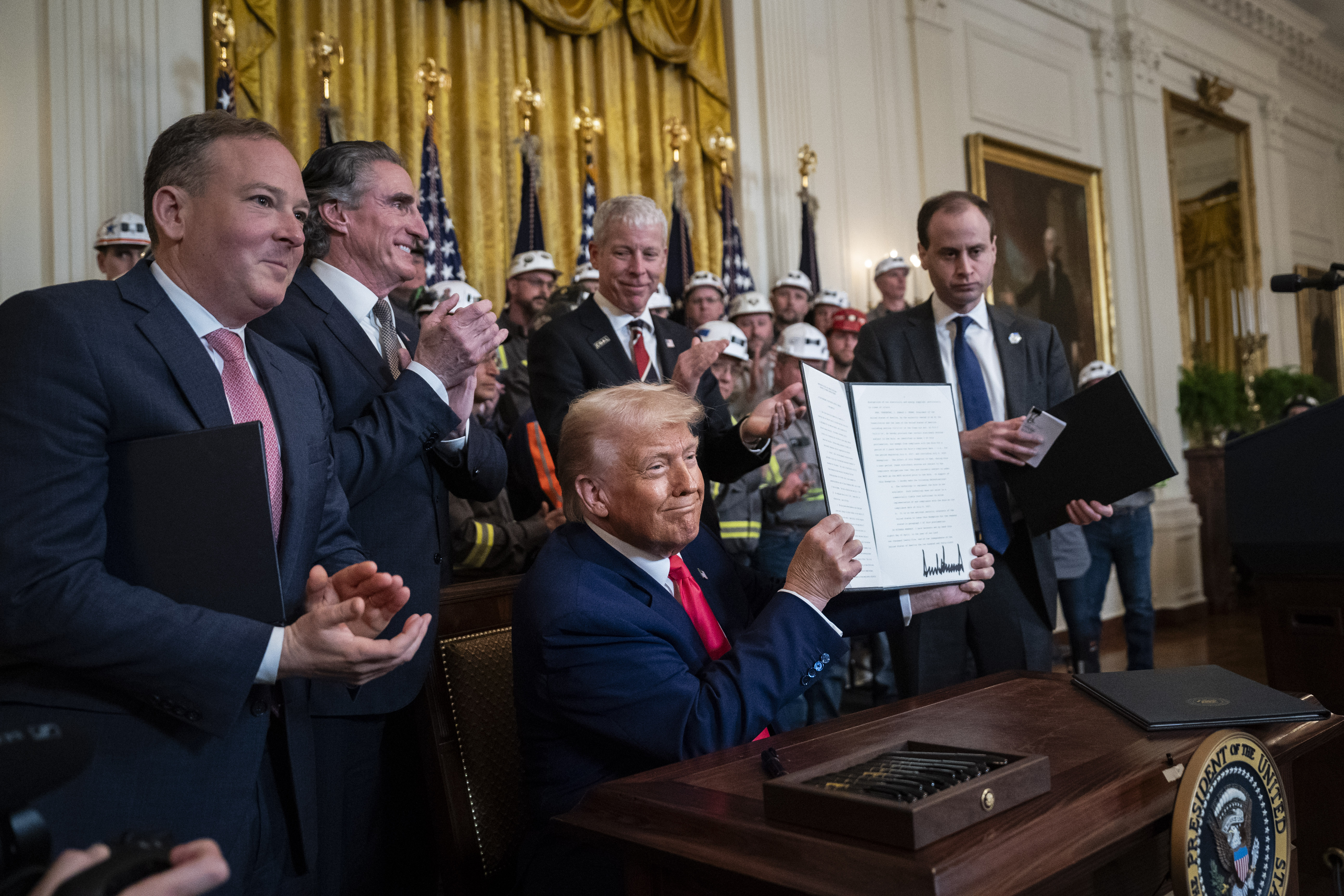
EPA Administrator Lee Zeldin will be alongside President Donald Trump for an event Wednesday focused on boosting U.S. use of coal, as mercury and air toxics standards are repealed. That is expected to be a prelude to Zeldin finalizing the endangerment finding repeal, an assignment the president handed him in an executive order signed on the first day of his second term in office.
“President Trump will be taking the most significant deregulatory actions in history to further unleash American energy dominance and drive down costs,” White House spokeswoman Karoline Leavitt said Tuesday.
The move marks a far more radical retreat on climate change compared to the steps to weaken regulations that were taken in Trump’s first term. Instead, Zeldin’s team has asserted that the EPA never had the power to write such rules to begin with.
Climate action advocates and Democrat-led states have vowed to challenge the repeal of the endangerment finding, a decision that not only erases President Joe Biden’s most important climate regulations, but is designed to make it more difficult for any future administration to rein in fossil fuel pollution from vehicles, power plants or other industries.
“Communities across the country will bear the brunt of this decision—through dirtier air, higher health costs, and increased climate harm,” said Michelle Roos, executive director of the Environmental Protection Network, a group of former EPA employees, in a statement. “The Trump EPA is surrendering its responsibility, turning its back on families and communities already facing the highest pollution and health risks, and dismantling decades of science and progress.”
Said Joseph Goffman, EPA’s top air official during the Biden administration, “This move is a fundamental betrayal of EPA’s responsibility to protect human health. It is legally indefensible, morally bankrupt, and completely untethered from the scientific record.”
The battle seems destined to land in the Supreme Court, forcing it to revisit its landmark 2007 ruling that greenhouse gases were pollutants under the Clean Air Act. The outcome of a legal challenge is by no means clear, with all five of the justices who formed the majority in that case, Massachusetts v. EPA, dead or retired.
To help readers sort through the meaning of the highly technical legal maneuver by the Trump administration, and look to what comes next, Inside Climate News tackled some of the key questions raised by the reversal of the endangerment finding:
- Does this mean that scientists now think climate change is not a problem?
A panel of the National Academies of Sciences, Engineering and Medicine (NASEM) put it bluntly: “The evidence for current and future harm to human health and welfare created by human-caused [greenhouse gases] is beyond scientific dispute,” the scientists said in a report submitted to the EPA as it launched its repeal process. They said that the endangerment finding that the Obama administration adopted in 2009 is now supported by longer observational records and multiple new lines of evidence.
The most recent National Climate Assessment in 2023 reported that temperatures in the contiguous United States had increased by 2.5°F (1.4°C) since 1970, a marked increase from the 1.3°F (0.7°C) warming over the 20th century that the EPA reported in 2009. Annual heat-wave frequency has tripled since the 1960s, storms are producing more intense rains and wildfires have become more severe. Hurricanes have been intensifying more rapidly since the early 1980s, and they break up slower. “Multiple lines of evidence show that greenhouse gas emissions from human activities are the primary driver of the observed long-term warming trend and other changes in Earth’s energy balance,” the NASEM panel said. “Natural forces cannot account for observed changes.”
The Trump administration didn’t ask NASEM for input, even though the Clean Air Act indicates that the EPA should consult with the National Academies on scientific issues. Instead, NASEM had to self-fund and fast-track its work to meet the tight deadline set for public comment last September. The group noted that it worked in the wake of a slew of climate-driven disasters in the United States: “the heavy rainfall of Hurricane Helene that destroyed homes and roads in the mountains of North Carolina, the fast-moving wildfires that displaced thousands in Los Angeles and affected air quality for miles around, and the rapid flooding of the Guadalupe River in central Texas that led to at least 135 fatalities.”
Such manifestations, and analytical methods that have allowed researchers to attribute them to climate change, are the most significant evolution in climate understanding since 2009, said Phil Duffy, chief scientist for the nonprofit group Spark Climate Solutions. “The evidence for societal harms from greenhouse gas emissions has become more of a present day reality than something that’s predicted and expected,” he said. Duffy, a top science adviser to President Joe Biden, was not involved in the NASEM report but was author of a peer-reviewed 2019 study that also found the scientific support for the endangerment finding had withstood the test of time.
When asked about the National Academies’ work, the EPA has stressed that its decision was based on new legal doctrines. In its proposal last year, the EPA asserted that the uncertainties “are more significant than previously believed,” and that “the more pessimistic assumptions” in the 2009 finding have not been borne out.
“We expect EPA to revoke the endangerment finding for legal reasons, not scientific ones.”
— Jeff Holmstead, a former EPA official
It was not immediately clear whether the agency, in its final proposal, would continue to lean on the well-worn science denial talking points compiled by the so-called “Climate Working Group,” five prominent climate skeptics hand-picked by Energy Secretary Chris Wright, a former oil executive, as advisors for the endangerment finding repeal process. More than 85 climate scientists submitted a report to the EPA detailing errors in the Climate Working Group’s report, and a federal judge ruled that Wright broke the law in establishing the group without regard to the Federal Advisory Committee Act’s transparency and fairness provisions.
In its original proposal, the Trump EPA relied on recent Supreme Court decisions it said restrict its authority to act on climate under current law, and close observers expect that will be the administration’s strategy.
“We expect EPA to revoke the endangerment finding for legal reasons, not scientific ones,” said Jeff Holmstead, a partner at the Bracewell law firm who served as head of EPA’s air office during President George W. Bush’s administration. “This is the only way that they can ‘drive a stake through the heart of climate religion,’ as Administrator Zeldin has said.”
- If this is about law and not science, how has the law changed since 2009?
The second Trump administration had the confidence to take on the endangerment finding largely because of how the president reshaped the Supreme Court in his first term, legal experts say. In two 6-3 decisions from a conservative majority bolstered by Trump’s three appointees, the justices created new doctrine that limited the power of federal regulatory agencies like the EPA.
“We’ve had an administrative law revolution,” said industry lawyer Matthew Leopold, who was the EPA’s general counsel in Trump’s first term, speaking at a forum last fall at the American Enterprise Institute (AEI), a conservative think tank. “The playing field that the Obama administration was playing on [when it made the endangerment finding] looks entirely different today.”
The Supreme Court struck down Obama’s signature climate policy, the Clean Power Plan, in 2022. And in that case, West Virginia v. EPA, the court established its so-called “major questions doctrine,” saying regulation of greenhouse gases was an issue of such great economic and political significance that the EPA could not regulate them without explicit direction from Congress. Then, in a 2024 case over fishing regulations, the Supreme Court overturned the principle that had guided regulatory law for 40 years, saying that federal agencies were due no deference in interpreting ambiguities in the law. The court said judges, not agencies, should decide the meaning of the law, even though in the environmental realm that typically involves application of science and knowledge of the best available technologies for reining in pollution.
Climate action advocates, however, argue that the Trump administration faces an uphill battle in defending its repeal of the endangerment finding, largely because the Supreme Court already has interpreted the Clean Air Act as applying to greenhouse gases—in Massachusetts v. EPA. The court has repeatedly declined efforts to overturn that precedent, including in the West Virginia v. EPA case.
“To be sure … the court limited precisely how EPA may regulate those pollutants, but even the current court has not challenged whether EPA may do so,” said David Doniger, senior attorney and strategist for the Natural Resources Defense Council, at a briefing for reporters several weeks before the decision was announced.
Doniger’s colleague, Meredith Hankins, legal director for NRDC’s climate program, says the Trump EPA is clearly relying on legal strategy since it can not offer a scientific rationale for repealing the endangerment finding. “Since EPA’s attempts to make up their own climate science has been laughed out of the room, the agency is left trying to make these tortured legal arguments that do not stand up to the slightest scrutiny,” she said.
Both The Washington Post and POLITICO reported in late January that debate within the administration over the EPA’s legal approach was delaying the process. Outside the administration, even lawyers who supported the move to overturn the endangerment finding acknowledged the challenges. “They are working to break the tool itself,” said Michael Buschbacher, a top attorney in litigation against greenhouse gas standards for vehicles, speaking at the AEI endangerment finding forum. Buschbacher said the many potential pitfalls make it “like a regulatory Everest … It’s dangerous. It’s a high-risk, high-reward endeavor.”
The Trump administration’s best chance of scaling that mountain is if it can make it to the Supreme Court, he said: “That’s probably where this is going to go if this administration is going to prevail.”
- So is this “final” decision really final?
Not in the least. The EPA’s regulatory determinations are challenged in court more than those of any other federal agency, according to tracking by the Institute for Policy Integrity at New York University, and this high-stakes decision will not be an exception.
Climate action advocates see the endangerment finding as a key line they must defend in what they see as the extraordinary all-out assault on environmental protection in the second Trump term. “Put simply, this is a gift-wrapped package for the fossil fuel industry,” said Manish Bapna, CEO of NRDC. “It is unscientific, it is bad economics, and it is illegal. So we’re gonna fight it.”
The first stop will be the D.C. Circuit Court of Appeals, which has exclusive jurisdiction over appeals of nationally applicable regulations. Seven of the 11 judges on that court were appointed by Presidents Obama or Biden.
- How hard would it be for a future administration to restore the finding that greenhouse gas emissions are a danger to human health and the environment?
It depends on the courts. If Massachusetts v. EPA is still standing at the end of the battle, the EPA will still have the power to regulate greenhouse gas emissions, like an arrow in its quiver that it just has to decide to use. But if the Supreme Court were to rule the Clean Air Act gives the EPA no authority over greenhouse gas emissions—reversing the Massachusetts decision and perhaps later cases that relied upon it—that leaves future administrations with an empty quiver.
“Then there would be the problem of a lack of authority, unless Congress wrote a new law,” said Doniger of NRDC.
This story is funded by readers like you.
Our nonprofit newsroom provides award-winning climate coverage free of charge and advertising. We rely on donations from readers like you to keep going. Please donate now to support our work.
Donate NowBut it has been more than two decades since a bipartisan consensus on climate action seemed fleetingly within reach in Congress. Congressional action has grown more elusive even as public support for action—especially deployment of clean energy—has grown. Democrats were able to get a $390 billion investment in clean energy, the Inflation Reduction Act, passed without GOP support in 2022.
The Biden climate plan was a carrot-and-stick approach to drive the United States to cut its carbon emissions 50 percent by 2030. The IRA’s incentives and subsidies were meant to drive down the price of clean energy, while EPA regulation pushed industry to make a transition away from fossil fuels. But over the past year, Trump and the Republican Congress have clawed back the IRA’s carrots. By revoking its endangerment finding, the EPA will also drop its stick.
Holmstead argued that withdrawal of the endangerment finding might actually force Congress to try to reach a bipartisan agreement on climate legislation: “The business community would like to have the long-term certainty that would come with bipartisan legislation, and if the environmental community sees that it can’t get what it wants from EPA, they might be more willing to make the kind of compromises that are always required to pass meaningful legislation.” But Holmstead added that he did not expect that to happen during the Trump administration.
No matter the outcome of the coming litigation over the endangerment finding repeal, the fossil fuel industry has won time. The Trump administration has ensured that the nation that has contributed the most to the atmosphere’s overload of climate pollution, the United States, will be entangled in litigation during years that scientists have said are crucial for driving down the pollution that is increasing risks and costs for communities as it alters the planet.
About This Story
Perhaps you noticed: This story, like all the news we publish, is free to read. That’s because Inside Climate News is a 501c3 nonprofit organization. We do not charge a subscription fee, lock our news behind a paywall, or clutter our website with ads. We make our news on climate and the environment freely available to you and anyone who wants it.
That’s not all. We also share our news for free with scores of other media organizations around the country. Many of them can’t afford to do environmental journalism of their own. We’ve built bureaus from coast to coast to report local stories, collaborate with local newsrooms and co-publish articles so that this vital work is shared as widely as possible.
Two of us launched ICN in 2007. Six years later we earned a Pulitzer Prize for National Reporting, and now we run the oldest and largest dedicated climate newsroom in the nation. We tell the story in all its complexity. We hold polluters accountable. We expose environmental injustice. We debunk misinformation. We scrutinize solutions and inspire action.
Donations from readers like you fund every aspect of what we do. If you don’t already, will you support our ongoing work, our reporting on the biggest crisis facing our planet, and help us reach even more readers in more places?
Please take a moment to make a tax-deductible donation. Every one of them makes a difference.
Thank you,

Marianne Lavelle
Bureau Chief, Washington, D.C.
Marianne Lavelle is the Washington, D.C. bureau chief for Inside Climate News. She has covered environment, science, law, and business in Washington, D.C. for more than two decades. She has won the Polk Award, the Investigative Editors and Reporters Award, and numerous other honors. Lavelle spent four years as online energy news editor and writer at National Geographic. She spearheaded a project on climate lobbying for the nonprofit journalism organization, the Center for Public Integrity. She also has worked at U.S. News and World Report magazine and The National Law Journal. While there, she led the award-winning 1992 investigation, “Unequal Protection,” on the disparity in environmental law enforcement against polluters in minority and white communities. Lavelle received her master’s degree from Columbia University Graduate School of Journalism, and is a graduate of Villanova University.