

If you think of Earth’s climate system as a backyard swing that’s been gently swaying for millennia, then human-caused global warming is like a sudden shove strong enough to disrupt the usual arc and buckle the chains.
And if humans keep heating the planet with greenhouse gas pollution, the climate swing could lock Earth into a hothouse trajectory, as parts of the system feed on their own momentum, even if emissions are reduced later, an international team of scientists warned Wednesday in a new paper published in the journal One Earth.
Their analysis covers 16 key Earth systems, including oceans, ice sheets and forests, that are likely to destabilize if the planet continues to warm. If large parts of the Amazon rainforest and tropical coral reefs die, they absorb less carbon dioxide, triggering a dangerous chain reaction of warming.
If Earth’s climate starts on a hothouse trajectory, it would represent a “global tipping point” as the heating sustains itself even if greenhouse gas emissions drop, said lead author William Ripple, a distinguished professor of ecology at Oregon State University and a leading researcher on climate tipping points.
In the backyard, that’s the moment when the push is so hard that the swing hesitates at the top, just long enough to show that the ride may not be under control anymore and the chains are being tested.
“What typically took thousands of years is now happening in decades,” Ripple said, adding that human-caused warming is already nudging the climate system out of 11,000 years of relative stability with good conditions for farming and societal development.
Earth could be entering a period of unprecedented climate change on a one-way trajectory, in which processes such as ice-sheet collapse can continue even if the average global temperature is stabilized, he said.

Recent observations suggest that the climate may be responding more strongly than some models predicted, Ripple added. “We are concerned that policymakers and the public may not yet be aware of these recent developments.”
In late January, another group of leading climate scientists urged policymakers to adopt a climate goal of limiting human-caused warming to 1 degree Celsius above the pre-fossil fuel era, which is more ambitious than the 1.5 to 2 degrees Celsius target set in the Paris Agreement. They’ve also recently reported that Earth is losing its reflective sheen, which amplifies warming, and that key ocean currents are changing in ways that destabilize the entire global climate system.
But it’s not clear if the scientific warnings are making a difference in “a post-truth era in which too many people prefer pleasant lies over unpleasant truths,” said Reinhard Steurer, a professor of climate policy and governance at the University of Natural Resources and Life Sciences in Vienna who studies how climate science and policy interact. He said that new studies outlining disastrous scenarios are unlikely to have much impact in the current political climate, but that researchers should keep speaking out, and not surrender to “techno illusions or hopium.”
The authors of the new paper stressed that a self-sustaining hothouse trajectory is not the same as a Hothouse Earth state, which would be when the global climate rebalances at a much hotter average temperature.
No Good Analog Climates
Instead of offering a single new climate forecast, the paper synthesizes decades of research revealing how different parts of the climate system influence one another. When one part of the system is destabilized, they wrote, it can amplify stress in others, pushing the planet along a self-reinforcing warming pathway.
Earth has had hothouse climates in the ancient geological past. But the authors of the new paper said there may not be a parallel to what’s happening now, at least not during the past 3 million years, co-author Johan Rockström, co-director of the Potsdam Institute for Climate Impact Research, said via email.
“The reason is that our starting point is a WARM state. So, we are going from WARM to HOT,” he wrote. This may mean “getting stuck” at a global mean surface temperature of 4 to 6 degrees Celsius above pre-industrial levels, he added.
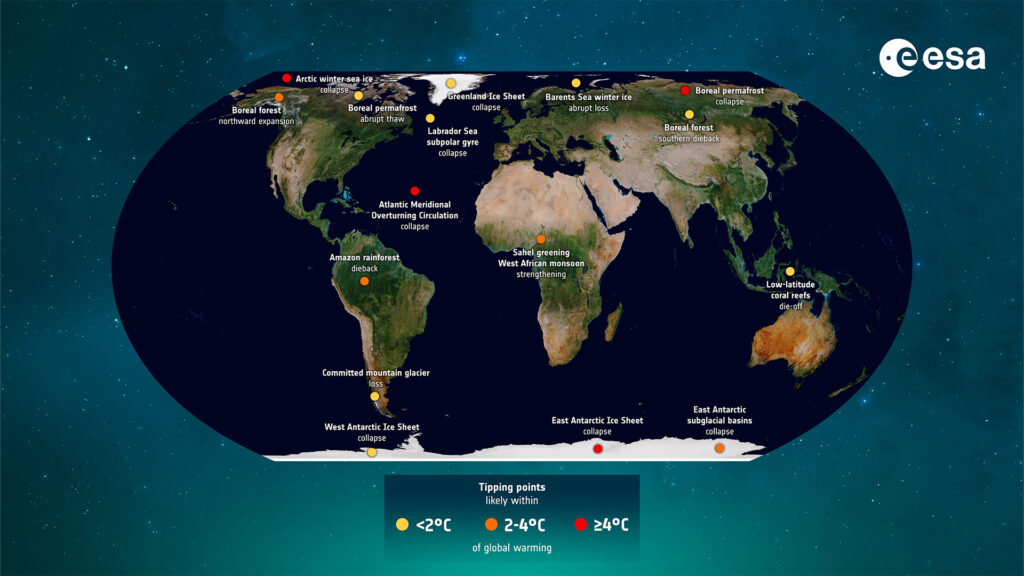
That amount of warming goes beyond current expectations and would devastate ecosystems and communities globally. Many other current climate projections suggest that, under current policies, warming would level off somewhere between 2.7 and 3 degrees Celsius.
Human-caused warming is happening much faster than any other warming documented in the paleoclimate record, and it’s also unprecedented because it’s driven by a single dominant force, Rockström added: human greenhouse gas emissions. Under these conditions, research has documented that Earth is already losing some of the natural buffers that dampened climate swings in recent millennia.
“We now see worrying signs that the Earth system is losing resilience,” Rockström said. Recent extremes, he added, are a sign that the climate system “may respond more strongly to the same amount of warming than it did before.”
This story is funded by readers like you.
Our nonprofit newsroom provides award-winning climate coverage free of charge and advertising. We rely on donations from readers like you to keep going. Please donate now to support our work.
Donate NowThe authors wrote that the magnitude and pace of recent climate extremes “have surprised scientists, raising questions about how well current climate projections capture risk.”
One warning sign is the recent acceleration of warming, from about 0.18 degrees Celsius per decade from 1970 to 2014, to about 0.26 degrees Celsius in the last decade; another is the reduced carbon uptake in tropical, temperate and boreal forests. And, Rockström added, “Earth is getting darker, due to multiple factors,” including melting ice, tree lines moving closer to the poles in the Northern and Southern hemispheres and changing cloud patterns due to increased evaporation and moisture in the atmosphere.
The recent acceleration of warming was also noted recently by climate scientist James Hansen, a former NASA researcher who has accurately projected the planet’s global warming trajectory for several decades.
In a climate bulletin published last week, Hansen wrote that a current shift toward a warm tropical Pacific Ocean phase could push Earth to a new temperature record this year or next, potentially surpassing 2 degrees Celsius above the pre-fossil-fuel era benchmark sometime in the 2030s.
“Don’t be too pessimistic as the evidence for high climate sensitivity grows,” Hansen wrote in his Feb. 6 update. “Realistic understanding of the climate situation, and public recognition of that, is the essential first step toward successfully addressing climate change.”
The science shows that climate stability is no longer guaranteed, Rockström said. Choices made this decade, he said, could shape the Earth System for generations.
About This Story
Perhaps you noticed: This story, like all the news we publish, is free to read. That’s because Inside Climate News is a 501c3 nonprofit organization. We do not charge a subscription fee, lock our news behind a paywall, or clutter our website with ads. We make our news on climate and the environment freely available to you and anyone who wants it.
That’s not all. We also share our news for free with scores of other media organizations around the country. Many of them can’t afford to do environmental journalism of their own. We’ve built bureaus from coast to coast to report local stories, collaborate with local newsrooms and co-publish articles so that this vital work is shared as widely as possible.
Two of us launched ICN in 2007. Six years later we earned a Pulitzer Prize for National Reporting, and now we run the oldest and largest dedicated climate newsroom in the nation. We tell the story in all its complexity. We hold polluters accountable. We expose environmental injustice. We debunk misinformation. We scrutinize solutions and inspire action.
Donations from readers like you fund every aspect of what we do. If you don’t already, will you support our ongoing work, our reporting on the biggest crisis facing our planet, and help us reach even more readers in more places?
Please take a moment to make a tax-deductible donation. Every one of them makes a difference.
Thank you,

Bob Berwyn
Reporter, Austria
Bob Berwyn is an Austria-based reporter who has covered climate science and international climate policy for more than a decade. Previously, he reported on the environment, endangered species and public lands for several Colorado newspapers, and also worked as editor and assistant editor at community newspapers in the Colorado Rockies.