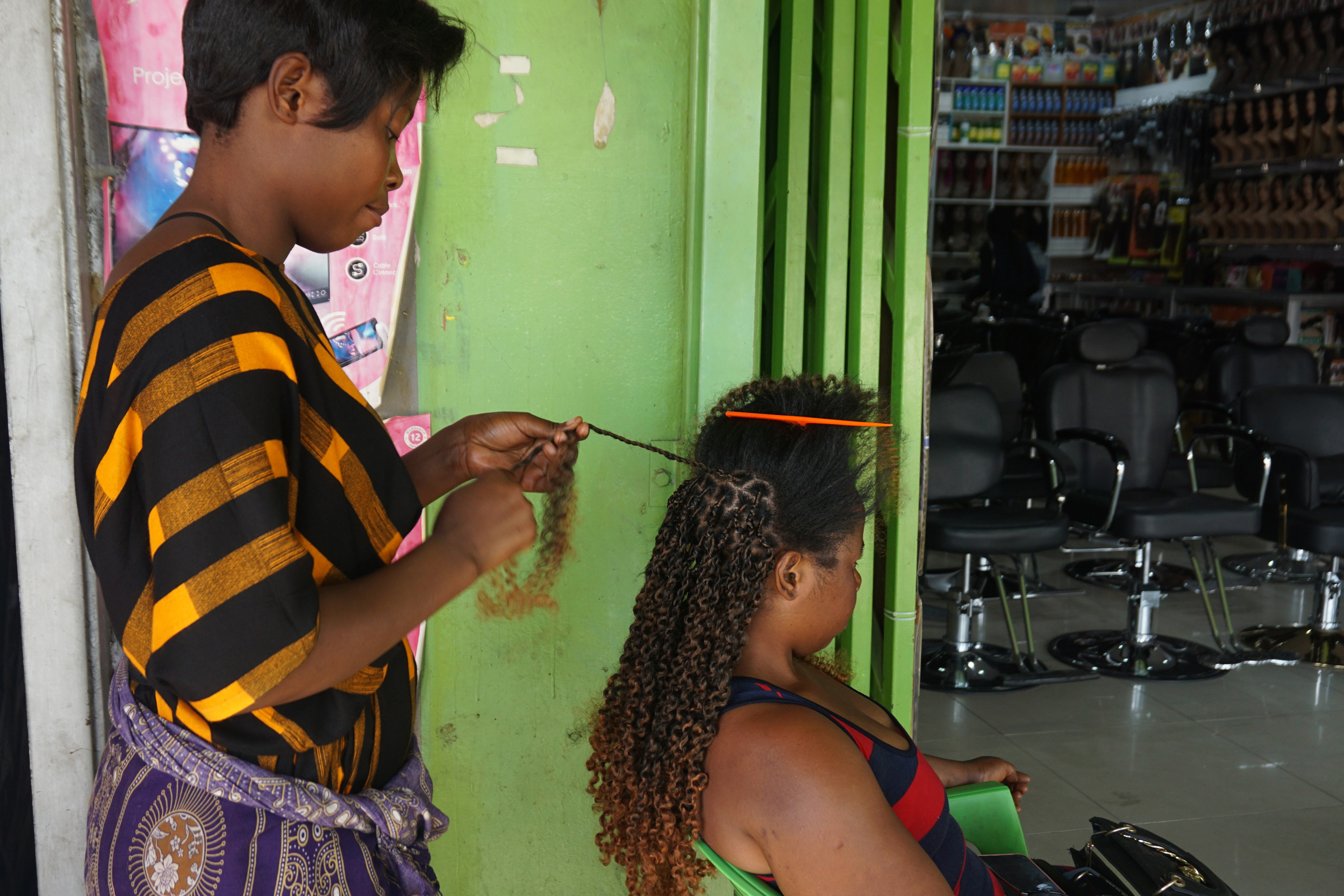


Elissia Franklin is an analytical chemist with an infectious laugh, a penchant for braided hair extensions and a fierce commitment to reducing health disparities for Black women. Growing up on Chicago’s South Side, she saw firsthand the systemic barriers Black women face and resolved to help her community benefit from all she learned as she pursued her career as a chemist.
She never anticipated just how personal her research path would become.
Eight years ago, Franklin was working on her Ph.D. thesis as a visiting senior research scholar at Beijing’s Tsinghua University. She was developing analytical techniques to characterize different types of fatty compound structures when a paper came out that would alter the course of her career.
Scientists with the Silent Spring Institute, which focuses on environmental causes of breast cancer, published the first study to measure dozens of chemicals linked to asthma and endocrine disruption in relaxers, root stimulators and other hair products marketed to Black women.
Suddenly, everything clicked for Franklin. The idea that there could be systemic health risks from cosmetics had never crossed her mind until she read that paper. She decided to harness her expertise in analytical chemistry to help her community avoid harmful exposures.
In a new study, Franklin, now a Silent Spring Institute research scientist, and scientists with the Southwest Research Institute in San Antonio identified scores of hazardous chemicals in hair extensions in what they call the most comprehensive analysis of this popular hair product.
The study, published on Wednesday in the peer-reviewed journal Environment and Health, tested both synthetic and “bio-based” products, made of human hair, banana fiber and silk, and identified four dozen chemicals listed as substances of public health concern. A dozen of the detected chemicals are flagged by California’s Proposition 65 as likely to cause cancer, birth defects or reproductive harm. The team found 17 chemicals associated with breast cancer in 36 of 43 samples, including substances that increase risk by boosting hormone production.
“I wish it was surprising,” said Janette Robinson Flint, executive director of Black Women for Wellness, who was not involved in the research. “Black women are overexposed and underprotected from harsh chemicals in all our products, from the lead in our lipstick to the hair that we choose.”
A body of literature indicates that personal-care products can be a substantial source of exposure to chemicals of concern, especially as they relate to hormone disruption, cancer risk and reproductive and developmental risk, said Ami Zota, an associate professor of environmental health sciences at Columbia University’s Mailman School of Public Health, who was not involved in the study.
Franklin’s study was going through peer review when Consumer Reports released results from its testing of 10 popular products used to braid hair for volatile organic compounds and heavy metals. The nonprofit group found carcinogens in every sample.
Franklin was not surprised. Synthetic fibers are often made of petrochemicals with toxic properties, including plastic polymers, acrylic, polyester and polyvinyl chloride. When they’re discarded, they go to landfills where they don’t break down.
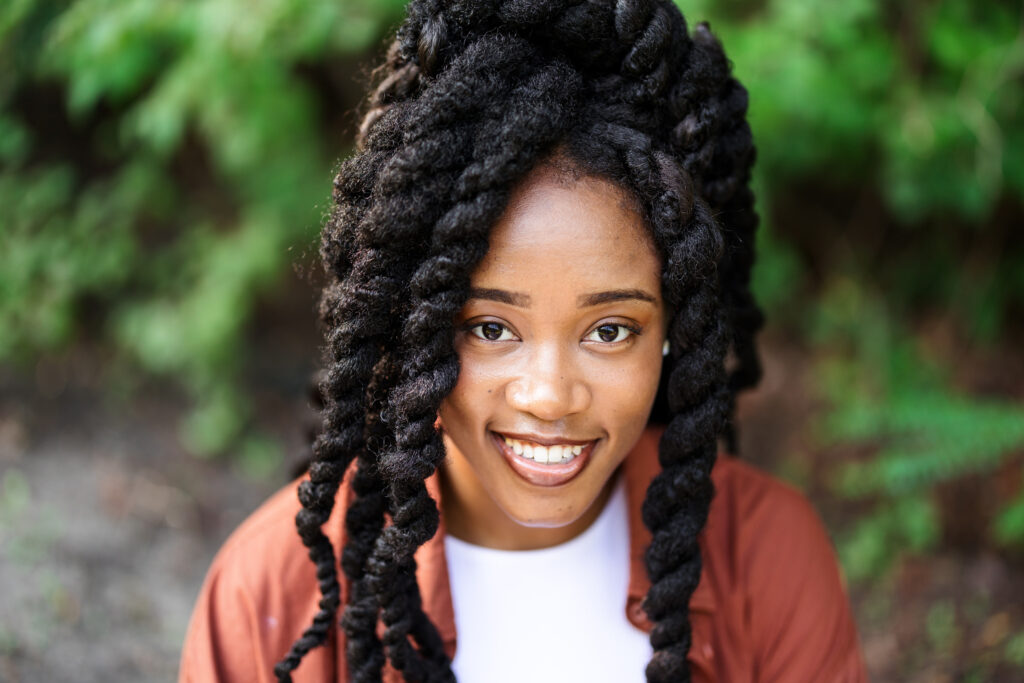
Prior research has highlighted products like chemical hair straighteners as a subcategory of concern, but braids and extensions have received a lot less attention, Zota said. “The Consumer Reports report put this issue on the map in a big way, but there really is a dearth of data in the peer-reviewed literature,” she said. “This new study begins to address that substantial data gap by doing this chemical analysis of over 40 different products.”
The hair-extension industry is projected to be valued at $14 billion by 2028 but is largely unregulated.
“More and more evidence is coming out to support that we need safer regulation around cosmetics and beauty products overall,” Franklin said.
After scientists at the National Institutes of Health reported an increased risk of uterine cancer and breast cancer linked to hair straighteners, the Biden-era Food and Drug Administration planned to ban cancer-causing formaldehyde in the products. But since President Donald Trump returned to the White House, the FDA missed the proposed ban deadline while the Environmental Protection Agency proposed loosening restrictions on the carcinogen.
As women learned about the hazards of synthetic braids, Franklin said, they switched to human hair. What the study shows, she said, is that the potential risks associated with hair extensions goes beyond synthetic braiding hair.
Still, it was the synthetic products that contained representatives of a particularly nasty class of chemicals called organotins. These toxic substances, used as biocides and heat stabilizers in PVC, are classified as “severely restricted” in the European Union.
“We were completely shocked to see that there were organotin compounds in some of the braiding hair,” Franklin said. The chemicals, which are not typically found in consumer products, were detected in the synthetic extensions.
“To have found them in a product that we’re using so intimately,” she said, “was absolutely shocking.”
“Regulatory Black Hole”
Franklin was still a postdoc in 2021, when she joined Silent Spring. That year the institute published research showing how people could reduce their exposure to flame retardants, chemicals associated with cancer, neurotoxicity and other health harms. They found that levels of the chemicals in people’s homes dropped significantly simply by replacing a flame-retardant-treated couch with untreated furniture.
As Franklin sat in meetings with colleagues talking about all the harms associated with flame retardants, she couldn’t believe it. “I’m like, that is in the hair I have on my head right now. How can that be?”
Franklin has been wearing braiding hair since she was a toddler. “It’s just what you do,” she said.
“Growing up, I would go to the beauty supply stores, the supplier of synthetic braiding hair, and it was on pretty much every product that I would pick up where it said ‘flame resistant, flame retardant,’” she said.
Here were her colleagues talking about how these specialty chemicals she’d always assumed protected women—stylists burn extensions to seal the braids in place—are linked to cancer, hormone disruption and developmental and reproductive problems. Her chemist brain started lighting up like a pinball machine, thinking about how to test for evidence of harm associated with wearing braiding hair.
She couldn’t find many studies in the scientific literature, and started thinking more and more about what was in those extensions. They’re made out of petrochemical plastic polymers. Then they have additives like flame retardants, so they don’t catch on fire when heat is applied to set the braids, and toxic PFAS to resist water. If these extensions are so chock-full of nasty chemicals, she wondered, why are they sold as a safe product to Black women?
Someone needed to figure out what chemicals were coming out of that braiding hair. `
But the scientific process is a slow-moving beast. Franklin started looking for funding in 2022, landed a grant the next year, then started buying different hair extension products online and at local beauty stores. She ended up buying more than 40 separate products made of different fibers, including synthetic (mostly plastic polymers), or “bio-based,” which included human hair, banana and silk sources. In 2024 Franklin harnessed her expertise in characterizing different chemical compounds to test the fibers.
By using a technique called “non-targeted analysis,” she cast a wide net to explore the range of possible chemicals in extensions. The approach does not reveal exact compounds or their concentrations but screens for a wide range of contaminants.
Franklin identified potential chemicals of concern that aren’t usually on researchers’ radar, like the organotin compounds, said Zota. “That was really interesting and novel.”
The study doesn’t look at how much of these chemicals are getting inside the body, Zota said, which would be important for thinking about health risk.
But the study suggests that there are chemicals of concern in these braids and extensions that warrant additional research, Zota said. And she said it shines a light on the “regulatory black hole” for products with a clear potential to expose consumers to harmful chemicals, given the prevalence of use, how long they’re worn and their close contact with the body and breathing zone.
Lack of Transparency
How Black women wear their hair, said Flint of Black Women for Wellness, “is an economic decision. It’s a political decision, and it impacts your whole life.”
Flint recently was honored at Los Angeles City Hall as a Black woman leader. But 30 years ago, the security crew barely let her through the door. She thinks it was because she wore her hair natural.
It wasn’t until 2019 that California became the first state to pass the CROWN Act—short for Creating a Respectful and Open World for Natural Hair. The law, versions of which have now passed in 27 states, prohibits discrimination in the workplace and schools based on natural hair textures and styles commonly associated with race, such as braids, locs and twists.
Beyond workplace discrimination, Flint said, Black women are increasingly thinking about how hair products affect their health.
Even when women, especially women of color, try to make safer choices, they are still having to navigate a highly unregulated market with little transparency in terms of what they’re actually buying and what they’re putting on their hair, Zota said.
And if these chemicals are getting into women’s bodies, it’s a chronic exposure.
“You aren’t taking the braids out at night and some women wear these braids for months at a time,” Franklin said, adding that she can’t recall ever seeing one of her cousins without extensions.
It shouldn’t be up to consumers to figure out what’s in these products, Franklin said. “I’m a chemist and I still struggle with figuring out what is bad and what is not because there’s no transparency here.”
Regulators allow manufacturers to add chemicals to products without testing for safety first.
And companies aren’t required to provide materials called “standards” that allow researchers to identify the chemicals they add to products.
“If you want to put this new compound in your product, one, you should test it for safety,” Franklin said. “But if you’re not, you should at least be producing the standard for us to be able to see if this new compound is being used across the board in your product.”
There were only two samples, labeled as nontoxic or “toxic free,” with no detections of hazardous chemicals. But just because her method didn’t detect anything this time, that doesn’t mean they won’t in a future study, she cautioned.
Two samples made of banana fibers had phthalates, endocrine disruptors called “everywhere chemicals” because they’re found in everything from air fresheners to toys. The samples came from Rebundle, a company aiming to create biodegradable hair products.
This story is funded by readers like you.
Our nonprofit newsroom provides award-winning climate coverage free of charge and advertising. We rely on donations from readers like you to keep going. Please donate now to support our work.
Donate NowIt’s unclear whether phthalates somehow contaminated the bananas or whether they sloughed off onto the braids from the packaging.
Ciara Imani May founded Rebundle in 2019 after getting fed up with all the adverse reactions caused by synthetic braids. She set out to see whether extensions could be made of materials that were not petrochemical-based.
“That’s how I ended up with banana fiber and working out of East Africa,” she said, while getting her hair braided with natural fibers in Kenya. “We’re glad that these sorts of peer-reviewed studies are being conducted on these products, because there is very limited information and research that has been done.”
This study gives companies like Rebundle a benchmark to understand where there might be gaps in research and how they can fill those gaps in their product-development processes, May said. Given that phthalates are ubiquitous, she said, they need to figure how they’re introduced into the fibers.
Extensions made of human hair had among the most chemicals linked to breast cancer and on the Prop 65 list, likely reflecting a buildup of contaminants in the person the hair came from.
Companies should be required to put labels on these products so consumers know what they might be exposed to, said Franklin. She would like to see hair extensions regulated under Prop 65.
Prop 65 labels have triggered reductions in toxic ingredients, work from Silent Spring has found. Companies shifted away from using toxic substances to protect their brand or to make a safer product.
Hoping for a Cultural Shift
The study opens up many avenues of research to determine if any of the detected harmful chemicals linked to cancer, developmental problems, infertility and other reproductive harms may be playing a role in Black women’s health disparities.
“The chemicals of concern found in hair extensions are really just the tip of the iceberg of the problem, because so many other beauty products that Black women are using are also causing harm,” said Janet Nudelman, director of Breast Cancer Prevention Partners’ Campaign for Safe Cosmetics.
Black women who regularly use permanent hair dyes have a 60 percent increased risk of breast cancer and a 44 percent higher risk of uterine fibroids, Nudelman said. “And Black women who regularly straighten their hair are 30 percent more likely to develop breast cancer and twice as likely to develop uterine cancer.”
Over the past two decades, the number of chemicals banned or restricted from cosmetics by the European Union has more than doubled, from 1,100 to more than 2,400, Nudelman said. “In stark contrast, in the U.S. only five additional chemicals were added to the banned or restricted list by the FDA.”
For the past six years, Nudelman and her colleagues have been working on the Safer Beauty Bill Package, which includes legislation that would direct the FDA to regulate synthetic braids. “We hope that consumers of Black beauty products and everyone will support this federal bill package,” she said. “It’s just so important.”
Studies like Franklin’s underscore how society disrespects women, said Flint, of Black Women for Wellness. “Why regulate a product for somebody you don’t care about?”
Society needs a cultural shift that values and protects women, Flint said. She tells women they should not blame themselves for the health consequences of the products they use, but the system of governance that fails to protect them.
And Franklin wants Black women to have the freedom to wear their hair however they want without being exposed to dangerous chemicals.
“We should not have to choose between wearing some of these hairstyles and safety,” she said.
About This Story
Perhaps you noticed: This story, like all the news we publish, is free to read. That’s because Inside Climate News is a 501c3 nonprofit organization. We do not charge a subscription fee, lock our news behind a paywall, or clutter our website with ads. We make our news on climate and the environment freely available to you and anyone who wants it.
That’s not all. We also share our news for free with scores of other media organizations around the country. Many of them can’t afford to do environmental journalism of their own. We’ve built bureaus from coast to coast to report local stories, collaborate with local newsrooms and co-publish articles so that this vital work is shared as widely as possible.
Two of us launched ICN in 2007. Six years later we earned a Pulitzer Prize for National Reporting, and now we run the oldest and largest dedicated climate newsroom in the nation. We tell the story in all its complexity. We hold polluters accountable. We expose environmental injustice. We debunk misinformation. We scrutinize solutions and inspire action.
Donations from readers like you fund every aspect of what we do. If you don’t already, will you support our ongoing work, our reporting on the biggest crisis facing our planet, and help us reach even more readers in more places?
Please take a moment to make a tax-deductible donation. Every one of them makes a difference.
Thank you,

Liza Gross
Reporter, California
Liza Gross is a reporter for Inside Climate News based in Northern California. She is the author of The Science Writers’ Investigative Reporting Handbook and a contributor to The Science Writers’ Handbook, both funded by National Association of Science Writers’ Peggy Girshman Idea Grants. She has long covered science, conservation, agriculture, public and environmental health and justice with a focus on the misuse of science for private gain. Prior to joining ICN, she worked as a part-time magazine editor for the open-access journal PLOS Biology, a reporter for the Food & Environment Reporting Network and produced freelance stories for numerous national outlets, including The New York Times, The Washington Post, Discover and Mother Jones. Her work has won awards from the Association of Health Care Journalists, American Society of Journalists and Authors, Society of Professional Journalists NorCal and Association of Food Journalists.