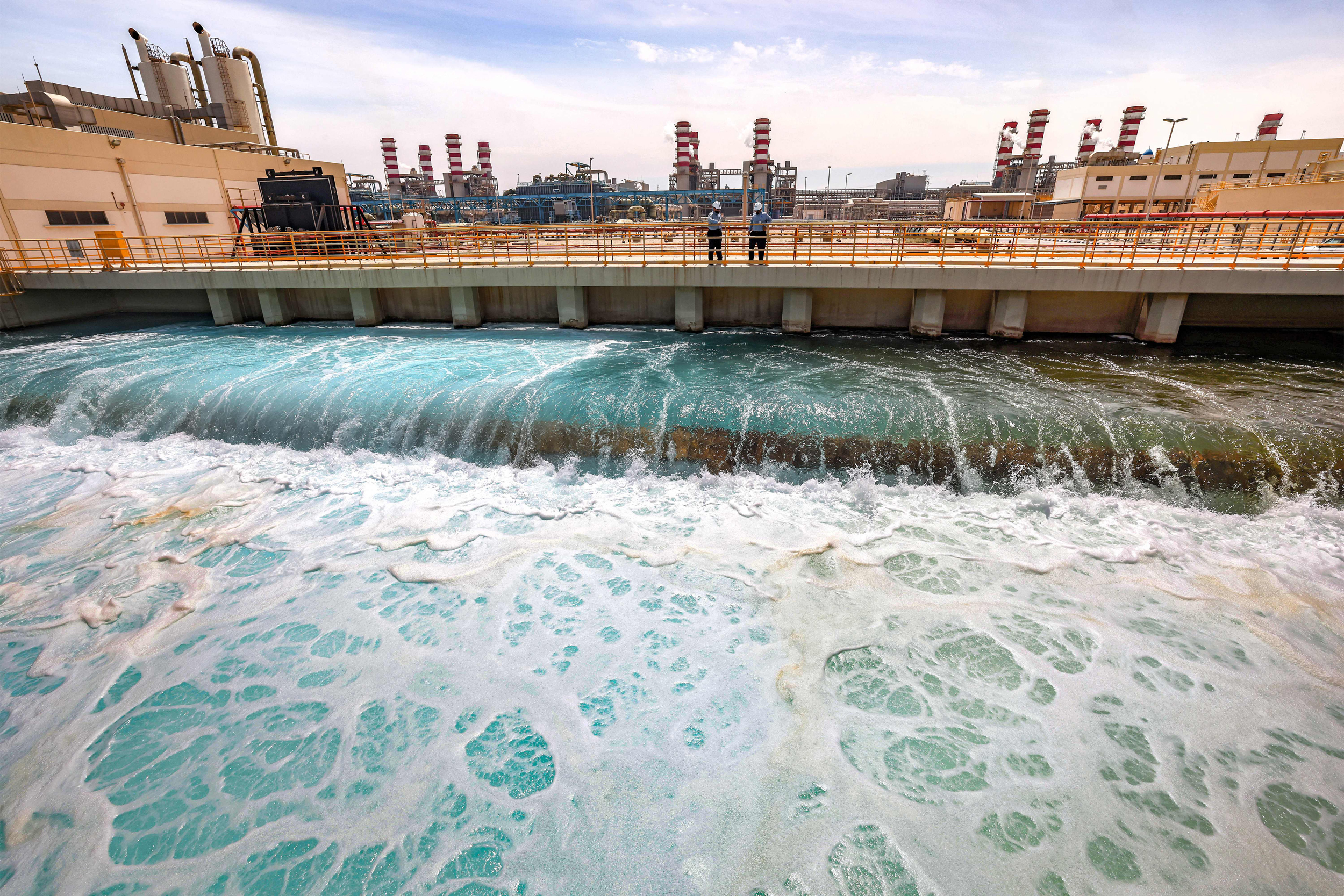


Recent attacks in the Middle East on desalination plants, facilities that remove salt from seawater, raise the potential for a humanitarian crisis if the region’s freshwater production facilities are subjected to more widespread destruction. The attacks also underscore the region’s heavy reliance on an energy-intensive method of producing drinking water that is powered almost entirely by fossil fuels.
On Saturday, Iranian Foreign Minister Abbas Araghchi accused the United States of striking a desalination plant in southern Iran. The U.S. has since denied any role in the attack. The next day, Bahrain accused Iran of damaging a desalination plant in a drone attack. The targeting of freshwater production facilities follows attacks on schools, airports, hotels and refineries since U.S Operation Epic Fury began in February. Attacking desalination plants is a violation of the Geneva Conventions, which established humanitarian laws for the treatment of non-combatants in war.
“It has erased previous red lines about attacking energy infrastructure, civilian infrastructure, and then the final red line of attacking desalination infrastructure,” Michael Christopher Low, director of the Middle East Center at the University of Utah, said of the Iran War. “It’s the most grievous kind of war crime that you can dream up.”
Of the world’s nearly 18,000 desalination plants, nearly one-third are located in the Middle East, with 2,382 facilities in Saudi Arabia alone, according to a recent study published in the journal npj Clean Water.
In the Middle East and North Africa, 83 percent of the population already faces severe water scarcity, a figure projected to rise to 100 percent by 2050, according to the World Resources Institute’s Aqueduct Water Risk Atlas. The Middle East is home to 6 percent of the world’s population and holds less than 2 percent of the world’s renewable freshwater. The rapid growth of the region’s cities has increased reliance on desalination.
“All of these great Gulf cities, Riyadh, Doha, Dubai, Abu Dhabi, they’re not possible without man-made, fossil fuel water,” Low said.
However, desalination, which typically uses a process called reverse osmosis to push seawater through ultra-fine membranes to remove salt and other contaminants, is a costly and energy-intensive process powered, and indirectly funded, by the region’s oil and gas wealth.
“You can’t step away from fossil fuels and fossil fuel production, because your water production is so closely linked,” said Low, who is currently writing a book titled “Saltwater Kingdoms: Fossil-Fueled Water and Climate Change in Arabia.”
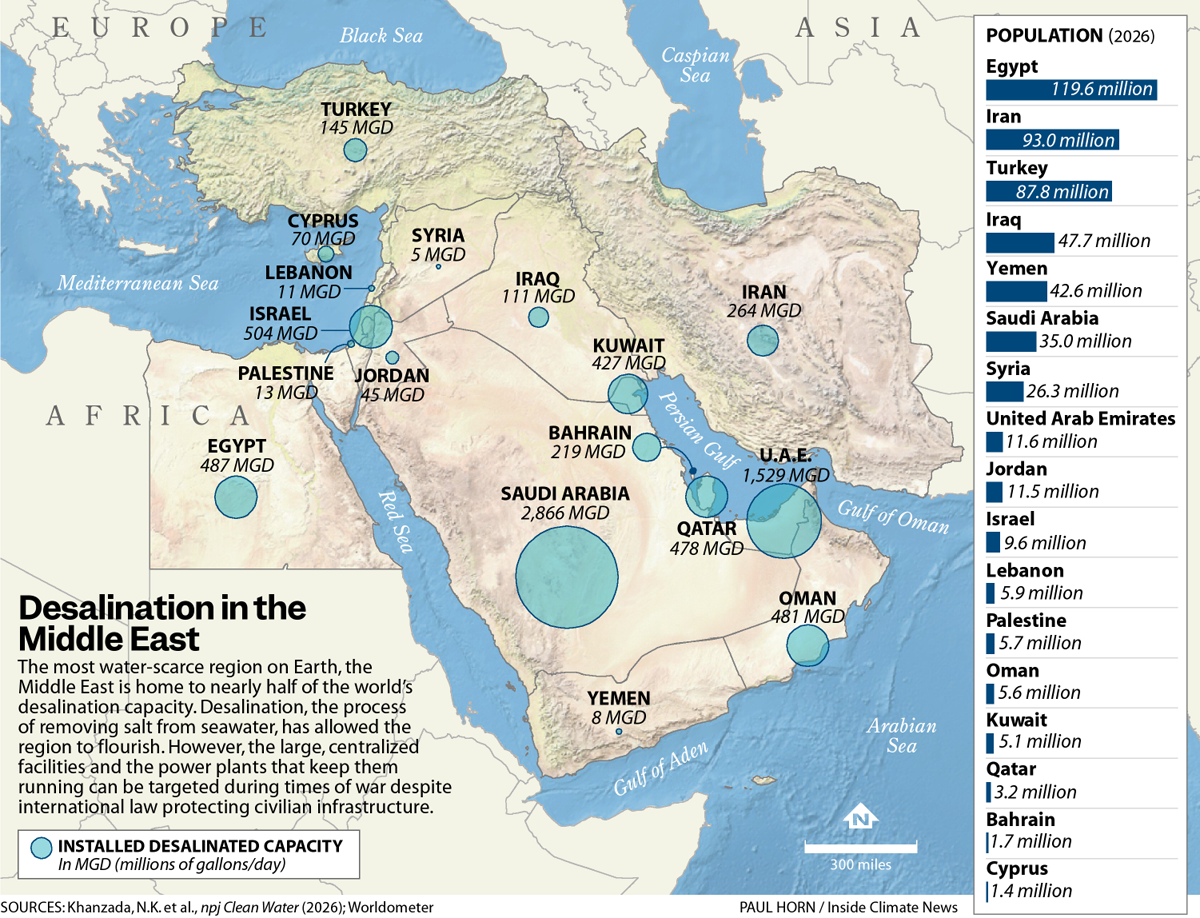
The connection between desalination and fossil fuels has long-term implications beyond the immediate attacks. “It’s not just the vulnerability of desalination to military campaigns or sabotage, but it’s also the embedded risk that is climate change,” Low said.
Such heavy reliance on desalination facilities makes cities in the Middle East particularly vulnerable.
As early as 1983, the U.S. Central Intelligence Agency warned that widespread disruption of desalination plants through sabotage or military action could lead to a “national crisis” in countries such as Saudi Arabia, Kuwait and Bahrain.
During the 1991 Gulf War, Iraq intentionally destroyed much of Kuwait’s desalination capacity. In 2016 and 2017 a Saudi-led coalition bombed desalination plants in Yemen. In 2019, Houthi rebels claimed responsibility for attacking a desalination plant in Saudi Arabia. Israel destroyed or otherwise shut down much of Gaza’s desalination capacity following Hamas’ attack on Israel in October 2023.
This story is funded by readers like you.
Our nonprofit newsroom provides award-winning climate coverage free of charge and advertising. We rely on donations from readers like you to keep going. Please donate now to support our work.
Donate NowErika Weinthal, chair of the Environmental Social Systems Division at Duke University’s School of the Environment, monitors attacks on desalination plants and other infrastructure in the Middle East and North Africa. The Targeting of Infrastructure in the Middle East project, a database maintained by Weinthal and colleagues, focuses on water, sanitation, energy, health and transportation infrastructure in conflict zones throughout the region since 2011.
Weinthal said the initiative is an attempt to provide a more complete understanding of warfare’s impacts by moving beyond immediate casualties.
“You are also harming civilians and the environment over the long term in ways that can’t be counted immediately,” Weinthal said. “If people don’t have access to clean drinking water, you will see more waterborne illnesses and infectious disease among the population.”
Weinthal said the frequent coupling of large desalination facilities and the power plants that feed them makes such facilities particularly vulnerable. “You don’t even have to destroy a desalination plant or a water treatment plant if you take out a power plant,” Weinthal said.
As the planet warms, the region will likely become increasingly dependent on desalination. Precipitation across the Middle East and North Africa is anticipated to decrease by 10 to 30 percent over the next century. By 2050, the region is projected to incur economic losses equal to 6 to 14 percent of its gross domestic product due to climate-induced water scarcity, according to the World Bank.
Climate change will also increase coastal water temperatures and salinity, reducing the efficiency of desalination plants, concluded a 2022 report by the Regional Organization for the Protection of the Marine Environment, an intergovernmental organization of eight Persian Gulf states.
Currently, almost all the Middle East’s desalination plants are powered by fossil fuels, with 93 percent of the required electricity coming from burning natural gas and 6 percent from burning oil. Some countries, including Saudi Arabia and the United Arab Emirates, have begun to develop renewable energy or nuclear power to drive desalination. However, only about one-third of Middle Eastern countries employ renewable energy for that purpose or have immediate plans to integrate it with freshwater production.
Globally, reverse osmosis desalination uses an estimated 100 terrawatt hours of energy per year, equivalent to approximately 0.4 percent of global electricity consumption. Emissions associated with that energy use were approximately 76 million tons of carbon dioxide in 2014, a figure projected to increase to 400 million tons of CO2 by 2050, according to a recent report by TRENDS Research & Advisory, an independent think tank based in Abu Dhabi. That 2050 figure is equal to the annual greenhouse gas emissions of 93 million automobiles, according to the U.S. Environmental Protection Agency.
“Unless you go to solar or a nuclear solution, you’re most likely contributing to more fossil-fuel use [and] more carbon forcing,” Low said. “It’s kind of a vicious cycle.”
About This Story
Perhaps you noticed: This story, like all the news we publish, is free to read. That’s because Inside Climate News is a 501c3 nonprofit organization. We do not charge a subscription fee, lock our news behind a paywall, or clutter our website with ads. We make our news on climate and the environment freely available to you and anyone who wants it.
That’s not all. We also share our news for free with scores of other media organizations around the country. Many of them can’t afford to do environmental journalism of their own. We’ve built bureaus from coast to coast to report local stories, collaborate with local newsrooms and co-publish articles so that this vital work is shared as widely as possible.
Two of us launched ICN in 2007. Six years later we earned a Pulitzer Prize for National Reporting, and now we run the oldest and largest dedicated climate newsroom in the nation. We tell the story in all its complexity. We hold polluters accountable. We expose environmental injustice. We debunk misinformation. We scrutinize solutions and inspire action.
Donations from readers like you fund every aspect of what we do. If you don’t already, will you support our ongoing work, our reporting on the biggest crisis facing our planet, and help us reach even more readers in more places?
Please take a moment to make a tax-deductible donation. Every one of them makes a difference.
Thank you,

Phil McKenna
Reporter, Boston
Phil McKenna is a Boston-based reporter for Inside Climate News. Before joining ICN in 2016, he was a freelance writer covering energy and the environment for publications including The New York Times, Smithsonian, Audubon and WIRED. Uprising, a story he wrote about gas leaks under U.S. cities, won the AAAS Kavli Science Journalism Award and the 2014 NASW Science in Society Award. Phil has a master’s degree in science writing from the Massachusetts Institute of Technology and was an Environmental Journalism Fellow at Middlebury College.