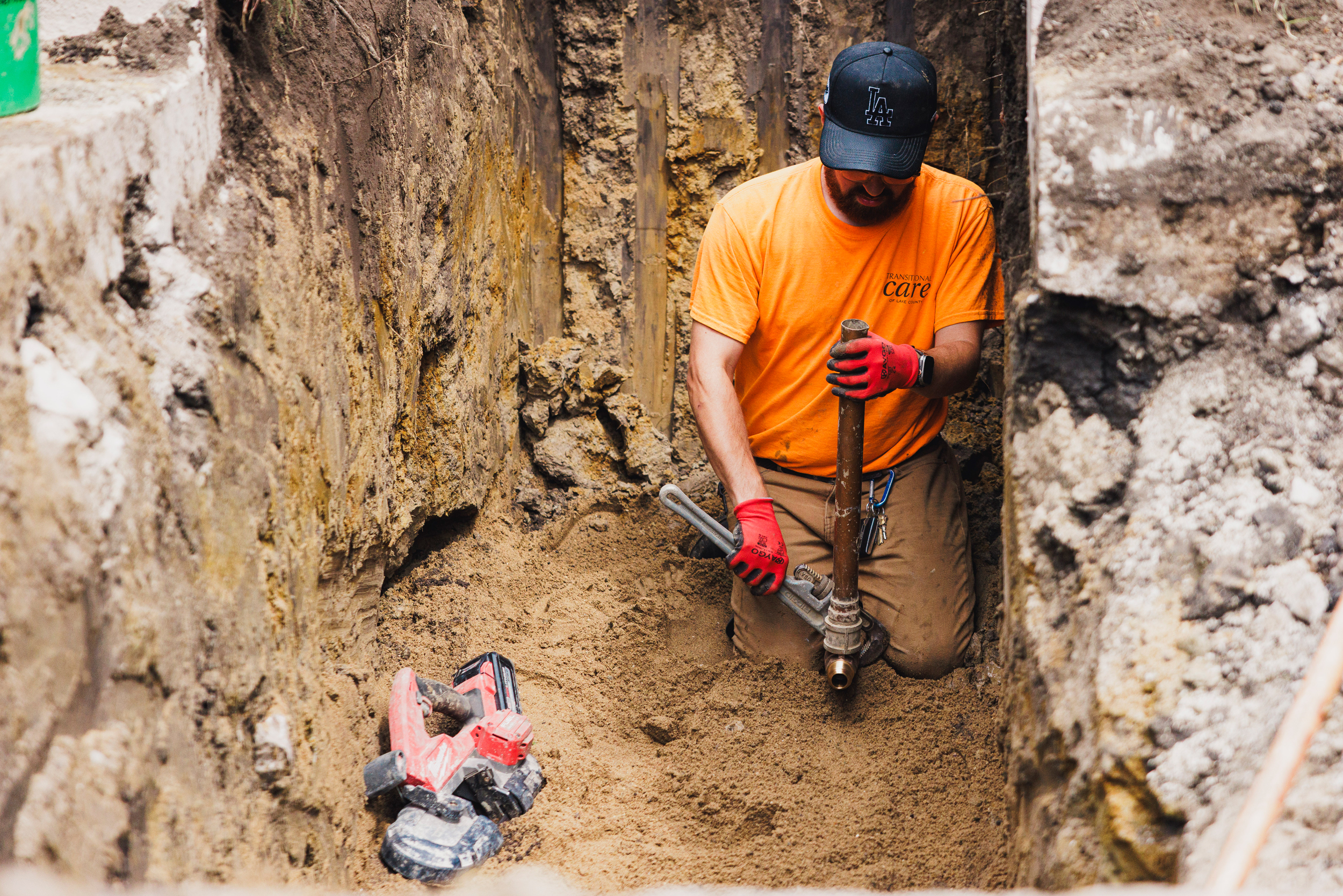


The Senate is taking up a spending package passed by the House of Representatives that would cut $125 million in funding promised this year to replace toxic lead pipes.
Including three of 12 appropriations bills, this package will fund parts of the federal government, including the Environmental Protection Agency. The Senate is slated to vote on it later this week. Near the end of more than 400 pages of text, it proposes repurposing some funds previously obligated by the 2021 Infrastructure Investment and Jobs Act, also known as the Bipartisan Infrastructure Law.
That law, advanced by the Biden administration, promised $15 billion over five years to fund the replacement of service lines—pipes routing water into people’s homes and other buildings—that are made of or contain lead, a neurotoxin that can cause cognitive, developmental, reproductive and cardiovascular harm.
The EPA released 2025 funding allocations in November, months late, obligating nearly $3 billion across the country. Illinois, the state with the most lead pipes in the nation, received the largest share. Another $3 billion was slated to be disbursed this year, the last for the funds.
The slashed $125 million would be repurposed for wildland fire management. Safe drinking water advocates and some lawmakers have called for the funds to be restored, calling them critical for health and safety. Because lead pipes are a public health hazard, the EPA has mandated that all states replace them within about a decade, with some extensions for states with many pipes, like Illinois.
“We are facing a water crisis, and I’m disappointed that money appropriated by the IIJA for lead pipe replacement is being repurposed by this legislation,” U.S. Rep. Debbie Dingell (D-Mich.) said in a statement to Inside Climate News. “Every American deserves clean water, and we will not stop fighting until we get the lead out.”
The EPA declined to comment on pending legislation, but a spokesperson wrote in an email that the Trump EPA’s work on drinking water is “unmatched,” and said that funding from the agency will “accelerate progress in finding and removing lead pipes that deliver water to homes, schools and businesses.”
President Donald Trump previously sought to almost completely eliminate a key funding source for drinking water, but the House rejected that proposal, and also refused to cut as much of the EPA’s budget as Trump wanted.
An earlier draft of the bill proposed cutting $250 million in lead pipe replacement funding, and House Democrats fought to protect the funds. In December, Dingell and Rep. Rashida Tlaib (D-Mich.) coordinated a letter to Senate leaders signed by 43 other members of Congress, arguing that the funding is critical for public health.
“Too often, our local communities do not have the resources and capacity to address this health risk without a more aggressive funding approach to this growing crisis,” the letter reads.
Julian Gonzalez, senior legislative counsel at Earthjustice, said the smaller cut is an improvement, but described it as “bittersweet.”
“It’s great that they were able to save $125 million from one version of the appropriations bill to the next, and it’s obviously really unfortunate and disappointing that there’s any clawback at all of these funds,” Gonzalez said.
This story is funded by readers like you.
Our nonprofit newsroom provides award-winning climate coverage free of charge and advertising. We rely on donations from readers like you to keep going. Please donate now to support our work.
Donate NowThe cost of replacement varies, but $125 million would pay for thousands of new lines. Any reduction in funding will have a material impact on peoples’ lives, Gonzalez added.
“If you just think about it as neighborhoods and families, then it becomes evident that it’s actually an enormous deal,” he said.
Mary Grant, water program director at Food & Water Watch, said communities burdened by lead pipes need “every dollar of federal support” to replace the toxic lines.
“I don’t think there is a real justification for cutting back lead service line funding,” Grant said. “At the end of the day, no matter where you live, no matter which party you vote for, everyone wants safe, lead-free water.”
There are millions of lead service lines across the country and replacing them is an expensive job, with estimates ranging from $45 billion to $90 billion. Cuts to federal funding will likely impact cities with high numbers of pipes, like Chicago, most severely, Grant said. Officials in Illinois have already called for greater financial support from the federal government to replace its hundreds of thousands of lead-containing lines.
The EPA estimated in 2024 that there were about 9 million lead service lines nationwide, but late last year the agency revised its estimate to 4 million. Drinking water advocates have criticized the new methodology, which estimates that the vast majority of the 24 million service lines of unknown material don’t contain lead—a far greater proportion than previous estimates.
In an emailed statement, an EPA spokesperson defended the new methodology and said the NRDC’s critiques are “simply wrong.” The new estimate involves “significantly more robust” data than the previous numbers, the agency statement said, given that all states were required to submit inventories of their service line materials in 2024.
“The EPA’s reduced number of presumed lead service lines may also be a precursor to future efforts to justify cuts in funding for replacement of these lead pipes,” wrote Erik D. Olson, the Natural Resources Defense Council’s senior strategic director for environmental health, in December. “This is penny-wise and pound-foolish, since the health and economic benefits of removing these lead pipes are more than 14 times the costs. And it does not bode well for the tens of millions of Americans who continue to drink lead-contaminated water from these lead pipes.”
About This Story
Perhaps you noticed: This story, like all the news we publish, is free to read. That’s because Inside Climate News is a 501c3 nonprofit organization. We do not charge a subscription fee, lock our news behind a paywall, or clutter our website with ads. We make our news on climate and the environment freely available to you and anyone who wants it.
That’s not all. We also share our news for free with scores of other media organizations around the country. Many of them can’t afford to do environmental journalism of their own. We’ve built bureaus from coast to coast to report local stories, collaborate with local newsrooms and co-publish articles so that this vital work is shared as widely as possible.
Two of us launched ICN in 2007. Six years later we earned a Pulitzer Prize for National Reporting, and now we run the oldest and largest dedicated climate newsroom in the nation. We tell the story in all its complexity. We hold polluters accountable. We expose environmental injustice. We debunk misinformation. We scrutinize solutions and inspire action.
Donations from readers like you fund every aspect of what we do. If you don’t already, will you support our ongoing work, our reporting on the biggest crisis facing our planet, and help us reach even more readers in more places?
Please take a moment to make a tax-deductible donation. Every one of them makes a difference.
Thank you,

Keerti Gopal
Reporter, Health and Justice
Keerti Gopal covers intersections between climate change, public health and environmental justice at Inside Climate News. Previously, she covered climate activism and movement repression. She is a National Geographic Explorer and has received fellowships from Fulbright, the Solutions Journalism Network, The Lever, and the National Press Foundation.