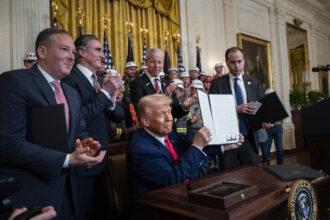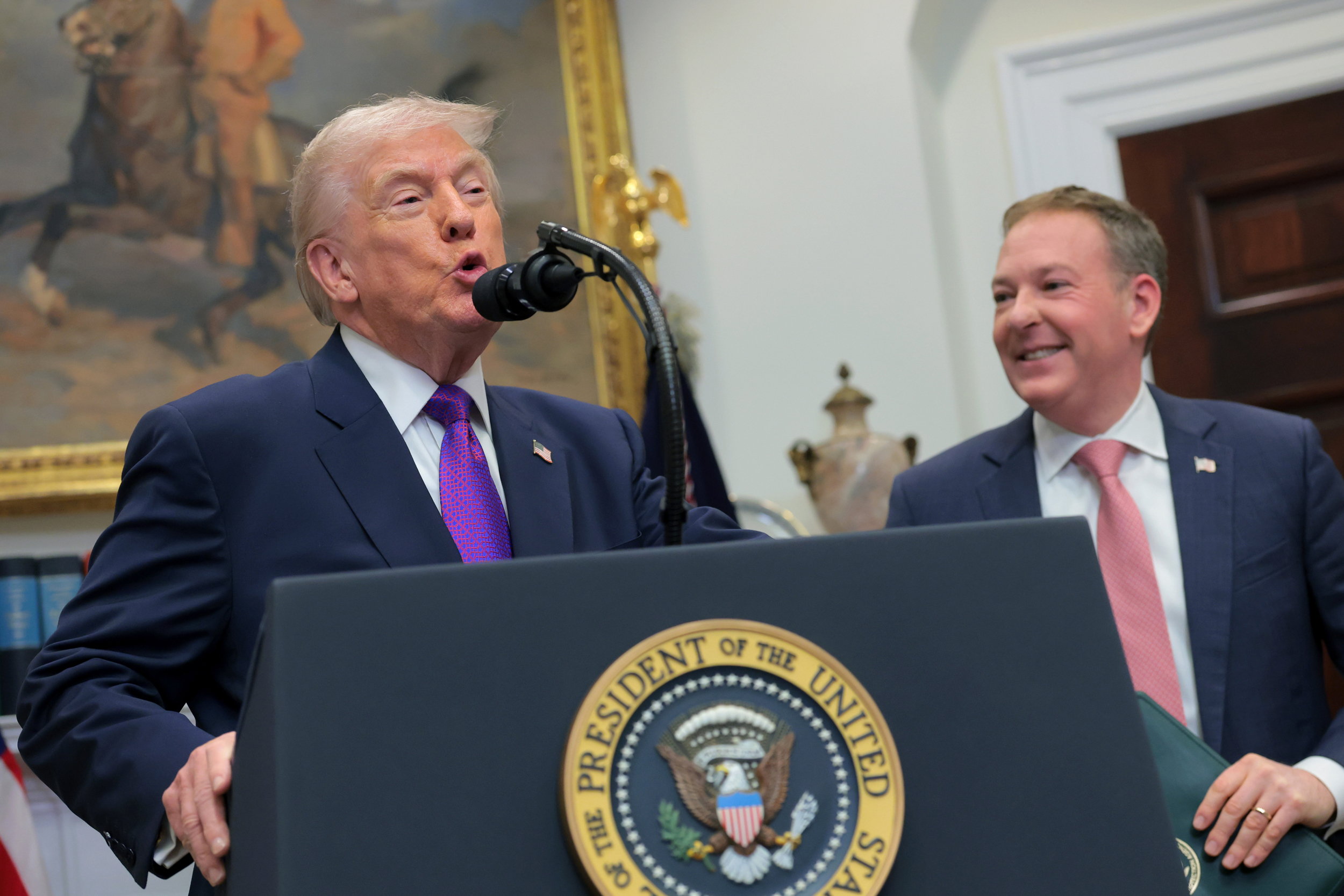


The Trump administration moved today to overturn a key legal foundation of the federal government’s authority to regulate greenhouse gases. In a press conference at the White House, President Donald Trump hailed the move as “the single largest deregulatory action in American history.”
The 2009 endangerment finding forms a cornerstone for the Environmental Protection Agency’s regulation of greenhouse gas emissions from sectors like motor vehicles and power plants. The finding stems from a 2007 Supreme Court decision, Massachusetts v. EPA, that held that greenhouse gases should be considered air pollutants under the Clean Air Act. The finding states that “current or projected concentrations” of these gases “threaten the public health and welfare of current and future generations.”
“This action will eliminate over $1.3 trillion of regulatory cost and help bring car prices tumbling down dramatically,” Trump said. “You can get a better car. You can get a car that starts easier, a car that works better for a lot less money.” While electric vehicles tend to cost more than gasoline-powered cars upfront, they generally cost consumers less over the lifetime of the vehicle. And the impacts of climate change are associated with increasing costs for government, businesses and homeowners.
Trump called the endangerment finding a “radical rule” with “no basis in fact” and “no basis in law.” But scientific and legal evidence supporting the EPA’s conclusions in the endangerment finding is well-established, experts say. Even supporters of the repeal acknowledge that it is likely to trigger a sustained backlash that could mean years of lawsuits, state action and activist campaigns.
In the wake of Trump’s announcement, lawyers from environmental groups across the country promised to challenge the repeal.
“We will see them in court,” said Marvin Brown, senior attorney at Earthjustice. “This is an affront to not only our public health, but also an affront to our future and to basic science and basic scientific principles.”
The Sierra Club’s Andres Restrepo, senior attorney for the organization’s environmental law program, said the EPA’s move was “an attempt at an end run around the Supreme Court’s decision from almost 20 years ago.” Restrepo said the Sierra Club intended to challenge the repeal in court. The Natural Resources Defense Council released a statement today that they too would join the fight against EPA administrator Lee Zeldin’s determination.
The body of research showing how rising concentrations of greenhouse gases in the atmosphere impact severe weather and the fundamental stability of the planet’s climate has only grown more substantial since 2009, said Robert Howarth, professor of ecology and environmental biology at Cornell University. “We knew the basic science [of global warming] in 1896,” he said. “That really hasn’t changed.”
Scientists’ knowledge about how greenhouse gases affect hurricanes, wildfires, heat waves, flooding and agricultural productivity becomes more detailed every year. The government’s decision today is “not based on science,” Howarth said. “It’s a predetermined political decision.”
During the press conference, Zeldin accused the Obama and Biden administrations of using “legal gymnastics” to “back door their ideological agendas on the American people.”
This story is funded by readers like you.
Our nonprofit newsroom provides award-winning climate coverage free of charge and advertising. We rely on donations from readers like you to keep going. Please donate now to support our work.
Donate NowThe Obama administration was responding to the 2007 Supreme Court ruling when it made the original endangerment finding, said Erika Kranz, a senior staff attorney in Harvard University’s Environmental and Energy Law Program. The Obama EPA’s decision came on the heels of the agency’s refusal to regulate greenhouse gases during the George W. Bush era. Former president Barack Obama criticized the repeal today, saying that it would mainly benefit the fossil fuel industry. “Without it, we’ll be less safe, less healthy and less able to fight climate change,” he wrote of the finding.
The proposal to repeal the finding argued that the Clean Air Act does not cover greenhouse gases because they do not cause harm “through local and regional exposure.” This idea contradicts the Supreme Court’s decision from 2007.
Kranz said she would be watching for a response from industry. The “complete whiplash” caused by a repeal of this finding—and the patchwork of state regulations that could ultimately result—would create the kind of market unpredictability that businesses generally prefer to avoid. “A lot of industry groups commented on EPA’s proposal last summer and were not in favor of the rescission,” she said.
Some groups, like the climate change-denying Heartland Institute, cheered the announcement, calling it “a win for car and truck buyers” that would cut “the legs out from under the EPA’s climate rules.” America’s Power, a national trade organization that advocates for the coal industry, said the endangerment finding has been used “as the basis for regulations that threaten the reliability of our nation’s electric grid.”
“Overturning bad EPA regulations is necessary but not sufficient,” said CEO and President Michelle Bloodworth. She urged the federal government to take further action to keep coal-fired power plants running. Trump has made support for the coal industry a major priority, including an executive order Wednesday directing the Defense Department to buy coal power.
In Pennsylvania, local officials and organizers will gather tomorrow in Pittsburgh to denounce what they view as Zeldin’s “reckless decision.” Vanessa Lynch, Pennsylvania field organizer with Moms Clean Air Force, said that she would be joining the press conference because she’s seen the impacts that climate change has already had on communities in western Pennsylvania, and she worries what a future of unchecked warming will look like for her children.
“Repealing this foundational finding is appalling,” she said. “We need to be able to depend on the EPA to live up to their job of protecting people and families across the country.”
About This Story
Perhaps you noticed: This story, like all the news we publish, is free to read. That’s because Inside Climate News is a 501c3 nonprofit organization. We do not charge a subscription fee, lock our news behind a paywall, or clutter our website with ads. We make our news on climate and the environment freely available to you and anyone who wants it.
That’s not all. We also share our news for free with scores of other media organizations around the country. Many of them can’t afford to do environmental journalism of their own. We’ve built bureaus from coast to coast to report local stories, collaborate with local newsrooms and co-publish articles so that this vital work is shared as widely as possible.
Two of us launched ICN in 2007. Six years later we earned a Pulitzer Prize for National Reporting, and now we run the oldest and largest dedicated climate newsroom in the nation. We tell the story in all its complexity. We hold polluters accountable. We expose environmental injustice. We debunk misinformation. We scrutinize solutions and inspire action.
Donations from readers like you fund every aspect of what we do. If you don’t already, will you support our ongoing work, our reporting on the biggest crisis facing our planet, and help us reach even more readers in more places?
Please take a moment to make a tax-deductible donation. Every one of them makes a difference.
Thank you,

Kiley Bense
Reporter, Pennsylvania
Kiley Bense covers climate change and the environment with a focus on Pennsylvania, politics, energy, and public health. She has reported on the effects of the fracking boom in Pennsylvania, the expansion of the American plastics industry, and the intersection of climate change and culture. Her previous work has appeared in the New York Times, the Atlantic, Smithsonian Magazine, the Believer, and Sierra Magazine, and she holds master’s degrees in journalism and creative writing from Columbia University. She is based in Pennsylvania.