

The Resistance, Part 1: With an army of lawyers, an activist legend squares off against polluting industries along the Texas coast she calls home.
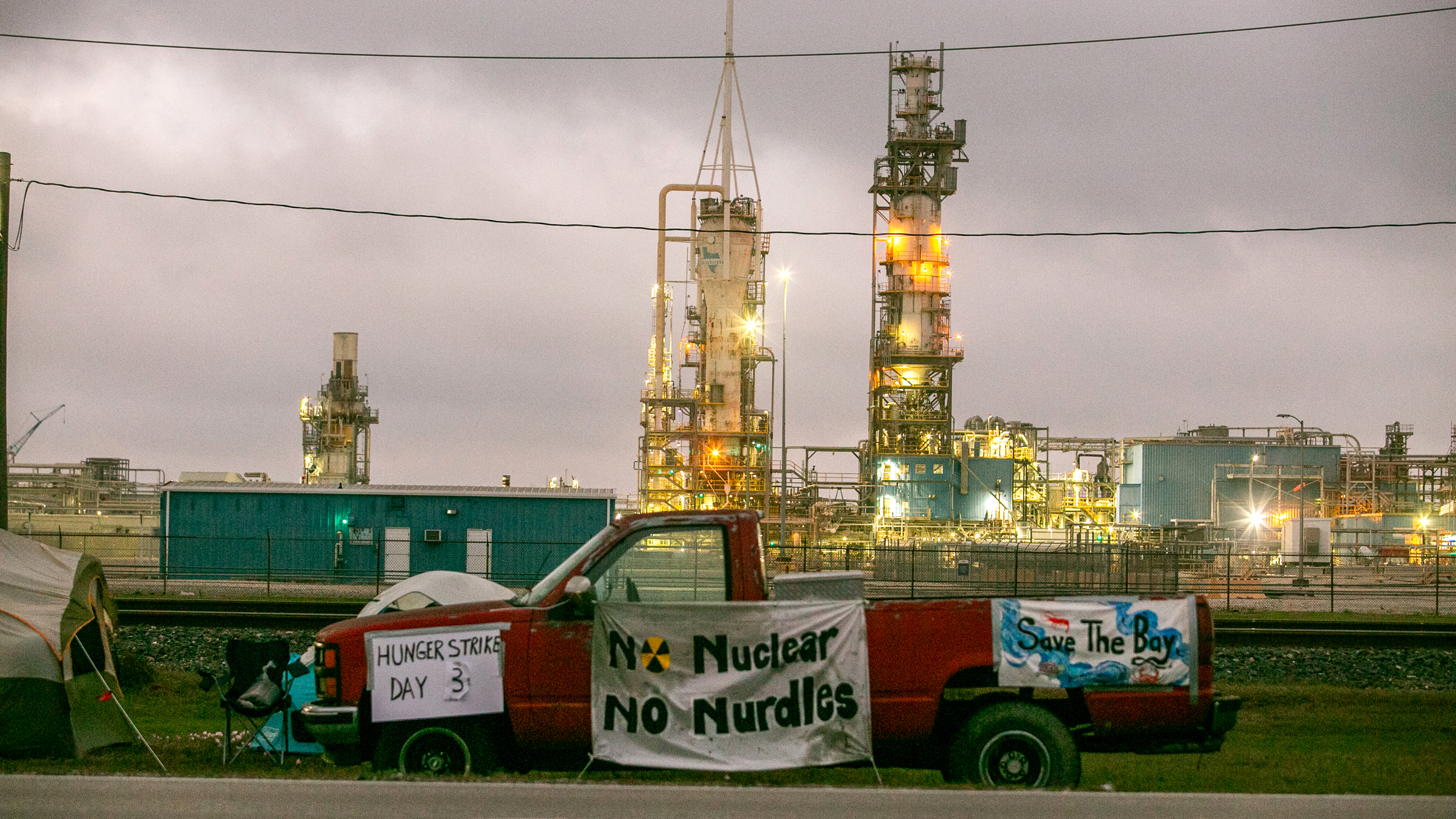
SEADRIFT, Texas—All day, Diane Wilson sat in a ditch outside a chemical plant here on the Gulf Coast of Texas, waiting to see if sheriff’s deputies would show up to run her off. When they didn’t, she returned the next morning, set up her tent, settled in and stopped eating.
Wilson, 78, watched the day go by, then spent the night and watched another.
By the fourth morning, her craving for food was fading. At twilight in early March, she crawled from her tent to the deafening screech of train breaks, pulled out her earplugs and grabbed a marker to update her sign.
“Hunger Strike: Day 4,” read the poster hung on the side of her truck. Beside it flapped a banner her grandkids had painted. “No Nuclear. No Nurdles,” it said.
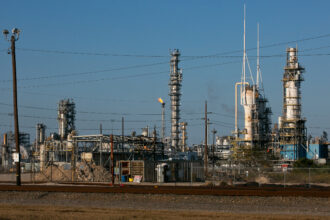
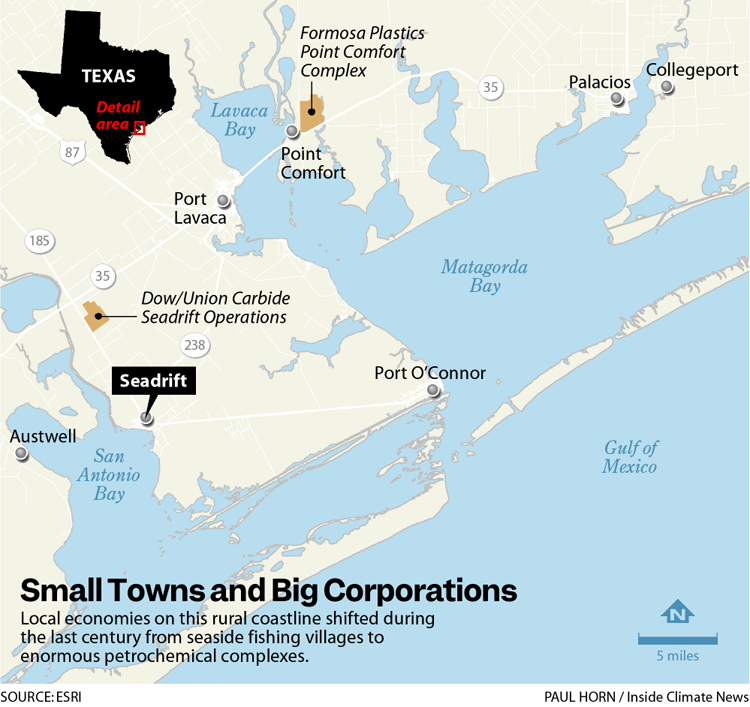
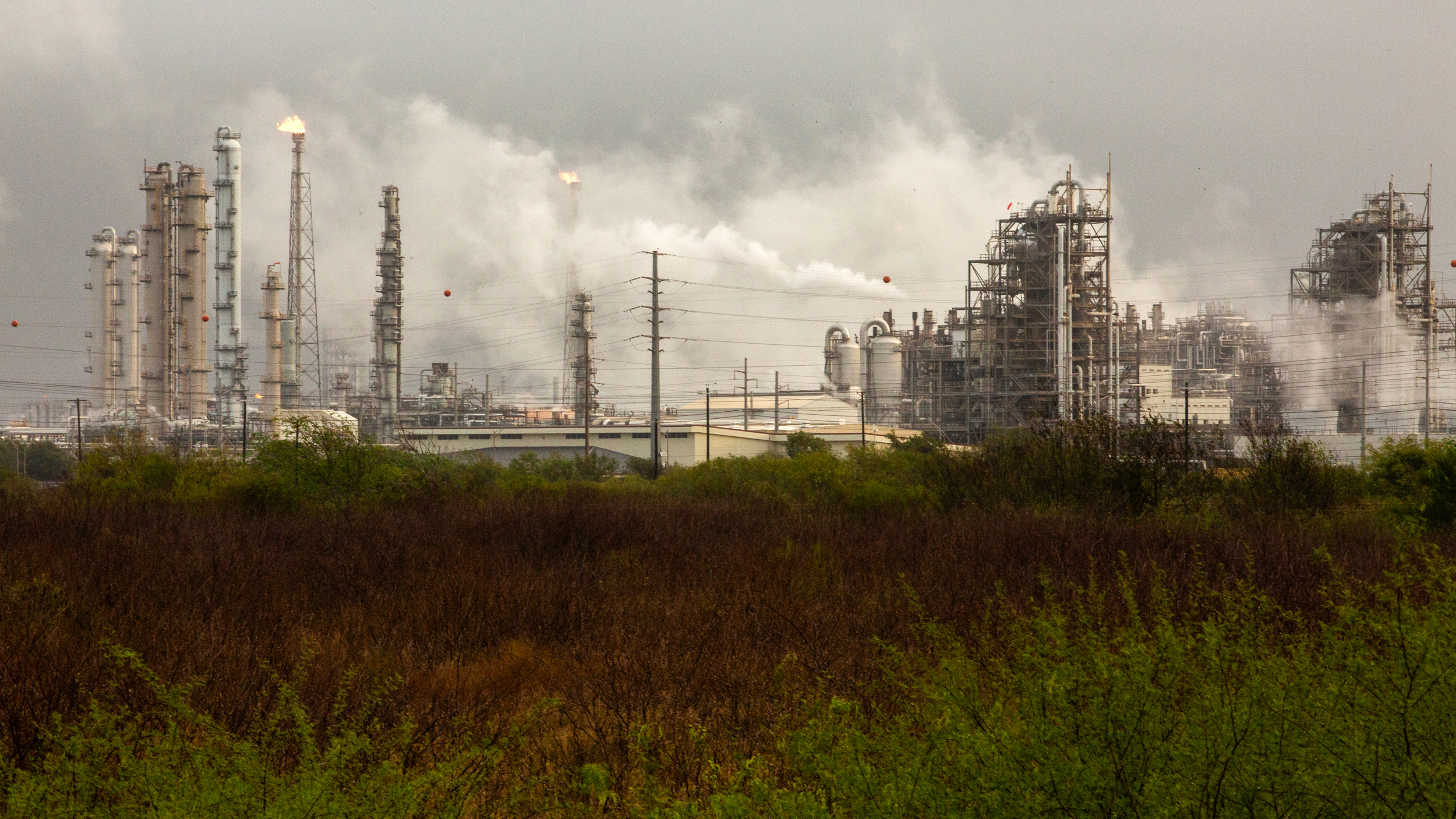
With a solar-powered laptop on a fold-out desk, Wilson began drafting her demands for Dow, the largest North American chemical manufacturer and the operator of the 4,700-acre complex outside her tent, about two hours southwest of Houston.
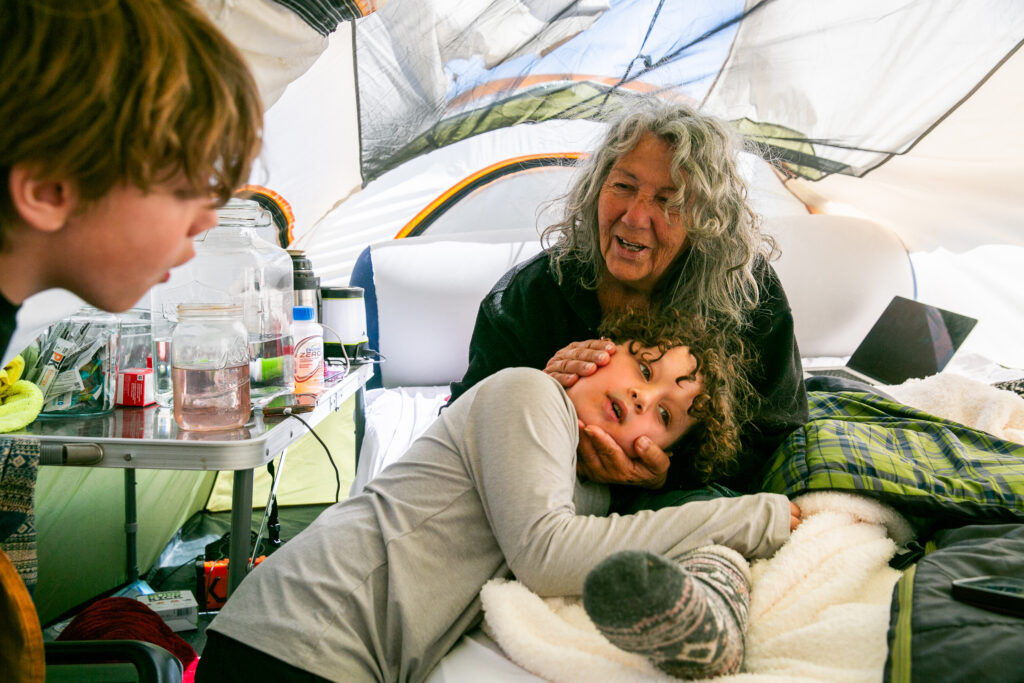
After five days without eating, she marveled at how much energy writing required. She knew that already. She’d written notes, letters, even sections of her books, while on hunger strikes many times before, but this time felt different. On the other side of her computer screen, a buzzing network of attorneys and advisors were editing her words and chiming in with suggestions.
Wilson, a great grandmother and retired shrimper with a reverence for solitude, generally preferred working alone. At least, that’s what she got accustomed to through countless silent mornings on the bay as a radical environmentalist for half her life, ostracized from communities where her roots stretched back generations.
Tall and strong with a rural high school education, Wilson never thought of herself as a woman who could have a dozen lawyers. Most of her eager, new helpers showed up in recent years after her small nonprofit won a $50 million settlement from a Taiwanese petrochemical plant in 2019, the largest award in a citizen lawsuit against a polluter in the history of the Clean Water Act.
Four years later, she received the Goldman Environmental Prize for North America, the most prestigious award in grassroots environmentalism, and its $200,000 cash award. She and her growing cadre of public-interest lawyers used the money to build a powerful machine that was pushing back against some of the nation’s biggest industrial actors.
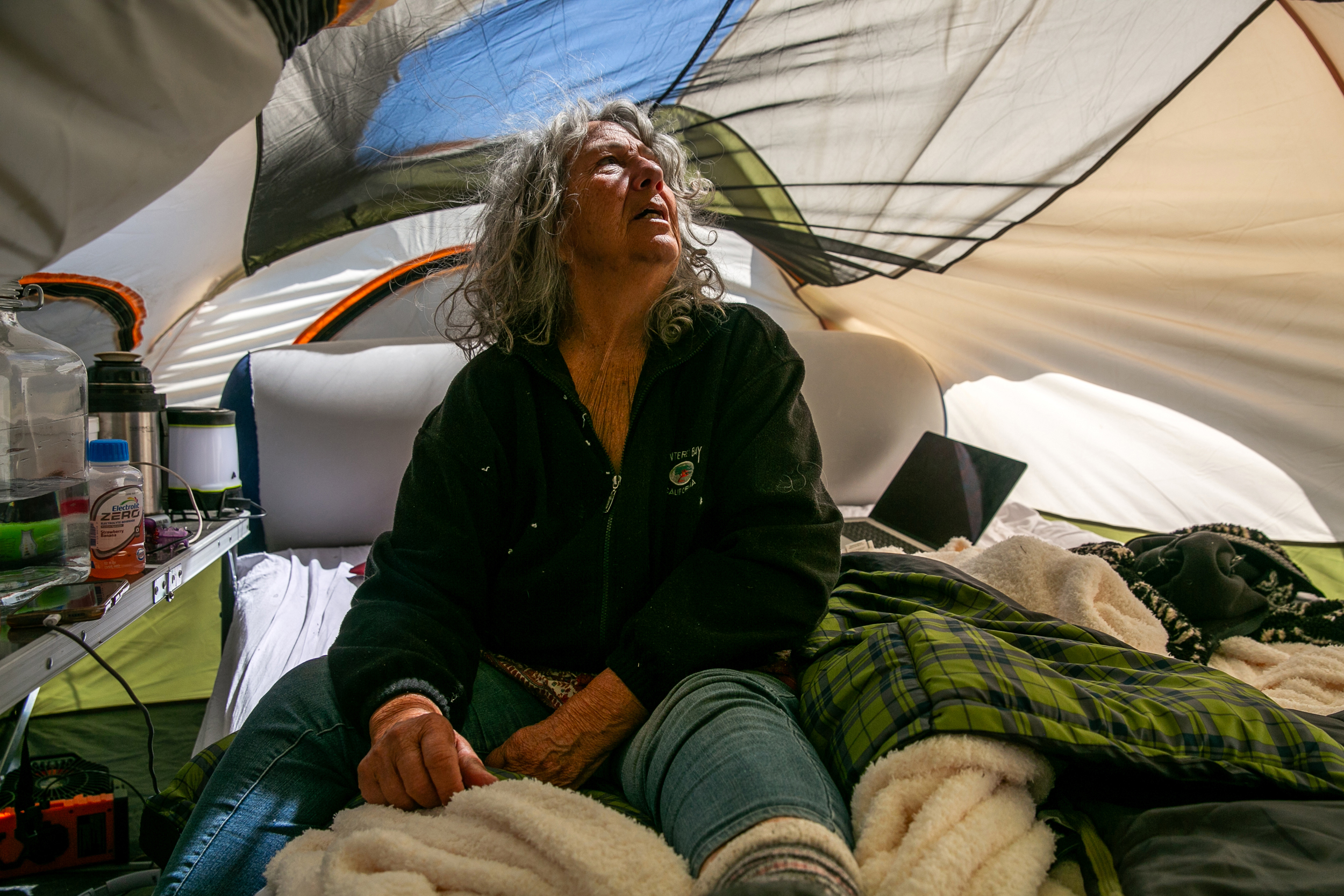
Reclined on an airbed in her popup tent, Wilson presided over a demanding regimen of Zoom calls with her network of allies to talk strategy and draft language amid the occasional, overbearing blast of train horns, interspersed with honks of support and engine revs of disapproval from vehicles on the state highway, about 20 feet away.
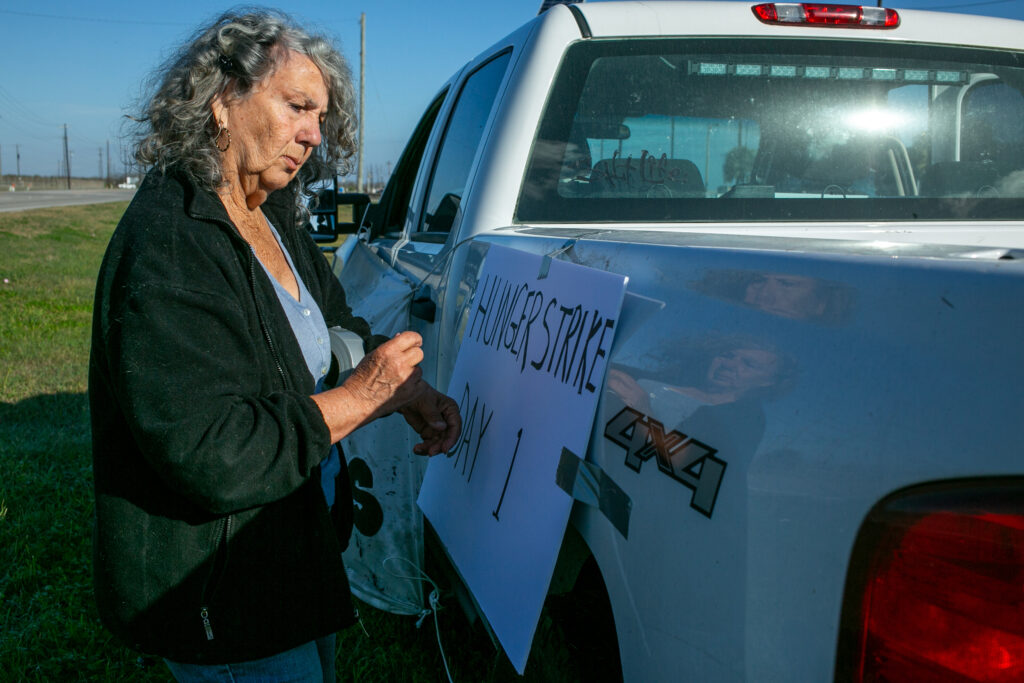
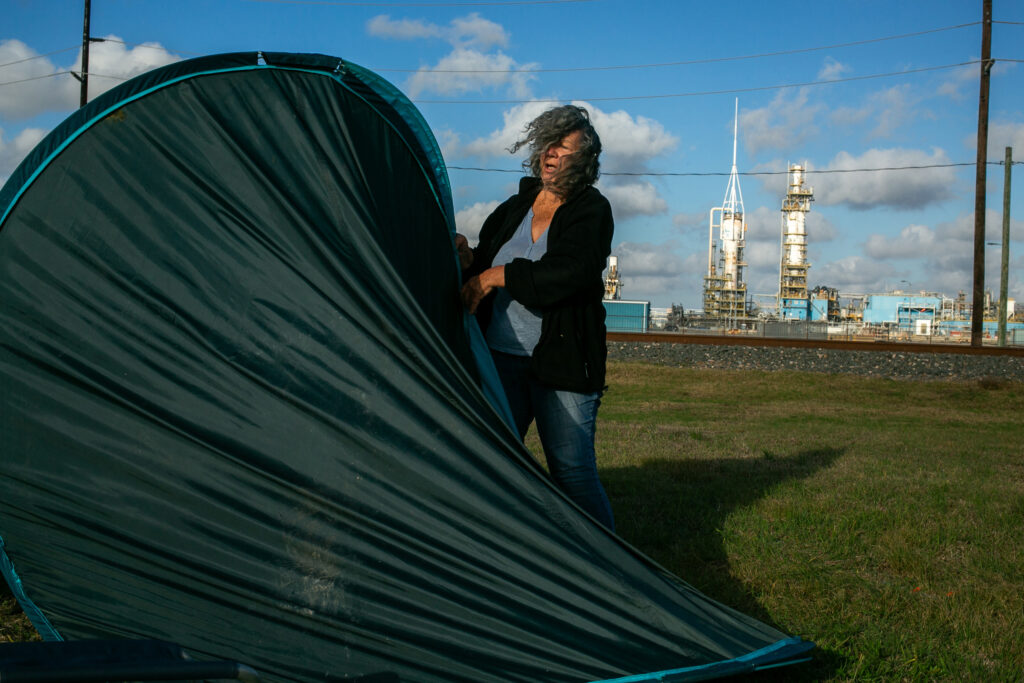
Diane Wilson posts a sign announcing the first day of her hunger strike and sets up a tent on March 2 outside Dow’s Seadrift complex.
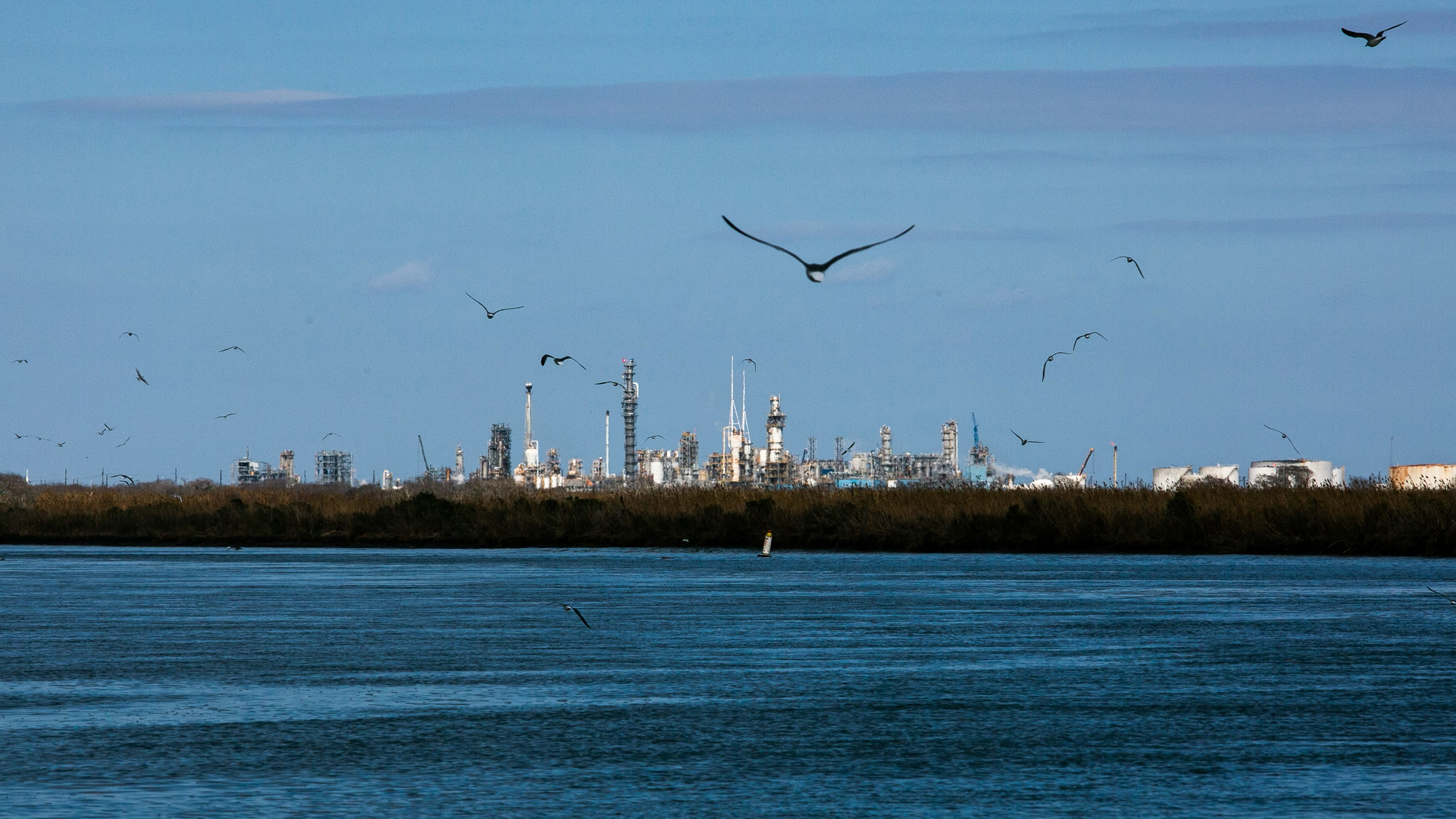
She scrolled through the comments on Facebook, where local news sites posted articles about her on Calhoun County community pages. There were some friendly remarks, as well as the usual:
“FRAUD NUT JOB!”
“Dow is laughing while you starve”
“Fruitcake. Has hated that plant for 50 years.”
“Lol, just ignore her. She’ll go away eventually. These people aren’t particularly devoted.”
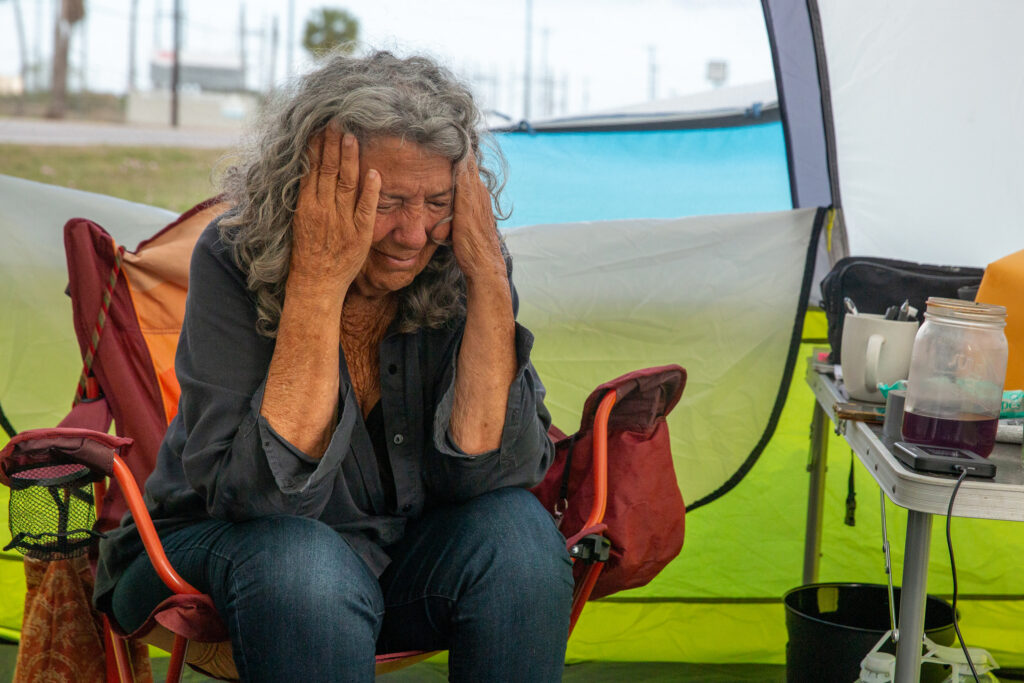
After seven days without food, walking began to get difficult. Wilson’s body felt weak, her energy low, but her focus was exceptional. The next day she finished her demands. There were two. A staff member of her organization, a former Buddhist monk, drove in from Houston and took Wilson in his red Toyota sedan a few hundred yards from her campsite to Dow’s office doors. Inside, she asked a guard to call the plant manager. She wanted to hand him her demands.
But the guard told her to leave. He wouldn’t call the manager. And if Wilson came back he would have her arrested. He had worked at that plant a long time, since before they called the place Dow, and he knew exactly who she was.
An Unreasonable Woman
She was nine years old when she first heard of the sprawling Dow plastics plant, which was owned by Union Carbide in 1957. She was pinching off shrimp heads with her grandma and other ladies at one of five fish houses that processed each day’s catch at the docks of Seadrift. A strange, new car drove up. Someone said it came from Union Carbide.
As an adolescent working on her dad’s or uncle’s boats, she listened to the rambling stories shrimpers told over crackly radios about the seasonal jobs they’d taken at Union Carbide, given all the trouble with the fishing economy. Wilson even took a job there briefly in the early 1970s when she was in her mid-20s.
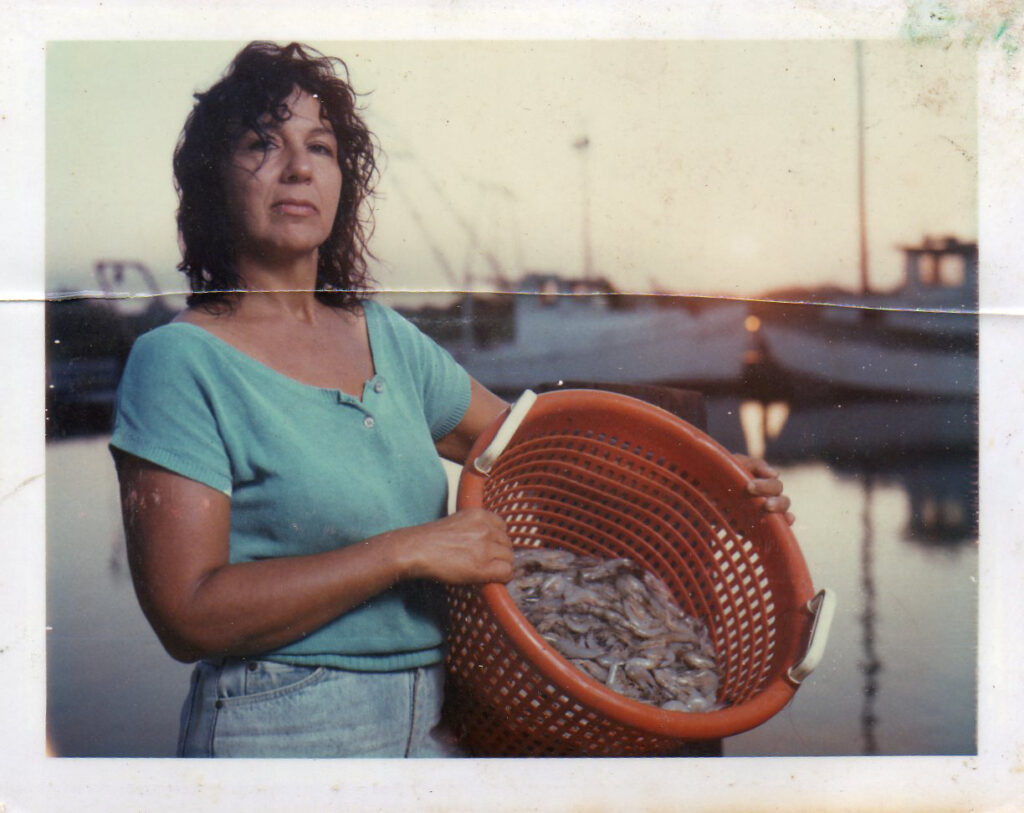
But she didn’t like the chemicals or being watched all the time. After two weeks she quit and walked home to Seadrift. Shrimping was tough, but at least she was free.
She married, had five kids, fixed shrimpers’ nets and managed her brother’s fish house. Her life seemed pretty normal for a poor, rural woman on the Texas coast until one day in 1989, when things began to spiral and never stopped.
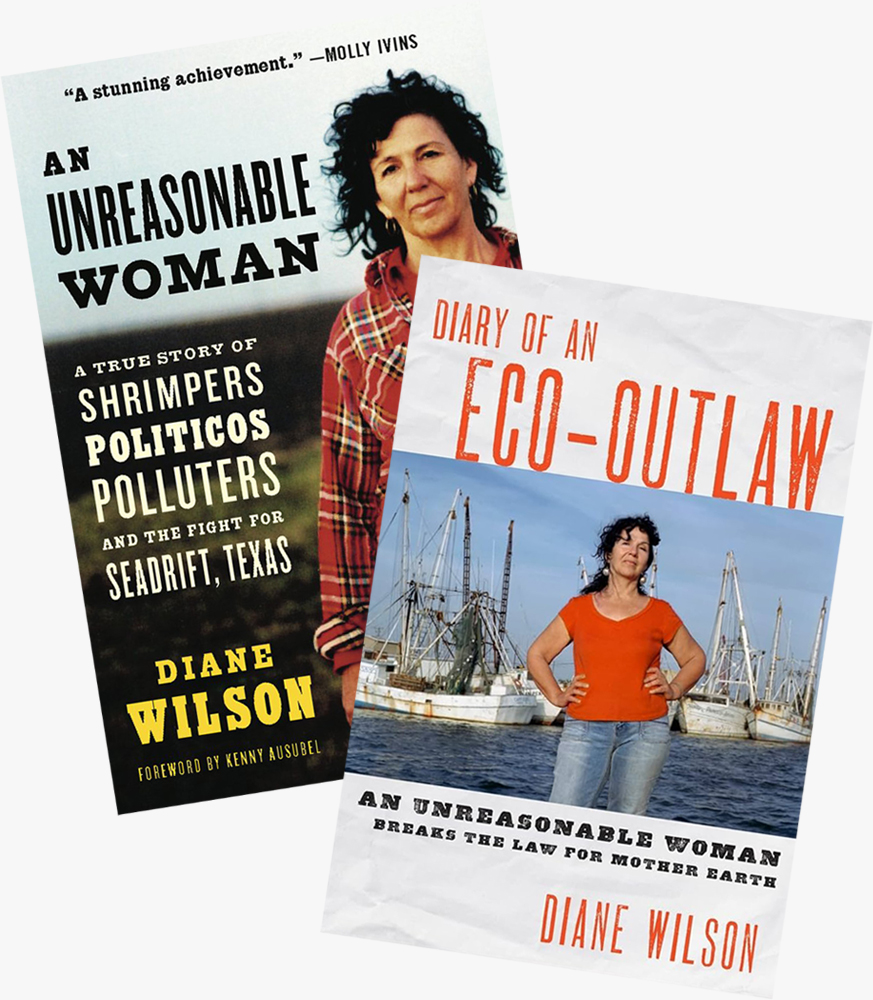
She published her first memoir, “An Unreasonable Woman,” in 2005, about her long fight against Formosa Plastics and the scourge of petrochemical pollution along the Texas Gulf Coast. In it, she describes her escalating activism, ostracization, hunger strikes, radicalization and early agreements with Formosa.
Her second memoir, “Diary of an Eco-Outlaw,” appeared in 2011. In the book, Wilson moves beyond Seadrift and describes her evolution as a national and international activist, beginning with her crusade against Dow and Union Carbide, which Dow acquired in 2001, for the 1984 Bhopal disaster in India. It ends with her co-founding of Code Pink, the women’s anti-war group formed in 2002 to stop the invasion of Iraq, and its relentless advocacy for an end to the war and the closure of Guantanamo Bay.
In 2013, Wilson went 54 days on hunger strike at a protest camp in Washington. Then on June 26, in observance of the International Day in Support of Victims of Torture, Wilson ignored the warnings of peers who told her she’d be shot if she vaulted the White House fence, and she threw herself over.
Dressed in an orange prisoner’s jumpsuit, lying on the White House lawn, faced with snarling German shepherds and shouting Secret Service agents pointing rifles, Wilson experienced the deepest moment of serenity in her life, she would later recall.
Formosa
At home she was an outcast. But she also became a magnet for indignant plant workers whose complaints had been dismissed by every level of authority until they reluctantly went to Wilson, the only one who would listen.
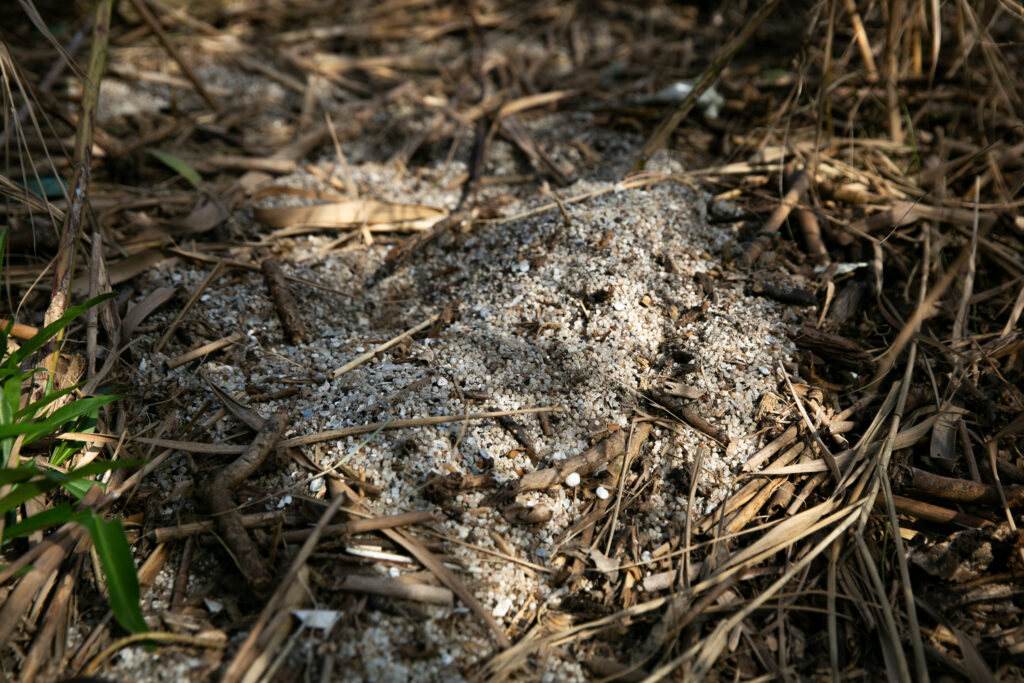
One worker showed Wilson the plastic pellets and powder in the water around Formosa. Unlike the fluids and vapors that Formosa released, these plastic solids, known as nurdles in the chemical industry, were easy to see and even pick up.
The more they probed, the more plastic they found. So Wilson and two retired Formosa workers started to collect it.
Wilson mentioned the hundreds of samples they had when she chanced, in 2015, to meet Amy Johnson, an attorney with Lone Star Legal Aid, one of few firms that took environmental cases pro bono in Texas. Johnson, an experienced lawyer who had once worked under Texas Gov. Ann Richards, didn’t see a case there.
Regardless, Wilson’s team kept collecting for a year until they had thousands of samples and Johnson agreed to take their case.
Standard water pollution permits in Texas authorize only “trace amounts” of “floating solids” like pellets and powder. To win in court, Wilson’s team would have to prove that Formosa had chronically violated its permit terms. Typically, similar pollution lawsuits are litigated based on companies’ emission records, but Wilson was the first to build a case based on citizen-gathered evidence.
The team brought in allied nonprofit attorneys, like Erin Gaines at Earthjustice, as well as volunteer scientists who measured and cataloged the plastic samples with the rigor required for admission as legal evidence.
They hauled truckloads to the federal courthouse in Victoria in 2019 when their case went to trial. Lawyers for Formosa told the judge that the company always complied with its permits. Then Wilson’s lawyers took the judge to the basement, where they’d heaped dozens of boxes of plastic pellets recovered from the waters near Formosa’s outfalls.
The judge ruled in Wilson’s favor, calling Formosa a serial violator. Rather than face court-ordered penalties for decades of non-compliance, Formosa opted to settle with Wilson, and the two parties began negotiating terms.
In subsequent conferences, Wilson and her crew of mostly female lawyers received treatment from Formosa’s all-male representatives that she considered crude and barbaric. They tried to brush her off with a pittance, she said, which made her think they didn’t realize how badly they’d lost. She considered all their offers absurd and rejected them every time. The contents of those negotiations are covered by confidentiality agreements.
With no progress in negotiations, Formosa’s lawyers summoned Wilson, Johnson and Gaines to their firm’s office on the downtown Austin lakefront in 2019. There they met no men from Calhoun County. Instead, awaiting them in a posh conference room was a Taiwanese-American woman from Formosa’s corporate office in New Jersey.
They bartered for hours but Wilson said she never budged. She knew what she wanted: a $50 million environmental trust fund, a cleanup campaign and comprehensive commitments to stop discharging plastic.
Formosa agreed to it all. But it still took months to realize the magnitude of Wilson’s victory. Over the next two years, Wilson allocated the $50 million to start a fishermen’s cooperative, build a new county park, provide wastewater treatment for a tiny nearby town, host summer camps for kids and sponsor scientific studies. She marveled how much nicer people were to her now that she, like the chemical companies, was giving out millions of dollars.
Meanwhile, Formosa’s cleanup efforts spiraled in scope as the enormous scale of accumulated plastics around Lavaca Bay came into focus. Formosa funded the development of new hardware to test for plastics in wastewater. When installed, in 2021, it continued detecting plastics in every sample. So, it is still paying millions of dollars of fines into Wilson’s trust fund to this day.
“We understand that compliance with local, state and federal regulations is our license to do business, which is why we take it seriously and work in close collaboration with relevant agencies to develop and implement effective operations and diligently do our best to help ensure the communities we live and work in can continue to be enjoyed by all,” said Amy Blanchett, Formosa’s spokesperson.
The trust fund established after the Formosa settlement moved to independent management and continued to sponsor large projects in the area. None of the money went to Wilson directly.
Then, in 2023, Wilson received the Goldman Environmental Prize, a $200,000 cash award, and a standing ovation at the San Francisco Opera for her fight against Formosa.
“There comes a time when a home needs defending, the lines need drawing in the sand and those that dare cross it go at their own risk,” Wilson, wearing a magenta gown, told the audience from a podium on stage. “Throughout this journey I’ve lost a lot of stuff. I lost my marriage, I lost my boat, I lost my job, I lost a lot of friends. But the funny thing is how you can lose it all but you gain your soul.”
“A Machine That Can’t Melt Down”
Just as Wilson wrapped up her settlement with Formosa, fate pulled her attention back to Dow in 2023. With 1,200 residents, Seadrift never made the news. But there it was in headlines shared on local Facebook pages. Even the governor made a post about Seadrift: Dow had selected its Seadrift site for a cutting-edge complex of small nuclear reactors.
When she read that, Wilson needed barely a split second to resolve that she would fight this plan until the end.
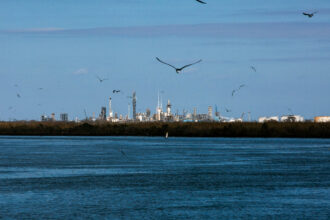
She thought of the hurricanes that periodically razed the region, about the beloved bay, the remnants of her cherished fishing community and the nuclear disaster that could do catastrophic damage to it all. She didn’t even care what anyone had to say about the nukes.
The project, in partnership with a nuclear startup called X-energy, was one of two funded by the U.S. Department of Energy to lead a renaissance of American atomic power. It used a revolutionary new type of fuel, long in development and supposedly meltdown-proof, which drastically reduced the safety requirements and cost of reactor designs.
“This technology is a game changer because of its safety,” said X-energy CEO J. Clay Sell, a former deputy energy secretary and special assistant to President George W. Bush, speaking to Gov. Greg Abbott during a 2023 panel discussion at the University of Texas at Austin. “We will build a plant that is physically impossible, Governor, to melt down.”
Jim Fitterling, CEO of Dow, nodded beside Abbott.
“When you start with a plant that is physically impossible to melt down it completely changes the nature of your engagement in the community,” said Sell, a lawyer from Texas. “We don’t have to deal with 10-mile-radius emergency planning zones. The emergency planning zone for this plant will be about 400 meters.”
He added: “When you start with a machine that can’t melt down, it allows us to reduce the required number of safety systems on that reactor by 80 to 90 percent… It’s a simpler, more elegant design with fewer parts, it is built in a factory, the components are delivered to site and construction really becomes assembly, measured in a period of months instead of years or decades.”
Wilson knew the steps to challenge permits from the Texas Commission on Environmental Quality, the Environmental Protection Agency and the Army Corps of Engineers.But she had no idea where to begin with the Nuclear Regulatory Commission. Barely anyone did. The NRC hadn’t issued construction permits for a reactor project in decades.
Wilson put out calls through her nationwide network and assembled a heavyweight team to fight the project. She recruited Tim Judson, executive director of the Nuclear Information and Resource Service, who had experience with NRC processes since the late 1990s. Wilson also got physicist Edwin Lyman, director of nuclear power safety with the Union of Concerned Scientists, who lectures around the world on risks of next-generation reactors.
Wilson knew she needed an environmental lawyer with enough guts to enter the arena with no experience in nuclear law and face pricey corporate attorneys. She used her Goldman Prize money to hire Marisa Perales, a partner in a downtown Austin law firm whose roots stretch back generations in the small South Texas town of Alice.
They knew that once the NRC posted Dow’s application online, they’d have just 60 days to read it and formulate a petition.
Nukes and Nurdles
Beyond the nuclear fight, the Goldman Prize money allowed Wilson to hire other helpers for a legal challenge she’d been thinking of for years. She wanted to repeat her Formosa takedown on Dow.
Her lawsuit against Formosa had jolted a national awareness that plastic discharge from production facilities wasn’t special to Calhoun County. In fact, it appeared widespread. Citizen groups in other states had replicated Wilson’s effort with measured success.
Wilson had known for years about pellets flowing down the waterway from Dow. But she lacked the capacity, now in her late 70s, to lead another collection campaign.
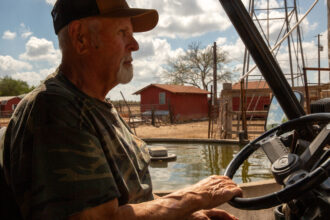
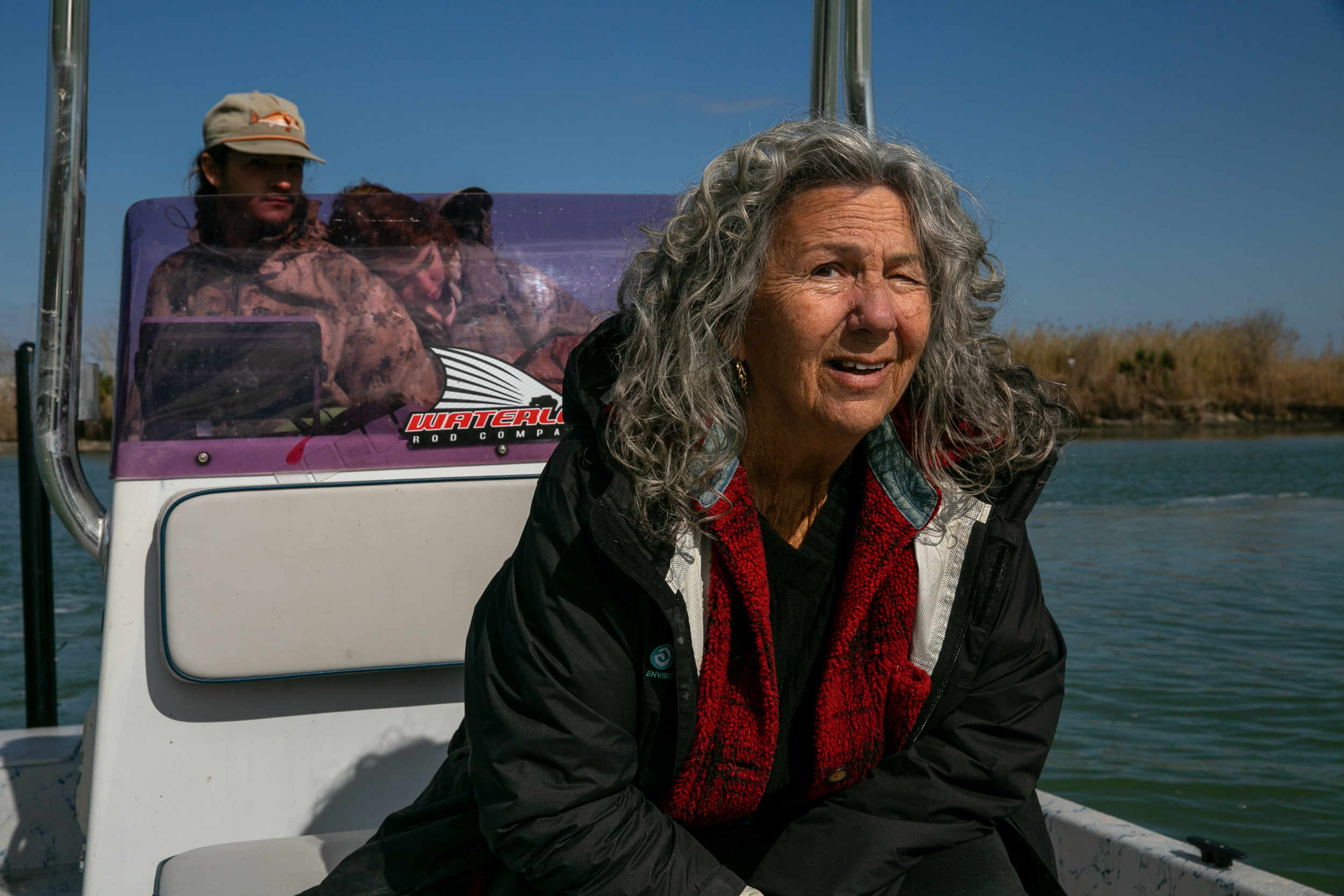
She paid a boat captain who had ridden the school bus with her son 20 years prior to patrol the shores near the Dow plant. He brought his young granddaughter, who leapt nimbly from the skiff to the banks to gather plastic pellets. Later, Wilson hired her 17-year-old nephew, Rusty, who loved boating, hunting and fishing on the bay. For him, it was a lot better than any other job he could get around town.
Once she was able to hire staff, the scope of Dow’s plastic pollution came into focus. The situation seemed to her much worse than the plastic spillage had been at Formosa.
Meanwhile, the NRC posted Dow’s reactor construction application on June 10, 2025. Sixty days later, Wilson’s team filed a 263-page petition with three contentions challenging the adequacy of the project’s safety systems, financial qualifications and vulnerabilities related to climate change. It was the first such challenge to a permit for the new generation of American reactors.
The federal Atomic Safety and Licensing Board Panel accepted one contention, regarding Dow’s demonstration of financial qualifications to build and operate the project. A date for that hearing still hasn’t been set.
Wilson, however, didn’t care about the finances. She was outraged the board wouldn’t entertain challenges to the novel safety systems of these supposedly fail-proof units, or hear arguments about the history of flooding along the coast.
In December, Wilson’s lawyers on the plastics case—four women with the Environmental Integrity Project and Earthjustice—filed the required 60-day notice of intent to sue Dow on similar grounds as Formosa, laying out summary evidence in a 25-page document.
But 58 days later, on Feb. 13, Texas Republican Attorney General Ken Paxton filed his own lawsuit against Dow in a move that repeated the allegations of Wilson’s lawyers but precluded Wilson’s group from litigating. At the same time, Dow sought a permit amendment to effectively legalize its release of plastic solids, which would be the first such authorization in the country.
“It could set a dangerous precedent,” Rebecca Ramirez, an Austin-based Earthjustice attorney representing Wilson, told reporters.
This story is funded by readers like you.
Our nonprofit newsroom provides award-winning climate coverage free of charge and advertising. We rely on donations from readers like you to keep going. Please donate now to support our work.
Donate NowWilson sensed that Dow and the state were not prepared to let her do what she did to Formosa again. With all apparent legal avenues blocked, she figured it was time for a hunger strike.
Her assistant from Houston, Dan Le, asked if they might wait to prepare a press release. But Wilson believed any good idea would crumble if given time. So on Monday, March 2, she set up her tent in the ditch outside Dow, hung her banner that said, “No Nuclear. No Nurdles,” and stopped eating.
The local Facebook pages lit up with news stories of their local celebrity doing what she’s always done. Amid all the haters online, Wilson had plenty of defenders.
“She is the only person in Calhoun county fighting for wildlife, fisheries, and estuaries,” one responded to her detractors on a post by the Victoria Advocate. “How about not shooting her in the back.”
“Thank you, Diane,” wrote another. “We don’t deserve you.”
“You’ve Already Been Warned”
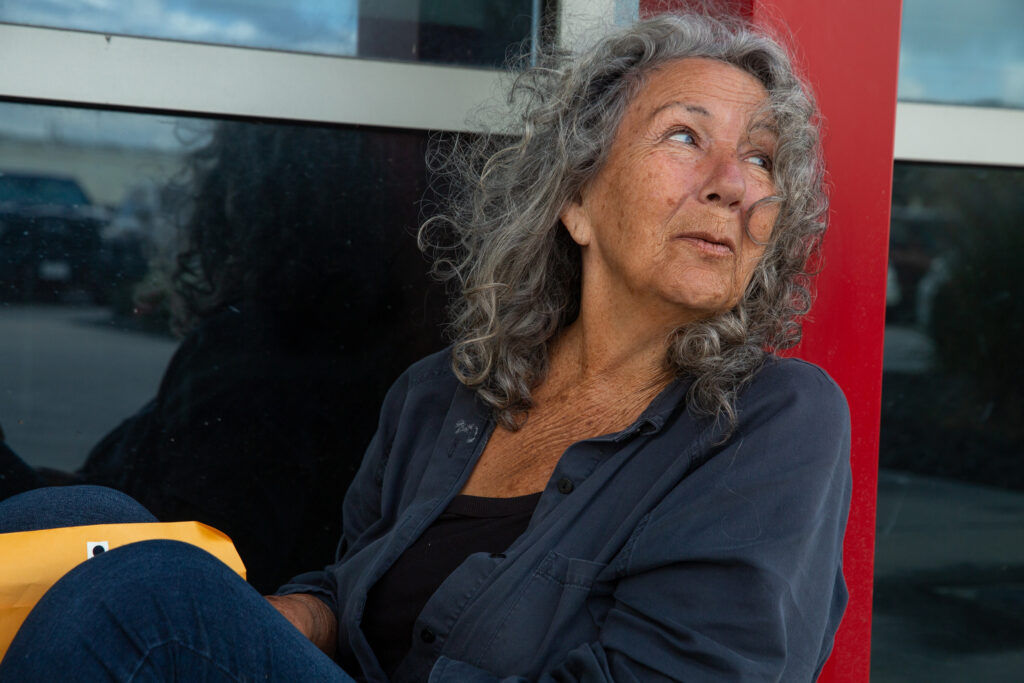
On March 27, 25 days into her hunger strike, Wilson chuckled as she told the friends gathered in her tent in the morning that she still hadn’t bathed. There were old timers and new helpers gathered to watch Wilson try to deliver her demands for a second time. Together they marveled at how far Wilson had come.
John Daniel, a 65-year-old Seadrift native and retired plant worker, came to help facilitate Wilson’s contact with Dow. He knew her before this environmental stuff even started, back when he was selling used tires at his welding shop and Wilson, the only woman he knew who changed her own tires, was fixing nets and running a fish house.

Her initial antics were hard to get used to. But he thinks she saw things back then that others only now have begun to recognize. Two days prior at a medical appointment, he said, his doctor had mentioned the hunger strike after seeing it online. He liked what Wilson was doing. A doctor. The tide was turning.
“Like little raindrops,” Wilson muttered weakly. “Bit by bit.”
“It’s changing from that crazy lady to admiration,” Daniel continued. “Respect is really heading your way.”
Robin Schneider, the retired, 28-year director of Texas Campaign for the Environment, recalled a moment last year at a voting location in Seadrift, when she saw the excitement of a retired Dow worker meeting Wilson for the first time.
“You were like the movie star,” Schneider said, and everyone in the tent awed in approval.
“It’s really different,” Wilson said slowly and faintly. “It’s a surprise.”
“About damn time is what it is,” Daniel said.
Minutes later, Schneider drove the crew to Dow’s door. They found it locked, so they waited.
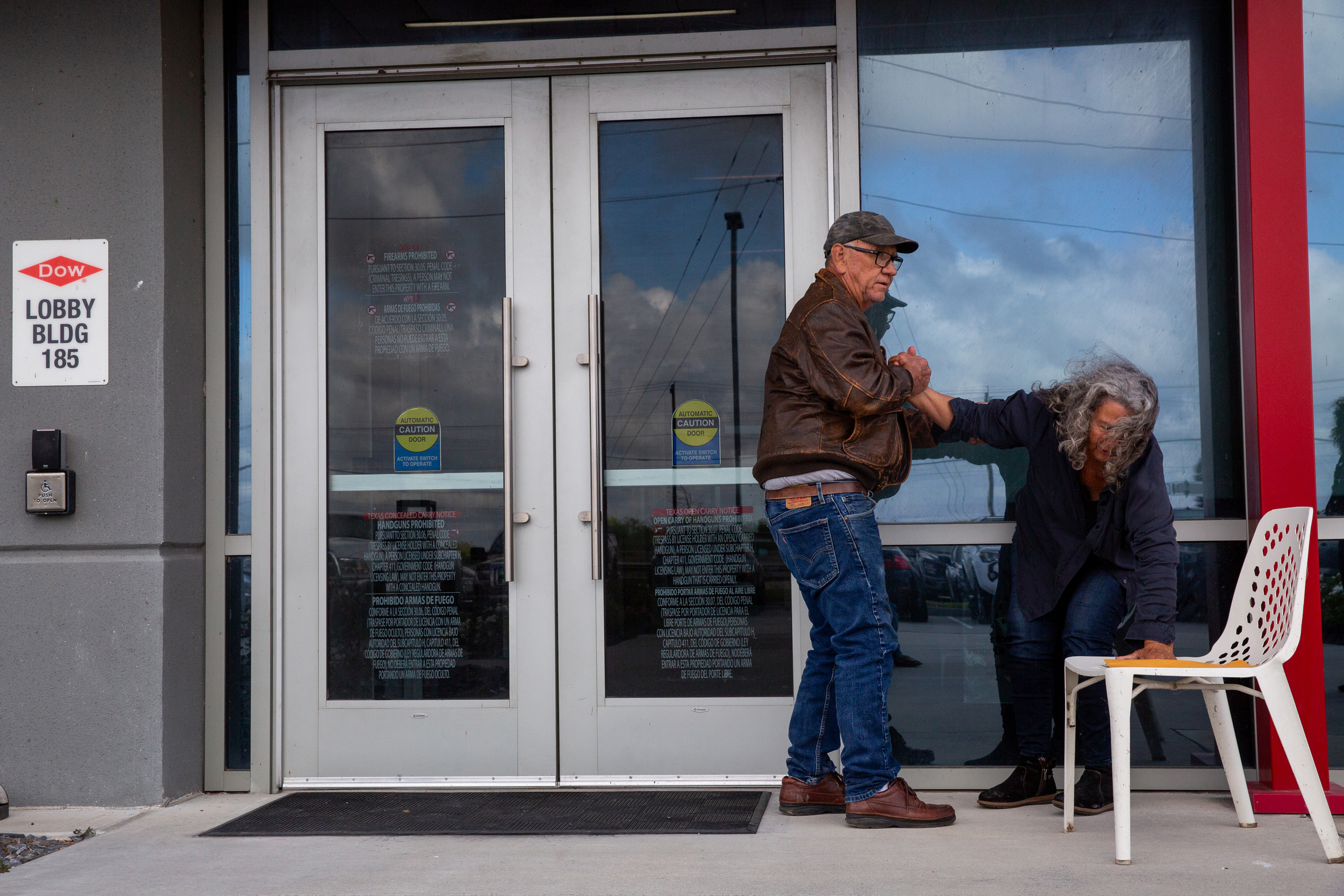
Daniel jiggled the handle with his thick, rugged hands. He peered inside the tinted windows at shadowy figures shuffling inside.
“They just don’t understand,” he bellowed at the window. “This Diane Wilson does not go away because you ignore her.”
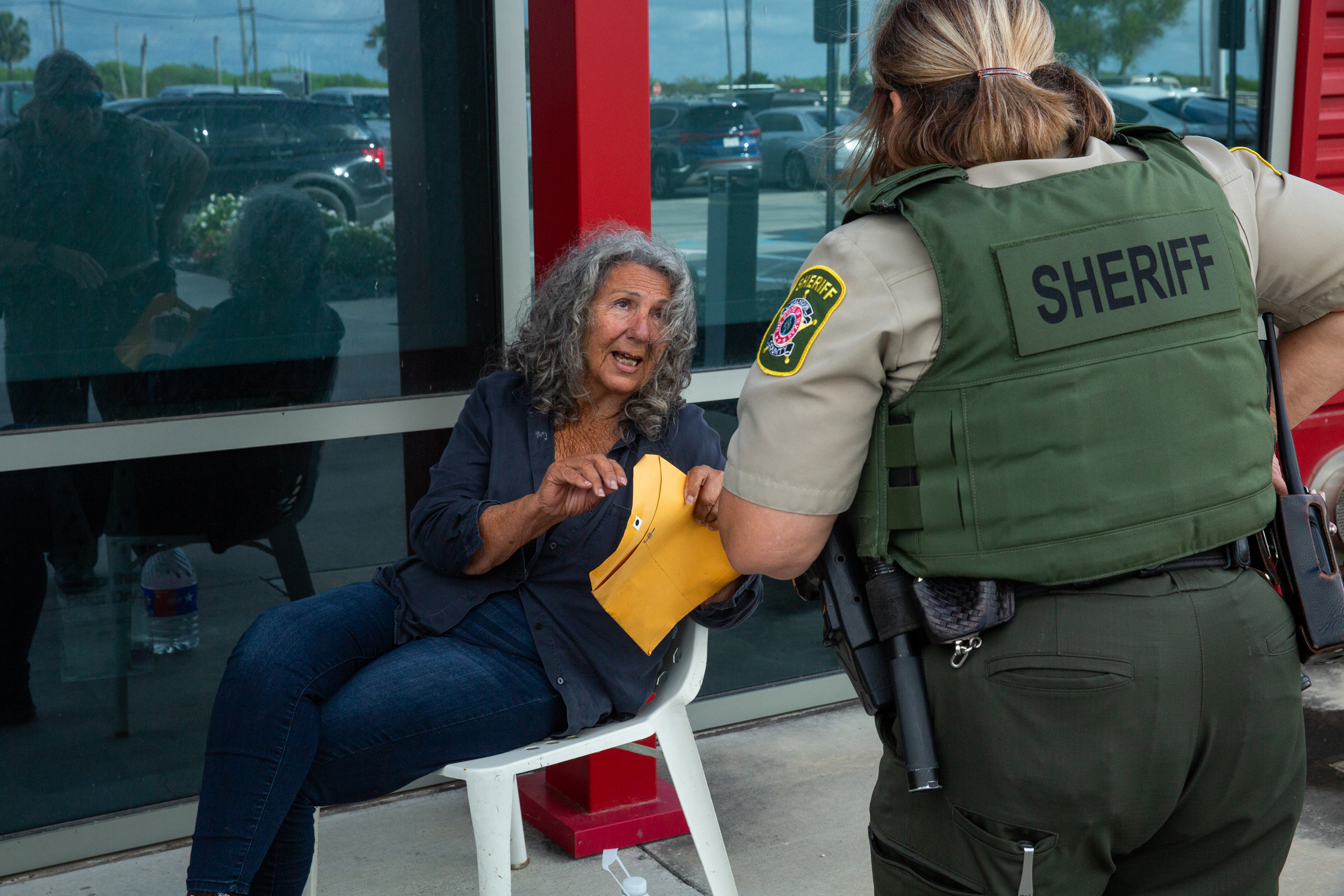
He grabbed a chair from Dow’s patio and brought it for Wilson, who was too weak to stand. Minutes later, two cars arrived from the Calhoun County Sheriff’s Department.
“You’ve already been warned,” a female deputy told Wilson, as Dow’s security chief stepped outside.
“You want us to arrest her?” the deputy asked, and the security chief nodded.
So she bundled Wilson in her back seat, handcuffed her and drove away.
The next day, the sheriff released her, so she returned to her tent to continue her hunger strike until she hit 30 days on April 1. Then she went home to plan her next move.
About This Story
Perhaps you noticed: This story, like all the news we publish, is free to read. That’s because Inside Climate News is a 501c3 nonprofit organization. We do not charge a subscription fee, lock our news behind a paywall, or clutter our website with ads. We make our news on climate and the environment freely available to you and anyone who wants it.
That’s not all. We also share our news for free with scores of other media organizations around the country. Many of them can’t afford to do environmental journalism of their own. We’ve built bureaus from coast to coast to report local stories, collaborate with local newsrooms and co-publish articles so that this vital work is shared as widely as possible.
Two of us launched ICN in 2007. Six years later we earned a Pulitzer Prize for National Reporting, and now we run the oldest and largest dedicated climate newsroom in the nation. We tell the story in all its complexity. We hold polluters accountable. We expose environmental injustice. We debunk misinformation. We scrutinize solutions and inspire action.
Donations from readers like you fund every aspect of what we do. If you don’t already, will you support our ongoing work, our reporting on the biggest crisis facing our planet, and help us reach even more readers in more places?
Please take a moment to make a tax-deductible donation. Every one of them makes a difference.
Thank you,

Dylan Baddour
Reporter, Austin
Dylan Baddour covers the energy sector and environmental justice in Texas. Born in Houston, he’s worked the business desk at the Houston Chronicle, covered the U.S.-Mexico border for international outlets and reported for several years from Colombia for media like The Washington Post, BBC News and The Atlantic. He also spent two years investigating armed groups in Latin America for the global security department at Facebook before returning to Texas journalism. Baddour holds bachelor’s degrees in journalism and Latin American studies from the University of Texas at Austin. He has lived in Argentina, Kazakhstan and Colombia and speaks fluent Spanish.