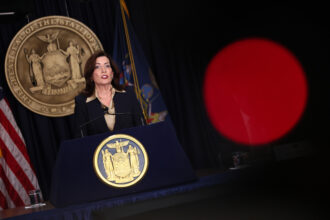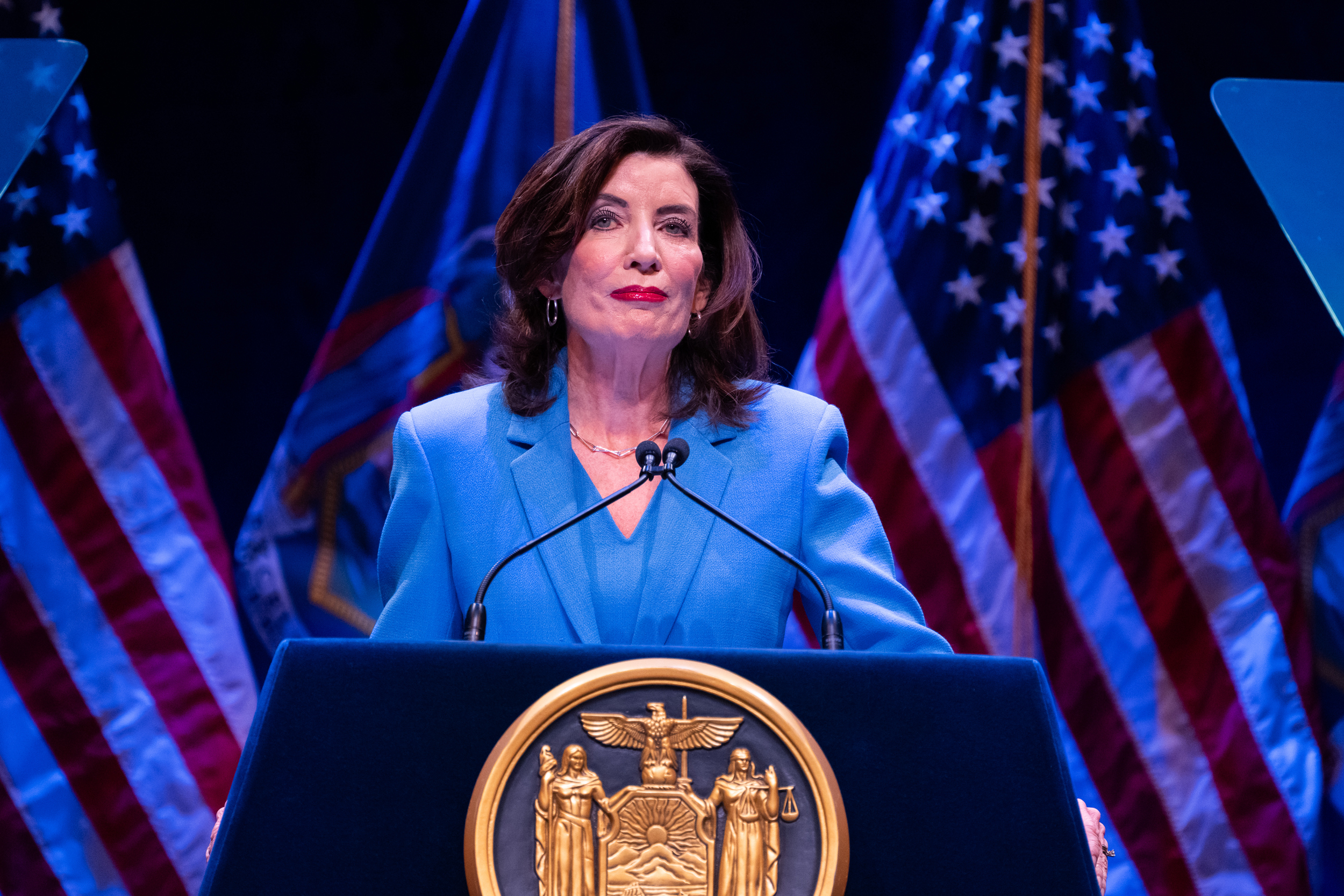


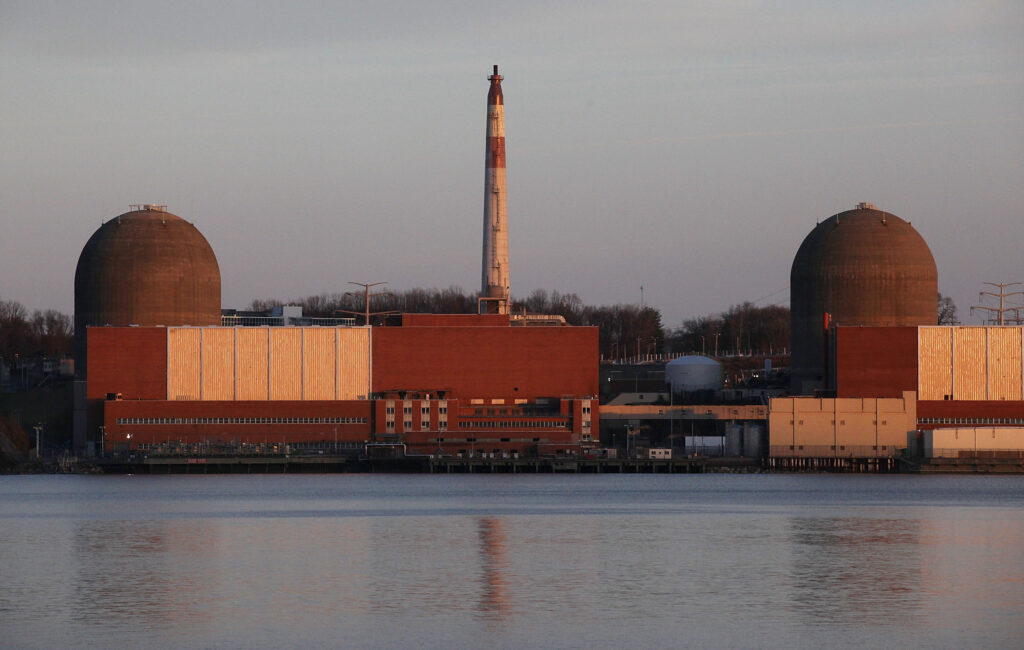
During her State of the State address this week, New York Gov. Kathy Hochul announced that she will push to invest more funds into nuclear energy, calling it “a vital part of our all-of-the-above approach to energy.”
The development of nuclear energy is a divisive issue among climate advocates in the state. Nuclear power plants do not pollute while operating and can operate continuously, unlike renewables, which are dependent on wind or sunshine. But the waste that the plants generate can be very radioactive and pose a threat to humans long after these facilities close.
Beyond fears of large-scale accidents—which are rare—nuclear power plants are costly to build and take a long time to come online. New York hasn’t built a new plant in decades.
“Whether or not her nuclear push is successful will depend on who pays for it and whether or not it will exacerbate the electricity affordability problem,” said Anshul Gupta, policy and research director at New Yorkers for Clean Power.
In her address, Hochul also announced that she would propose legislation to lower New York’s electricity rates, which are some of the highest in the country, to protect New Yorkers “from being blindsided by exorbitant rate hikes.”
Climate advocates believe the electricity rates—which Con Edison, a New York City-based utility, has recently proposed to raise—could be lowered by further expanding the state’s clean energy portfolio. The state faces the risk of electricity grid reliability issues over the next few years if capacity is not increased, driven in part by the proposed construction of power-hungry data centers.
Notably absent from Hochul’s speech was any reference to the state’s Climate Act—landmark legislation that requires the state to achieve a 40 percent reduction from 1990 levels in economy-wide greenhouse gas emissions by 2030 and an 85 percent reduction by 2050.
During last year’s State of the State address, she announced plans to invest $1 billion in the Sustainable Future Program to support the state’s clean energy transition. She made no promises to reinvest in the fund this year, worrying some climate advocates.
Hocul has also refused to fully implement the cap-and-invest program, a feature of the state’s Climate Act, which would require polluters to buy “allowances” for their greenhouse gas emissions.
The money from those sales would go toward energy bill rebates and reinvestment in emissions-reduction initiatives, such as building electrification. Many climate advocates view this influx of funds as central to the state’s move away from fossil fuels.
After a judge determined that the state violated its own law by delaying implementation of the program’s regulations, the state’s Department of Environmental Conservation finalized the emissions tracking program in December.
“We are a little disappointed that in 2026 the state is not making sufficient progress towards achieving the goals of the state’s climate law and decarbonizing the economy,” Gupta said.
The state’s Climate Act requires that 70 percent of the state’s electricity come from renewable sources by 2030—though the governor and the state’s energy planning arm, the New York State Energy Research and Development Authority, have both acknowledged that New York is unlikely to meet that goal.
Conditions have changed considerably since the Climate Act was signed into law in 2019. Amid market shifts, inflation, the state’s regulatory landscape and the Trump administration’s opposition to offshore wind, it has become increasingly challenging to secure approval for renewable energy projects.
The state attorney general recently sued the Trump administration for suspending work at two New York offshore wind projects in December.
“It’s been a really difficult time for the offshore wind industry and Governor Hochul has been one of our fiercest allies,” said Alicia Gené Artessa, director of the New York Offshore Wind Alliance.
In her speech, the governor, who is up for re-election this year, placed herself at odds with President Donald Trump on another issue. She pledged to fight the Trump administration’s attacks on New York City’s congestion pricing, which charges a fee to drivers entering lower Manhattan.
Although the policy has been shown to reduce traffic gridlock and even improve air quality in some neighborhoods, Trump has criticized it as recently as this week. Last year, he attempted to revoke federal approval for congestion pricing, though a judge blocked his efforts.
“When they tried to kill congestion pricing, we beat them in court again and again,” Hochul said. “But my message to the wannabe king remains the same: We will not bow.”
About This Story
Perhaps you noticed: This story, like all the news we publish, is free to read. That’s because Inside Climate News is a 501c3 nonprofit organization. We do not charge a subscription fee, lock our news behind a paywall, or clutter our website with ads. We make our news on climate and the environment freely available to you and anyone who wants it.
That’s not all. We also share our news for free with scores of other media organizations around the country. Many of them can’t afford to do environmental journalism of their own. We’ve built bureaus from coast to coast to report local stories, collaborate with local newsrooms and co-publish articles so that this vital work is shared as widely as possible.
Two of us launched ICN in 2007. Six years later we earned a Pulitzer Prize for National Reporting, and now we run the oldest and largest dedicated climate newsroom in the nation. We tell the story in all its complexity. We hold polluters accountable. We expose environmental injustice. We debunk misinformation. We scrutinize solutions and inspire action.
Donations from readers like you fund every aspect of what we do. If you don’t already, will you support our ongoing work, our reporting on the biggest crisis facing our planet, and help us reach even more readers in more places?
Please take a moment to make a tax-deductible donation. Every one of them makes a difference.
Thank you,

Lauren Dalban
Reporter, New York City
Lauren Dalban is a New York City-based reporter with a background in local journalism. A former ICN fellow, she now covers environmental issues in all five boroughs. Originally from London, she earned a B.A. in History and English from the University of Virginia, and an M.S. from Columbia Graduate School of Journalism.