

For its first three decades, the data center industry was not used to the limelight, quietly building server closets in office basements and later the infrastructure to power credit cards, digital health records, social media and streaming services.
But in the last few years, the industry has begun powering an explosive new technology—AI—which has changed everything, requiring vastly more energy, upgraded regulations for grid access and cost allocation and new local laws in response to growing community opposition.
The race among Big Tech companies to develop the most sophisticated artificial intelligence systems has launched what Ning Lin, chief economist at the Bureau of Economic Geology at The University of Texas at Austin, called a new era of data centers during a conference last week about powering artificial intelligence at the Federal Reserve Bank of Dallas.
The once discreet sector now requires enormous hyperscale warehouses across sprawling campuses running off a gigwatt of electricity that have become almost synonymous to the public with the race for AI dominance.
Andrew Schaap, CEO of Aligned Data Centers, a major Dallas-based data center developer, said the scale to which the capital, expertise, infrastructure and cloud services has evolved should be likened to a historical moment less like that of the early 2000s dot-com boom and more like the Industrial Revolution.
“It’s really the closest analogy, ” Schaap said at the Federal Reserve Bank conference. “Changing how we do things, what we’re doing.”
Aligned Data Centers owns more than 60 data center campuses. Some of the company’s smallest construction projects cost $500 million, Schaap said, with the largest in excess of $10 billion dollars.
Schaap said the speed requirements being asked of major data center developers today have dramatically changed the way the market is being served.
Within 90 days of delivering the completed supercomputer warehouses, Schaap said, clients are 100 percent operational. “That’s unheard of,” Schaap said. “It used to take them years to get to 60 percent.”
Data centers used to ask utilities for more power than they needed and would use very little. Now, data centers are using 95 percent of every megawatt available to the project from utilities, Schaap said.
Lin, the University of Texas economist, said the first era of modern data centers, from the 1990s to 2010, serviced internal I.T., email and enterprise resource planning, automating and centralizing business functions of accounting and human resources. These facilities were often known as service closets, dealing mostly in kilowatts or low megawatts, Lin said.
The second era, from 2010 to 2023, introduced streaming, mobile and software services. It also introduced hyperscalers, or large cloud-computing servers, which could range up from 10 to 100 MW. The third era of data centers, from 2024 to now, are running AI training and inference, in both rural and urban areas, and at times even requiring gigawatts of power.
The Electric Reliability Council of Texas (ERCOT), the state’s grid operator, continues to see a rapid growth of these energy intensive sites, with many requesting more than one gigawatt per project, according to the grid operator.
Texas’ independent electric grid is tracking more than 225 gigawatts of large load interconnections, with data centers making up more than 70 percent of those projects.
Even before the recent wave of data centers, large loads were a part of Texas and its grid. The state has been solving how to deal with big energy demands from the oil and gas refineries and other manufacturers for years, Lin said.
“If you think about all the things that we build, they all kind of check a similar box,” Lin said. Regardless if it’s a data center or an oil and gas refinery, these projects require energy, access, water, land, communities and a regulatory path, she said.
The competition for these resources has led to new rulemaking in Texas and big questions for ERCOT and the rest of the industry and grid.
This story is funded by readers like you.
Our nonprofit newsroom provides award-winning climate coverage free of charge and advertising. We rely on donations from readers like you to keep going. Please donate now to support our work.
Donate NowA law passed last year requires Texas regulators to reconsider how infrastructure costs incurred by both these energy intensive projects and the state’s population growth are divided. ERCOT is dealing with that rulemaking through the Public Utility Commission of Texas this year. “I would say this year is kind of a transition year,” Chad Seely, ERCOT senior vice president of regulatory policy, said.
And across the U.S., grid operators and data center industry members are trying to sort out how to distribute existing generation and new capacity as it becomes available onto the grid with an influx of users.
Legacy loads, which are often less energy demanding and have less money than AI developers, shouldn’t get first rights because they were there first, said Stu Bresler, CEO of the regional grid operator PJM, which services parts of 13 states, from North Carolina to Illinois, and the District of Columbia. But also, given the amount of money data center developers are able to put up, he said, it’s not fair to residential, commercial and other industrial customers to allow data centers to dominate by resorting to the typical resolution of whichever entity can pay more.
ERCOT and PJM, the grids in which the most data center development is happening, are wrestling with how to maintain the benefits that these competitive markets have shown, while dealing with this new load on its system, Bresler said.
As data centers have garnered more public opinion and grown their environmental footprint, more large scale facilities have sought out rural sites and are encountering significant community resistance.
In Texas, Lin said, developers are racing to build in unincorporated counties, where the county cannot regulate land use, and development is by right, to avoid city regulations and public processes.
“It is triggering a lot of local opposition and frustrations,” Lin said.
From 2024 to 2025, delays and cancellations of U.S. data centers due to grassroots protests cost more than $64 billion, according to Lin.
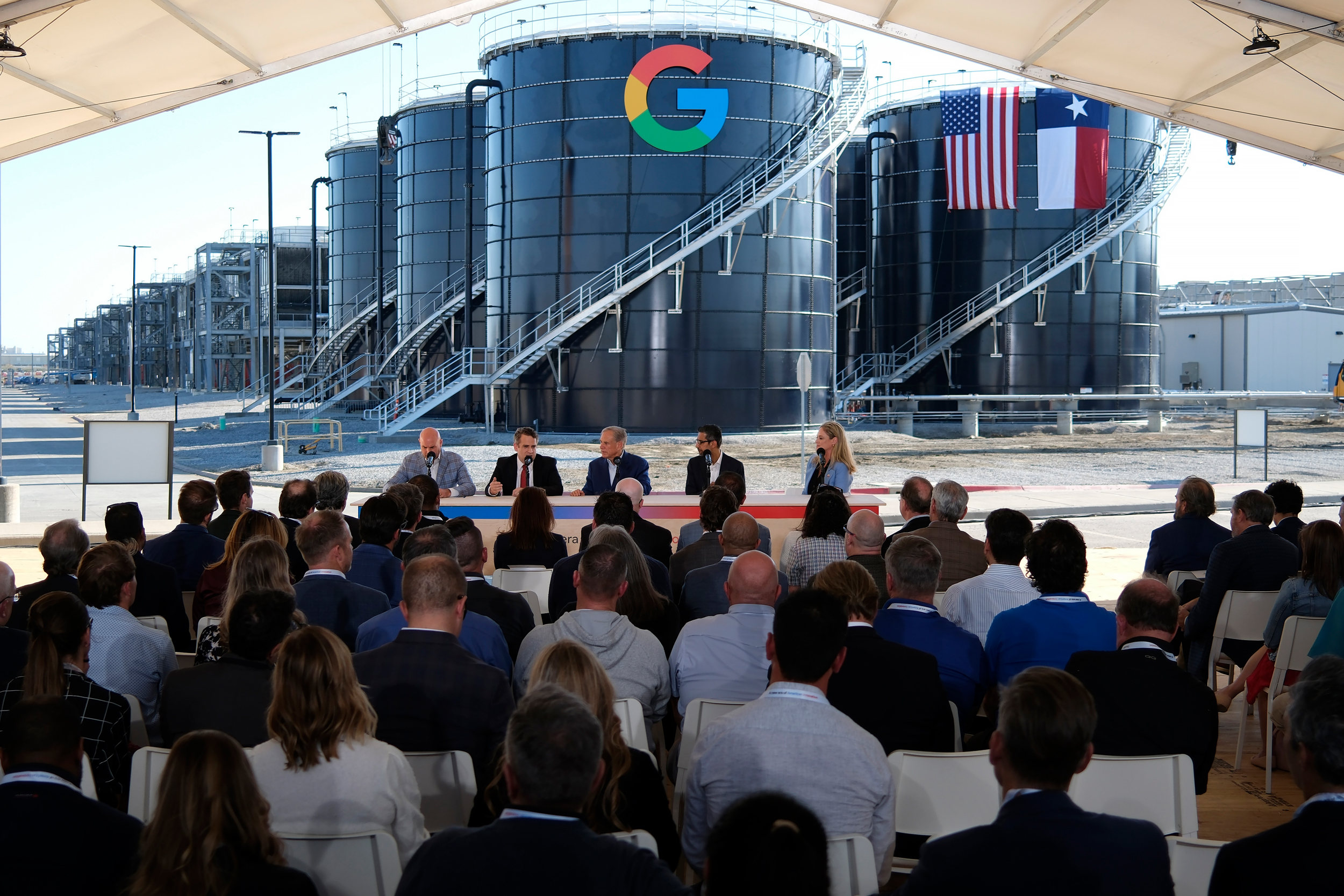
As a result, the data center industry has spent more time communicating with residents of its projects not only about the water, electricity and land demands of its projects, but also what the facility supports. Which is just about everything at this point, said Doug Lewin, the Texas lead for Google’s Energy Market Development team. Before joining the company this year, Lewin was a longtime independent Texas energy consultant.
Governments, hospitals, corporations, big to small, all have their own data center operations, Lewin said. “All of these things that are going on take very real, physical, things in order to run.” Lewin said.
Schaap said part of the industry’s role now is to connect for the public what the business does and why. “We don’t build these for fun,” Schaap said. “We build them because there’s a demand, and that demand is coming from this,” he said, holding up his cellphone.
About This Story
Perhaps you noticed: This story, like all the news we publish, is free to read. That’s because Inside Climate News is a 501c3 nonprofit organization. We do not charge a subscription fee, lock our news behind a paywall, or clutter our website with ads. We make our news on climate and the environment freely available to you and anyone who wants it.
That’s not all. We also share our news for free with scores of other media organizations around the country. Many of them can’t afford to do environmental journalism of their own. We’ve built bureaus from coast to coast to report local stories, collaborate with local newsrooms and co-publish articles so that this vital work is shared as widely as possible.
Two of us launched ICN in 2007. Six years later we earned a Pulitzer Prize for National Reporting, and now we run the oldest and largest dedicated climate newsroom in the nation. We tell the story in all its complexity. We hold polluters accountable. We expose environmental injustice. We debunk misinformation. We scrutinize solutions and inspire action.
Donations from readers like you fund every aspect of what we do. If you don’t already, will you support our ongoing work, our reporting on the biggest crisis facing our planet, and help us reach even more readers in more places?
Please take a moment to make a tax-deductible donation. Every one of them makes a difference.
Thank you,

Arcelia Martin
Reporter, Texas Renewables
Arcelia Martin is an award-winning journalist at Inside Climate News. She covers renewable energy in Texas from her base in Dallas. Before joining ICN in 2025, Arcelia was a staff writer at The Dallas Morning News and at The Tennessean. Originally from San Diego, California, she’s a graduate of Gonzaga University and Columbia University Graduate School of Journalism.