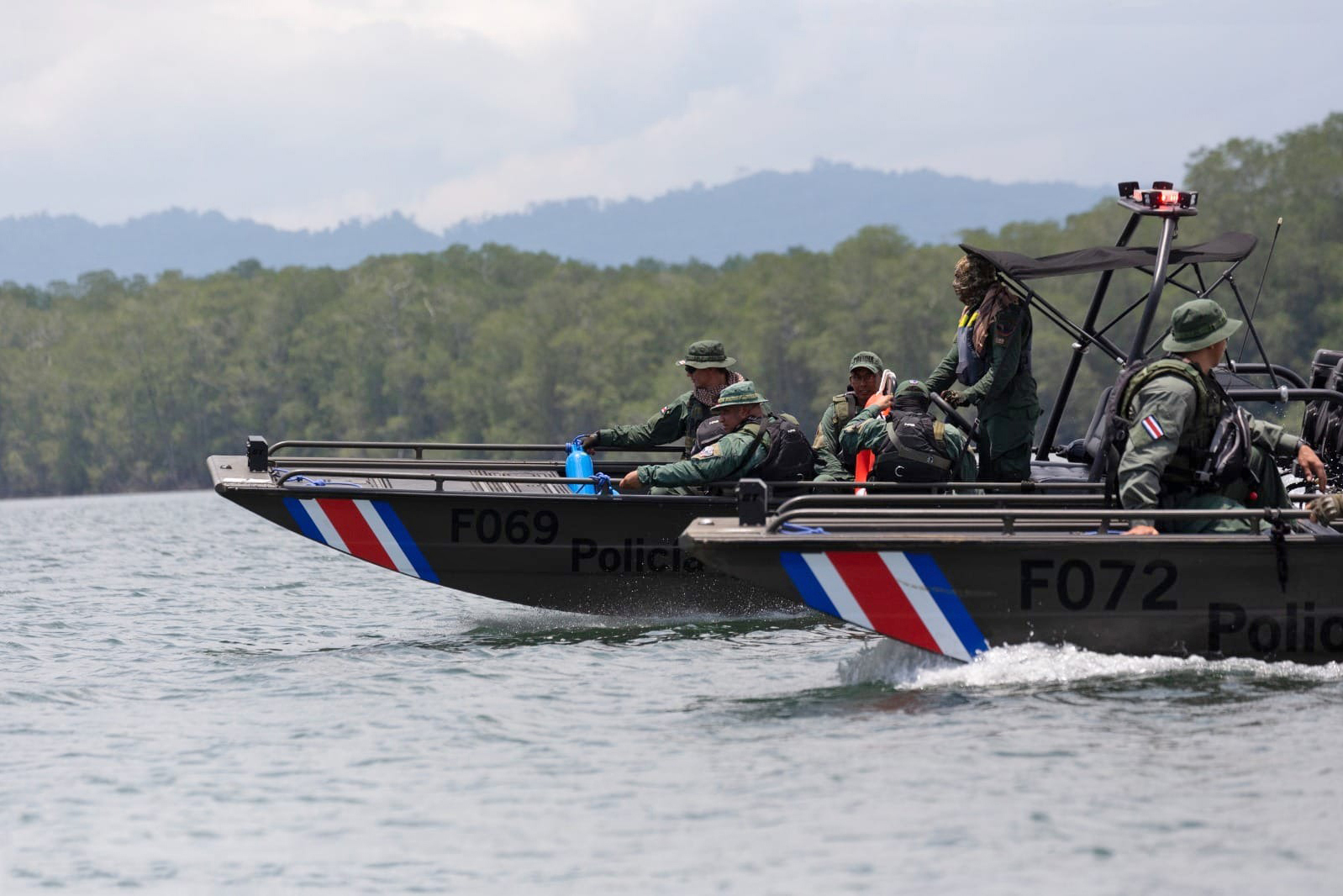


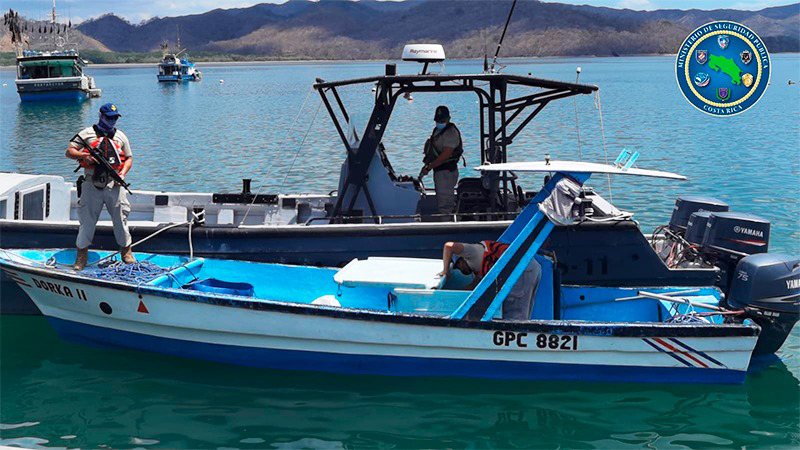
In April 2022, a blue and white fishing boat sliced through the protected waters surrounding Costa Rica’s Isla San José at high speed. Its 75-horsepower engine churned the turquoise surface of the Guanacaste Conservation Area, a UNESCO World Heritage Site teeming with manta rays and bottlenose dolphins.
Onboard, three fishermen were attempting to escape the law as a triple-engined Costa Rican Coast Guard speedboat closed in. Minutes later, balaclava-clad patrolmen boarded the panga and opened its coolers: 62 kilograms of red snapper, some still alive, gills gasping, was now evidence of a crime.
The Dorka II was Costa Rican-registered, but its crew members were Nicaraguan. The captain, identified only as Salazar, was arrested and later convicted of illegal fishing, and found to already have a lengthy record for “various violations of the Fisheries and Aquaculture Law,” according to the Costa Rican Ministry of Public Security.
While hailed as a success for marine protection, the arrest exposed an uncomfortable contradiction: In the preceding six years, the Dorka II had received 87,667 liters of subsidized fuel from the Costa Rican government’s fisheries department. Forty transfers of tax-exempt fuel had saved the vessel’s owner more than $62,300, according to government records.
The Costa Rican state was caught funding its own environmental crimes.
The Dorka II encounter was not an isolated incident. A groundbreaking investigation by La Nación, one of Costa Rica’s largest newspapers, this year found that in the past decade law enforcement caught 108 subsidized commercial fishing boats illegally poaching, sharkfinning, or entering Marine Protected Areas (MPAs).
Despite an international image as a leader of Latin American conservation, Costa Rica’s fisheries fuel subsidy program—costing over $15 million annually—is funding the very marine destruction it claims to prevent through overfishing and poaching. The scandal deepened when La Nación revealed tax-exemptions had also been given to 51 ships implicated in narco-trafficking.
Globally, governments hand out $35 billion in fishing subsidies each year. Of these, roughly $22 billion have been categorized as harmful in the way they artificially strengthen fishing capacity by offsetting the costs of fuel, gear or boat construction, according to the United Nations Trade and Development board. That money accelerates the rate at which the world’s waters are running out of fish.
The problem of subsidies is not limited to national waters like those where the majority of Costa Rican ships operate. Most of the world’s high-seas fishing fleets would be unprofitable were it not for government subsidies, according to a 2018 study by Enric Sala, founder of the Pristine Seas project, an initiative to protect marine habitats by the nonprofit National Geographic Society. Among the countries that most heavily subsidize their fishing fleets are the United States, Spain and China, the report found.
These subsidies now support a global fishing fleet 2.5 times bigger than the sustainable limit, according to the WWF. “Fuel subsidies reduce the natural economic limits that normally help control fishing efforts,” said Damián Martinéz-Fernandez, conservation director at the Costa Rican Fishing Federation (FECOP). “Cheaper fuel may unintentionally allow fishing effort to stay high even as the resource declines,” he said. Costa Rican subsidies have helped double commercial landings of sailfish in recent years, despite population estimates having halved, Martinéz-Fernandez said.
Rapid depletion of fish stocks is not just an ecological disaster. It is a critical but often-overlooked component of the climate crisis.
The ocean is the world’s largest carbon sink, and healthy fish populations are essential to the process to capture and store carbon from the atmosphere. Large apex predators like tuna or whales provide nutrients to plankton that produce oxygen and store significant sums of carbon in their biomass. By increasing the rate of marine life destruction, subsidies weaken the planet’s natural defenses against climate change.
Costa Rica ratified the World Trade Organization’s September 2025 Agreement on Fisheries Subsidies aimed at reducing overfishing harms. However, arrest timelines show the problem worsened last year, when Costa Rican authorities intercepted 18 subsidized boats for illegal fishing, double the average for the three previous years.
While the Costa Rican Agricultural Affairs Committee recently called for improved policing of who receives subsidies, over 1.9 million liters of subsidized fuel had gone, over the last decade, into the tanks of those boats caught poaching in 2024. Taxpayers had lost over $1.1 million to ocean exploitation.
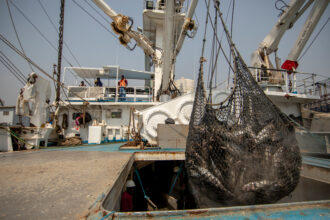
An analysis of Costa Rica’s Institute of Fisheries and Aquaculture records by Inside Climate News found $62 million of government-subsidized fuel, designed to support small-scale fishing, has gone to Costa Rica’s largest and most industrial fishing vessels since 2015. Over the last decade, the analysis shows, nearly half of all subsidized fuel has gone to 13 percent of all ships registered in the country. These boats play a significant role in depleting tuna, mahi-mahi and shark stocks at alarming rates, according to research published in 2025 in Frontiers in Marine Science.
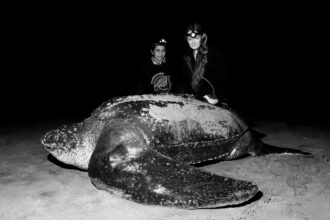
Averaging 22 days per trip, these 300 or so ships target large pelagic fish—those swimming in open waters—using longlining, a technique known for its high level of bycatch. Between 1999 and 2010, Costa Rica’s longliners, using this technique, inadvertently caught and killed an estimated 700,000 endangered Olive Ridley turtles, as well as silky sharks, stingrays and sailfish, according to a 2013 study from the Journal of Experimental Marine Biology and Ecology.
Coinciding with warming waters, this fishing approach is producing a compounding ecological effect. As greenhouse gas emissions warm the Pacific Ocean, commercially valuable tuna stocks are moving poleward, forcing subsidized fleets to undertake longer, more carbon-intensive trips to plunder previously unfished grounds. A policy intended to support small-scale coastal fishermen is instead subsidizing large-scale ecological harm.
Geography too plays a role. The very elements that make Costa Rica so well suited to marine ecotourism are also what makes it uniquely vulnerable to such state-sponsored plundering.
The Costa Rica Thermal Dome—an oceanographic phenomenon 200 to 600 miles off its Pacific Coast—draws colder, nutrient-rich water to the nation’s shores, attracting high-value fisheries like yellowfin and skipjack tuna. The country also has a designated exclusive economic zone—coastal areas and waters protected by international law—that is 11 times the size of its land mass.
Costa Rica abolished its armed forces over 75 years ago and without a Navy to protect it, its waters have become relatively easy to violate. Cheap fuel, through the subsidy program, encourages industry fishermen to loot remote marine areas hundreds of miles offshore, according to the Center for Latin American & Latino Studies at American University in Washington, D.C.
Harmful subsidies appear to be outpacing marine policing. In August 2022, the Costa Rican Coast Guard spotted the use of illegal gillnets in the brackish estuary off the Gulf of Nicoya’s Berrugate Island. As authorities approached, two fishermen performed dangerous evasive maneuvers whipping up the muddy water. After a brief chase, the Coast Guard pinned the small boat against an embankment.
Facing the patrol boat, the men wielded a knife at officers and threatened to set fire to the government vessel, according to local broadcaster Teletica. As officers were trying to hook the illegal net from the water, the fishermen slammed on the throttle and fled through the shallow mangrove-filled waters. Government records show that the boat, identified as the Arilis-B, had received 18,288 liters of subsidized fuel worth $13,000 from 2015 to 2021.
Costa Rica’s weak enforcement has been criticized on the international stage.
In 2021, the National Oceanic and Atmospheric Administration reported to the U.S. Congress that Costa Rica was “failing to effectively manage and control its fleet.” The report alleged there was harvesting of North Atlantic swordfish without quotas, extensive overfishing of Atlantic white marlin and a failure to submit catch data for tuna.
Costa Rica also reacted slowly to threats, critics said. The hammerhead shark population fell by 90 percent before the state introduced a 2023 ban on its commercial fishing. Costa Rica lacks the monitoring systems to track populations and effectively assess species loss, according to fishing federation FECOP, and failures to rein in excesses belie the nation’s celebrated image as a conservation champion.
Decades of Costa Rican subsidies have warped fleet dynamics and undercut livelihoods. While there are an estimated 15,000 fishermen in Costa Rica, only 2,000 are licensed. The remaining 13,000 or so, without the official documentation to receive subsidies, cannot compete with the financially advantaged bigger boats. The industrial fleet floods the market, drives down prices and depletes stocks that squeeze multi-generational fishing communities out of business.
In June, small-scale fishermen from the Pacific Coast’s Gulf of Nicoya gathered at a legislative forum to voice their discontent at dwindling corvina, snapper, white mullet and shrimp stocks. “The situation is about to get chaotic,” a fisherman from Isla Chira told the Tico Times. “Hunger is going to strike island and coastal communities.”
“One of the main reasons why marine conservation is not being successful in Costa Rica is because the native, local, small-scale fishing communities are being displaced,” said Vivienne Solis-Rivera, a biologist with the Costa Rican conservation nonprofit CoopeSoliDar. Most small-scale fishers—especially Indigenous, Afro-descendant communities and women working in fish processing—are unlicensed and therefore unable to receive subsidies or compete with industrial fishing fleets, in turn destroying local stewardship, she said.
This story is funded by readers like you.
Our nonprofit newsroom provides award-winning climate coverage free of charge and advertising. We rely on donations from readers like you to keep going. Please donate now to support our work.
Donate NowTo many observers, this is the fundamental injustice of the subsidy program: a taxpayer-supported mechanism that actively disadvantages sustainable fisheries in favor of industrial fleets. “Costa Rica has much more structural issues to solve to make sure we have an equitable and sustainable marine conservation effort,” Solis-Rivera said.
In Costa Rica, studies show that the failures are rooted, in part, in poor bureaucracy. A 2024 audit by the Comptroller General’s Office discovered that the Institute of Fisheries and Aquaculture (INCOPESCA), which regulates the industry and oversees the program, and the Costa Rican Petroleum Refinery (RECOPE), which provides the fuel, carried out only “weak and scarce” inspections. Of the more than 40 million liters of fuel supplied between January 2023 and April 2024, over half of transactions had irregularities including incomplete documentation and allocations far exceeding a vessel’s capacity, the audit found.
In one notable example, INCOPESCA approved for two boats with similar engines and requirements vastly different amounts: 6,875 liters for one; 19,327 liters for the other. “There is a risk that fuel provided at a competitive price is being used for illicit activities,” the audit said, criticizing INCOPESCA.
INCOPESCA did not respond to requests for comment.
However, the state-funded program has subsidized more than just illegal fishing. Recent arrests of INCOPESCA officials suggest it may have been involved in international illicit drug smuggling.
In November, a former INCOPESCA Director and the head of fuels for the central Caribbean region were arrested in a raid tied to the so-called South Caribbean Cartel, what officials described as a transnational drug network, according to reporting by news outlet CR Hoy. They are among about 30 people facing prosecution for the transport of cocaine through contacts in Costa Rica and across Latin America, the United States and Europe, according to local media reports. They were charged with money laundering and allegedly using their positions to aid the cartel’s receipt of subsidized fuel for its fleet of drug smuggling boats, CR Hoy reported.
The raid occurred as Gilbert Bell Fernández, a separate alleged drug kingpin in Costa Rica, awaits extradition to the United States. Bell Fernández was the recipient of 2.1 million liters of subsidized gasoline from INCOPESCA, according to La Nación, and his arrest has triggered broader hand-wringing about how the fuel subsidy program has funded boats involved in narco-trafficking.
The case of the Dorka II underscores serious flaws in the fuel subsidy program beyond high profile arrests. Despite the criminal conviction of the boat’s captain in 2022, its owner, Jose Daniel Toledo Estrada, received at least 12 subsidies totaling $19,000 in savings after that point, according to INCOPESCA records. Inside Climate News was unable to reach Toledo Estrada for comment.
Perhaps the biggest suprise—and failure—of Costa Rica’s supervision is that the Dorka II remained in operation at all. Though a lower court initially allowed the boat to operate and freely receive fuel subsidies, that decision was overturned in September 2025. A senior criminal court found the Dorka II should not have been allowed to commercially fish because the captain’s $12,000 criminal fine went unpaid. Nevertheless, the vessel’s owner received at least 26,400 liters of gasoline subsidized by the state over the past three years, according to publicly-available INCOPESCA fuel records. INCOPESCA did not respond to requests for comment.
Costa Rica not only failed to prevent illegal fishing in the first place—it had paid for the gas to keep the Dorka II in operation.
This reporting was produced in part by the Outlaw Ocean Project, with research assistance provided by Anya Warrier.
About This Story
Perhaps you noticed: This story, like all the news we publish, is free to read. That’s because Inside Climate News is a 501c3 nonprofit organization. We do not charge a subscription fee, lock our news behind a paywall, or clutter our website with ads. We make our news on climate and the environment freely available to you and anyone who wants it.
That’s not all. We also share our news for free with scores of other media organizations around the country. Many of them can’t afford to do environmental journalism of their own. We’ve built bureaus from coast to coast to report local stories, collaborate with local newsrooms and co-publish articles so that this vital work is shared as widely as possible.
Two of us launched ICN in 2007. Six years later we earned a Pulitzer Prize for National Reporting, and now we run the oldest and largest dedicated climate newsroom in the nation. We tell the story in all its complexity. We hold polluters accountable. We expose environmental injustice. We debunk misinformation. We scrutinize solutions and inspire action.
Donations from readers like you fund every aspect of what we do. If you don’t already, will you support our ongoing work, our reporting on the biggest crisis facing our planet, and help us reach even more readers in more places?
Please take a moment to make a tax-deductible donation. Every one of them makes a difference.
Thank you,

Johnny Sturgeon
Fisheries Reporter
Johnny Sturgeon is a London-based reporter covering fisheries and aquaculture. Joining us from the Outlaw Ocean Project, he has experience producing in-depth maritime investigations for nonprofit newsrooms. A former boatbuilder, he holds a B.A. in History & Politics from the University of Oxford, and an M.S. from Columbia Journalism School.