

Maine is now the first state to pass a moratorium on the development of large data centers, and others may follow.
The Maine House and Senate this week passed LD 307, which prohibits state and local governments from approving data centers with at least 20 megawatts of electricity demand until at least October 2027. The bill awaits a signature from Gov. Janet Mills, who has not commented on whether she will sign it.
Maine is one of about a dozen states with legislative proposals this year to pause or ban data centers amid rising concerns about the projects’ size and energy and water consumption. Community opponents of data centers are grappling with what they view as intrusive development as the broader public worries that the rise of artificial intelligence—fueled by data centers—will lead to mass job losses.
Analysts who follow state-level discussions of data centers say Minnesota is also a good candidate to pass a bill on this subject, along with Illinois, even though there is not yet a bill pending in Illinois.
U.S. data centers had more than 50 gigawatts of electricity demand as of last year, which, for context, is about double the peak demand of the entire New England grid, which covers six states, including Maine. And this is before some super-sized data centers that are still in early planning stages. It’s not clear how the electricity grid will build enough power plants to meet demand, or how residential ratepayers can be shielded from high electricity bills driven by data center demand.
The debate in Maine gives a sense of how this topic interacts with partisan politics. It passed the House, 79-62, and the Senate, 21-13.
The Democrats who control the House and Senate described the bill as providing breathing room to write rules to regulate data centers. The opponents, mainly Republicans, said the bill would discourage investment and harm the economy.
The measure calls for convening a special council to evaluate concerns about data centers and recommend new policies to the legislature.
Maine has had relatively little data center development, with about 10 sites, none of which are large “hyperscalers” that are inspiring backlash in Virginia, Texas and other states.
The goal of the bill is to use the experiences in other states as “a cautionary tale that Maine could really learn from,” state Rep. Melanie Sachs, a Democrat and lead sponsor of the bill, said in an interview.
“Let’s just make sure our regulatory framework can meet the moment,” she said.
State Sen. Matt Harrington, a Republican, was among the opponents. He said the bill would delay or cancel major projects, including data centers being discussed in the communities of Sanford and Jay.
“This is billions of dollars in potential investment in Maine,” he said during debate last week.
Mills had indicated she wanted the bill to include an exemption for the project in Jay, which would redevelop a former paper mill site. The bill does not contain such an exemption.
The governor could sign the legislation, veto it or allow it to become law by taking no action within 10 days. Sachs said she doesn’t know what Mills will do, and her office did not respond to a request for comment.
Environmental advocates are praising the bill as a model for how states can take control of a wave of development that has outpaced regulators’ ability to protect the public.
“Voters do not want these facilities in their backyard,” said Sarah Woodbury, legislative director for Maine Conservation Voters, an environmental advocacy group. “In Maine, every time a community has tried to get [a data center], the town has rebelled and it has failed. So I think the politics around data centers are similar here [as] they are in other places.”
Woodbury is proud that Maine would be leading the country in reining in data centers if the bill becomes law.
Lawmakers in 13 other states have introduced bills or resolutions that would pause development of data centers in some way, but none of these have passed a legislative chamber, according to the NC Clean Energy Technology Center.
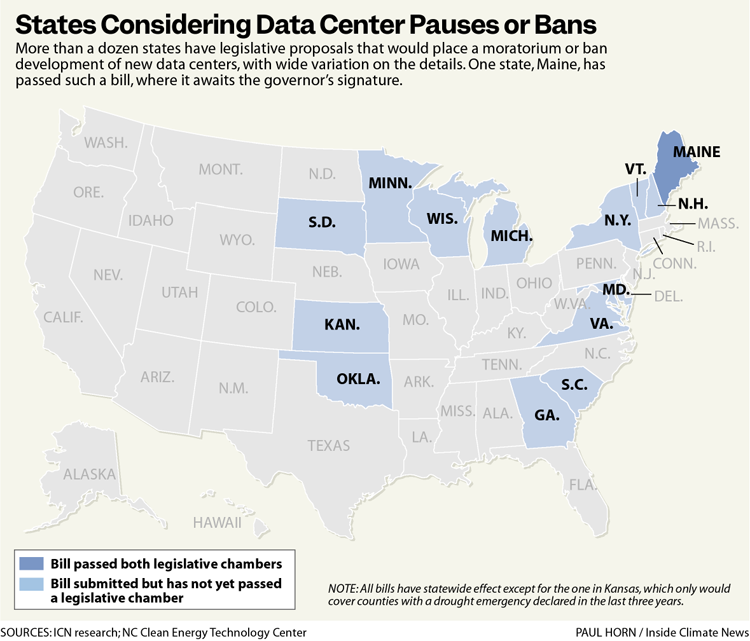
Dozens of local governments across the country have also adopted bans and moratoria, and many others are in the works.
U.S. Sen. Bernie Sanders (I-Vt.) and U.S. Rep. Alexandria Ocasio-Cortez (D-N.Y.) have proposed a national moratorium on AI data centers.
“The politics of this are still evolving,” said Anthony Elmo, a researcher for Good Jobs First, a nonprofit watchdog organization that tracks government subsidies for corporations.
Elmo cautions against characterizing data centers as a partisan topic. He has seen opposition to development from Democrats and Republicans, especially when talking about specific projects.
That said, he thinks data center restrictions are most likely in states where Democrats control the legislature and the governor’s office, in part because Republicans tend to be skeptical of regulation.
Asked which state is most likely to follow Maine, he said there is no clear answer, but he is watching Illinois and Minnesota as examples of places where a data center backlash is happening and elected officials are sympathetic to the concerns.
Regardless of what states do, he expects data center backlash to grow as the developments get bigger, expand to more places and their backers continue to have difficulty answering basic questions from residents.
About This Story
Perhaps you noticed: This story, like all the news we publish, is free to read. That’s because Inside Climate News is a 501c3 nonprofit organization. We do not charge a subscription fee, lock our news behind a paywall, or clutter our website with ads. We make our news on climate and the environment freely available to you and anyone who wants it.
That’s not all. We also share our news for free with scores of other media organizations around the country. Many of them can’t afford to do environmental journalism of their own. We’ve built bureaus from coast to coast to report local stories, collaborate with local newsrooms and co-publish articles so that this vital work is shared as widely as possible.
Two of us launched ICN in 2007. Six years later we earned a Pulitzer Prize for National Reporting, and now we run the oldest and largest dedicated climate newsroom in the nation. We tell the story in all its complexity. We hold polluters accountable. We expose environmental injustice. We debunk misinformation. We scrutinize solutions and inspire action.
Donations from readers like you fund every aspect of what we do. If you don’t already, will you support our ongoing work, our reporting on the biggest crisis facing our planet, and help us reach even more readers in more places?
Please take a moment to make a tax-deductible donation. Every one of them makes a difference.
Thank you,

Dan Gearino
Reporter, Clean Energy
Dan Gearino covers the business and policy of renewable energy and utilities, often with an emphasis on the midwestern United States. He is the main author of ICN’s Inside Clean Energy newsletter. He came to ICN in 2018 after a nine-year tenure at The Columbus Dispatch, where he covered the business of energy. Before that, he covered politics and business in Iowa and in New Hampshire. He grew up in Warren County, Iowa, just south of Des Moines, and lives in Columbus, Ohio.