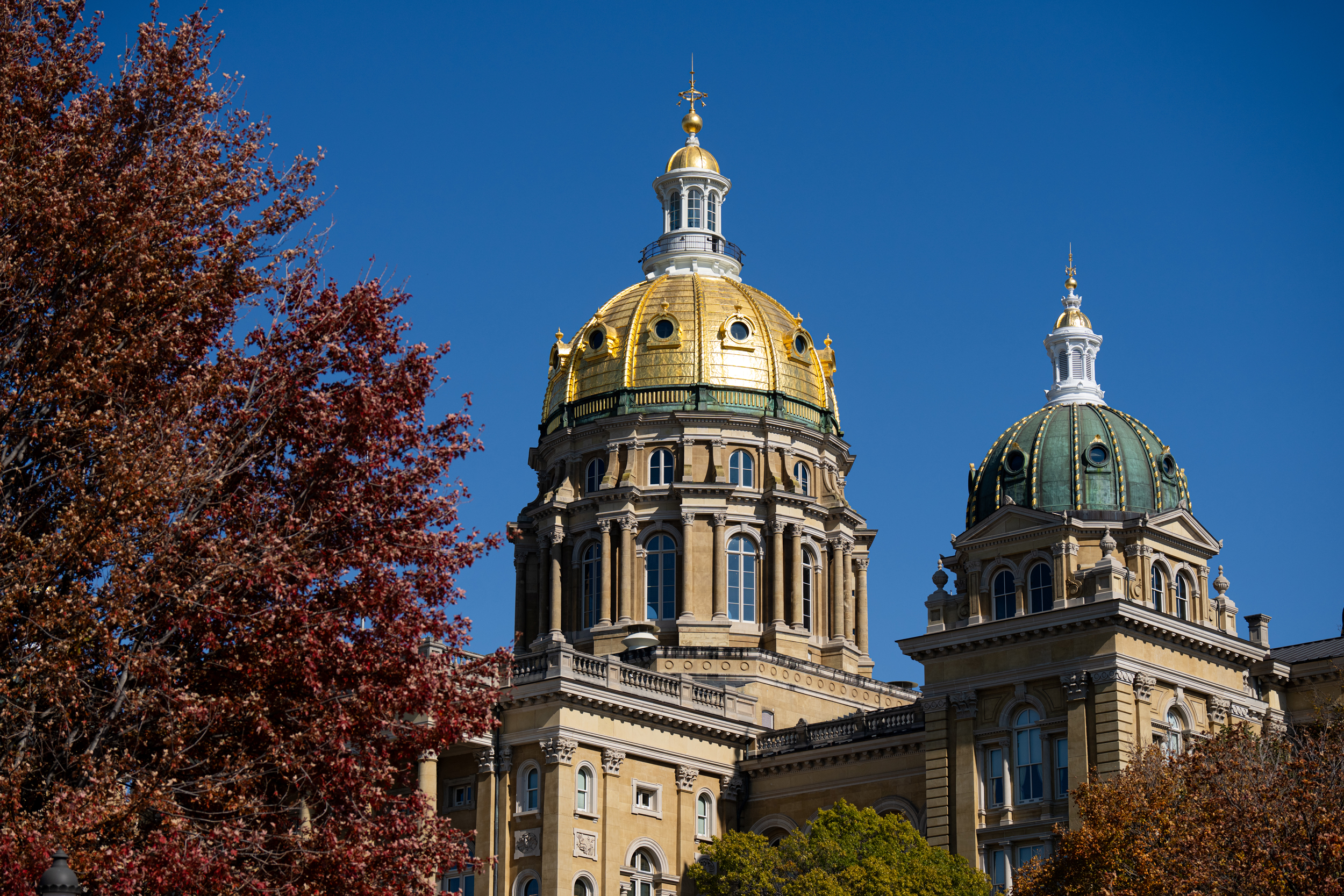


DES MOINES, IOWA—Another legislative session began this week in Iowa, but it’s unclear if lawmakers will take steps to address agricultural pollution in its waterways.
Despite mounting pressure from environmental and citizen advocacy groups to bolster clean-water protections in Iowa, opening remarks by House and Senate leaders largely failed to mention nitrate pollution in the state’s waters, which rank among the highest levels nationwide.
Republican lawmakers plan to focus on property tax reform and eminent domain for carbon pipelines, Senate Majority Leader Mike Klimesh and House Majority Leader Bobby Kaufmann said in their introductory remarks on Monday.
Democratic lawmakers, meanwhile, will emphasize affordability and public education this session, said Senate Minority Leader Janice Weiner.
House Minority Leader Brian Meyer was the only floor leader in the legislature to mention Iowa’s struggle with nitrate pollution levels in waterways, noting the Democratic caucus’ focus this year on improving quality of life in the state, including by “finally delivering results on water quality.”
Meyer’s comments came just days after the capital city’s water utility announced an unusual mid-winter operation of its nitrate-removal facility. Central Iowa Water Works relies on the facility when nitrate levels in the Des Moines and Raccoon rivers spike, ensuring that drinking water sourced from the rivers falls below the EPA’s nitrate standards of 10 mg/L.
Last summer, the facility operated for 112 days to address near-record nitrate levels in the two rivers, which provide nearly 20 percent of Iowa residents with their drinking water. But a nitrate surge in the winter is unusual. This is the first time that Central Iowa Water Works has operated the nitrate removal facility in January since 2015.
Unseasonably warm weather and a backlog of nitrate from fertilizer and livestock manure in Iowa’s soil are to blame, said Larry Weber, director of the University of Iowa’s hydroscience and engineering center.
Heavy snowfall early in the winter left an insulating layer atop fields. With that snow now melted and temperatures above freezing, tile lines buried beneath fields continue to route nitrates from farmland into waterways.
While in the past wintertime spikes in nitrate levels were linked to heavy rainfall, Weber notes that wet conditions don’t explain the current levels. In fact, over half of Iowa is currently experiencing at least mild-drought conditions.
“This is just a clear indication that we’ve got this unlimited store of excess nitrate in the soil column,” he said. “And as long as it’s wet and the tile lines are running, that stuff’s coming out. This is our new normal.”
In her “condition of the state” address to a packed House chamber on Tuesday evening, Iowa Governor Kim Reynolds spoke at length about Iowa’s cancer crisis and steps her administration has taken to improve rural healthcare access and cancer screenings. However, she did not mention nitrate levels or concerns that consistent exposure to elevated nitrate levels in waterways might be contributing to the state’s rising cancer rate, the second highest in the nation.
Though snubbed in opening remarks, water quality took center stage at a meeting of the Senate Committee on Natural Resources and the Environment held Monday. There, committee members called for bipartisan progress on clean water.
“Iowa’s waterways have the highest cancer-link nitrate concentrations in the nation, and our water crisis has reached a breaking point,” said state Sen. Art Staed, the top Democrat on the committee. “Protecting clean water must be a shared priority.”
This story is funded by readers like you.
Our nonprofit newsroom provides award-winning climate coverage free of charge and advertising. We rely on donations from readers like you to keep going. Please donate now to support our work.
Donate NowRepublicans Annette Sweeney, the committee chair, and Tom Shipley, committee vice chair, expressed their commitment to the state’s environment, but seemed poised to double down on the state’s existing approach to tackling nitrate: a 12-year-old nutrient reduction strategy that prioritizes voluntary conservation practices aimed at mitigating nutrient loss from cropland.
“I know that we have done an awful lot to address many of these issues,” said Shipley. “Something is being done right…and I want to help make improvements in the things we can do better on.”
Sweeney described her involvement with water-quality conservation practices as a longtime leader of the South Fork Watershed Alliance and on family farmland, as well as through the Senate Agriculture Committee and Natural Resources and Environment Committee.
“I believe in our water quality. I believe that we need to make sure that we build upon what we have established and keep the conversations open for more improvement in our water quality,” Sweeney said.
Though great strides have been made in the adoption of conservation practices on farmland, the practices alone are insufficient to tackle Iowa’s water issues, said Colleen Fowle, water program director for the Iowa Environmental Council. “These changes aren’t taking place more broadly across the state, at a quick enough rate for us to see substantive change within our lifetime,” Fowle said. ”We really can’t afford to sit idle.”
The Iowa Environmental Council wants to see funding reinstated this session for the Iowa Water Quality Information System, a University of Iowa-based statewide water-quality monitoring network that was defunded three years ago.
Both the Council and Food and Water Watch, a Washington, D.C.-based nonprofit, recommend reappropriating at least $500,000 to the University of Iowa IIHR Hydroscience and Engineering laboratory, which has operated the network since 2012.
Since losing state funding in 2023, the network has survived on grants, private donations and, most recently, a $200,000 investment from Polk County, the capital seat.
There was no mention of the network at Monday’s committee meeting.
As the session continues, Fowle hopes to see water quality receive more airtime on the Senate and House floors. “I think legislators are still trying to get a handle on what can be done in the short term,” she said. “We know that it is going to take more than a couple of policies passed during one legislative session to see real change.”
This story was updated Jan. 16, 2026, to correct the spellings of Bobby Kaufmann and Janice Weiner’s names.
About This Story
Perhaps you noticed: This story, like all the news we publish, is free to read. That’s because Inside Climate News is a 501c3 nonprofit organization. We do not charge a subscription fee, lock our news behind a paywall, or clutter our website with ads. We make our news on climate and the environment freely available to you and anyone who wants it.
That’s not all. We also share our news for free with scores of other media organizations around the country. Many of them can’t afford to do environmental journalism of their own. We’ve built bureaus from coast to coast to report local stories, collaborate with local newsrooms and co-publish articles so that this vital work is shared as widely as possible.
Two of us launched ICN in 2007. Six years later we earned a Pulitzer Prize for National Reporting, and now we run the oldest and largest dedicated climate newsroom in the nation. We tell the story in all its complexity. We hold polluters accountable. We expose environmental injustice. We debunk misinformation. We scrutinize solutions and inspire action.
Donations from readers like you fund every aspect of what we do. If you don’t already, will you support our ongoing work, our reporting on the biggest crisis facing our planet, and help us reach even more readers in more places?
Please take a moment to make a tax-deductible donation. Every one of them makes a difference.
Thank you,

Anika Jane Beamer
Reporter, Iowa
Anika Jane Beamer covers the environment and climate change in Iowa, with a particular focus on water, soil and CAFOs. A lifelong Midwesterner, she writes about changing ecosystems from one of the most transformed landscapes on the continent. She holds a master’s degree in science writing from the Massachusetts Institute of Technology as well as a bachelor’s degree in biology and Spanish from Grinnell College. She is a former Outrider Fellow at Inside Climate News and was named a Taylor-Blakeslee Graduate Fellow by the Council for the Advancement of Science Writing.