

The Iran war’s disruption to the global energy market should be a wake-up call for countries that continue to rely on fossil fuels, said United Nations climate chief Simon Stiell in a speech on Monday.
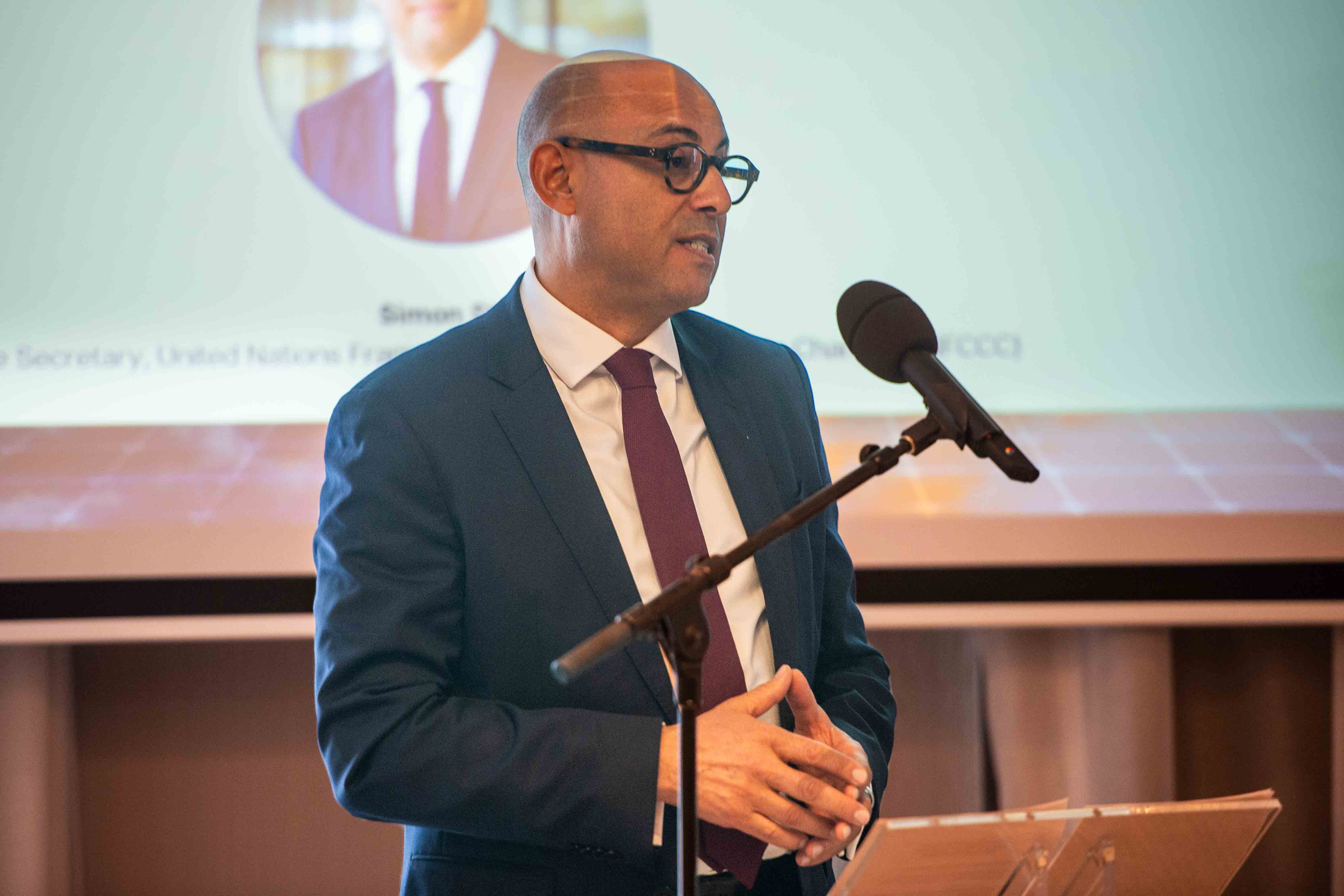
Addressing a European audience at the Green Growth Summit in Brussels, the executive secretary of the U.N. Framework Convention on Climate Change warned strongly against fossil fuel dependence. He urged government leaders to speed up the renewable energy transition to ensure security and economic growth.
“Climate cooperation is a cure for the chaos of this moment,” Stiell said, according to a transcript published online.
The U.S.-Israeli war with Iran has cut off a fifth of the world’s oil supply, triggering global shortages and price spikes, with ongoing volatility. Describing the last few weeks as “yet another abject lesson,” Stiell said doubling down on fossil fuels is the wrong response.
“This is completely delusional,” Stiell said. “History tells us, this fossil fuel crisis will happen again and again.”
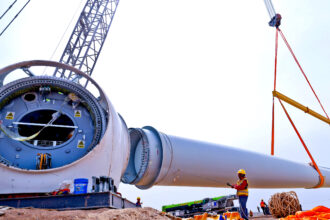
Instead, Stiell urged European leaders to adopt policies that boost renewable energy and climate resilience, citing economic and health benefits and insulation from global turmoil. He echoed arguments from some experts who say the war is making the case for renewable energy.
Stiell also emphasized the financial costs of climate change, citing research showing that last summer’s climate extremes in Europe caused at least €43 billion in short-term economic losses. At the same time, fossil fuel companies continued to rake in taxpayer-funded subsidies around the world.
“Meek dependence on fossil fuel imports will leave Europe forever lurching from crisis to crisis, with households and industries literally paying the price,” he said.
Kate Logan, director of the China Climate Hub and Climate Diplomacy at the Asia Society Policy Institute, said the speech marked a shift for Stiell and the UNFCCC.
“The tone of the messaging here has a degree of urgency that’s unusual for the UNFCCC to come out with publicly,” said Logan, who attends the annual Conference of the Parties climate talks as an observer.
That change in tone is a testament to the gravity of the current global moment, Logan said.
“Even though they’ve long emphasized the energy security and economic growth benefits of renewables, we’re in a moment where we need to transition away from fossils and that’s clearer than ever,” she said. Referring to the 2015 climate treaty signed by nearly every country, she added: “They’re making the case in a way that’s much broader than just focusing on the Paris Agreement.”
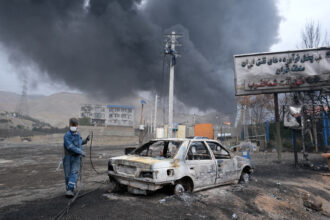
The U.S. and Israel’s war in Iran—launched without approval from Congress or the U.N. Security Council—has already killed more than 1,440 people in Iran, according to the country’s health ministry, and displaced more than 800,000 people in Lebanon amid a domino effect of counterstrikes.
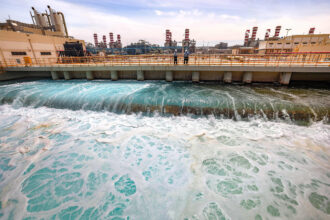
Attacks on Iran’s desalination plants, which the U.S. denied responsibility for, jeopardize water access for millions in the region and violate international law, while further highlighting the risks of fossil-fuel dependence, experts say. The plants’ rely on oil and gas.
Stiell’s comments were directed at a European audience, in the wake of several years of energy insecurity and volatility. But the war’s energy ramifications are spreading worldwide, particularly in countries most reliant on imported oil and gas.
Pakistani officials announced a two-week closure of schools and scaled back some government operations to save fuel. In India, the world’s second-largest importer of liquefied petroleum gas, a cooking gas shortage has strained households and businesses, prompting widespread protests.
Bangladesh and Myanmar reportedly implemented fuel rations. The Philippines announced a four-day workweek for some government offices in an attempt to reduce energy demand.
This story is funded by readers like you.
Our nonprofit newsroom provides award-winning climate coverage free of charge and advertising. We rely on donations from readers like you to keep going. Please donate now to support our work.
Donate NowThe Strait of Hormuz is also a crucial shipping lane for fertilizer manufactured using fossil gas, and reports say governments in Africa are bracing for economic shocks to their agriculture sectors.
In his call to action, Stiell argued that renewable energy can provide nations energy security and stability during periods of conflict.
“Sunlight doesn’t depend on narrow and vulnerable shipping straits,” he said. “Wind blows without massive taxpayer-funded naval escorts.”
Kate Guy, a senior fellow with the Center on Global Energy Policy at Columbia University, said the Iran war demonstrates how countries can weaponize the flow or production of energy resources, particularly fossil fuels.
An economy powered by clean energy wouldn’t eliminate supply-chain vulnerabilities in a conflict, such as production of critical minerals for renewables, Guy said. But such an economy is by nature more distributed, with fewer choke points than the global oil and gas market.
“Renewable energy, just by necessity, adds fewer of those leverage points,” Guy said.
Stiell urged leaders to focus on the economic and societal benefits of reducing emissions, despite a “new world disorder where some major powers do as they please, unconstrained by economic logic or current alliances.”
In 2025, President Donald Trump pulled the U.S. out of the Paris climate pact, a move that went into effect this year. Rachel Santarsiero, director of the National Security Archive’s Climate Change Transparency Project, which tracks the historical record of U.S. climate policy, said that line in Stiell’s speech seemed to point to the U.S.
“We are, at least in the climate sense, definitely acting as a very rogue, isolationist entity,” Santarsiero said of the U.S. “If other nations kind of follow suit and just buck international environmental diplomacy and cooperation, I think we’re in for a pretty scary reality.”
About This Story
Perhaps you noticed: This story, like all the news we publish, is free to read. That’s because Inside Climate News is a 501c3 nonprofit organization. We do not charge a subscription fee, lock our news behind a paywall, or clutter our website with ads. We make our news on climate and the environment freely available to you and anyone who wants it.
That’s not all. We also share our news for free with scores of other media organizations around the country. Many of them can’t afford to do environmental journalism of their own. We’ve built bureaus from coast to coast to report local stories, collaborate with local newsrooms and co-publish articles so that this vital work is shared as widely as possible.
Two of us launched ICN in 2007. Six years later we earned a Pulitzer Prize for National Reporting, and now we run the oldest and largest dedicated climate newsroom in the nation. We tell the story in all its complexity. We hold polluters accountable. We expose environmental injustice. We debunk misinformation. We scrutinize solutions and inspire action.
Donations from readers like you fund every aspect of what we do. If you don’t already, will you support our ongoing work, our reporting on the biggest crisis facing our planet, and help us reach even more readers in more places?
Please take a moment to make a tax-deductible donation. Every one of them makes a difference.
Thank you,

Keerti Gopal
Reporter, Health and Justice
Keerti Gopal covers intersections between climate change, public health and environmental justice at Inside Climate News. Previously, she covered climate activism and movement repression. She is a National Geographic Explorer and has received fellowships from Fulbright, the Solutions Journalism Network, The Lever, and the National Press Foundation.