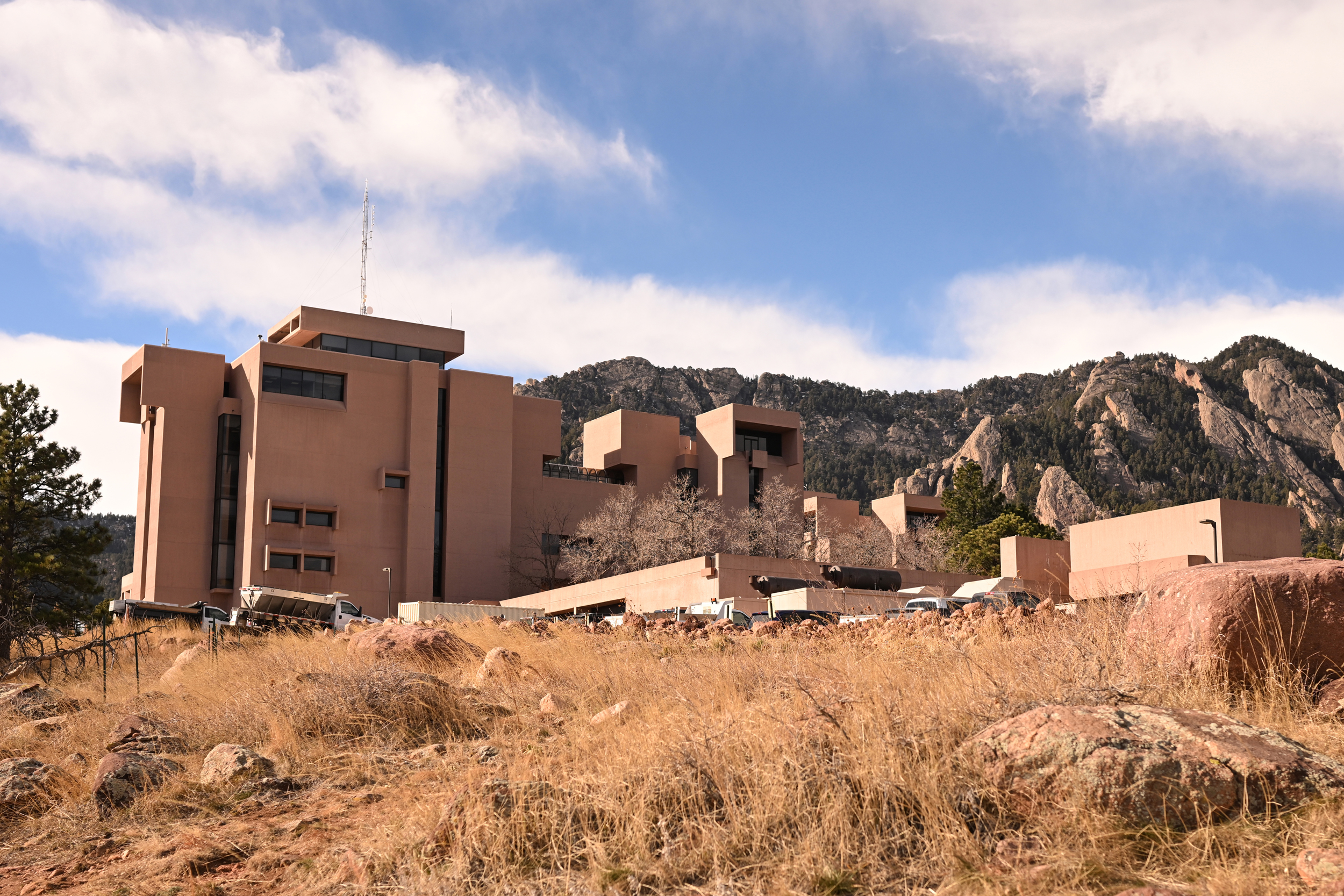


One of the world’s leading climate, weather and wildfire science research institutions is being targeted for elimination in what many of those affected see as President Donald Trump’s political vendetta against Colorado Gov. Jared Polis.
Word that the National Center for Atmospheric Research in Boulder would be broken up, with some of its functions moved elsewhere, came hours after the cancellation of $109 million in federal environmental and safety grants for Colorado, and one day after Trump took time during an Oval Office ceremony to excoriate Polis as a “weak and pathetic man.” Russell Vought, the director of the White House budget office, announced that the center would be eliminated in a post on the social media site X on Tuesday evening. His office did not respond to a request for further comment Wednesday.
On Thursday night, the ongoing dispute killed any chance of passing the long-disputed government funding package for Fiscal Year 2026 before senators left for the holidays. The Senate had been closing in on a deal, but threw in the towel after Colorado’s Democratic senators, Michael Bennet and John Hickenlooper, pledged to hold up the appropriations package until their demand to keep NCAR funded is met.
“As Trump’s rampage continues, we will pull every lever available to do what is right for Colorado,” they said in a statement. The Senate adjourned Thursday, with the federal government facing another shutdown deadline Jan. 30.
Trump’s beef with Polis stems from the jailing of a former county election official in Colorado, Tina Peters, who was convicted of giving Trump allies unauthorized access to a voting machine in the aftermath of the 2020 election. An anonymous White House official told The Washington Post: “The Colorado governor obviously isn’t willing to work with the president.”
Scientists affiliated with NCAR expressed shock that the center—a linchpin in climate and weather research globally—is at risk of becoming collateral damage in one of Trump’s feuds.
“One theory is that this is designed to put pressure on the Governor of Colorado to allow the pardon Trump attempted to go through???!!!” wrote NCAR distinguished scholar Kevin Trenberth in an email. “Shutting NCAR would be a major setback for the entire community and would have impact[s] for decades to come.”
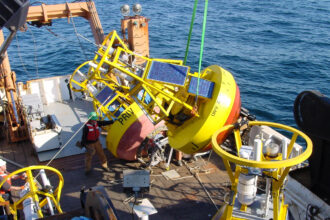
NCAR, founded in 1960 and administered by the National Science Foundation, provides state-of-the-art data and technology resources for 129 North American university partners. Partners rely on NCAR supercomputers, heavily instrumented aircraft and Earth-systems modeling. NCAR developed the Dropsonde, the equipment that hurricane hunter aircraft use to measure temperature, pressure and humidity of tropical storms. The center does real-time operational forecasting for the military, for example, at the anti-ballistic missile systems site at Fort Greely, Alaska, and has done the computer modeling that has helped improve forecasting of wildfire behavior.
NCAR is “is quite literally our global mothership,” said climate scientist Katharine Hayhoe in a post on X. “Nearly everyone who researches climate and weather—not only in the US, but around the world—has passed through its doors and benefited from its incredible resources.”
NCAR is “truly an international treasure, not just a national treasure,” said Antonio Busalacchi, president of the University Corporation for Atmospheric Research (UCAR), which manages NCAR for the National Science Foundation. UCAR has 1,450 employees, 830 of them at NCAR.
As of Wednesday midday, Busalacchi said he had received no word from Washington about the dismantling plan aside from Vought’s announcement Tuesday night, linking to an exclusive USA Today story that quoted him.
Aside from meeting any political aims, the elimination of NCAR would fulfill Vought’s goals of shrinking the size of government and rooting out climate science. “This facility is one of the largest sources of climate alarmism in the country,” Vought said in his post on X, quoting verbatim the controversial conservative blueprint for the Trump administration, Project 2025, which he helped author.
He said that critical weather work would be moved to another location, but gave no details. Daniel Swain, an expert on extreme weather at the University of California Agriculture and Natural Resources and an NCAR research partner, disputed the idea that the study of climate and weather can be separated.
“Increasingly, the science has demonstrated that there is no clean separation between weather and climate,” Swain said in a YouTube livestream Wednesday. “It’s the same atmosphere. It’s just different timescales.”
Swain said he is only able to do his work at the University of California because all of his computing needs are met by NCAR. “There are hundreds, if not thousands, of scientists all around the country that use those NCAR resources day to day to do their science, to conduct their visualizations,” he said. “It’s actually a very efficient process, in the sense that it centralizes what otherwise would be distributed, more expensive, complicated, and in many cases, therefore just wouldn’t happen at all.”
He noted the irony that the NCAR community was grappling with the news at the same time that Boulder has been under an extreme wildfire risk warning—the kind of warning that NCAR’s research has enabled. The local utility, Xcel Energy, preemptively cut power in the region as a result.
“If there are no major fires in the Boulder area, it is possibly at least going to be in part because these excellent weather forecasts regarding the upcoming event allowed the utilities to take preemptive action and prevent those branches and trees that might fall on power lines from igniting the fires,” Swain said.
NCAR received $123 million in funding from the National Science Foundation in the last fiscal year, accounting for one-half of its budget, according to Science magazine. NCAR receives other funding from the Pentagon and other federal agencies as well as from states and private sources. NCAR and UCAR are part of a complex of more than 30 federally funded laboratories and institutions in Colorado that have a $2.6 billion annual impact on the state’s economy, according to research by the University of Colorado’s Leeds School of Business.
Polis said in a statement that Colorado has not received information directly from the Trump administration about the NCAR plan or the cancellation of a wide array of transportation grants that was reported by The Colorado Sun. The cuts include a $66 million grant set to pay for a critical rail-safety mechanism in the northern part of the state, $11.7 million to electrify the Fort Collins vehicle fleet and $11.7 million to Colorado State University Pueblo to study how to power rail vehicles with hydrogen and natural gas.
If the reports are true, Polis said, “public safety is at risk and science is being attacked.
“Climate change is real,” he said. “But the work of NCAR goes far beyond climate science. NCAR delivers data around severe weather events like fires and floods that help our country save lives and property, and prevent devastation for families. If these cuts move forward we will lose our competitive advantage against foreign powers and adversaries in the pursuit of scientific discovery.”
In a post on X, Rep. Joe Neguse (D-Colo.), who represents the district that includes Boulder, called the plan to dismantle NCAR “a deeply dangerous & blatantly retaliatory action by the Trump administration.
“NCAR is one of the most renowned scientific facilities in the WORLD — where scientists perform cutting-edge research everyday,” Neguse wrote. “We will fight this reckless directive with every legal tool we have.”
This story was updated Dec. 19 to reflect the Colorado senators’ hold-up of the chamber’s budget bill and their demand to keep NCAR open.
About This Story
Perhaps you noticed: This story, like all the news we publish, is free to read. That’s because Inside Climate News is a 501c3 nonprofit organization. We do not charge a subscription fee, lock our news behind a paywall, or clutter our website with ads. We make our news on climate and the environment freely available to you and anyone who wants it.
That’s not all. We also share our news for free with scores of other media organizations around the country. Many of them can’t afford to do environmental journalism of their own. We’ve built bureaus from coast to coast to report local stories, collaborate with local newsrooms and co-publish articles so that this vital work is shared as widely as possible.
Two of us launched ICN in 2007. Six years later we earned a Pulitzer Prize for National Reporting, and now we run the oldest and largest dedicated climate newsroom in the nation. We tell the story in all its complexity. We hold polluters accountable. We expose environmental injustice. We debunk misinformation. We scrutinize solutions and inspire action.
Donations from readers like you fund every aspect of what we do. If you don’t already, will you support our ongoing work, our reporting on the biggest crisis facing our planet, and help us reach even more readers in more places?
Please take a moment to make a tax-deductible donation. Every one of them makes a difference.
Thank you,

Marianne Lavelle
Bureau Chief, Washington, D.C.
Marianne Lavelle is the Washington, D.C. bureau chief for Inside Climate News. She has covered environment, science, law, and business in Washington, D.C. for more than two decades. She has won the Polk Award, the Investigative Editors and Reporters Award, and numerous other honors. Lavelle spent four years as online energy news editor and writer at National Geographic. She spearheaded a project on climate lobbying for the nonprofit journalism organization, the Center for Public Integrity. She also has worked at U.S. News and World Report magazine and The National Law Journal. While there, she led the award-winning 1992 investigation, “Unequal Protection,” on the disparity in environmental law enforcement against polluters in minority and white communities. Lavelle received her master’s degree from Columbia University Graduate School of Journalism, and is a graduate of Villanova University.